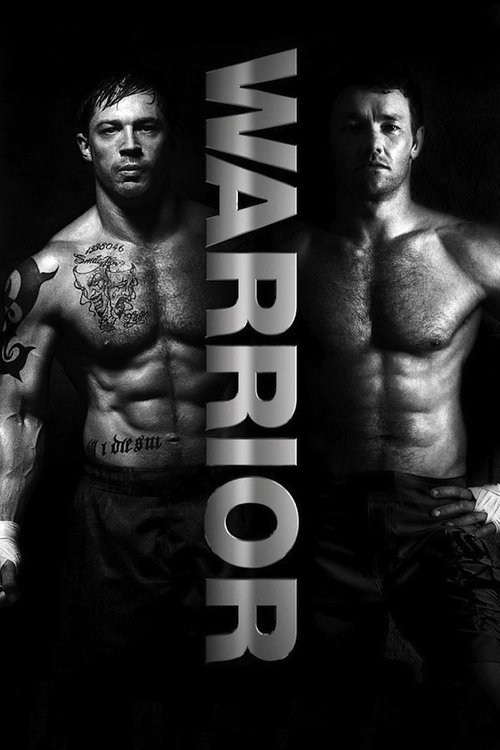
Warrior
2011 · Gavin O'Connor
For when you need a good cathartic cry disguised as a fight movie — underdogs, broken fathers, brothers with unfinished business. A crowd-pleaser with heavy emotional weight; comfort viewing for people who like their comfort to hurt a little.
What it's about
Two estranged brothers from a broken Pittsburgh family enter the same winner-take-all mixed martial arts tournament without knowing it. Tommy is a haunted Marine veteran who shows up at the door of their father — a recovering alcoholic who wrecked the family — and asks him to train him; Brendan is a high-school physics teacher fighting in parking lots to save his house from the bank. Every bout brings them closer to a collision neither can avoid.
The experience
Bruising and openly emotional — the fights hit hard, but it's the family wounds underneath that do the real damage. It builds with the momentum of a great sports movie and earns tears from people who couldn't care less about MMA.
Performances
Tom Hardy plays Tommy as a coiled, wounded animal, all shoulders and silence; Joel Edgerton makes Brendan's decency quietly heroic; and Nick Nolte earned an Oscar nomination as their father, whose sobriety came too late for anyone to forgive.
The craft
The fights are shot with rare clarity and physical honesty — you always know where you are in the cage and what each blow costs. The script runs sports-movie machinery and family melodrama in parallel and makes both pay off in the same ring.
Why it matters
A modest earner in theaters that grew into one of the most beloved sports dramas of its decade, and a launchpad moment for Tom Hardy and Joel Edgerton on their way to stardom.
Snapshot
A Pittsburgh-set MMA drama in which two estranged brothers — Tommy Conlon, a traumatized Marine veteran, and Brendan Conlon, a financially desperate high-school physics teacher — independently enter the same winner-take-all mixed martial arts tournament, the fictional "Sparta," and discover they must eventually fight each other. Their alcoholic father, Paddy, trained both men as boxers in childhood and has now found sobriety in time for neither son to forgive him. The film is simultaneously a sports procedural, a family melodrama, and a study of male grief. Nick Nolte received an Academy Award nomination for Best Supporting Actor; Tom Hardy and Joel Edgerton delivered breakthrough-caliber performances before either had fully crossed into international stardom. Warrior opened to modest box office but accumulated a devoted following through home video and streaming, and is now routinely cited among the finest American sports films of the twenty-first century.
Industry & production
Gavin O'Connor developed the project over several years, co-writing the screenplay with Anthony Tambakis and Cliff Dorfman. The film was produced through O'Connor's own company and distributed by Lionsgate, which at the time was building a robust mid-budget drama slate alongside its Hunger Games franchise plans. The budget was in the range of twenty-five million dollars — modest for an effects-heavy tentpole, substantial for a character drama, and reflective of the production's ambition to shoot practical fight sequences with trained athletes rather than rely heavily on digital augmentation. Warrior premiered at the Toronto International Film Festival in September 2011, a platform that underscored its awards-season intentions, though its commercial performance at the theatrical box office was disappointing relative to its eventual cultural footprint. The film's rehabilitation into canonical status is largely a streaming-era phenomenon: its emotional architecture plays powerfully on repeated viewing, and its word-of-mouth traveled through online communities invested in both MMA and in quality drama.
The casting process was central to the production's identity. Tom Hardy, already known for Bronson (2009) and on the cusp of The Dark Knight Rises, committed to an extreme physical transformation and an extended MMA training regimen. Joel Edgerton, then better known in Australia than internationally, was cast partly for the way his more compact, technically grounded presence would contrast with Hardy's volcanic physicality. Nick Nolte brought the weight of his own public biography — years of well-documented personal struggle — to a role that required an actor whose history of damage would read on his body without being performed. Frank Grillo, cast as Brendan's trainer and corner man, was at that point a journeyman character actor; the role helped catalyze a second chapter of his career.
Technology
Warrior was shot on film and on digital formats in a hybrid approach typical of early-2010s productions navigating the transition. The fight sequences required cameras that could survive the physical environment of a cage or ring without sacrificing image quality, and the production used a combination of Steadicam, handheld operation, and cage-mounted positions to capture the MMA bouts from inside the geometry of the action. Real UFC and MMA fighters — including Kurt Angle, a legitimate Olympic gold medalist in freestyle wrestling, cast as Tommy's most formidable early opponent — competed in staged but choreographed bouts that drew on genuine athletic technique. Hardy and Edgerton trained extensively in Brazilian jiu-jitsu, wrestling, and Muay Thai to achieve the technical legibility the film requires: the camera is close enough that unconvincing movement would register immediately.
The sound design used ringside microphones and body-mounted contact recording to capture the physiological texture of impact in ways that conventional foley work cannot fully reproduce. This production practice, increasingly common in MMA and boxing films of the period, creates a sonic intimacy that implicates the viewer in the violence rather than aestheticizing it from a distance.
Technique
Cinematography
Masanobu Takayanagi, a Japanese-born cinematographer who also lensed The Grey (2012) and Silver Linings Playbook (2012) in the same productive period, shot Warrior in a style that suppresses spectacle in favor of psychological proximity. The palette is deliberately desaturated — steel grays, institutional fluorescents, the particular amber of Pennsylvania rust-belt bars — with only the arena sequences admitting anything like saturated color, and even those environments read as artificial, commercial, and loud in contrast to the film's private emotional spaces. Takayanagi frequently works in shallow depth of field during dialogue scenes, isolating faces from their surroundings and heightening the sense of men trapped inside their own unspoken histories. In the fight sequences, the camera rarely pulls to a master shot: it stays at body level, in the scrum, tracking the athleticism while remaining attentive to what the faces reveal under duress.
Editing
The film's editorial rhythm is one of its formal achievements, managing the structural challenge of interweaving three narrative strands — Tommy's path, Brendan's path, and Paddy's deterioration — without losing momentum in either the dramatic or the athletic registers. The editing accelerates during bouts in ways that feel calibrated to MMA's actual temporal logic (rounds, rest intervals, the punctuation of submission or knockout) rather than to the more conventionally cinematic rhythms of boxing films. Between fights, the pace opens to accommodate the film's melodramatic demands: extended takes, silences held long enough to become uncomfortable, the kind of restraint that presupposes an audience willing to sit with unresolved feeling.
Mise-en-scène / staging
O'Connor stages the family confrontations — Tommy and Paddy in the motel room, Brendan and Paddy at the kitchen table, the two brothers avoiding eye contact in the tournament corridor — with a theater director's instinct for triangulated space and blocked exits. Characters are placed at distances from one another that encode the emotional temperature of each exchange: proximity has to be earned and is frequently refused. The Pittsburgh locations (the family house, Brendan's classroom, the gym) are integrated into the film's class argument, grounding the characters' financial precarity in a specific industrial geography of decline. The Sparta tournament arena, by contrast, is anonymous and interchangeable — a corporate spectacle space that the film regards with some ambivalence, as both the brothers' financial salvation and the stage for their exposure.
Sound
Mark Isham's score operates in the understated register characteristic of his better dramatic work, providing atmospheric support without telegraphing emotion. The film's most significant sonic decision, however, is curatorial: the placement of "About Today" by the National — a song whose lyric is an extended question about the distance that accumulates between people who once knew each other — over a key late scene in which Paddy relapses. The National's music, with its bass-baritone vocals and slow-building arrangements, had become by 2011 a kind of sonic shorthand for a particular mode of adult grief, and the song's deployment here is precisely and almost dangerously well-chosen. Whether the choice reads as earned emotional culmination or as a manipulation of borrowed affect is one of the film's genuinely contested aesthetic questions.
Performance
Hardy's performance is built on withholding: Tommy speaks in short declarative sentences, deflects inquiry, and performs emotional states primarily through the body he has weaponized. The physical transformation Hardy underwent — adding significant mass to an already imposing frame — is inseparable from his interpretive choices, since Tommy's body is both his inheritance (from a father who trained him) and his armor against that inheritance. The film is careful to provide Tommy with a backstory (a unit lost to friendly fire in Iraq, a promise made to a dead comrade's widow) that explains his rage without excusing it, and Hardy honors that complexity by never making the character sympathetic in the conventional sense. Edgerton's Brendan operates in a different register entirely: domestic, emotionally available, almost stubbornly ordinary. His fighting style — patient, technical, survival-oriented — mirrors his life outside the cage, and the film draws consistent meaning from the contrast. Nolte works in the register of decay and partial repair, conveying the specific exhaustion of a man who has done genuine damage and knows that contrition cannot undo it.
Narrative & dramatic mode
Warrior operates as a classic melodrama in the technical sense: a narrative driven by deferred revelation, blocked communication, and the structural withholding of emotionally necessary information. The brothers' estrangement is established through ellipsis and inference rather than expository flashback; the full geometry of the family wound is assembled gradually, with each new piece of information recalibrating the viewer's sympathies. The film's essential dramatic engine is a Cain and Abel structure — two sons of the same damaged house, competing for a prize that each believes will redeem him — routed through a sporting contest that makes their collision both literal and metaphorical. The climactic fight in the film's final act is the rare moment in sports cinema where the athletic outcome and the emotional resolution are genuinely inseparable: who wins or loses matters far less than what the act of fighting each other costs them, and what it releases.
Genre & cycle
Warrior sits at the intersection of the sports film, the family melodrama, and the post-9/11 veterans' drama. Its most immediate generic predecessor is the boxing film tradition running from Rocky (1976) through Raging Bull (1980) and forward to Million Dollar Baby (2004), a lineage that uses combat sports as a vehicle for examining class mobility, masculinity under pressure, and the body as both instrument and evidence of character. Its nearest contemporary was The Fighter (2010), David O. Russell's Massachusetts boxing drama, which similarly used a combat sport as the frame for a family story about dysfunction, co-dependence, and the cost of escape. Together, The Fighter and Warrior constitute something like a brief cycle of critically prestigious American fighting films in the early 2010s, a cycle that coincided with MMA's rise into mainstream cultural visibility through the UFC's aggressive expansion.
The MMA setting is not incidental. The sport's formal demands — the integration of striking, wrestling, and submission grappling; the use of a cage rather than a rope-bounded ring; the specific vocabulary of positions and techniques — required the film to develop a cinematic grammar for depicting it that had no direct precedent. In this respect Warrior is a genuine generic innovation: it helped establish the visual and narrative conventions through which MMA drama is subsequently represented.
Authorship & method
Gavin O'Connor established himself as a director of intimate sports dramas with Miracle (2004), the account of the 1980 US Olympic hockey team's improbable gold medal run. Both films share a preoccupation with team or familial solidarity under extreme pressure, and both demonstrate O'Connor's preference for authentic athletic environment over stylized spectacle. Where Miracle operated in an inspirational register appropriate to a Disney production, Warrior pursues a darker, more psychologically demanding mode, and the shift reflects O'Connor's development as a filmmaker willing to let his stories remain unresolved at the level of feeling even when the plot requires resolution. His collaboration with Tambakis and Dorfman produced a script unusual in the sports-film genre for the specificity and asymmetry of its characterization: the brothers are not contrasting versions of a single type but genuinely different people shaped differently by the same experience of damage.
Takayanagi's visual contributions have already been addressed; his instinct for a naturalistic, observational aesthetic proved well matched to O'Connor's sensibility. Isham, a versatile composer with credits in jazz, pop, and film score across several decades, provided a score that supports without overwhelming a film already dense with performed emotion.
Movement / national cinema
Warrior is emphatically a film of the American rust belt — specifically of Pittsburgh and its surrounds, a geography associated in the cultural imagination with industrial decline, working-class masculinity, and the residue of a mid-century economic order that has contracted around its inhabitants. This situates the film within a loose cycle of American films from the 2000s and 2010s — including The Wrestler (2008), Winter's Bone (2010), Killing Them Softly (2012) — that use post-industrial or economically marginal American landscapes as the setting for dramas about precarity, diminished options, and the violence that attends them. The film's attention to Brendan's mortgage crisis, his teaching salary, and the financial logic of prize-fight purses anchors its emotional narrative in a specific economic moment: the immediate aftermath of the 2008 financial crisis, when the threat of foreclosure was both widespread and acutely symbolic.
Era / period
The film registers its 2010–11 moment in multiple ways. The post-Iraq War backdrop — Tommy's trauma is inseparable from the specific circumstances of that conflict, including the friendly-fire incident that is coded as the institutional betrayal of soldiers by the military that deployed them — connects it to a substantial body of early-2010s American cinema grappling with the human cost of the post-9/11 wars. The MMA setting places it within the specific cultural history of the UFC's mainstream arrival, a phenomenon of the mid-2000s that the film engages rather than simply uses. And the foreclosure subplot situates Brendan's desperation within the financial landscape of the Great Recession in ways that give the film's class argument historical specificity.
Themes
The film's thematic core is the inheritance of damage — what fathers pass to sons and what sons do with what they've been given. The Conlon family is a system for the transmission of violence: Paddy used his fists on his children, Tommy uses his fists on opponents, Brendan uses his fists to keep his family from financial collapse. Each generation's violence is formally similar and morally distinct, and the film is careful not to collapse these distinctions into a simple causative chain. Alongside this runs an examination of male emotional incapacity — the inability of men who love each other to speak that love directly, the ways athletic performance becomes a proxy for intimacy — and of the specific wounds that alcoholic parenthood inflicts: not the dramatic single trauma but the accumulated, ordinary failure of care. The film's treatment of military service and veteran reintegration is less developed but present: Tommy's silence about his own heroism (he saved fellow soldiers in the incident the military suppressed) is consistent with the film's broader argument that its men are constitutionally unable to offer their better selves to view.
Reception, canon & influence
Backward influences: The film draws most heavily on the Rocky cycle and on Raging Bull's model of athletic excellence as pathology and grace simultaneously. Its family dynamics owe something to the domestic melodramas of the 1950s and early 1960s — particularly the tradition of films that use the household as a site of barely suppressed violent feeling — as well as to the working-class family dramas of the American New Wave. The Deer Hunter (1978) is a precedent for Warrior's combination of Pennsylvania industrial setting, male friendship under pressure, and Vietnam-era (here Iraqi) trauma; Ordinary People (1980) for its dramatization of grief displaced into destructive behavior within a family that has lost the capacity for honest speech.
Critical reception: The film received strong reviews on release, with particular praise directed at the performances, but its awards campaign was limited. Nick Nolte's Oscar nomination was the film's primary awards-season recognition. Some critics identified the film's emotional mechanics as manipulative — the deployment of the National, the structural engineering of the fraternal climax — while acknowledging the skill of the manipulation. A minority view found the MMA setting a barrier to engagement; the majority recognized that O'Connor had used the sport's physical grammar with genuine intelligence.
Forward influence: Warrior is now widely taught and cited as a model of sports-film dramaturgy, particularly for the economy with which it manages multiple simultaneous narrative strands without sacrificing character depth. Its influence on MMA-themed dramatic content — including the television drama Kingdom (2014–2017), which shares the sport, the family-dysfunction premise, and the aesthetic of working-class masculine grief — is readily traceable. More diffusely, the film contributed to a legitimation of MMA as a subject for serious dramatic treatment, demonstrating that the sport's physical vocabulary could sustain the kind of psychological weight that boxing dramas had carried for decades. Tom Hardy's performance, in particular, has been extensively analyzed as a study in physical acting and the embodiment of suppressed interiority, and it remains a reference point in discussions of screen performance in the 2010s.
A Deleuzian reading
Start with the corridor.
The full Deleuzian reading of Warrior →
Reception
A box-office flop in 2011 despite glowing reviews — it barely made back its budget — Warrior was steadily rescued by word of mouth and streaming until 'criminally underrated' became practically its official title.
How Warrior was received, from release to now →
Influences: the films it descends from and the films it influenced
- Raging Bull (1980) — Takayanagi's practice of embedding cameras at body height inside the fighting space and recording impact sound within the action zone is a direct inheritance of Chapman and Scorsese's technique of converting athletic violence into psychological portraiture through radical camera proximity.
- The Deer Hunter (1978) — O'Connor's use of Pennsylvania's steel-mill geography as a visual argument about working-class dispossession and post-industrial male identity directly echoes Cimino's foundational practice of rooting male trauma in the specific textures of industrial landscape, while both films encode veteran damage (Vietnam/Iraq) through the register of masculine friendship under pressure.
- Ordinary People (1980) — The structural architecture of family grief encoded as behavioral displacement and emotional withdrawal — forcing itself into open confrontation only through a long-deferred revelation — is the dramatic template O'Connor inherits for the Hardy–Nolte dynamic, where the incapacity for honest speech is both symptom and subject.
- Rocky (1976) — The sports-film dramaturgy of physical training as character excavation and the underdog championship bout as cathartic endpoint within a working-class location that itself makes the class argument — Warrior is the most psychologically demanding heir to this template, inheriting the architecture while darkening its emotional logic.
- On the Waterfront (1954) — The Cain-and-Abel brother dynamic organized around one wound — one brother's forfeiture of the other's potential — is Warrior's structural precedent, while Brando's technique of embodying interiority through physical restraint and minimal gesture is the direct performance ancestry of Hardy's approach to Tommy's suppressed violence.
- East of Eden (1955) — Kazan's construction of sibling rivalry around a father's unequal dispensation of affection — one son visibly favored, one excluded — is the melodramatic architecture Warrior inherits for the Brendan/Tommy/Paddy triangle, where parental failure is the originating wound that structures every subsequent scene.
- Blue Collar (1978) — Schrader's pioneering use of Detroit automobile-factory locations as visual arguments about working-class economic subjugation — the physical environment of labor encoding characters' class position and constrained possibility — is the direct precedent for O'Connor's treatment of Pittsburgh's post-industrial landscape as a continuous class statement.
- Tender Mercies (1983) — Duvall's performance established the specific grammar of masculine emotional withholding — the economy of gesture, the stillness under pressure, damage surfacing through small physical choices rather than expressive outburst — that Nick Nolte's Paddy Conlon directly inherits and that anchors the film's claim on seriousness.
- Magnolia (1999) — Anderson's construction of multiple simultaneous family-trauma narrative strands — each maintaining character depth while converging on a shared cathartic endpoint — and his structural use of a single licensed song ('Wise Up') to briefly suspend narrative for emotional reckoning directly anticipate Warrior's three-strand architecture and its deployment of the National's 'About Today.'
- The Wrestler (2008) — Aronofsky and Libatique's decision to shoot Rourke's physicality in a naturalistic, desaturated, body-proximate observational register — handheld, available-light, refusing to aestheticize the sport as spectacle — established the formal vocabulary O'Connor applies to MMA, demonstrating that combat athleticism could bear the full weight of psychological realism.
- Million Dollar Baby (2004) — Fuses combat-sport spectacle with somber family melodrama and the trainer/father-figure bond, sustaining the surrogate-family-in-the-gym structure that Million Dollar Baby centered.
- Creed (2015) — Coogler inherits Warrior's model of staging fight sequences with body-proximate cameras that convert athletic competition into psychological portraiture — most explicitly in the single-take round — while extending its argument that the sports-drama genre can carry the full weight of father-son legacy narrative within a working-class visual register.
- Southpaw (2015) — Fuqua applies Warrior's desaturated observational palette and contact-heavy fight coverage to a damaged-protagonist sports drama whose physical dominance masks psychological disintegration, extending O'Connor's structural argument that post-2008 masculinity-in-crisis can be encoded through a combat sport's physical grammar.
- Manchester by the Sea (2016) — Lonergan extends Warrior's formal vocabulary of grief-as-behavioral-displacement and deferred revelation — organizing the entire film around a long-withheld traumatic disclosure — within the same post-industrial New England working-class visual register, pushing emotional reticence until it becomes the film's explicit subject rather than its texture.
- Hell or High Water (2016) — Mackenzie and screenwriter Sheridan extend Warrior's post-2008-financial-crisis visual argument — post-industrial locations as evidence of systemic dispossession readable in every composition — into the Texas landscape, maintaining the sibling pair as the load-bearing emotional unit and using physical environment as continuous class argument.
- The Fighter (2010) — Russell's film shares Warrior's structural combination of working-class sports drama, familial dysfunction as primary dramatic engine, and contrasting sibling performance registers — Wahlberg's physical restraint against Bale's expressive excess mirrors Edgerton/Hardy — along with licensed songs as emotional punctuation; the two films define their genre moment together.
- The Smashing Machine (2025) — The direct MMA-cinema sibling: cage-fight coverage built for diegetic combat realism, sharing the still-thin canon of serious mixed-martial-arts drama the film aims to anchor.
- Real Steel (2011) — Same-year combat-sport family melodrama built on the identical engine: estranged working-class men resolve their wounds inside a bracketed tournament, the fights doubling as the drama's emotional throughline.
- The Iron Claw (2023) — Extends the same fusion of combat-sport choreography with a fraternal-tragedy structure, staging brothers and a damaged patriarch so the bouts read as family reckonings.
- Jersey (2019) — Constructs the sports film as family melodrama anchored by a wounded patriarch, prioritizing the domestic bond over the athletic contest the same way Jersey does.
- Dangal (2016) — Shares the estranged patriarch who forges his children into elite fighters, resolving the family conflict through tournament-bracket bout construction like Dangal's academy rupture.
Similar films
- The Fighter (2010) — influence & lineage
- The Smashing Machine (2025) — influence & lineage
- The Wrestler (2008) — influence & lineage
- Creed (2015) — influence & lineage
- Southpaw (2015) — influence & lineage
- Raging Bull (1980) — influence & lineage
- Sarpatta Parambarai (2021) — shared sensibility
- Million Dollar Baby (2004) — shared sensibility