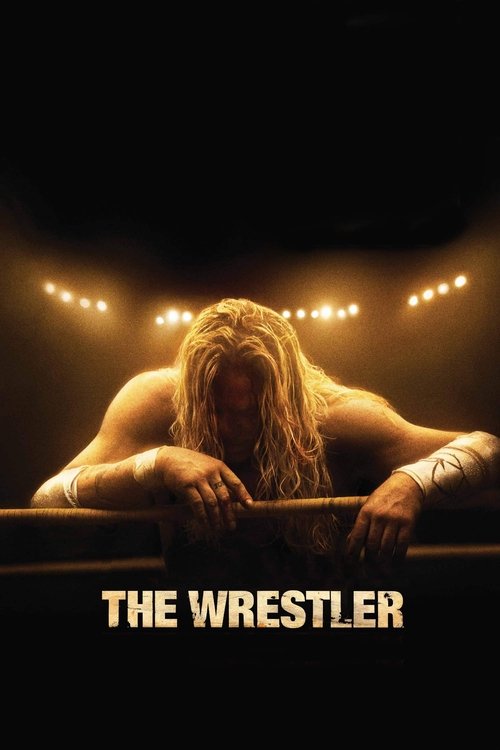
The Wrestler
2008 · Darren Aronofsky
For when you want to feel something real — a rough-edged, big-hearted character study about washed-up dreams and second chances. Bring some resilience; it's a bruiser, but a deeply human one.
What it's about
Randy 'The Ram' Robinson headlined arenas in the 1980s; twenty years on he's wrestling weekend matches in school gyms, living in a New Jersey trailer he keeps getting locked out of, and working a supermarket deli counter to make rent. After a brutal match and a heart attack, he's told his body is done — and the film follows him as he tries to build a life outside the ring: a tentative romance with an aging stripper, an attempt to reconnect with the daughter he abandoned, and the constant pull of the only place he's ever felt loved.
The experience
Raw and unglamorous but full of battered warmth — it hurts to watch in places, both physically and emotionally, yet it's tender toward its broken hero in a way that sneaks up on you. You leave sore and moved.
Performances
Mickey Rourke's comeback for the ages — his own scarred face and history bleed into Randy so completely that the line between actor and role nearly disappears. Marisa Tomei matches him beat for beat as a stripper facing her own expiration date; both earned Oscar nominations.
The craft
Darren Aronofsky throws out his usual flash for a handheld, documentary-style camera that trails Randy through locker rooms and deli counters like a fly on the wall, and shows the backstage machinery of wrestling — the friendships, the staples, the razor blades — with unblinking honesty. Grainy, wintry, and completely convincing.
Why it matters
It won the Golden Lion at Venice, resurrected Rourke's career overnight, and reset Aronofsky's — proof he could work stripped-down and intimate. It remains the definitive film about pro wrestling's human cost.
Snapshot
The Wrestler is the film with which Darren Aronofsky stripped away the baroque formalism of his early work and the film that resurrected Mickey Rourke as a major screen actor. It follows Randy "The Ram" Robinson, a professional wrestler two decades past the arena-headlining peak of his 1980s fame, now grinding through weekend bouts in school gymnasiums and VFW halls across New Jersey, living in a trailer he is periodically locked out of, working a supermarket deli counter, and pumping his battered, chemically maintained body full of steroids and painkillers to keep performing. After a brutal "hardcore" match and a subsequent heart attack, Randy is told he can no longer wrestle, and the film becomes a study of a man with no life outside the ring trying, and largely failing, to build one — courting an aging stripper, Cassidy, who keeps him at professional arm's length, and attempting to repair his abandonment of his estranged daughter, Stephanie. The picture's quiet devastation lies in its recognition that Randy is only fully alive when he is performing pain for an audience, and that the love offered to him offstage cannot compete with the ring's annihilating embrace. Awarded the Golden Lion at the Venice Film Festival and built around one of the great comeback performances in modern cinema, The Wrestler is at once a piece of vérité naturalism, a backstage exposé of an unglamorous subculture, and a secular passion play.
Industry & production
The Wrestler was made as a deliberately modest, independently financed production, a sharp contrast to the comparatively lavish, effects-heavy The Fountain (2006) that immediately preceded it in Aronofsky's filmography and was widely regarded as a commercial disappointment. The screenplay was written by Robert Siegel, formerly editor-in-chief of the satirical newspaper The Onion, for whom this was a breakthrough as a feature screenwriter. Aronofsky produced through his own company, Protozoa Pictures, with Scott Franklin; the European sales and finance house Wild Bunch was among the backers, and Fox Searchlight handled the film's prestige release in the United States. The budget was small by studio standards, and the production's economy is legible on screen in its location shooting and unadorned style.
The film's defining production decision was its casting. Aronofsky's commitment to Mickey Rourke as Randy is the film's central origin story: at one stage other actors were associated with the project — Nicolas Cage is the name most frequently cited in connection with an earlier iteration — but Aronofsky pursued Rourke against considerable industry skepticism about the actor's bankability and reputation for difficulty. The casting transformed the film into a meta-text, because Rourke's own trajectory — a celebrated leading man of the 1980s whose career had collapsed amid a period as a professional boxer and a reputation for self-sabotage — so closely mirrored Randy's that the role and the man became almost impossible to separate. The production drew heavily on the real independent-wrestling world, casting genuine wrestlers in supporting roles and staging matches within actual indie-circuit events, lending the backstage and in-ring material a documentary authenticity. Marisa Tomei was cast as Cassidy and Evan Rachel Wood as Stephanie.
Technology
The Wrestler was shot on 16mm film — Super 16 — rather than on the larger-format 35mm or the digital systems then coming into vogue, and that choice is fundamental to its identity. The grainy, slightly desaturated texture of 16mm gives the image a rough, reportorial quality consonant with the world it depicts, evoking documentary and news footage rather than polished fiction. The film makes no use of the visual-effects apparatus or the elaborate optical and montage techniques that characterized Aronofsky's earlier pictures; its technology is the lightweight, mobile, handheld camera, and its aesthetic ambition is precisely to disguise its own artifice. The in-ring violence — staple guns, barbed wire, broken glass, the self-inflicted "blading" that draws real-looking blood — is rendered through practical means and unflinching framing rather than digital trickery, a methodological honesty that mirrors the film's interest in the genuine physical toll of a faked sport.
Technique
Cinematography
The cinematography is by Maryse Alberti, a cinematographer with deep roots in documentary, and her background is the key to the film's look. Alberti shoots much of the picture handheld, with the camera frequently positioned behind and to the side of Randy, following the back of his head through corridors, locker rooms, and supermarket stockrooms — a "following" framing widely understood as an homage to the Dardenne brothers' Rosetta (1999) and the broader European tradition of observational realism. This over-the-shoulder pursuit traps the viewer in Randy's wake, making us his perpetual companion and emphasizing his isolation within crowded spaces. The palette is muted and wintry, drawn from the gray New Jersey light of strip malls, parking lots, and off-season boardwalks; the only zones of saturated color are the ring, bathed in performance light, and the strip club, lit in a red-and-blue erotic glow. The handheld restlessness lends even quiet domestic scenes a documentary contingency, as though the camera had stumbled upon real events rather than staged them.
Editing
The editing, by Andrew Weisblum, serves the film's naturalism by effacing itself. Where Aronofsky's earlier work, especially Requiem for a Dream (2000), was famous for its hyperkinetic "hip-hop montage" of rapid micro-cuts, The Wrestler adopts long, patient takes and an unhurried observational rhythm that lets scenes play out at the pace of lived experience. The cutting builds a deliberate structural rhyme between the two worlds in which Randy performs his body for spectators: the wrestling arena and the strip club, each a stage where an aging body sells an illusion of desire or danger for cash, and the editing repeatedly draws the parallel between Randy and Cassidy as fellow performers nearing the end of their viability. The film's most bravura sustained sequence — Randy's shift behind the deli counter, shot as if it were an entrance to the ring — uses an unbroken following shot to transform mundane labor into another arena, and the editing's restraint is what makes its eventual emotional climaxes land.
Mise-en-scène / staging
The film's staging is committed to the unglamorous specificity of its milieu: the grimy locker rooms where wrestlers amicably choreograph the violence they will perform as enmity, the cramped trailer, the fluorescent supermarket, the tired strip club, the New Jersey landscape of the deindustrialized Atlantic seaboard. Production and costume design root Randy in a vanished 1980s: his peroxide-blond hair, his spandex and fringe, his hearing aid, the Nintendo wrestling game bearing his likeness that he plays with a neighborhood kid, the cassette-era hair-metal he reveres. This carefully assembled texture of obsolescence makes Randy a man marooned in his own past, his body and his iconography both relics. The wrestling sequences are staged to reveal the craft behind the spectacle — the pre-match planning of moves, the concealed blades, the collaborative artifice — without diminishing the genuine physical punishment the performers absorb, holding in tension the sport's fakery and its real cost.
Sound
The sound world divides cleanly along Randy's nostalgia. His emotional universe is scored by 1980s hair metal — the music of his glory years — and the film stages a key scene of communion between Randy and Cassidy around their shared love of that era and their shared contempt for the grunge that displaced it, Randy memorably blaming Kurt Cobain and the 1990s for killing the culture that gave him meaning. Clint Mansell, Aronofsky's regular composer across all his films to that point, supplies an original score far sparer and more restrained than his celebrated, propulsive work on Requiem for a Dream. The film's most decorated sonic element is its closing original song, "The Wrestler," written and performed by Bruce Springsteen — reportedly composed as a favor at Rourke's request, the two men being acquainted — whose plainspoken, first-person lament over the end credits crystallizes the film's pathos. The song won the Golden Globe for Best Original Song; its conspicuous absence from the Academy Award nominations became a minor controversy of that awards season.
Performance
Performance is the film's reason for being. Mickey Rourke's Randy is a feat of total embodiment — physical, in the bulked and scarred body he built for the part, and emotional, in a portrait of wounded, child-like tenderness beneath a wrecked tough-guy exterior. Rourke plays Randy as a fundamentally gentle man whose only fluency is in the ring, awkward and over-eager in every encounter that requires ordinary intimacy, and the performance derives almost unbearable poignancy from the audience's knowledge of how nearly it doubles Rourke's own life. The work won him the Golden Globe and BAFTA for Best Actor and an Academy Award nomination, which he is widely felt to have narrowly lost to Sean Penn. Marisa Tomei, as Cassidy/Pam, gives a brave and unsentimental performance as a stripper enforcing the boundary between her work persona and her real life as a single mother, herself confronting the same obsolescence of the aging performing body; she received an Academy Award nomination for Best Supporting Actress. Evan Rachel Wood, in fewer scenes, supplies the raw, unforgiving anger of the abandoned daughter, grounding the film's domestic tragedy.
Narrative & dramatic mode
The Wrestler's dramatic mode is naturalist tragedy organized around the structure of the comeback story — only to refuse the comeback's redemptive promise. The narrative follows the familiar beats of a sports drama: the broken-down athlete, the cardiac warning that should end his career, the attempt to retire and build a normal life, the climactic return to the ring. But Aronofsky and Siegel systematically invert the genre's consolations. The romance with Cassidy and the reconciliation with Stephanie, which a conventional film would treat as Randy's salvation, are presented as a path he is constitutionally unable to follow; his fumbling attempts at ordinary life fail not through external villainy but through his own incapacity to exist anywhere but in front of a crowd. The film thus becomes the story of a man choosing the thing that will kill him because it is the only place he is real. The famously ambiguous ending — Randy mounting the top rope for his signature "Ram Jam" leap, his damaged heart a death sentence, the image cutting to black before he lands — stages this as a deliberate, even triumphant, self-immolation, leaving the literal outcome unresolved while making the spiritual one unmistakable.
Genre & cycle
The film sits at the intersection of the sports drama and the social-realist character study, and it belongs to a cycle of films that strip professional spectacle of its glamour to expose the bodies broken in its service. Its closest kin within Aronofsky's own work is Black Swan (2010), its near-immediate successor, with which it forms an explicit companion diptych: both are portraits of performers — a wrestler, a ballerina — who destroy their bodies in pursuit of a transcendent performance, the two art forms (the lowest and highest of physical disciplines) treated as mirror images of the same compulsion. More broadly, The Wrestler descends from the anti-heroic boxing and fight films — the lineage of Fat City (1972), Raging Bull (1980), and the down-and-out-athlete tradition — that use the combat sport as a vehicle for studies of masculine self-destruction. It also participates in a strain of American independent realism concerned with working-class and post-industrial decline. As a film about professional wrestling specifically, it is nearly singular in taking the subculture seriously as a site of genuine craft, community, and bodily sacrifice rather than as camp or joke.
Authorship & method
The Wrestler is legible as a pivotal authorial statement precisely because it appears to suppress its author's signature. Across Pi (1998), Requiem for a Dream, and The Fountain, Aronofsky had established a reputation for aggressive formal control — split screens, montage barrages, time-lapse, elaborate symbolism. Here he submerges all of that beneath a vérité surface, and the discipline of that self-effacement is itself the authorial gesture. Yet the film's deep continuities with his other work are clear: an obsessive protagonist destroyed by a consuming devotion, the body in extremis as the locus of meaning, and addiction — to a substance, an ideal, a performance — as a governing metaphor. Randy's relationship to the ring is structurally identical to the addictions of Requiem and the obsessions of Black Swan.
The authorship is shared with several decisive collaborators. Robert Siegel's screenplay supplied the unsentimental architecture and the deli-counter realism. Cinematographer Maryse Alberti translated Aronofsky's turn toward realism into a concrete documentary grammar. Editor Andrew Weisblum executed the renunciation of montage in favor of patience. Composer Clint Mansell preserved the throughline to Aronofsky's earlier scores while radically reducing their volume, and Bruce Springsteen's contributed song became an authorial coda from outside the production proper. Above all, the film is co-authored by Mickey Rourke, whose biography and persona are so woven into Randy that the performance functions as a second text laid over the script — a fact Aronofsky courted deliberately in casting him.
Movement / national cinema
The Wrestler is a work of American independent cinema in dialogue with European art-house realism. Its handheld, following-camera style and its observational ethics are openly indebted to the Dardenne brothers and the broader tradition of European social realism, and its prestige path ran through the European festival circuit, taking the top prize at Venice before its American release. Domestically it belongs to the milieu of late-2000s American independent film as represented by distributors like Fox Searchlight, which specialized in awards-oriented, modestly budgeted features. Its setting in the post-industrial New Jersey shore — a landscape of economic exhaustion that Springsteen's music has long mythologized — gives it a specifically American regional and class identity, marrying the European formal influence to a native subject of working-class decline.
Era / period
The film is set in its own present, the late 2000s, but it is saturated with the period of Randy's lost prime, the 1980s, and much of its emotional weight comes from the gap between the two. The 1980s appear as a vanished golden age of professional wrestling's mainstream cultural peak and of the hair-metal music Randy loves; the present is a diminished aftermath of indie-circuit obscurity, autograph conventions populated by other broken-down veterans, and an economy of strip malls and hourly wage labor. The film is acutely a document of post-industrial American decline, its New Jersey of shuttered possibility echoing the wider economic anxieties of its moment. Randy's obsolescence — his body, his fame, his music, his very mode of masculinity all rendered antique — makes him an emblem of a particular American experience of being left behind by time.
Themes
The film's governing theme is the performer's tragic dependence on performance: Randy is alive, loved, and whole only when offering his body to a crowd, and the love available to him in private life cannot substitute for that public communion. Around this orbit several entwined concerns. There is the theme of the body as sacrifice — the literal flesh given over to injury, surgery, chemical maintenance, and finally cardiac collapse, which lends the film its insistent, almost religious imagery of a man crucified for an audience; the comparison of Randy to a sacrificial or Christ-like figure, bearing wounds for the crowd's catharsis, is one the film invites. There is the theme of authenticity and artifice, dramatized through the paradox that wrestling is "fake" combat producing real damage, and extended to the parallel performances of the strip club, where genuine human connection is sold as illusion. There is the theme of obsolescence and aging, shared between Randy and Cassidy as two performers whose bodies are losing their market. And there is the theme of fatherhood and failed redemption, in Randy's doomed effort to reclaim his daughter, which the film treats with unsparing refusal of easy reconciliation. Beneath all of it lies a meditation on identity collapsed into a single role — the man who is nothing once he steps outside the ring.
Reception, canon & influence
The Wrestler was met with strong critical acclaim and was treated as both a major comeback and a significant artistic course-correction for its director. It won the Golden Lion at the 2008 Venice Film Festival, and the awards season that followed was dominated by Mickey Rourke's performance, which took the Golden Globe and BAFTA for Best Actor and earned an Academy Award nomination; Marisa Tomei received an Academy Award nomination for Best Supporting Actress, and Bruce Springsteen's title song won the Golden Globe for Best Original Song. The narrative of Rourke's personal redemption through the role became inseparable from the film's reception and was a substantial part of its cultural impact. Critics singled out the courage of Aronofsky's stylistic restraint and the film's unsentimental compassion.
Influences on the film run backward to the European social realism of the Dardenne brothers and the observational documentary tradition that shaped Maryse Alberti's approach, and, in genre terms, to the anti-romantic fight-film lineage of Fat City and Raging Bull. Springsteen's own body of work about working-class New Jersey is a clear cultural antecedent, and the real independent-wrestling subculture supplied both subject and texture. Its influence forward is felt most immediately in Aronofsky's own Black Swan (2010), conceived as its companion piece and sharing its premise of self-destructive performance, which brought him still greater mainstream success. The film also reset Mickey Rourke's career and stands as a landmark example of the late-career comeback role. More durably, it elevated professional wrestling as a subject worthy of serious dramatic treatment and offered a widely emulated model of how a familiar genre — the sports comeback story — can be hollowed out and refilled with tragic, naturalist content. It retains a secure place in the canon of 2000s American independent cinema and is frequently cited among the defining performances of its decade.
A Deleuzian reading
The first thing you see of Randy is the back of his head.
The full Deleuzian reading of The Wrestler →
Reception
It arrived as a shock double-comeback — Aronofsky rebounding from The Fountain's flop and Mickey Rourke rising from the ashes — winning the Golden Lion at Venice in 2008. Today it's settled in as Aronofsky's warmest, most restrained film, often paired with Black Swan as a companion piece about bodies destroyed by performance.
How The Wrestler was received, from release to now →
Influences: the films it descends from and the films it influenced
- Raging Bull (1980) — Established the anti-romantic fight film built on an actor's total bodily transformation and a fighter whose self-destruction is staged as the real arena, the template Rourke and Aronofsky strip of operatic style but keep at the core.
- Fat City (1972) — Pioneered the low-rent, observational boxing milieu of aging never-weres and back-room gyms, supplying the unsentimental palooka realism that Robert Siegel's deli-counter screenplay descends from.
- The Set-Up (1949) — Codified the over-the-hill fighter taking one last beating in near-real-time, the durational cruelty of watching an obsolete body absorb punishment that Randy's matches reprise.
- Rosetta (1999) — Originated the handheld camera pinned to the back of the protagonist's neck and shoulders in tight following shots, the exact vérité grammar Alberti adopts to trail Randy through corridors to the ring.
- Le Fils (The Son) (2002) — Refined the practice of withholding context and reading meaning off a working body's labor through patient long takes, the self-effacing observation Aronofsky imports as his whole method here.
- Faces (1968) — Demonstrated 16mm documentary-grammar immersion in which performance reads as lived behavior rather than acting, the actor-as-second-text approach Aronofsky exploits by casting Rourke's biography into Randy.
- Rocky (1976) — Built the canonical sports-comeback architecture — the underdog's redemptive return — that The Wrestler deliberately hollows out and inverts, denying the uplift its genre promises.
- Requiem for a Dream (2000) — Aronofsky stripped the formal fireworks of Requiem to a handheld follow-shot grammar but retained the anti-redemptive compulsion arc and the dual-register performance mode — Rourke's Randy 'The Ram' as the body-as-addiction-machine, demonstrating that the moral architecture of Requiem survives translation into an austere register.
- 8 Mile (2002) — Extends the handheld vérité-from-behind tracking of a deglamorized performer and the anti-wish-fulfillment ending that refuses the triumphant payoff.
- Million Dollar Baby (2004) — Carries forward the anti-formula sports tragedy — naturalist, body-destroying, observed in unglamorous backrooms — turning the comeback narrative against its protagonist exactly as Eastwood does the underdog arc.
- Leaving Las Vegas (1995) — Self-destruction-as-agency carried by a performer's total-immersion role, where the protagonist actively chooses the decline rather than being saved from it.
- Body and Soul (1947) — Its handheld camera bodily following the fighter through the arena is a direct heir to Howe's roller-skate mobile, subjective in-ring photography.
- The Fighter (2010) — Extends the working-class boxing biopic into handheld, near-documentary domestic naturalism, treating the milieu's texture and family dysfunction with the same anti-glamorous observational eye.
- Warrior (2011) — Carries forward the wounded-body combat drama in which the fighter's physical punishment is the emotional text, applying the post-Wrestler naturalist sports-tragedy register to MMA.
- Whiplash (2014) — Reprises the body-in-extremis premise of an artist destroying his flesh for a performing ideal — bleeding hands instead of staple guns — with addiction-to-craft as the governing metaphor Randy embodies.
- Foxcatcher (2014) — Applies The Wrestler's desaturated palette, suppressed score, and total-embodiment casting to the wrestling world, treating the sport as a site of serious naturalist tragedy that the seed film legitimized.
- Creed (2015) — Direct collaborator lineage — shot by Maryse Alberti — extending her handheld, super-16 documentary boxing grammar (the unbroken one-take fight) into a revival of the comeback genre on vérité terms.
- Sound of Metal (2019) — Builds on total-embodiment performance and the body-in-extremis premise — a performer losing the very faculty his identity depends on — rendered through patient, self-effacing observation and an ambiguous, non-redemptive ending.
- The Iron Claw (2023) — The most literal heir: naturalist professional-wrestling tragedy of broken bodies and obsolescence, treating the squared circle as worthy of serious dramatic grief in the exact register The Wrestler opened up.
- The Smashing Machine (2025) — The proximate generic model: Maryse Alberti's follow-behind, over-the-shoulder telephoto vérité tracking a deglamorized fighter through physical decline is the exact handheld-intimacy grammar Safdie inherits.
- Iron Man 2 (2010) — Mickey Rourke's bruised, immersive-method comeback performance there is the exact register he imports as Ivan Vanko, and the film shares Libatique's naturalistic handheld craft.
- Logan (2017) — Model of the late-career elegy built on a battered physical performer, making the failing body the subject and locating redemption in self-sacrifice rather than victory.
- Jersey (2019) — Shot the aging athlete's ruined body with handheld naturalistic restraint that refuses glamour, the anti-spectacle register Sanu John Varughese adopts for Jersey's older protagonist.
- Southpaw (2015) — Maryse Alberti's over-the-shoulder handheld follows the fighter through corridors into the arena so the walkout is experienced as labor, and pins the drama on an estranged daughter — the staging and the reconciliation structure Southpaw repeats in its tunnel walks and Leila scenes.
- Black Swan (2010) — Aronofsky's declared companion piece, transposing the same premise of self-annihilating devotion to a performing craft and the body in extremis onto ballet, sharing the structural rhyme of a performer consumed by the role.
- Good Time (2017) — Shares the super-16 handheld following-shot aesthetic and immersive vérité-naturalism, pinning the camera to a self-destructive protagonist careening through grimy outer-borough texture in real time.
- Inside Llewyn Davis (2013) — Maryse Alberti's handheld desaturated cinematography places a performer whose talent has no available reward structure in a social-realist visual register identical in logic to Delbonnel's, and the final frame refuses to confirm whether the protagonist's last performance is triumph or death — the same irresolutory strategy Llewyn Davis uses.
- Birdman or (The Unexpected Virtue of Ignorance) (2014) — Builds its drama on metatextual casting — a faded star playing a version of his own career and comeback — exactly the Keaton/Birdman gambit of actor-as-self.
- Tatami (2024) — Its handheld camera trailing the athlete from backstage tunnels into the arena maps the geography of combat sport as bodily labor — the behind-the-competitor follow Tatami uses to bind coach and fighter.
- Spider-Man: Brand New Day (2026) — Verité follow-cam study of a broken man's body and diminishment models the small, bodily, actor-first register that Cretton favors over comic-book scale.
- Real Steel (2011) — Shares the low-rent, rust-belt spectacle-fighting milieu — underground venues, gaudy showmanship, broken men grinding for cash — the down-market texture Real Steel gives its robot-boxing underworld.
- Dallas Buyers Club (2013) — Its closest tonal cousin: handheld follow-the-back vérité, available light, and a needle-drop soundtrack wrapped around a battered everyman's physical decline and shot on the run.
- A Star Is Born (2018) — Handheld behind-the-shoulder immersion tracking a self-destructing performer across the backstage-to-stage threshold, the staging logic Cooper echoes walking Jackson and Ally from wings to spotlight.
- Dangal (2016) — Parallel model of grappling-sport authenticity achieved through an actor's punishing physical remaking and intimate, legible body-in-motion coverage rather than stylized spectacle.
- Pusher 3 (2005) — Handheld follow-cam shadowing an aging, physically obsolescent man through the bodily labor of his trade, locating tragedy in decline and no-longer-being-feared rather than downfall — Milo's theme in another key.
- Aadukalam (2011) — Tails a fighter's body with embedded handheld camera through a working-class fighting subculture in natural light, sport-as-fate rendered documentary-close.
Similar films
- Creed (2015) — influence & lineage · same viewing thread
- Rocky (1976) — influence & lineage · same viewing thread
- The Iron Claw (2023) — influence & lineage · same viewing thread
- Black Swan (2010) — influence & lineage · often watched together
- Raging Bull (1980) — influence & lineage
- The Fighter (2010) — influence & lineage
- Warrior (2011) — influence & lineage
- The Smashing Machine (2025) — influence & lineage
All the films related to The Wrestler →
Watch it with: curated runs of related films
- The Working-Class Long Shot — A run of men whose bodies and grit are their only capital, each grinding toward a single shot at dignity — watch them together and the American bootstrap dream and its bleaker European labor-film shadow start to rhyme.