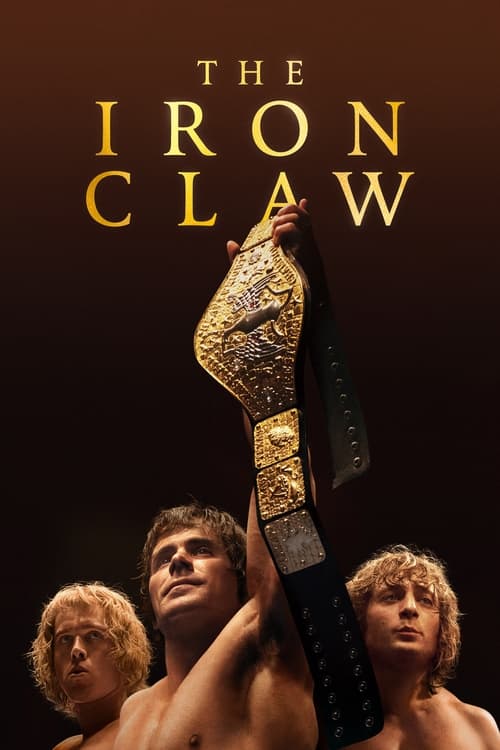
The Iron Claw
2023 · Sean Durkin
When you need a good cry and want to earn it — a film about brotherhood and loss to sit with, not escape into. Emotionally heavy; save it for a night you can absorb it.
What it's about
The true story of the Von Erich brothers, a Texas wrestling dynasty of the early 1980s, raised and driven by their domineering father-coach Fritz, a former wrestler chasing the championship that eluded him. Told through the eyes of Kevin, the film follows the brothers' rise through the intensely physical world of the regional circuit — and the terrible price the family pays for their father's ambition.
The experience
A slow-building heartbreaker wearing a sports movie's clothes. The ring sequences are sweaty and alive, but the film's real weight is the tenderness between the brothers and the dread that gathers around them — it's the kind of watch that leaves you quiet when the credits roll.
Performances
Zac Efron is a revelation as Kevin — a hulking physical transformation wrapped around a gentle, wounded soul, career-redefining work. Holt McCallany is quietly chilling as Fritz, a father whose love and cruelty are indistinguishable, and Jeremy Allen White brings live-wire hunger to brother Kerry.
The craft
Sean Durkin shoots the wrestling with real texture — the smoke, the sweat, the period grain of the territorial circuit — while keeping his camera trained on the family dinner table where the real damage is done. The restraint is the point: tragedy arrives without melodrama, which makes it hit harder.
Why it matters
A word-of-mouth hit for A24 that redefined Efron as a serious dramatic actor and brought the Von Erich story — wrestling's most famous family tragedy — to an audience far beyond the sport's fans.
Snapshot
The Iron Claw is a family tragedy dressed in the trunks of a sports biopic — the true story of the Von Erichs, a Texas dynasty of professional wrestlers who dominated the regional circuit of the early 1980s and were then dismantled, one son at a time, by early death. Written and directed by Sean Durkin and produced by A24, the film centers on Kevin Von Erich (Zac Efron), the brother who survived, and reconstructs the household governed by patriarch Fritz Von Erich (Holt McCallany), a former wrestler who bent his sons toward the championship he never won. It is less a chronicle of matches than a study of inherited ambition and grief, and it belongs recognizably to Durkin's ongoing preoccupation with controlling authority figures and the families that orbit them. Received warmly by critics and buoyed by Efron's much-discussed physical and dramatic transformation, it stands as one of the more emotionally direct entries in A24's mid-decade run of American dramas.
Industry & production
The film was produced and distributed by A24, with the United Kingdom's Access Entertainment and Durkin's own production company among the backers, and received a theatrical release in the United States in December 2023. It was Durkin's third feature and his first working at this scale of ensemble and physical staging, following the intimate chamber pieces Martha Marcy May Marlene (2011) and The Nest (2020). Production drew on the real institutional history of World Class Championship Wrestling (WCCW), Fritz Von Erich's Dallas-based territory, and the film recreates that regional-wrestling milieu — the arenas, television broadcasts, and promotional culture of the pre-national-consolidation era before the sport was absorbed into a single dominant company.
A notable production fact, openly acknowledged by Durkin, is that the film omits one of the Von Erich brothers, Chris, and compresses the family's losses; Durkin has said the full historical record of the family's tragedies was too much for a single narrative to hold without straining credulity. Kevin Von Erich, the surviving brother, was consulted, lending the project a degree of first-hand grounding. Where precise budget and box-office figures are concerned, I won't assign numbers I can't verify; the film was understood as a modestly budgeted awards-season drama that performed respectably for its distributor rather than a wide commercial event.
Technology
The Iron Claw is not a technologically experimental film, and its craft interest lies in restraint rather than novelty. It reconstructs an early-1980s visual world — analog television aesthetics, arena lighting, period-correct broadcast graphics for the WCCW segments — and integrates staged wrestling footage designed to read as authentic televised bouts of the era. I can't confirm the specific capture format (film stock versus digital) from the reliable record, so I won't assert one; what is evident on screen is a controlled, slightly desaturated palette and a period fidelity that subordinates any technical flourish to the drama. The wrestling sequences depend more on choreography, body training, and staging than on digital effects, and the film largely avoids the compositing-heavy spectacle common to contemporary sports cinema.
Technique
Cinematography
The film was photographed by Mátyás Erdély, the Hungarian cinematographer best known for the immersive, single-perspective camerawork of László Nemes's Son of Saul (2015). Here his approach is markedly different — steadier, more classical, built around a warm but muted register that evokes 1980s Texas without tipping into nostalgia pastiche. Erdély favors clean, often symmetrical compositions for the domestic scenes, framing the brothers as a unit and isolating Fritz within the geometry of the home, while the in-ring sequences open up into brighter, harder arena light. The camera tends to hold and observe rather than chase, a choice that lets grief accumulate in stillness; the film's most devastating moments are frequently staged in wide or medium shots that refuse melodramatic close-up emphasis.
Editing
The editing — by Matthew Hannam, Durkin's collaborator from The Nest — carries the film's episodic, chronicle structure, moving across years and losses with an unhurried rhythm that mirrors the family's fatalism. The cutting is patient in the dramatic scenes and more kinetic in the ring, matching the tempo of staged bouts. The film's structural challenge is that it must depict repeated tragedy without numbing the viewer; the editing meets this partly through pacing that lets each loss land discretely rather than piling them into montage, preserving the individuality of each brother's fate.
Mise-en-scène / staging
Durkin stages the Von Erich household as a closed system — a ranch world of chores, weight training, and paternal inspection where affection and discipline are indistinguishable. The recurring visual motif of the brothers together (working, roughhousing, mourning) establishes their bond as the film's emotional spine and makes their attrition structurally unbearable. Period production and costume design reconstruct the era with understatement, and the wrestling arenas are dressed to evoke regional-territory scale rather than arena-rock spectacle. The staging of the wrestling itself is a technical achievement: the bouts had to be choreographed to read as real televised matches while remaining physically safe for actors carrying the film's dramatic weight; the wrestling coordination drew on professionals experienced in translating the sport for the screen.
Sound
The score is by Richard Reed Parry, a member of Arcade Fire, whose music leans toward restrained, elegiac textures rather than triumphal sports-movie swell. The sound design contrasts the amplified, crowd-roar sonics of the ring with the quiet of the family home, using that opposition to underline the gap between public spectacle and private devastation. The film also deploys period needle-drops characteristic of its early-1980s setting, though I'll avoid citing specific track attributions I can't confirm.
Performance
Performance is the film's headline. Zac Efron, as Kevin, undertook a substantial physical transformation and delivers a performance built on repression and dignity — a man taught not to show pain, gradually cracking. The role was widely read as a reframing of Efron's career, foregrounding dramatic depth over the star persona that preceded it. Jeremy Allen White plays Kerry, Harris Dickinson plays David, and Stanley Simons plays Mike, each individuating a brother inside the family unit; Holt McCallany's Fritz is a study in controlling love curdled into pressure, and Maura Tierney plays the mother, Doris, as a figure of withheld, complicit silence. Lily James appears as Pam, Kevin's wife, functioning as the outsider whose warmth exposes the family's emotional constriction.
Narrative & dramatic mode
The film operates in the mode of the biographical chronicle-tragedy: a broadly chronological account, filtered through Kevin's perspective, that accumulates loss with an almost mythic sense of inevitability. The Von Erichs themselves invoked a "family curse," and Durkin folds that folklore into the film's dramatic architecture — not endorsing the supernatural, but dramatizing how a family internalizes catastrophe as fate. The structure is elegiac rather than suspenseful; because the historical outcomes are grim and, for many viewers, known, the film generates tension not from whether the brothers will fall but from watching Kevin try to hold the family together against forces he cannot name. Its final movement turns toward the possibility of survival and a life beyond the father's shadow, giving the tragedy a coda of hard-won release rather than pure despair.
Genre & cycle
The Iron Claw sits at the intersection of the sports biopic and the American family melodrama, and it is in productive tension with both. As a wrestling film it inevitably converses with Darren Aronofsky's The Wrestler (2008), the modern benchmark for cinema that treats professional wrestling as bodily sacrifice rather than kitsch. But where The Wrestler studies a single broken man, The Iron Claw studies a bloodline, aligning it as much with dynastic tragedy as with the sports genre. It also belongs to the 2010s–2020s cycle of prestige biopics that reexamine masculine institutions — sports, music, business — through the lens of damage and toxic authority, and to A24's broader catalog of character-driven American dramas.
Authorship & method
Sean Durkin is the film's clearest authorial signature. Across his three features he has returned to a single preoccupation: the charismatic, controlling authority figure and the intimate system built around him. Martha Marcy May Marlene dramatized a cult and its manipulative leader; The Nest traced a family unmoored by a patriarch's overreaching ambition; The Iron Claw completes an unofficial trilogy of controlling patriarchs and the households they shape. Durkin's method favors observational restraint, ensemble intimacy, and a refusal of easy catharsis, and he wrote as well as directed here, giving the project a unified vision.
His key collaborators reinforce that sensibility. Cinematographer Mátyás Erdély brings European art-cinema rigor and a controlled palette; editor Matthew Hannam, returning from The Nest, shapes the chronicle's patient rhythm; composer Richard Reed Parry supplies an elegiac, non-triumphal score. The casting of Zac Efron against type, and the ensemble's physical commitment to the wrestling, are themselves authorial choices — Durkin using genre spectacle as a delivery system for a chamber drama about grief.
Movement / national cinema
The film is firmly within American independent-prestige cinema as channeled through A24, and it is a specifically American story — about a Texan family, a regional sport, and a national appetite for self-made spectacle. At the same time, its craft carries a transatlantic imprint: Durkin has worked extensively between the U.S. and the U.K., and his key cinematographer is Hungarian. The result is an American subject rendered with the restraint and formal control associated with European art cinema, a hybrid that distinguishes it from more conventionally rousing homegrown sports films.
Era / period
The Iron Claw is a period film set principally in the early-to-mid 1980s, and its era-fidelity is central to its meaning. It captures professional wrestling at a specific historical hinge — the twilight of the regional "territory" system, when promotions like Fritz Von Erich's WCCW commanded local loyalty before the sport's consolidation into a single national brand. The film uses this moment to underscore the Von Erichs' aspiration and its limits: a family reaching for immortality within a structure that was itself about to be swept away. As a production of 2023, it also reflects contemporary interest in reinterpreting the 1980s and in interrogating the era's ideals of masculine toughness and paternal command.
Themes
The film's governing theme is inherited masculinity — the way a father's unrealized ambition and his creed of stoic strength are passed down as both gift and curse. Grief is its second great subject, examined not as a single event but as an accumulating condition, and the film is unusually honest about how families are taught not to grieve. Related threads run throughout: brotherhood as refuge and as shared fate; the "curse" as a name families give to compounded loss; the collision between public spectacle and private pain; and, finally, the possibility of breaking a cycle — of a surviving son choosing tenderness and a different kind of fatherhood over the model he inherited. Durkin treats emotional repression itself as a lethal force, and the film's quiet argument is that the refusal to feel is what the "curse" really was.
Reception, canon & influence
Critically, The Iron Claw was received warmly, with particular praise for Efron's performance and for Durkin's handling of an almost unrelenting tragedy without tipping into exploitation; the ensemble and the film's emotional sincerity were widely singled out. The most persistent point of critical discussion — the omission of brother Chris and the compression of the family's real losses — became part of the film's reception rather than a simple flaw, prompting reflection on the ethics and limits of adapting extreme true events. I'll refrain from citing specific awards or precise box-office and review-aggregate figures I cannot verify.
Looking backward, the film's clearest influence is The Wrestler (2008), which established the modern template for treating wrestling as serious cinema of the body; beyond that, it draws on the traditions of American family melodrama and the dynastic tragedy. Durkin's own earlier work — the controlling-patriarch studies of Martha Marcy May Marlene and The Nest — is its most direct antecedent. Looking forward, the film's most tangible legacy has been its role in recasting Zac Efron as a dramatic actor and in reinforcing A24's brand of emotionally serious, craft-forward American drama. As a relatively recent release, its longer influence on the sports-biopic form remains to be seen, and it would be premature to claim a settled canonical status; what can be said is that it renewed the case, after The Wrestler, that professional wrestling is legitimate material for tragedy on screen.
A Deleuzian reading
Four brothers in one frame.
The full Deleuzian reading of The Iron Claw →
Reception
Warmly received on release but famously shut out of the 2024 Oscar race — the total awards snub, especially for Zac Efron, became the story, and the outrage only cemented its reputation as one of the era's great tearjerkers.
How The Iron Claw was received, from release to now →
How to watch The Iron Claw: what to notice on a first viewing
- Watch how far back the camera stays during hard news. Erdely frames the most painful moments in wide or medium shot, never in an emphatic close-up. The distance keeps the film from telling you how to feel, so you have to decide for yourself.
- Notice the ranch chores and training drills that repeat throughout. Durkin stages the household as a closed system of chores, weight training, and paternal inspection, where affection and discipline blur together. The routine itself is the pressure; nothing needs to be said for you to feel it.
- Notice how the ring scenes cut fast and the home scenes don't. Hannam's editing quickens to match the tempo of the wrestling bouts, then slows to a patient, unhurried rhythm once the story returns home. The two tempos mark two different kinds of time: the arena's decisive action and the household's waiting.
- Listen for how the crowd roar cuts out once you're home. The sound design contrasts the amplified roar of the arena with the quiet of the family house. That quiet is where the film's real subject lives, away from the spectacle.
- Watch for the claw hold: a hand closing over the head. The finishing move recurs across matches and outside them too, in handshakes and in Fritz's grip on his sons. The move names the film: love and control here take exactly the same grip.
The whole guide to watching The Iron Claw, with the keys for a rewatch →
Influences: the films it descends from and the films it influenced
- The Wrestler (2008) — Establishes the template Durkin inherits: a documentary-realist camera tethered to the performer's punished body, treating the choreographed brutality and backstage ritual of pro wrestling as serious cinema rather than kitsch.
- Raging Bull (1980) — Model for lead physical transformation and for staging in-ring/in-arena body-punishment as the external expression of a self-destructive masculinity that the drama refuses to redeem.
- Martha Marcy May Marlene (2011) — Durkin's own founding text for the controlling-patriarch trilogy: observational restraint, elliptical calm, and a closed household organized entirely around one charismatic authority figure.
- The Nest (2020) — Direct antecedent sharing editor Matthew Hannam, whose patient chronicle rhythm and slow accretion of dread carry over, plus the study of a family unmoored by a patriarch's overreaching ambition.
- Son of Saul (2015) — Cinematographer Mátyás Erdély's signature here — shallow-focus, body-proximate observational framing with a controlled palette — is the European art-cinema rigor he brings to Durkin's wide, symmetrical compositions.
- Foxcatcher (2014) — Prior model for shooting American wrestling as muted, symmetrically composed dread governed by a controlling patron, and for the ethics of adapting a real family's sporting tragedy without sensationalism.
- The Deer Hunter (1978) — Source for the chronicle-tragedy structure that tracks a bonded working-class male ensemble across accumulating, unredeemed losses, scored elegiacally rather than triumphantly.
- East of Eden (1955) — Foundational American melodrama of inherited masculinity — sons competing for a withholding father's approval — that Durkin restages as a dynastic curse passed down the household.
- Giant (1956) — Template for the multi-decade Texan dynastic family melodrama, using wide observational framing of land and household to make a bloodline's ambition and decline the true subject.
- King Richard (2021) — Contemporary sports biopic organized around a controlling father who engineers his children's athletic destiny, extending the closed-household-system-as-training-camp premise into melodrama.
- Creed (2015) — Carries The Wrestler's body-cinema forward into inherited-legacy sport, framing the ring as the arena where a father's absence and a son's masculinity are physically worked out.
- The Master (2012) — Parallel study of a charismatic, controlling authority and the intimate system built around him, using chamber-drama intensity and physical performance rather than plot to render domination.
- The Fighter (2010) — Companion working-class fight-family drama built on ensemble-brothers dynamics, where the sport is a delivery system for domestic melodrama about siblings and a governing parent.
- Warrior (2011) — Extends the same fusion of combat-sport choreography with a fraternal-tragedy structure, staging brothers and a damaged patriarch so the bouts read as family reckonings.
- Waves (2019) — A24 family chronicle sharing the grief-as-accumulation architecture and a wrestling son crushed under a demanding father, using formal control and elegiac scoring to structure catastrophe.
- The Whale (2022) — Kindred A24 chamber tragedy driven by an against-type actor's radical physical transformation and a closed domestic space, wringing grief from the body without tipping into exploitation.
- The Smashing Machine (2025) — A24-era anti-triumphal study of the wrestling body as it breaks down; the cost-of-the-body decline narrative and deglamorized physical-transformation lead built on the same elegiac restraint.
- Marty Supreme (2025) — The contemporary A24 sport-as-tragedy, staging ambition and bodily self-destruction within a milieu rendered through tactile period naturalism rather than triumph-arc convention.
Similar films
- The Wrestler (2008) — influence & lineage · same viewing thread
- Creed (2015) — influence & lineage · same viewing thread
- Warrior (2011) — influence & lineage
- Waves (2019) — influence & lineage
- King Richard (2021) — influence & lineage
- Southpaw (2015) — same viewing thread
- Beautiful Boy (2018) — shared sensibility
- Society of the Snow (2023) — shared sensibility
All the films related to The Iron Claw →
Watch it with: curated runs of related films
- The Working-Class Long Shot — A run of men whose bodies and grit are their only capital, each grinding toward a single shot at dignity — watch them together and the American bootstrap dream and its bleaker European labor-film shadow start to rhyme.