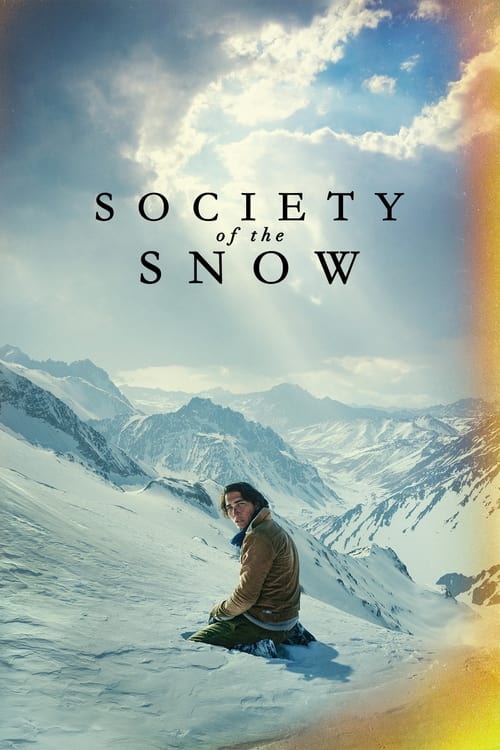
Society of the Snow
2023 · J. A. Bayona
When you want a true story that puts you through it — an epic about endurance and brotherhood for a night you're ready to feel something big. Emotionally demanding, not casual viewing, but deeply rewarding.
What it's about
In October 1972, a plane carrying a Uruguayan rugby team to Chile crashes high in the Andes, leaving the survivors stranded on a glacier with almost nothing — no rescue coming, no food, and winter closing in. Drawn from years of the real survivors' testimony, it follows the young men through seventy-two days of cold, faith, and impossible decisions, told with the dead as much in mind as the living.
The experience
Punishing and tender at once: the crash and the mountain sequences are viscerally intense, but the film's real register is elegy — it keeps asking what people owe each other when everything is stripped away. You come out shaken and strangely uplifted.
Performances
A largely unknown Uruguayan and Argentine cast plays the young men, and their anonymity is a strength — you believe them as a team, not as stars, and Enzo Vogrincic anchors the film with aching gravity.
The craft
Bayona shoots the mountain as a real, murderous place — the crash sequence is staggering, the cold feels physical, and the visual effects disappear into the reality. Michael Giacchino's score mourns rather than thrills. It absolutely rewards a big screen and good speakers.
Why it matters
It reclaimed a famous disaster story for the culture it happened to, told in Spanish with Uruguayan voices, and earned Oscar nominations including Best International Feature — a landmark for Bayona's return to Spanish-language filmmaking.
Snapshot
J. A. Bayona's return to Spanish-language filmmaking after a Hollywood detour is the most searching cinematic reckoning yet with the 1972 Andes air disaster — the crash of Uruguayan Air Force Flight 571 that left forty-five passengers, most of them members of the Old Christians rugby club, stranded for seventy-two days on a glacier at roughly 3,600 meters in the Cordillera de los Andes. Working from Pablo Vierci's 2008 book La sociedad de la nieve — assembled from years of direct testimony by the survivors, Vierci having been a childhood friend of several of the men aboard — Bayona constructs not a survival thriller but an elegy narrated posthumously by one who did not come home. The film reclaims the story for its culture of origin: Spanish-language, Uruguayan in conscience, Catholic in spiritual idiom. Against Frank Marshall's Alive (1993), which centered on the ordeal's sensational cannibalism and on the will of individual protagonists, Bayona insists on the collective, the philosophical, the indebted — on what it means to survive by bearing the weight of those who didn't.
Industry & production
Society of the Snow was produced by Apaches Entertainment, the banner Bayona co-founded with producer Belén Atienza, with whom he has worked across his entire career. Netflix acquired worldwide distribution rights and released the film theatrically in Spain and Latin America in December 2023 before a global streaming launch in January 2024 — positioning it as a flagship prestige offering and an implicit declaration that Bayona's return to Spanish-language work was not a retreat but a consolidation.
The choice of source text carries ideological weight. Piers Paul Read's Alive (1974) had long set the English-language terms for the disaster, and Marshall's 1993 film drew on it. Vierci's La sociedad de la nieve was written from inside the survivors' community and gives the story a different epistemological standing: the survivors tell it on their own terms, not as English-speaking outsiders reconstructed it. Netflix's willingness to fund a major Spanish-language production without anglophone casting concessions reflects the consolidation, in the post-Roma (2018) streaming economy, of prestige non-English cinema as a viable category. Bayona and Atienza leveraged that shift precisely.
Casting drew on largely unknown and emerging actors from Uruguay, Argentina, and Spain. Enzo Vogrincic, a Uruguayan actor with a modest prior screen record, anchors the film as Numa Turcatti — the nominal moral center of the group, and the film's posthumous narrator, who died on the mountain from a septic wound days before rescue arrived and thus never learned that his companions survived. The predominantly male ensemble prepared through sustained physical conditioning; the production worked directly with surviving members of the 1972 group and their families, who lent both testimony and moral authority to the undertaking, acting as an informal ethics committee on the handling of the deceased.
Technology
Bayona's team faced a fundamental material problem: the actual crash site — a glacier in the high Andes — is inaccessible for sustained production. Filming was distributed across multiple locations and modes. Mountain sequences were shot in the Sierra Nevada in southern Spain and in Argentine Patagonia, whose glacial and snow-covered terrain approximated the Cordillera without replicating it. The interior of the wrecked Fairchild aircraft — both the fuselage in which the survivors sheltered and the surrounding debris field — was reconstructed in physical detail calibrated against photographic records and archaeological documentation of the site.
The production prioritized practical construction and location shooting over digital replacement. Visual effects were applied selectively — extending vistas, handling the avalanche sequence, integrating location plates — but the creative emphasis was consistently on placing actors in genuine cold, genuine altitude, genuine harsh light. The physical discomfort legible on the performers' faces and bodies is a direct documentary product of those conditions, not a prosthetic effect.
Technique
Cinematography
Director of photography Pedro Luque Briozzo designed a visual strategy built around the landscape's overwhelming verticality and blankness. The camera is frequently placed low to the snow so that the white horizon fills the upper register and the figures appear marooned rather than grounded — creatures in a space that does not acknowledge them. The color palette desaturates markedly in the high-altitude passages, stripping warmth from the image so that cold becomes something felt rather than depicted. Portraiture in the interior sequences is handled in closer, more mobile registers, and the oscillation between intimate handheld and vast impersonal long-shots gives formal structure to the film's central tension: human interiority against indifferent scale.
The crash sequence is shot with deliberate disorientation — a rapid, fragmented montage of impacts and interlocking spaces that refuses legibility, rendering the disaster as chaos before it becomes narrative. Natural light was prioritized wherever achievable, giving the daylight snow passages a harshness and glare consistent with survivors' accounts of snow-blindness and sensory assault.
Editing
The cutting — handled by Jaume Martí, Bayona's long-standing editorial collaborator — maintains a rhythm that alternates between the stasis of confinement and the sudden violence of incident. The seventy-two days are not structured by day-count titles or mechanical chronology; the edit traces emotional arcs, compressing time within sequences and stretching it across silences. The avalanche that kills several survivors midway through the film is cut with a abruptness that refuses any reprieve: the warmth of the preceding conversation gives way to obliteration without preparation or catharsis, insisting that survival and death share the same uninterrupted texture of time.
Mise-en-scène / staging
Bayona is a trained formalist with a debt to classical Hollywood staging — Hitchcockian precision in the placement of figure and frame is evident from his early shorts and The Orphanage (2007) onwards. Society of the Snow confronts the specific problem of a large ensemble confined to a uniform and extremely limited space. The fuselage interior becomes a stage in the theatrical sense: a fixed location with shifting moral tableaux, its cramped geometry requiring every staging decision to carry relational meaning. The cannibalism is staged with deliberate plainness — no expressionistic lighting, no horror-genre signaling — insisting that the act be understood as practical, communal, and morally negotiated rather than transgressive. This refusal of spectacle is the film's most radical formal choice, and the one most clearly differentiating it from Marshall's 1993 version.
Sound
Sound design is among the film's most distinguished achievements. The Andes environment is rendered through layered wind, the structural groaning of the aircraft, the compression of packed snow underfoot, and the particular silence of altitude — an absence of biological sound, birdsong, or ambient life that registers as uncanny. The crash sequence deploys a full low-frequency spectrum to approximate physical impact. In quieter passages, the mix pushes environmental detail forward while pulling dialogue slightly back, so that the characters are heard as part of the environment rather than above it — a sonic statement of the film's philosophical position regarding the relationship between human life and the impersonal natural world.
Performance
Vogrincic's work as Numa Turcatti is built on restraint and presence. Because Numa narrates from beyond death — already knowing the outcome, watching his companions from a posthumous vantage — Vogrincic must convey interiority through stillness, a quality closer to Bressonian occupation of the frame than to conventional dramatic performance. The ensemble shares this discipline: the film does not traffic in actorly breakdown-scenes or cathartic speeches. Emotion accumulates through small gestures — the handling of the dead, the holding of another person's gaze, the passing of food — rather than through escalating melodrama. The mode was clearly shaped in rehearsal with the actual survivors as a form of testimony-fidelity, a commitment to not performing grief that any of the living witnesses would recognize as false.
Narrative & dramatic mode
The film's central formal gambit — narration by a character who died on the mountain — immediately displaces the conventional survival-film suspense structure, in which tension is organized around who will live. Because Numa frames the story from death, we know before the film begins that he, and many others, will not return. Suspense is consequently replaced by something closer to elegy and philosophical inquiry: what does it mean to choose to survive, and what obligation do the living bear to the dead who made that survival possible?
This obligation is made literal in the film's treatment of the decision to eat the bodies of deceased companions. Bayona frames this not as crisis or transgression but as covenant — the dead are understood, within the Catholic framework the survivors themselves applied, to offer their bodies as a final act of solidarity with the living. The theology is internally consistent and rendered without irony: it is not endorsed by the film so much as faithfully inhabited, because the survivors inhabited it, and the film is testimonial in its fundamental orientation.
The narrative is loosely episodic rather than tightly plotted: attempts, losses, adaptations, waiting. The climactic crossing by Nando Parrado and Roberto Canessa — the two-man expedition that ultimately reached rescue — is not withheld as a third-act revelation but unfolds as one episode among many in a long collective struggle.
Genre & cycle
Society of the Snow participates in the survival film while systematically refusing several of its generic conventions. The canonical Hollywood survival film — from Cast Away (Zemeckis, 2000) to 127 Hours (Boyle, 2010) — organizes itself around a single protagonist whose ingenuity and will power the narrative forward. Bayona's film is explicitly and emphatically collective: the ensemble shares agency, culpability, grief, and decision-making. No single hero is elevated. In structure and moral orientation, it is closer to certain ensemble war films of solidarity than to the individualist survival genre proper.
The film also belongs to the cycle of Spanish and Latin American prestige cinema that has achieved global visibility through streaming platforms in the 2010s and 2020s, following the template Cuarón's Roma established. Like Roma, it is a Spanish-language Netflix production that competed at the highest level of international awards recognition without anglophone concessions.
There is additionally a subgenre of films centered specifically on the Andes crash. The 1993 Alive is the obvious predecessor; Bayona's film is explicitly in dialogue with and in disagreement with it.
Authorship & method
J. A. Bayona (born 1975, Barcelona) emerged from a generation of Spanish filmmakers shaped by the legacies of Almodóvar and by the horror-adjacent sensibility of Guillermo del Toro, who produced his debut. His career has been defined by the tension between a rigorous formalism learned from classical Hollywood — Spielberg and Hitchcock are his most frequently cited touchstones — and a desire to work with emotionally raw material: grief, loss, parent-child separation, the body under extremity.
The Orphanage (2007) announced a filmmaker in command of atmosphere and sustained performance (Belén Rueda). The Impossible (2012) applied those gifts to a true-story disaster at a larger scale — the film attracted criticism for its focus on a wealthy European family amid the 2004 tsunami's wider catastrophe, a critique that Bayona has acknowledged as informing his approach here. A Monster Calls (2016) was his most explicitly poetic work: an allegory of grief rendered through fairy-tale formalism. Jurassic World: Fallen Kingdom (2018) was a commercial assignment that produced competent franchise filmmaking with few personal marks.
Society of the Snow reads as both a return to personal filmmaking and a summation: it draws on the elegiac register of The Orphanage, the disaster-realism of The Impossible, and the literary seriousness of A Monster Calls, while absorbing the lessons of what went wrong, critically, in the earlier disaster film. Belén Atienza's presence as producer across the entire Spanish-language body of work provides the most consistent creative context for Bayona's sensibility to develop. Pedro Luque Briozzo's cinematography and the survivor community's ongoing participation as consultants are the most significant collaborations specific to this film.
Movement / national cinema
The film is a Spanish production, but its cultural allegiance is Uruguayan. The story is Uruguayan, the characters are Uruguayan, and the narrative perspective is emphatically Latin American — a reclamation of a story that English-language culture had effectively appropriated through Read and Marshall. This hybridity is characteristic of contemporary Ibero-American cinema, in which production infrastructure frequently crosses the Atlantic while storytelling remains rooted in Latin American experience.
Bayona occupies a position in Spanish cinema analogous to his near-contemporary Alejandro Amenábar — filmmakers who emerged in the late 1990s and 2000s with strong genre sensibilities and who moved between Spanish and international production without fully belonging to either. The film's Oscar nomination for Best International Feature Film extends the consolidation of Spanish-language cinema as a globally legible prestige category.
Era / period
Society of the Snow appeared at the height of the streaming era's consolidation of international prestige cinema, and its existence is in a meaningful sense a product of Netflix's post-Roma investment in non-English language awards films. The film represents the mature phase of that model: a high-budget, technically ambitious production in a non-English language, targeted simultaneously at awards consideration and global streaming audiences. That this model can sustain genuinely personal, artistically uncompromising filmmaking — rather than merely efficient production — is part of what the film demonstrates.
Themes
The film's central inquiry is into the nature of community under existential pressure: who are we to one another when survival requires the unthinkable? The survivors' decision to eat their dead is treated not as fall but as covenant — the body as gift, the living as stewards of the dead's final sacrifice. This frames the film's Catholic theology not as consolation or transcendence but as a framework for obligation and solidarity, rendered without sentimentality.
Related to this is the film's sustained interest in how collective solidarity is built and maintained under conditions that would dissolve it — how people choose to care for each other when every calorie of warmth spent on another is taken from oneself. Unlike the Hollywood model, in which the protagonist earns survival through exceptional individual qualities, the Andes survivors survive collectively or not at all. The film is interested in the ethics of that collectivity.
The landscape functions not merely as setting but as philosophical argument. The grandeur of the Andes is not the Romantic sublime in which the human spirit triumphs over adversity; it is closer to the impersonal in the Schopenhauerian sense — a universe that does not notice us. The survivors' persistence against this indifference is made meaningful not by heroism but by love.
Memory and bearing witness are the film's closing preoccupation. By narrating from beyond death, Numa asks what the living owe the dead beyond their own survival. The film implicitly positions itself as an act of that remembrance — testimonial cinema in which the artistic and the ethical cannot be separated.
Reception, canon & influence
Society of the Snow was received with broad critical acclaim. At the Goya Awards in early 2024 it swept the major categories, including Best Film and Best Director. Spain submitted it for the Academy Award for Best International Feature Film at the 96th Academy Awards, where it received a nomination — ultimately losing in a competitive field to Jonathan Glazer's The Zone of Interest. Netflix reported viewership figures placing the film among its most-watched non-English language titles of the period, though Netflix's self-reported metrics warrant cautious interpretation as marketing claims rather than independently verified data.
Influences on the film (backward). The 1993 Alive is the unavoidable precursor and, in important ways, the film Bayona is arguing against: where Marshall's film elevated individual will and treated the cannibalism as horrific spectacle, Bayona insists on the collective and on plainness. Roberto Rossellini's neorealism — in the ensemble staging, the preference for non-celebrity performers, the documentary texture of physical experience — is the most legible formal precedent, even if not directly acknowledged. Werner Herzog's engagement with landscape as existential antagonist (Aguirre, the Wrath of God, 1972; Fitzcarraldo, 1982) provides a philosophical context for Bayona's treatment of the Andes as impersonal force. The debt to Robert Bresson runs deep: in the non-expressive performance mode, the film's insistence on the body's material conditions, and the spiritual dimension arrived at without sentimentality, Bayona is working within a Bressonian tradition — absorbed as method rather than explicit citation. Terrence Malick's use of posthumous voiceover as philosophical meditation in The Thin Red Line (1998) offers the nearest precedent for the film's narrative mode, though Bayona's film is less diffuse and more formally bounded than Malick's characteristic practice.
Legacy / what it shaped (forward). As of writing, the film's forward influence remains open — it is too recent for legacies to have consolidated. What can be said is that its critical and commercial success further validates the model of high-ambition Spanish-language prestige cinema financed through streaming, and demonstrates that such films can compete at the highest level of international recognition without anglophone compromise. It stands as Bayona's most uncompromised personal statement — the film most likely to be considered his defining work — and has revived significant scholarly and popular attention to the 1972 disaster and to the survivor community's own terms for understanding it. Its influence on Spanish-language cinema's self-presentation to global audiences, and on the broader subgenre of collective survival and testimonial cinema, will become clearer as the decade advances.
A Deleuzian reading
The camera sits low, almost in the snow.
The full Deleuzian reading of Society of the Snow →
Reception
It slipped onto Netflix in early January 2024 with modest fanfare, then word of mouth turned it into one of the platform's biggest non-English hits — by Oscar night it was the retelling everyone said finally did the story justice.
How Society of the Snow was received, from release to now →
Influences: the films it descends from and the films it influenced
- Alive (1993) — Bayona's cannibalism-as-plainness staging and collective-protagonist structure is a sustained formal rebuttal to Marshall's individualist, spectacle-driven treatment of the same Andes events and the same survivor testimony.
- Rome, Open City (1945) — Rossellini's neorealist ensemble staging — non-celebrity performers, authentic location texture, physical experience as dramatic content rather than psychological interiority — is the formal template Bayona absorbs for the Andes camp sequences.
- Pickpocket (1959) — Bresson's direction of models toward body-focused, non-expressive delivery without psychological interiority is the performance methodology Bayona absorbs for the survival ensemble's restraint — absorbed as inherited method rather than explicit citation.
- Night and Fog (1955) — Resnais's non-chronological montage using posthumous narration to frame historical atrocity as living ethical debt rather than closed past event is the structural template for Bayona's elegy-over-suspense organization and his debt-to-the-dead theme.
- Aguirre, the Wrath of God (1972) — Herzog's cinematographic treatment of the Amazon as impersonal force that frames and dwarfs human will without metaphor provides Bayona's formal template for the Andes as existential antagonist rather than dramatic backdrop.
- Fitzcarraldo (1982) — Herzog's commitment to filming actual extreme-environment physical labor rather than simulating it establishes the practical-over-VFX precedent Bayona follows in using real Andes locations and actual altitude conditions rather than studio reconstruction.
- Come and See (1985) — Klimov's technique of rendering atrocity through the witness's physically transformed presence rather than direct spectacle — horror registered in the body rather than displayed to the camera — is the formal precedent for Bayona's cannibalism-as-plainness doctrine.
- The Thin Red Line (1998) — Malick's use of a dead soldier's posthumous philosophical voiceover to reframe collective combat as elegiac meditation on mortality is the direct narrative structural model for Bayona's posthumous narrator and non-chronological emotional arc.
- Son of Saul (2015) — Nemes's confined-ensemble staging keeps atrocity at the edge of frame while centering the witness's physical experience, refusing exploitation without refusing presence — the formal precedent for Bayona's fuselage-bound collective survival and his ethical staging of the cannibalism sequences.
- Touching the Void (2003) — Macdonald's hybrid documentary of Andean high-altitude survival deploys the same altitude-environmental-sound layering and survivor-testimony ethics framework, treating the survivor's own terms for meaning as both formal and ethical constraint.
- The Impossible (2012) — Bayona's own earlier true-disaster film applies the same Hitchcockian formal rigor and survivor-testimony ethics to a different catastrophe; criticism of its individual-family focus is explicitly acknowledged by Bayona as the formative pressure behind Society of the Snow's shift to collective protagonist.
- The Revenant (2015) — Lubezki's natural-light-only cinematography in snow and extreme cold — practical outdoor shooting without artificial illumination — is the direct industrial precedent Pedro Luque responds to in Society of the Snow's natural-light-priority, desaturated high-altitude palette.
- The White Ribbon (2009) — Haneke combines posthumous first-person narration, Bressonian performance restraint, and austere cold-climate cinematography to convert collective guilt into moral inquiry — the same cluster of formal techniques Bayona deploys, substituting alpine snow for Haneke's Prussian winter.
- Roma (2018) — Cuarón's Netflix-financed Spanish-language prestige film — natural-light priority, non-celebrity-feeling ensemble performance, Ibero-American subject pitched at international award recognition — validates and models the streaming-platform prestige strategy Society of the Snow extends.
- The Zone of Interest (2023) — Both films subordinate dialogue systematically to environmental sound design as a formal strategy for rendering collective historical atrocity as quotidian reality; they competed in the same Academy Awards cycle as formally convergent ethical responses to mass survival and witness.
- All Quiet on the Western Front (2022) — Berger's non-anglophone Netflix prestige war film uses the same desaturated cold palette and collective-over-individual anti-heroic survival framing, consolidating a shared formal language for streaming-financed European testimonial cinema competing at the international feature level.
- The Lost Bus (2025) — Builds a known-outcome survival reconstruction on survivors and bereaved families as the evidentiary spine, casting for physical correspondence to the real people and withholding the rescue as a climax — the same contract with the record Lizzie Johnson's book gives Greengrass.
Similar films
- The Revenant (2015) — influence & lineage
- Touching the Void (2003) — influence & lineage
- The Summit of the Gods (2021) — shared sensibility
- Intacto (2001) — shared sensibility
- Snowpiercer (2013) — shared sensibility
- A Twelve-Year Night (2018) — shared sensibility
- Gravity (2013) — shared sensibility
- The Flight of the Phoenix (1965) — shared sensibility
All the films related to Society of the Snow →
Watch it with: curated runs of related films
- Ordinary People, Impossible Odds — A run of true-life ordeals where staying alive comes down to sheer endurance and the people who refuse to leave anyone behind — watch them together when you want to be reminded what human beings actually do at the edge.