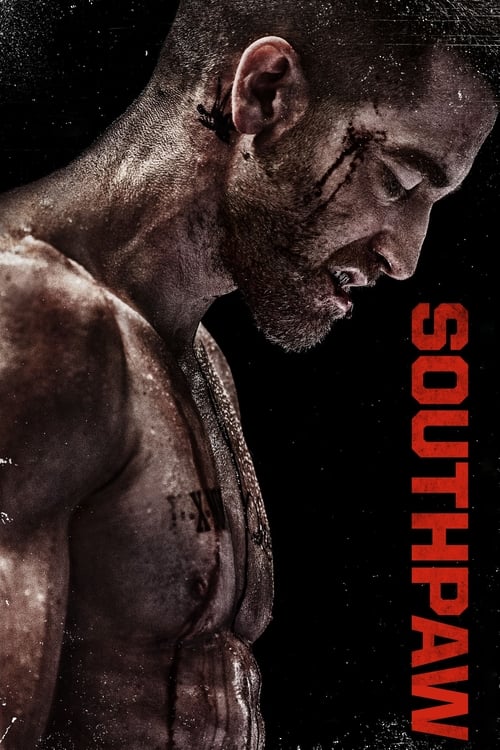
Southpaw
2015 · Antoine Fuqua
For when you want a big cathartic sports movie that earns a lump in your throat — rock bottom, the training montage, the comeback. Comfort food with bruises on it.
What it's about
Billy Hope is an undefeated boxing champion whose whole style is absorption — he wins by taking punishment until fury carries him through. He has the belt, the mansion, a wife who steadies him and a young daughter who adores him, and then one violent moment tears it all down: career, fortune, and custody of his little girl. Broke and unraveling, he walks into a rundown gym run by Tick Willis, a trainer of tough amateur kids, to learn the one thing he never bothered with — defense.
The experience
A full-throated melodrama that hits like its hero fights: blunt, emotional, relentless. You know roughly where the fall-and-rise arc is going, and it works anyway — the grief is raw, the fights are punishing, and the father-daughter scenes will get you.
Performances
Jake Gyllenhaal transformed himself physically and vocally into a mumbling, coiled fighter, and it's the engine of the film. Forest Whitaker brings weathered patience as the trainer, and young Oona Laurence more than holds the screen against both of them.
The craft
Antoine Fuqua shoots the fights up close and inside the punishment, sometimes from the fighter's own point of view, so you feel every shot Billy absorbs. The ring sound design is visceral, and the score — among James Horner's last — carries the grief underneath the spectacle.
Why it matters
Remembered chiefly as one of Gyllenhaal's great physical transformations, part of the run that made him the most committed shape-shifter of his generation of American actors.
Snapshot
Southpaw is a boxing melodrama in the oldest sense of the term — a fall-and-rise story about a man who loses everything and must be rebuilt from the feet up — executed with the kinetic surface of a mid-2010s American action picture. Jake Gyllenhaal plays Billy "The Great" Hope, an undefeated junior middleweight champion whose style is pure absorption: he wins by letting himself be hit until rage carries him through. That method, which the film establishes as both his gift and his pathology, is the thesis. When his wife Maureen (Rachel McAdams) is killed in a scuffle provoked by a rival, Billy's career, fortune and custody of his daughter Leila (Oona Laurence) collapse in sequence, and he is remade by a gym trainer, Titus "Tick" Wills (Forest Whitaker), who teaches him the one thing he has never learned — defense.
The film sits at a peculiar intersection. It was written by Kurt Sutter, creator of Sons of Anarchy, in a register of operatic masculine self-destruction; directed by Antoine Fuqua, a filmmaker with a long-standing personal investment in boxing; scored by James Horner, who died weeks before its release; and outfitted with a soundtrack curated by Eminem, for whom the screenplay was originally conceived. It arrived in July 2015, four months before Creed would revive the genre with far greater critical success, and its reception has been shaped ever since by that adjacency. What survives most durably is Gyllenhaal's performance and the film's unusual structural choice to make the custody hearing, not the title fight, the true site of jeopardy.
Industry & production
Southpaw is a case study in the mid-2010s American mid-budget adult drama — a category then in visible decline. It was produced through Escape Artists (Todd Black, Jason Blumenthal, Steve Tisch), with Fuqua's own production banner involved, and distributed in the United States by The Weinstein Company. The reported budget sat in the low-to-mid tens of millions, modest by the standards of its summer release corridor, and the film returned a theatrical profit on a worldwide gross well above that figure. Precise figures vary across sources and should be treated as approximate.
The project's development history is its most-cited industrial fact. Sutter wrote the screenplay with Eminem in mind, conceived loosely as a companion to 8 Mile (2002) — a story of a performer whose talent is inseparable from his damage. Eminem ultimately did not star; the role went to Gyllenhaal, and Eminem's involvement was redirected into the music, where he executive-produced the soundtrack and contributed original tracks including "Phenomenal" and "Kings Never Die." The residue of that origin is legible in the finished film: Billy Hope's inarticulacy, his orphanage upbringing, his rage as a class symptom rather than a character flaw, all read as material written for a rapper before it was written for an actor.
The Weinstein Company's release strategy is itself period-specific. TWC had built its identity on awards-season positioning, and Southpaw was marketed with an awards-caliber transformation performance at its center while being released in late July — an attempt to have a summer commercial run and a long-tail prestige conversation at once. The prestige half did not materialize; Gyllenhaal received no major nomination, which became a minor recurring story given that he had also been passed over for Nightcrawler the previous year.
Production drew on real venues and real boxing infrastructure. Fight sequences were staged in working arenas before crowds, and the broadcast apparatus of televised boxing — commentary desks, ring announcers, the visual grammar of HBO's fight coverage — was reproduced with participation from figures from the actual sport, including working commentators and former professional fighters in supporting roles. Curtis "50 Cent" Jackson, cast as Billy's promoter Jordan Mains, brought a genuine outside credential: he had operated a boxing promotion company, and the casting carries a documentary charge the script does not have to explain.
Technology
Southpaw is a digital-capture film of its moment, and its technological interest lies less in any single innovation than in how thoroughly it absorbs the visual conventions of televised sport into a narrative feature. The fight scenes are constructed as a layered system: broadcast-style long lenses from fixed ringside positions, handheld work inside the ropes, and small-format rigs that place the camera at or near the fighters' eyeline. The resulting texture toggles between the mediated, authoritative image the audience knows from television and a subjective image television cannot deliver — the view from inside a man being hit.
The film also uses high-frame-rate photography sparingly and pointedly, isolating moments of impact — sweat spray, a mouthguard leaving the mouth, a head snapping — with a legibility that ordinary coverage cannot achieve. This is a technique inherited from sports broadcasting's own slow-motion replay culture and from the action cinema of the preceding decade; Southpaw deploys it as punctuation rather than as a governing style.
Publicly documented detail on specific camera packages, lens choices and rig design for this production is thinner than for larger-scale films of the period, and claims about exact equipment should be treated with caution.
Technique
Cinematography
Mauro Fiore shot the film, continuing a working relationship with Fuqua that began with Training Day (2001) and continued through The Equalizer (2014). Fiore's contribution here is structural rather than decorative: he builds a legible visual economy in which lighting quality tracks Billy's material condition. The championship world is amber and gold — arena spill, flashbulbs, the burnished excess of the Hope mansion, a house lit like a showroom. The collapse is rendered in cool, flat, under-lit interiors: institutional corridors, the child services office, a stripped and emptied home, a rented room. The recovery, staged largely in Tick's gym, is neither: it is fluorescent, unglamorous, tungsten-and-daylight, a working space rather than a stage.
Fiore's fight photography is deliberately inconsistent in the good sense — the film's grammar changes as Billy's craft changes. The early bouts are covered chaotically, cameras jammed close, framing broken, the audience denied the geometry of the fight because Billy himself has no geometry. The climactic fight, after Tick's retraining, is shot with markedly more spatial clarity: wider, more stable, with the ring's dimensions legible. The camera learns defense at the same time the character does. Whether or not this was articulated as a plan, it is the film's most sophisticated formal gesture.
Editing
John Refoua, another Fuqua collaborator, cuts the picture on two clocks. The fights are fast, percussive, and organized around impact rather than continuity — a strategy that risks incoherence and occasionally succumbs to it. The dramatic material is cut much more patiently, with long-held two-shots in the custody scenes and in the gym.
The film's most conspicuous editorial decision is compressive: the destruction of Billy's life is delivered as an accelerating montage of losses — the funeral, the suspension, the foreclosure, the removal of his daughter — that telescopes months into minutes. This is melodramatic time, not naturalistic time, and it is where critics most often located the film's weakness. It is also, arguably, its genre's native grammar; The Champ and Rocky III work the same way.
Mise-en-scène / staging
The production design is organized around a single subtractive arc. The Hope mansion is introduced as a catalog of new-money signifiers — scale without taste, gold fixtures, a garage of cars, memorabilia as décor — and is then systematically emptied, item by item, until Billy is standing in bare rooms. Tick's gym is its inverse and its correction: peeling paint, hand-lettered signage, mismatched equipment, a wall of local kids' photographs. It is a space defined by use rather than display, and the film stages Billy's redemption as a literal relocation into it.
Billy's body is itself part of the design. Gyllenhaal's Billy is covered in text and image — tattoos that spell out his marriage, his daughter, his self-mythology — so that the character's inner life is written on a surface he cannot read aloud. The staging repeatedly isolates him at the edges of institutional rooms, in chairs too small, hands in his lap, physically miscast in every environment that is not a ring.
Sound
The sound design executes the film's central subjective move. In the fights, the crowd is treated as a variable: full-spectrum roar for the broadcast perspective, then abruptly narrowed to breath, heartbeat, glove-on-glove friction and the internal thud of impact when the film moves inside Billy's head. Punches carry an exaggerated low-frequency weight that is not naturalistic and is not meant to be — it is the sound of being hit as remembered, not as recorded.
James Horner's score, one of his last, is markedly restrained: strings and piano, elegiac rather than triumphal, working against the material's pugilistic surface. Horner died in a plane crash in June 2015, weeks before the film's release, and Southpaw carries a dedication to him. His cues sit in deliberate tension with the soundtrack's hip-hop needle-drops — Eminem's contributions foremost — producing a two-track sonic identity: the music of Billy's public persona versus the music of his grief.
Performance
Gyllenhaal's work here belongs to his most physically extreme period, immediately following the severe weight loss of Nightcrawler (2014). He trained for months under professional boxing instruction and rebuilt his physique into that of a working fighter, and the result is credible in the specific way that matters: the footwork, the guard, the exhaustion between rounds. But the performance's more interesting register is vocal and cognitive. Billy is written as barely verbal, his speech slurred and clipped by damage and by class, and Gyllenhaal plays him as a man perpetually two beats behind the room.
Whitaker underplays Tick almost to the point of withholding, refusing the mentor role's warmth; his authority is procedural rather than paternal. Oona Laurence, as Leila, delivers the film's most controlled work — a child performance built on refusal rather than pathos, and the source of the film's few genuinely unmanaged emotional moments. Naomie Harris, as the child services caseworker, and Rachel McAdams, as Maureen, are both constrained by function; McAdams's early removal from the narrative drew sustained criticism as an instance of a female character existing to be lost.
Narrative & dramatic mode
The film is pure melodrama, and understanding it requires taking that seriously rather than as an insult. Its logic is moral and escalatory: virtue and vice are externalized, coincidence is permitted, and emotional states are expressed as material events. Billy does not gradually decline; he is stripped, in stages, of wife, house, title, license, manager, and finally daughter, each loss arriving as a discrete blow in a rhythm indistinguishable from the rounds of a fight.
The structurally notable choice is that the climax is doubled and the weighting is inverted. The championship bout against Escobar is the genre's expected terminus, but the film has already located its real stakes in a family court hearing. Billy's redemption is legally adjudicated before it is athletically confirmed. This gives the boxing an unusual function — it is not the test but the aftermath — and it aligns Southpaw less with Rocky than with the father-and-child boxing melodrama descending from The Champ.
The screenplay's weaknesses are structural: the inciting tragedy depends on an implausibly public provocation, the antagonist Escobar is a thin instrument, and the mentor's own backstory arrives on schedule. Sutter's dialogue is at its strongest in scenes of institutional humiliation — hearings, negotiations, meetings with people who hold power over Billy — and weakest when it must supply articulate self-knowledge to a character defined by its absence.
Genre & cycle
Southpaw is a late entry in the American boxing film, a genre with an unusually stable set of moral positions: the ring as site of class mobility and class entrapment, the promoter as corrupting agent, the trainer as surrogate father, physical punishment as moral accounting. Its immediate lineage runs through The Champ (1931; remade 1979) for the father-child axis, Rocky (1976) for the gym-as-sanctuary and the retraining montage, Raging Bull (1980) for the fighter whose self-destruction is inseparable from his craft, and The Fighter (2010) and Warrior (2011) for the contemporary family-melodrama variant of the combat film.
Its cycle position is specific and slightly unlucky. The mid-2010s saw a concentrated revival of the fight picture, and Southpaw opened months before Creed (2015), which pursued similar generic material — inherited legacy, mentorship, a fighter's body as narrative — with more formal invention and a stronger critical reception. The two films are now routinely discussed as a pair, generally to Southpaw's disadvantage. It also arrived shortly after the Mayweather–Pacquiao bout of May 2015, an event widely read as demonstrating boxing's diminished cultural centrality — context that made the film's straightforward faith in the sport's mythology feel, to some critics, belated.
Authorship & method
Fuqua's authorship is best understood as a set of consistent preoccupations rather than a signature style: men whose competence is inseparable from their violence, institutions that fail the people inside them, urban American spaces photographed with a commercial director's attention to surface. He came from music videos and commercials, and the fluency shows in the montage and needle-drop sequences. Southpaw is also, uniquely in his filmography to that point, a personal-interest project — Fuqua is a genuine boxing enthusiast, and he would later direct the documentary What's My Name: Muhammad Ali (2019), confirming the subject as a durable rather than incidental concern.
The collaborator group is largely a continuing one. Fiore had shot Training Day and The Equalizer; Refoua had cut recent Fuqua pictures; the working method visible on screen — real locations, practical crowds, a preference for physical staging over digital augmentation — is consistent across those films. Gyllenhaal and Fuqua would work together again on The Guilty (2021).
Sutter's authorship pulls in a different direction. His television work — The Shield as a writer, Sons of Anarchy as creator — is defined by long-form tragic architecture, loyalty codes, and men destroyed by the institutions they build. Compressed into two hours, that sensibility produces a film that is emotionally maximal and narratively schematic, and the seams between Sutter's melodramatic engineering and Fuqua's naturalistic surface are visible.
Horner's score deserves its own note in any account of the film's authorship. His decision to write against the material — restrained, mournful, avoiding the brass triumphalism the genre invites — is the single strongest argument that Southpaw is a film about bereavement that happens to contain boxing rather than the reverse.
Movement / national cinema
The film belongs to no movement; it belongs to a production category. It is an American independently financed, studio-distributed adult genre picture of the kind that was rapidly disappearing in the mid-2010s as major studios consolidated around franchise tentpoles and prestige drama migrated toward streaming. That Southpaw was made at all, at that budget, with that cast, in that release slot, is a fact about a specific industrial window that had largely closed within five years.
Its national-cinema affiliations are the New York working-class film — Hell's Kitchen origins, orphanage and group-home backstory, the city as a machine for producing fighters — and the broader American tradition of the sports film as a vehicle for class narrative. The film's politics are implicit and conventional: the sport is a legitimate route out of poverty, its business apparatus is predatory, and personal discipline is the answer to structural precarity.
Era / period
Southpaw is legible as a 2015 artifact in several ways. It is a product of The Weinstein Company's late period, when the company's awards-first model was straining. It reflects the mid-2010s vogue for the actorly body transformation as both craft claim and marketing asset, a discourse Gyllenhaal was central to across Nightcrawler, Southpaw and Nocturnal Animals. It participates in the era's convention of borrowing the visual authority of live sports television. And its posthumous release of a James Horner score marks the end of a compositional era in American film music — Horner having been, since the 1980s, one of the defining voices of the mainstream orchestral score.
Themes
The film's governing theme is the cost of a body used as an instrument. Billy's fighting style — winning by being hurt — is presented as a psychological formation traceable to institutional childhood: a man who learned that endurance is the only available power. The retraining plot is therefore not a technical adjustment but a moral one; learning to not be hit is learning that his suffering has no exchange value.
Fatherhood is the second axis, and the film's most sincere. The custody narrative reframes the sports film's usual question — can he win? — as can he be trusted with a child? Leila's grief is written as anger directed at her father, and the film resists reconciling them on schedule, which is the source of its best scenes.
Class runs beneath both. The mansion, the cars, the entourage and the promoter are shown as a thin membrane over precarity; Billy's fortune evaporates because he never controlled it. Tick's gym proposes the alternative — a community institution serving neighborhood kids, sustained rather than extracted — and the film's ending returns Billy there.
A fourth thread, less developed, concerns spectacle and complicity. The HBO apparatus is reproduced faithfully enough that the audience watching Billy be damaged occupies the same position as the crowd inside the film. Southpaw raises this and does not pursue it, which is a fair summary of its ambitions generally.
Reception, canon & influence
Critical reception was mixed, and the division was unusually consistent in its terms. Reviewers broadly credited Gyllenhaal with a committed, physically and emotionally persuasive performance, and broadly faulted the screenplay as assembled from genre parts — the tragedy as contrivance, the mentor as fixture, the arc as foregone. Praise for Whitaker and, notably, for Oona Laurence recurred. Aggregate scores settled around the middle of the range; the film was neither a critical success nor a dismissal. Awards traction did not follow, despite a campaign positioning Gyllenhaal for consideration, and the omission became a modest talking point in the 2015–16 season. Commercially the film performed respectably, comfortably recouping a modest budget.
Backward, the influences are explicit and largely unhidden: The Champ for the father-child melodrama and its emotional method; Rocky for the retraining structure and the gym's moral geography; Raging Bull for the fighter whose ring behavior is continuous with his domestic destruction; The Fighter and Warrior for the contemporary template of the combat film as family drama; and, in its origins, 8 Mile, whose DNA persists in the protagonist's inarticulate class rage.
Forward, the influence is limited and honest to state as such. Southpaw did not establish a template; Creed, released the same year, absorbed most of the decade's boxing-film attention and lineage. The film's durable traces are narrower: it consolidated Gyllenhaal's mid-2010s reputation as an actor of extreme physical commitment, a reputation that shaped his subsequent casting; it deepened Fuqua's engagement with boxing, which produced the Ali documentary four years later and continued a director-actor partnership resumed on The Guilty; and it stands as one of the last scores by James Horner, which has given the film a place in discussions of his career that has nothing to do with its genre. Reports of further extensions of the property circulated after release, but the record on what came of them is thin and should not be overstated.
Its canonical position, twenty-odd years into the century, is that of a well-made minor entry: a film whose craft — particularly Fiore's photography, Horner's score, and Gyllenhaal's performance — outruns its screenplay, and which is most often invoked as the other 2015 boxing film. That framing is unfair in one respect. Southpaw's decision to locate its climax in a custody hearing rather than a title fight is a real structural idea, and the boxing film has produced few enough of those.
A Deleuzian reading
He walks into the punches.
The full Deleuzian reading of Southpaw →
Reception
Landed in 2015 to shrugs — critics called it a clichéd boxing melodrama saved by its lead — and a decade on that's roughly where it still sits: nobody's reclaiming the script, but Gyllenhaal's performance keeps getting retroactive respect as part of his great mid-2010s run.
How Southpaw was received, from release to now →
How to watch Southpaw: what to notice on a first viewing
- Watch Billy drop his hands and let himself get hit. His whole method is absorption. He takes shots until the hurt turns into rage and the rage carries him. Gyllenhaal trained for months, and the footwork and guard read as a working fighter's. The style is the character. A man who only knows how to endure will handle everything outside the ring the same way.
- Notice you cannot tell where the fighters are in the ring. Fiore jams the cameras in close and breaks the framing in the early bouts. High-speed inserts pull out single impacts: sweat spray, a mouthguard leaving the mouth, a head snapping back. You get sensation with no map, which is what Billy has. Remember this coverage. The camera does not stay this way.
- Look at the color of the light in each new place. Arena and mansion arrive in amber and gold. Institutional rooms are cool, flat, and underlit. Tick's gym is fluorescent and tungsten, a working space rather than a showroom. Fiore tracks Billy's bank balance in the lighting. You can tell where he stands financially from one frame, with no dialogue.
- Listen for the crowd noise dropping away to breath and heartbeat. The mix treats the roar as a dial. It narrows to breathing, glove on glove, and the thud of impact heard from inside the skull, then opens back out. The punches do not sound recorded. They sound remembered. The mix tells you when you are inside his head.
- Look at what is printed on Billy's skin. His marriage, his daughter, and his own legend are tattooed across his body. Sutter wrote him barely verbal, so his inner life sits on a surface he never reads aloud. Everything he cannot say is legible on him. Watch other people read it before he manages a sentence.
The whole guide to watching Southpaw, with the keys for a rewatch →
Influences: the films it descends from and the films it influenced
- Body and Soul (1947) — James Wong Howe shot the climactic bout handheld on roller skates inside the ropes, inventing the in-ring subjective camera position that Southpaw alternates against Fiore's long-lens broadcast coverage to switch the fight between degraded sensation and legible geography.
- The Set-Up (1949) — Built its fight scenes out of cutaways to individual ringside faces so the crowd reads as a bloodthirsty chorus rather than ambience — the same editorial logic Refoua uses when Southpaw's crowd is intercut and then acoustically dropped away into Hope's tinnitus.
- Requiem for a Heavyweight (1962) — Opens with an unbroken first-person round shot from inside the losing fighter's head, the image smeared and unreadable until he is dragged to the corner — the prototype for Southpaw's degraded-to-legible grammar, where impact inserts blur out and the frame only resolves between rounds.
- Rocky (1976) — Established the retraining montage as a scored second-act engine and the trainer's dilapidated gym as moral geography — a space you must be readmitted to before you can fight — which Southpaw reproduces beat-for-beat in Wills's gym under Horner's cue.
- Kramer vs. Kramer (1979) — Located a film's true climax in a custody hearing, staging the father's cross-examination as the scene where his character is finally adjudicated; Southpaw's doubled-inverted climax borrows that structure wholesale, making the title fight the anticlimax and the family-court testimony the real bout.
- The Champ (1979) — Zeffirelli's remake of Vidor's 1931 melodrama meters every fight by cutting to the child at ringside and ends on the child's uncomprehending grief in close-up — the exact emotional method Southpaw transfers to Leila, whose reaction shots carry dramatic information the fights themselves withhold.
- Raging Bull (1980) — Frank Warner's mix collapses crowd roar into animal sound and abrupt silence to render the fighter's interiority, and the film treats ring behavior and domestic destruction as one continuous act — both the subjective crowd attenuation and the ring/home continuity that Southpaw's sound design and script inherit.
- Training Day (2001) — First pairing of Fuqua and Mauro Fiore, establishing the practical-source, real-location lighting scheme in which wealth is keyed clean and daylit while poverty is sodium-lit and underexposed — the class index Fiore reuses to separate Hope's mansion from Wills's gym.
- Ali (2001) — Shot bouts by mixing telephoto ringside coverage with in-close handheld and mixed the arena roar as a subjective pressure that swells and cuts out with the fighter's attention, the hybrid fight-photography package Southpaw adopts as its default.
- 8 Mile (2002) — Southpaw began as an Eminem vehicle and keeps its DNA: a protagonist whose class rage is articulate only in performance and mute everywhere else, with a curated hip-hop soundtrack doing the interior monologue the character cannot speak.
- Million Dollar Baby (2004) — Tom Stern lit the Hit Pit as near-black with isolated practicals, making the gym a moral interior rather than a location, and built the film on a trainer who becomes a surrogate parent — the lighting scheme and relational architecture Southpaw hands to Fiore and Whitaker.
- The Wrestler (2008) — Maryse Alberti's over-the-shoulder handheld follows the fighter through corridors into the arena so the walkout is experienced as labor, and pins the drama on an estranged daughter — the staging and the reconciliation structure Southpaw repeats in its tunnel walks and Leila scenes.
- What's My Name: Muhammad Ali (2019) — Fuqua's archival-only construction, with no talking heads and the fights assembled entirely from period broadcast footage, extends the ringside television grammar of Southpaw into a film where the broadcast image is the sole material.
- The Guilty (2021) — Resumes the Fuqua–Gyllenhaal method established here — build the film on sustained close coverage of an actor in physical and vocal duress who cannot say what he means — stripped to a single room and eleven shooting days.
- Michael (2026) — Fuqua's own template of a male body driven to punishing physical extremity under a fraught father-mentor, here rerouted into the disciplined labor of rehearsal and choreography.
- Creed (2015) — Released the same year and reaching for the same device from the opposite end: both films use the actual apparatus of televised boxing — network graphics, real commentators, walkout staging — as diegetic narration, but Coogler answers Southpaw's cut-heavy coverage with Maryse Alberti's unbroken single-take round.
Similar films
- The Wrestler (2008) — influence & lineage · same viewing thread · often watched together
- Creed (2015) — influence & lineage · same viewing thread
- Training Day (2001) — influence & lineage · often watched together
- Million Dollar Baby (2004) — influence & lineage
- Warrior (2011) — influence & lineage
- The Fighter (2010) — influence & lineage
- Raging Bull (1980) — influence & lineage
- Rocky (1976) — influence & lineage · same viewing thread
All the films related to Southpaw →
Watch it with: curated runs of related films
- The Working-Class Long Shot — A run of men whose bodies and grit are their only capital, each grinding toward a single shot at dignity — watch them together and the American bootstrap dream and its bleaker European labor-film shadow start to rhyme.