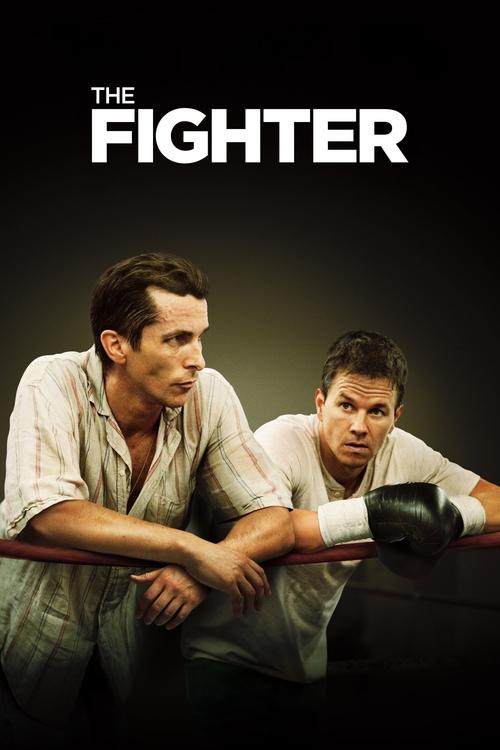
The Fighter
2010 · David O. Russell
For when you want a crowd-pleaser with teeth — a stand-up-and-cheer sports movie that also works as a bruising family drama. Great with a group, and it earns its fist-pump ending honestly.
What it's about
In the faded mill town of Lowell, Massachusetts, boxer 'Irish' Micky Ward gets one last shot at climbing toward a world title — if his family doesn't drag him down first. His trainer is his half-brother Dicky, a former local hero hollowed out by crack addiction, and his manager is their steamroller of a mother; loving them and escaping them turn out to be the same fight. It's a true story that's as much about a family as a sport.
The experience
Loud, funny, abrasive, and surprisingly tender — the family screaming matches hit harder than the fights, and the fights hit plenty hard. It moves with a scrappy, live-wire energy that keeps a familiar underdog arc feeling raw.
Performances
Christian Bale is astonishing as Dicky — wiry, motor-mouthed, heartbreaking — and Melissa Leo matches him as the ferocious matriarch; both won Oscars. Mark Wahlberg's quieter, watchful Micky is the anchor that lets them go big, and Amy Adams brings real steel to the bartender who takes Micky's side.
The craft
David O. Russell shoots the family scenes like a brawl — overlapping dialogue, restless handheld camera, a Greek chorus of sisters — then films the bouts in the flat video style of the era's TV broadcasts, so they feel like found footage of real fights. The whole thing crackles with the texture of a specific place and class.
Why it matters
A career-reviving triumph for Russell and the film that turned Bale's transformation into legend, it reset the bar for how alive and unsentimental a boxing biopic could feel.
Snapshot
The Fighter dramatizes the mid-career rise of "Irish" Micky Ward (Mark Wahlberg), a working-class light welterweight from the faded mill town of Lowell, Massachusetts, whose late run to a world title was tangled up with the fortunes of his half-brother and trainer, Dicky Eklund (Christian Bale), a former local boxing hero undone by crack addiction. Directed by David O. Russell and released by Paramount at the end of 2010, the film is at once a boxing picture in the Rocky lineage and a caustic family drama about loyalty, addiction, and the pull of a hometown that both forms and stifles its subjects. It became a signal comeback for Russell and a critical triumph on the strength of its ensemble: Bale and Melissa Leo (as the brothers' domineering mother, Alice) won Academy Awards, and the film drew nominations for Best Picture, Best Director, and Amy Adams's supporting turn, among others. Its central formal gambit is to render the fights in the flat, immediate register of HBO television broadcast, grounding a genre of myth in the texture of the actual.
Industry & production
The project's decisive fact is that it was, for the better part of a decade, Mark Wahlberg's undertaking. A producer and star with roots in nearby working-class Massachusetts, Wahlberg championed the material through a long, unstable development, trained as a boxer for years so that the fight footage would not require a double or heavy cutting, and reportedly built a ring at his home to stay ready. Directorial attachments shifted over the years — Darren Aronofsky was associated with the material and ultimately took an executive-producer credit, and other filmmakers circulated before Russell committed. Casting likewise churned: various high-profile actors were floated for the Dicky role before Bale took it.
Financing came together through Relativity Media, with Paramount distributing in the United States; the production was made economically, on a budget widely reported in the region of $25 million, modest for a star-driven awards title. Shooting took place largely on location in Lowell itself — the Wards' real town — over a compressed schedule, a constraint that suited Russell's fast, improvisatory method and lent the film its lived-in specificity. Commercially it was a clear success, earning many times its budget in worldwide release and performing durably through the winter awards season; precise grosses are a matter of trade record rather than something to reconstruct here. Its awards run — two acting Oscars from seven nominations — cemented it as one of the year's prestige successes and reset Russell's standing in the industry after a fallow, troubled stretch.
Technology
The Fighter is technologically notable less for novelty than for a deliberate split of image systems. The dramatic scenes were shot on 35mm film by cinematographer Hoyte van Hoytema, giving the domestic and street material a grained, handheld warmth. The boxing sequences, by contrast, were staged and captured to imitate the look of an HBO televised bout: the production drew on the conventions — and, by widely repeated account, the equipment and personnel — of actual broadcast boxing coverage, so that the ring footage carries the harder, video-inflected clarity and ringside camera positions of a real fight telecast. The film also folds in the aesthetic of documentary video through the conceit of an HBO crew trailing Dicky. This layering — film for life, broadcast video for the fights, documentary video for Dicky's delusion — is the picture's key technical idea, and it works precisely because it does not call attention to itself as an effect.
Technique
Cinematography
Van Hoytema, then early in his English-language career, shoots the Lowell exteriors and cramped interiors with a restless, close, handheld camera that stays inside the scrum of the family. Available and practical light, muted New England palettes, and tight framings keep the film's world small and airless — the visual argument being that Micky's problem is as much claustrophobia as competition. The contrast with the fight footage is the point: when the film cuts to the ring, the image hardens into the legible, wide-and-tight grammar of televised boxing, and the switch registers as a shift from private chaos to public performance.
Editing
Pamela Martin's cutting, Oscar-nominated, manages two distinct rhythms. The dramatic scenes are edited for overlap and collision, letting Russell's crowded, interruption-heavy performances breathe while keeping the many-bodied family legible. The fights, staged so they could be covered like broadcasts, are cut with comparatively long, coherent takes rather than the fragmentary quick-cut montage typical of the genre — a choice that trades adrenaline for credibility and lets Wahlberg's real training show. The editing also has to police the film's tonal seams, moving between farce, menace, and sentiment within single sequences.
Mise-en-scène / staging
The staging is built around bodies in tight rooms: the Ward-Eklund household, dominated by Alice and a chorus of sharp-tongued sisters, is choreographed as a single unruly organism, and much of the film's comedy and threat comes from how many people Russell packs into a frame and how they talk over one another. Lowell's triple-deckers, barrooms, gyms, and the crack house are rendered with documentary specificity. The recurring image of Dicky trailed by a camera crew stages his self-deception physically — he performs a comeback for a documentary that is really about his ruin.
Sound
Michael Brook's score is spare and largely deferential, ceding much of the soundtrack to needle-drops — hard rock and period tracks that key the film's working-class, turn-of-the-millennium New England register and drive its fight and montage passages. The sound design leans into the din of the household and the acoustic difference of the ring; dialogue is dense, overlapping, and thickly accented, part of the film's insistence on regional authenticity. (The specific song cues are a matter of the film's music record; the general strategy — muscular rock over minimal orchestral scoring — is what defines the sound.)
Performance
Performance is the film's center of gravity. Bale, in a physically transformed, twitchy, motor-mouthed turn as Dicky, gives the picture its live wire — charismatic, self-destructive, and finally moving; the role won him the Academy Award for Best Supporting Actor. Leo won Best Supporting Actress as Alice, the manager-mother whose fierce love is also a form of control. Adams, cast against her established warmth, is flinty and grounded as Charlene, the girlfriend who becomes Micky's route out of the family's orbit. Wahlberg, by design, plays the still center — a recessive, watchful protagonist whose restraint throws the surrounding performances into relief; it is a genuinely unshowy piece of acting easily undervalued precisely because it works. Russell's method — loose, improvisatory, actor-forward — is legible throughout.
Narrative & dramatic mode
Formally the film is a biographical sports drama, but its dramatic engine is familial rather than pugilistic. The sports-movie skeleton — underdog, setbacks, training, title shot — is present and satisfied, yet the real conflict is Micky's struggle to individuate from a family that manages him into losses while calling it loyalty. The screenplay (Scott Silver and the writing team of Paul Tamasy and Eric Johnson, from a story developed with Keith Dorrington) structures the film as a triangulation: Micky is pulled between the family bloc (Alice, Dicky, the sisters) and the new alliance of Charlene and his father. Dicky's arrest and imprisonment function as the crisis that forces a realignment, and his recovery and Micky's ascent are braided so that the "comeback" belongs to both brothers. The film is candid about addiction and about the way a family can mistake enabling for devotion, and it resists a purely triumphal register even as it delivers the expected victory.
Genre & cycle
The Fighter sits squarely in the American boxing film, a genre with deep roots — Body and Soul, The Set-Up, Champion, Requiem for a Heavyweight, and above all Rocky (invoked in the very framing of Micky's story) and Raging Bull, whose fraternal jealousy and self-destruction it distantly echoes. The TMDB framing's "Rocky-like rise" is apt for the surface, but the film's sensibility — grimy realism, addiction, a study of brotherhood — aligns it more with the darker, character-driven strain. It also belongs to a specific late-2000s/early-2010s cycle of grounded, awards-oriented fight films preoccupied with the wreckage around the ring, with Aronofsky's The Wrestler (2008) as a near neighbor (and Aronofsky, notably, an executive producer here). Equally it is a working-class New England drama, a regional mode the film shares with pictures set in the mill towns and neighborhoods of the northeast.
Authorship & method
David O. Russell's authorship is defined by a chaotic, performance-first ethos: overlapping dialogue, handheld immediacy, tonal volatility that swings from comedy to violence, and a trust in actors to find scenes on their feet. The Fighter channels that sensibility toward realism rather than the absurdism of his earlier I Heart Huckabees, and it marked his re-emergence after a difficult period. The film also inaugurated the ensemble-driven, actor-showcase mode that would define his subsequent run — Silver Linings Playbook (2012) and American Hustle (2013) — and reunited him repeatedly with players from those films.
The key collaborators shape the result decisively. Cinematographer Hoyte van Hoytema, before his later work on large-format spectacle, supplies the film's grained, intimate texture. Editor Pamela Martin braids the domestic and broadcast rhythms. Composer Michael Brook provides a restrained score that lets rock needle-drops carry the emotional and kinetic load. The screenplay by Scott Silver, Paul Tamasy, and Eric Johnson keeps the family drama primary. Wahlberg's function as star-producer is itself an authorial force: his years of training and advocacy determined the film's shape as much as any single creative choice.
Movement / national cinema
The film belongs to no formal movement; it is mainstream American independent-adjacent filmmaking financed and distributed within the studio system. Its most meaningful affiliation is regional — a strand of American cinema attentive to the specific class textures of post-industrial New England, its accents, Catholic working-class families, and declining mill economies. In method it draws on American realist and improvisational traditions (the handheld, overlapping-dialogue lineage) rather than any national school abroad, and its documentary-video conceit connects it to a broader realist impulse in American narrative film of the period.
Era / period
The film is a product of its 2010 moment in both craft and industry: the tail end of an era when a mid-budget, star-driven adult drama could still be a major studio-season awards player, and a time when the borrowing of television and documentary video aesthetics for grounded realism was ascendant. Its depicted period is the 1990s into 2000, anchored to the true events of Ward's career and to Dicky's involvement with a real HBO documentary about crack addiction in Lowell — a period detail the film treats as central rather than incidental. End cards gesture toward Ward's later, more famous ring history, situating the film as the origin chapter of a story its audience partly already knew.
Themes
The film's governing theme is the double bind of family: love and sabotage as the same gesture. Alice and Dicky manage Micky in ways that harm him, and the drama asks what a person owes to the people who made him versus what he owes himself. Addiction is treated with unusual candor for a sports film — Dicky's crack habit is neither romanticized nor simply condemned, and his recovery is granted real weight. Brotherhood and doubling run throughout: the two fighters are versions of each other, one squandering talent, one nearly denied his own. Class and place are inseparable from character — Lowell is a fate to be escaped or embraced. And beneath the genre's redemption arc sits a subtler argument about self-determination: that becoming a champion requires, first, the harder fight to define oneself against one's own kin.
Reception, canon & influence
Critically, The Fighter was strongly received, with near-universal praise for its ensemble and for Russell's control of a volatile tone; the performances of Bale, Leo, and Adams drew the most sustained acclaim. It converted that reception into major awards recognition — seven Academy Award nominations, including Best Picture, Director, Original Screenplay, and Film Editing, and wins for Bale and Leo — a rare double acting victory that fixed the film's reputation as an actor's showcase.
Looking backward, the film's influences are legible and acknowledged: the Rocky template of the local underdog; the fraternal wreckage and boxing realism of Raging Bull; the broader tradition of the fight film as a vehicle for class drama; and, contemporaneously, The Wrestler's study of a broken athlete, a kinship underscored by Aronofsky's producing role. The HBO-broadcast and documentary-video conceits draw on realist and vérité traditions rather than on any single precursor.
Looking forward, the film's chief legacy is twofold. Within David O. Russell's career it launched his most celebrated run and consolidated a repertory, ensemble-driven, performance-first mode that shaped Silver Linings Playbook and American Hustle. Within the culture it helped renew the boxing biopic as prestige awards material and reinforced the viability of the grounded, family-centered sports drama over pure ring spectacle. It also stands as a landmark in the careers of its principals — a defining supporting role for Bale, a rare against-type triumph for Adams, and the fullest vindication of Wahlberg's long labor as both actor and producer. Where the historical record on some development details is genuinely thin — the exact sequence of directorial attachments, for instance — the film's central facts, its craft strategy, and its reception are well established, and it endures as one of the more durable American sports dramas of its decade.
A Deleuzian reading
A man walks down a Lowell street with a camera crew behind him, telling everyone he's making a comeback.
The full Deleuzian reading of The Fighter →
Reception
A hit and awards magnet on release — it resurrected David O. Russell after years in the wilderness post–I Heart Huckabees and launched his Silver Linings/American Hustle run. Now it's often called the best and least mannered film of that whole Russell streak, even as the director himself has become a fraught name.
How The Fighter was received, from release to now →
Influences: the films it descends from and the films it influenced
- Raging Bull (1980) — The template for boxing as fraternal wreckage — a fighter managed and betrayed by a brother, plus the demand that a lead physically remake his body for the role, the discipline Bale's transformation directly answers.
- The Set-Up (1949) — Established the seedy, real-time ring bout shot from within the crowd's sweat and smoke, the claustrophobic staging of the fight-as-labor that Russell's HBO-broadcast rounds inherit.
- Fat City (1972) — The available-light, downbeat portrait of faded club fighters in a decaying working-class town — Conrad Hall's grained naturalism is the visual ancestor of van Hoytema's intimate 35mm texture here.
- On the Waterfront (1954) — Fixed the fight film as class drama and the 'contender' betrayed by his own corner, delivered through Method-actor intimacy that made the boxer's family loyalty the true arena.
- Rocky (1976) — The local-underdog blueprint rooted in a specific blue-collar Northeastern city, where training montage and neighborhood identity, not ring spectacle, carry the emotional stakes.
- A Woman Under the Influence (1974) — The source of the improvisatory ensemble and overlapping domestic volatility — actors finding a scene on their feet inside a crowded, chaotic family frame — that defines Russell's directing method.
- Mean Streets (1973) — Pioneered handheld immediacy fused with rock needle-drops that carry the kinetic and emotional load in place of orchestral scoring, the exact scheme Michael Brook's restrained score cedes to here.
- The Wrestler (2008) — Its vérité handheld tracking that follows a broken athlete's body from behind, and Aronofsky's own producing hand on The Fighter, make it the immediate craft precursor for the grounded fighter-in-decline study.
- Million Dollar Baby (2004) — Extends the lived-in boxing-naturalism strain — working-class milieu, physical-transformation performances, family as both support and damage — into the prestige sports drama of the next decade.
- Cinderella Man (2005) — A boxing biopic built around a scene-stealing supporting turn (Bale's trainer) that echoes Giamatti's Joe Gould as the film's emotional engine.
- Silver Linings Playbook (2012) — Directly extends Russell's repertory, performance-first mode — overlapping dialogue, tonal swings between comedy and violence, and a volatile family double-bind — carried over with returning players.
- American Hustle (2013) — Consolidates the actor-showcase method launched here: improvisatory ensemble, period rock needle-drops, and handheld immediacy trusted to let performances find the scenes.
- Creed (2015) — Revives the Rocky underdog line with a contemporary broadcast-boxing look, staging its rounds in bravura long takes that make the televised fight feel documentary-immediate.
- Southpaw (2015) — Continues the prestige boxing biopic built on drastic physical transformation and a grief-driven family collapse, ring realism serving domestic melodrama.
- Foxcatcher (2014) — Extends the grounded, family-centered combat-sport drama over ring spectacle, with lead actors physically remade to embody wrestlers inside a suffocating study of class and control.
- I, Tonya (2017) — Takes the working-class sports biopic into vérité mockumentary — a broadcast/interview conceit, an abusive family double-bind, and propulsive rock needle-drops descended from this film's realist strategy.
- Boogie Nights (1997) — Shares the Wahlberg working-class-Massachusetts persona deployed inside a sprawling needle-drop-scored ensemble, where a surrogate family's dysfunction is staged in restless crowded frames.
- Warrior (2011) — Rebuilds the same fraternal combat drama and family double-bind, using a broadcast-sports visual grammar to frame estranged brothers converging on a televised bout.
- The Smashing Machine (2025) — HBO-documentary visual texture and addiction-within-the-family realism rendered in a working-class fight milieu — the doc-inflected register the dossier flags via Hyams's HBO lineage.
- The Iron Claw (2023) — Companion working-class fight-family drama built on ensemble-brothers dynamics, where the sport is a delivery system for domestic melodrama about siblings and a governing parent.
Similar films
- Warrior (2011) — influence & lineage
- Creed (2015) — influence & lineage
- Raging Bull (1980) — influence & lineage
- The Wrestler (2008) — influence & lineage
- American Hustle (2013) — influence & lineage
- Southpaw (2015) — influence & lineage
- Rocky (1976) — influence & lineage
- Million Dollar Baby (2004) — shared sensibility