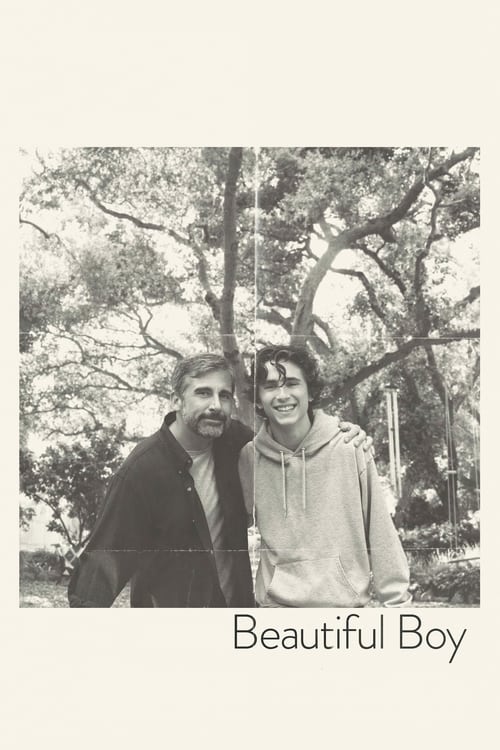
Beautiful Boy
2018 · Felix van Groeningen
When you need a good cry, or when addiction has touched your life and you want a film that tells the truth about it without melodrama. This is a challenge, not comfort — save it for a night you can sit with heavy feelings.
What it's about
A journalist father watches his bright, charming teenage son slide from experimenting with drugs into a devastating methamphetamine addiction, and throws everything he has at saving him. Drawn from the real memoirs of David and Nic Sheff, it moves between golden California memories and a much harder present, following a family learning what love can and can't fix.
The experience
Tender and quietly wrenching — every relapse lands against the image of the child the father still sees, so the sadness accumulates rather than spikes. It refuses easy catharsis, which makes it hurt more honestly.
Performances
Timothée Chalamet is the reason to watch: charming, wrecked, and unreachable, sometimes within a single scene — the performance that confirmed he was no one-film wonder. Steve Carell matches him in a minor key of helpless watchfulness.
The craft
Felix van Groeningen braids two memoirs — father's and son's — into a shattered chronology, cutting between memory and present so the past keeps ambushing the story. The structure is the point: addiction here is circular, not climactic, and the film's shape makes you feel that loop in your body.
Why it matters
It cemented Chalamet's arrival as a major dramatic actor and stands as one of the era's defining portraits of the American addiction crisis seen from inside a family.
Felix van Groeningen made his name in Flanders with The Broken Circle Breakdown, an Oscar-nominated tragedy told in shattered chronology; for his American debut he brought that structure to the twin memoirs of David and Nic Sheff — a journalist father and the son whose methamphetamine addiction he could document but never solve. The film braids both books, cutting between golden California memory and a grim present so that every relapse lands against the image of the child the father still sees. Steve Carell works in a minor key of helpless watchfulness, but the film belongs to Timothée Chalamet, in the performance that confirmed Call Me by Your Name was no accident: charming, wrecked, unreachable, sometimes within a single scene. Van Groeningen refuses the standard recovery arc — addiction here is circular, not climactic — and scores the spiral to an unusually eloquent soundtrack running from Perry Como to Sigur Rós. Its refusal of catharsis frustrated some critics; it is precisely what the Sheffs' story demanded.
Reception
Landed at TIFF 2018 with Oscar buzz that quickly cooled — critics praised the performances but called the film itself repetitive, and Chalamet's Globe/SAG/BAFTA run famously ended in an Oscar snub. Now it lives on less as an awards drama than as a Letterboxd 'movies that emotionally wrecked me' staple.
How Beautiful Boy was received, from release to now →
Influences: the films it descends from and the films it influenced
- The Broken Circle Breakdown (2012) — Van Groeningen's own template: a family tragedy shattered into non-chronological shards and intercut so joy and devastation collide in adjacent scenes.
- Foxcatcher (2014) — Pioneered Carell's affect-flattened, minimalist dramatic mode played hard against his comic persona — the exact restraint deployed as the watchful father.
- Christiane F. (1981) — Unflinching, de-glamorized chronicle of a middle-class teen's heroin spiral that refuses any redemptive uplift.
- The Panic in Needle Park (1971) — Documentary-flat, largely unscored realism that presents the relapse cycle without melodramatic shaping.
- Days of Wine and Roses (1962) — Dramatizes addiction as a recurring loop rather than a curable arc — the foundational anti-recovery structure.
- Drugstore Cowboy (1989) — Matter-of-fact addict interiority that refuses the cautionary-tale frame and its moral scaffolding.
- Requiem for a Dream (2000) — Parallel cross-cutting between multiple entangled addictions that builds toward a deliberate refusal of catharsis.
- 21 Grams (2003) — Shuffled, non-chronological editing that withholds cause-and-effect so grief registers associatively rather than causally.
- Trainspotting (1996) — Codified the eclectic needle-drop as the primary scoring language of an addiction narrative, curating pop tracks as emotional counterpoint.
- Honey Boy (2019) — Father-son addiction memoir adapted from the participant's own first-person writing and braided across two interleaved timelines.
- Waves (2019) — Fractures a family-trauma narrative across formal ruptures and drives it with a wall-to-wall eclectic needle-drop soundtrack.
- Call Me by Your Name (2017) — Establishes Chalamet's unguarded, physically loose performance register and the sun-warmed observational close-ups van Groeningen carries directly over.
- Blue Valentine (2010) — Intercuts a tender past against a corroded present so the two timelines emotionally indict each other.
- Manchester by the Sea (2016) — Flashbacks erupt unannounced into the present tense and grief is denied any clean resolution.
- Moonlight (2016) — A single life told in discontinuous chapters, favoring restraint over exposition and using score-and-needle-drop punctuation as emotional syntax.
- Ben Is Back (2018) — Same-year parent-child addiction drama anchored by a movie star's de-glamorized restraint (Roberts mirroring Carell's containment).
- The Eight Mountains (2022) — Same authorial hand tracing a male bond fracturing and reconverging over years through restrained, non-melodramatic naturalist performance rather than plot incident.
Similar films
- Call Me by Your Name (2017) — influence & lineage
- Waves (2019) — influence & lineage
- Moonlight (2016) — influence & lineage
- The Broken Circle Breakdown (2012) — influence & lineage
- Manchester by the Sea (2016) — influence & lineage
- Drugstore Cowboy (1989) — influence & lineage · often watched together
- Boyhood (2014) — shared sensibility
- Close (2022) — shared sensibility