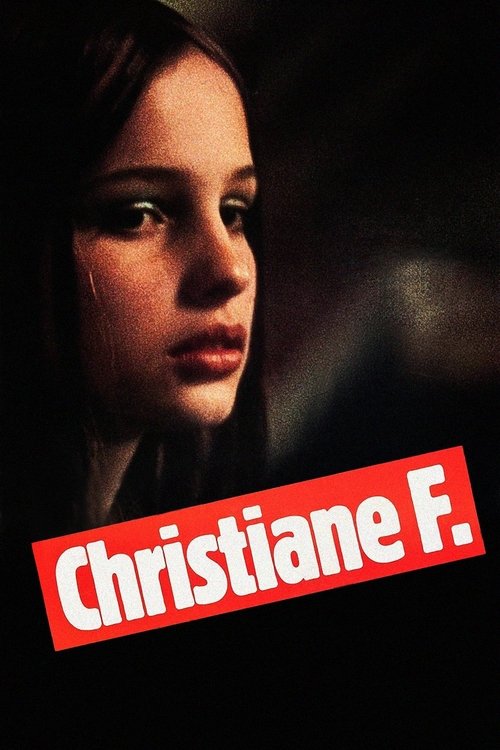
Christiane F.
1981 · Uli Edel
For when you're ready for a genuinely tough watch — a film you choose to be confronted by, not comforted. Save it for a night when you can sit with something heavy afterward.
What it's about
Christiane is thirteen, bored, and watchful, living in the concrete high-rises of 1970s West Berlin. Drawn to the city's nightlife and to a boy in its orbit, she drifts step by step into the heroin scene clustered around the Zoo train station — a world of teenage users, small betrayals, and a life that keeps narrowing toward the next fix. It's drawn from a real teenager's testimony, and it feels like it.
The experience
Bleak, immersive, and hard to shake — it refuses melodrama and refuses rescue, which is exactly what makes it devastating. The neon and the David Bowie soundtrack give way to some of the most unflinching scenes of addiction ever filmed.
Performances
Natja Brunckhorst, barely a teenager herself, is astonishing as Christiane — watchful, guarded, and utterly believable, holding the camera through scenes no young actor should be able to survive.
The craft
Uli Edel shoots the Berlin locations — the tower blocks, the discos, the station underpasses — with documentary rawness, and stages the mechanics of using without flinching or glamorizing. Bowie's music (and an appearance) anchors the film in its exact cultural moment. Its power is in what it declines to soften.
Why it matters
A massive international success and a generational shock in Germany, it became the defining screen portrait of teenage heroin addiction and a reference point for every unvarnished drug film since.
Snapshot
Christiane F. — Wir Kinder vom Bahnhof Zoo ("We Children from Zoo Station") is a West German drama that follows a bored, watchful thirteen-year-old from the concrete towers of West Berlin's Gropiusstadt as she drifts from a modish teen disco into the heroin economy that clustered around the Bahnhof Zoo railway station in the mid-1970s. Its subject is addiction rendered without redemptive arc: the slow narrowing of a life to the next fix, the drift into child prostitution on the "Babystrich" beside the station, and the deaths that punctuate the group of young users around her. The film's authority derives from its source — a real testimony — and its notoriety from how unsparingly it stages the mechanics of using: the cook-up, the needle, the vein, the withdrawal. It arrived as one of the most commercially successful and internationally exported German films of its era, carried in part by David Bowie's Berlin-period music and an on-screen appearance, and it has functioned ever since as a touchstone and cautionary reference point for the drug film as a genre.
Industry & production
The film was produced within the commercial wing of West German cinema by Bernd Eichinger, the producer who would come to define Constantin's ambitions for internationally legible German pictures across the following decades. Eichinger and his collaborators built the project around a property with extraordinary pre-sold recognition: the 1978 book Wir Kinder vom Bahnhof Zoo, assembled by the Stern journalists Kai Hermann and Horst Rieck from tape-recorded interviews with Christiane Felscherinow, had been a publishing sensation in Germany. Adapting a documented, named case of teenage heroin addiction carried both marketing power and obvious hazards — the material was legally sensitive, its protagonist a minor, its content certain to draw censors and moral concern. The screenplay was written by Herman Weigel.
The production leaned into verisimilitude by casting non-professionals in the central roles — Natja Brunckhorst as Christiane and Thomas Haustein as her boyfriend Detlev — and by shooting in and around the real geography of the story: the Gropiusstadt estate, the environs of the Bahnhof Zoo, and the club culture the book described. Casting genuine adolescents to enact heroin use and prostitution was, and remains, the production's most ethically fraught decision, and much of the film's later discussion has circled the question of what it asked of its young leads. Beyond the general shape of the shoot, the granular production record — exact budget, schedule, precise box-office figures — is not something I can state reliably here, and I will not invent numbers; what is firmly established is that the film was a major domestic hit and a durable international export.
Technology
Christiane F. is a conventional early-1980s 35mm production, and its technical interest lies less in novel apparatus than in how standard tools were bent toward grime and low light. The film works extensively in the underlit interiors of stations, public toilets, stairwells, and the disco, environments that push film stock toward its limits and reward a cinematography built on available and practical sources rather than sculpted studio light. The other technological signature is sonic and musical: the film's use of recorded music — principally David Bowie's Berlin-era catalog — as a structuring presence rather than incidental scoring, an approach that anticipated the later ubiquity of the curated pop soundtrack as both dramatic engine and commercial asset. The accompanying soundtrack album, effectively a Bowie compilation tied to the film, became a notable object in its own right.
Technique
Cinematography
The photography commits to a grounded, desaturated realism appropriate to the material: cold daylight on the estate, sodium and neon in the night city, and cramped, shadowed interiors where faces are frequently half-lost. The camera tends to stay close to Christiane, adopting her scale and her sightlines, so that the adult world of the station reads as a set of looming, transactional encounters rather than an explained environment. The film's most discussed images are its most clinical — the framing of injection, the tightening on skin and needle — where the camera's steadiness becomes a moral instrument, refusing to look away and refusing to aestheticize. The two credited directors of photography are, to the best of the established record, Justus Pankau and Jürgen Jürges; Jürges in particular went on to a distinguished career as one of German cinema's leading cinematographers. Readers should treat the precise division of labor between them as not firmly documented here.
Editing
The cutting, credited to Jane Seitz, tracks the internal clock of addiction: stretches of waiting and torpor punctuated by the sudden urgency of scoring and using. Time compresses and dilates around the drug — the film can elide days of decline in a passage and then hold, unbearably, on a single sequence of withdrawal. The editorial rhythm is at its most expressive in the movement between the euphoric first experiences (often carried on music) and the grinding repetition of dependency, where the montage strips away novelty and leaves only the loop of need. The structure is essentially chronological and testimonial, mirroring the book's first-person account, with the cutting serving descent rather than suspense.
Mise-en-scène / staging
Space is the film's argument. Gropiusstadt's high-rise blocks establish an anonymized modernist landscape — planned, vertical, socially thin — from which the station's chaotic, human-scaled underworld offers a perverse warmth and belonging. The Bahnhof Zoo itself, with its tiled passages and the "Sound" discotheque's promise of European modernity, is staged as a threshold between childhood and the market in bodies and drugs. Production design foregrounds the squalor of use — filthy bathrooms, abandoned flats, the paraphernalia of the fix — without gothic exaggeration; the horror is administrative and banal. The staging repeatedly places children's bodies in adult transactional frames, which is precisely the source of the film's disquiet.
Sound
The soundtrack is inseparable from the film's identity. Bowie's Berlin-trilogy music — instrumental and vocal pieces from the Low/"Heroes"/Station to Station orbit, including the German-language "Helden" — is used both diegetically (the disco, a concert) and as commentary, binding the story to the actual cultural weather of 1970s West Berlin, a city Bowie himself famously inhabited during that period. A staged concert sequence brings Bowie on screen as a performing presence, folding the film's icon of Berlin cool directly into its narrative world. Against this musical richness, the naturalistic sound design of the drug scenes — the plainness of rooms, the absence of scoring at the worst moments — makes the silences land harder.
Performance
Natja Brunckhorst's Christiane is the film's center of gravity: a performance built on watchfulness and flat affect, a child registering an adult catastrophe from inside it, neither pleading for sympathy nor performing depravity. The non-professional casting yields an unpolished immediacy that professional technique might have smoothed away; the young actors seem to inhabit rather than illustrate their circumstances. Thomas Haustein's Detlev supplies the film's doomed romance, the tenderness between the two leads making the descent legible as loss rather than spectacle. The ensemble of young users around them functions almost as a chorus of possible fates, and the cumulative effect of their attrition is delivered through performance as much as plot.
Narrative & dramatic mode
The film operates in a confessional-realist mode inherited directly from its source: a first-person testimony reconstructed as dramatized fact. This is the "true account" as tragedy of descent — a structure that deliberately withholds the reversal and recovery that conventional drama would supply. Christiane's occasional voice and the film's fidelity to documented event give it the texture of witness rather than fiction, aligning it with the social-problem film and the semi-documentary case study. Dramatically it privileges accumulation over incident: the power comes not from a single turning point but from the patient demonstration that each accommodation to the drug forecloses the next choice. Where a moralizing film would externalize a villain, Christiane F. keeps the antagonist internal and pharmacological.
Genre & cycle
Christiane F. belongs to the lineage of the addiction film — the tradition, reaching back through pictures like The Man with the Golden Arm and The Panic in Needle Park, that treats narcotic dependency as its central dramatic subject and insists on the physical detail of use. It also sits within the youth social-problem film, the cycle concerned with adolescents failed by, or falling through, the institutions of an affluent society. What distinguishes it within these cycles is its documentary provenance and its refusal of the redemptive template: it is closer to a clinical descent narrative than to a cautionary tale with a moral escape hatch, and that severity became part of its generic influence.
Authorship & method
Uli Edel directs with a method oriented toward immersion and unflinching observation, prioritizing the credibility of environment and the reality of youthful performance over stylistic flourish. His subsequent career — the confrontational adaptation Last Exit to Brooklyn (1989) and, much later, the historical The Baader Meinhof Complex (2008) — confirms a recurring appetite for socially charged, uncomfortable material handled with a certain unsentimental directness. The producing intelligence of Bernd Eichinger is equally an authorial force here: Eichinger's instinct for material with scale and international reach, and his later run of ambitious German productions, is visibly prefigured in the way this film marries difficult subject matter to broad commercial ambition. Among the key collaborators, screenwriter Herman Weigel shaped the testimonial book into dramatic form; editor Jane Seitz gave the descent its temporal architecture; and the cinematography (Pankau and Jürges, per the established record) supplied the cold, close realism. The single most consequential "collaborator," in cultural terms, is David Bowie, whose music and on-screen presence anchor the film to a specific Berlin.
Movement / national cinema
The film is a product of West German cinema at a particular moment — the early 1980s, as the auteur-driven New German Cinema of Fassbinder, Wenders, Herzog, and Schlöndorff was cresting and, with Fassbinder's death in 1982, beginning to close. Christiane F. is best understood as adjacent to rather than squarely within that art-cinema movement: it shares the New German Cinema's engagement with the wounds and anomie of the Federal Republic — the alienation beneath the "economic miracle," the void in the new housing estates — but it channels those concerns through a more commercial, internationally exportable form associated with Eichinger and Constantin. It is, in effect, a bridge between the socially critical impulse of the movement and the market-facing German cinema that would follow.
Era / period
The film is doubly period-marked: it depicts the mid-to-late 1970s West Berlin drug milieu, and it was made and released at the turn into the 1980s, when heroin had become a visible European public-health emergency and moral panic. Its West Berlin is the walled, subsidized island city — culturally charged, socially precarious, home for a time to Bowie and a magnet for a certain bohemian and countercultural energy that curdled, at its edges, into the world of the film. The Gropiusstadt setting locates it within the disillusion of 1970s modernist urban planning, and the whole is suffused with the specific texture of that decade's youth culture, from the disco to the fashion to the music.
Themes
At its core the film is about the manufacture of dependency and the collapse of agency — how appetite becomes compulsion and how compulsion hollows out identity, relationship, and future. Interlocking themes give this spine its flesh: the failure of family and institutions to hold a child; the anomie of the planned modern city and the counterfeit belonging offered by the drug scene; the commodification of the adolescent body through prostitution; and the seductions and betrayals of subcultural glamour, where the promise of adult freedom masks entrapment. Love, too, is a theme — the genuine tenderness between Christiane and Detlev — rendered tragic by its powerlessness against the drug. Throughout, the film insists on the ordinariness of catastrophe: this is not an underworld of exotic villains but a short walk from an ordinary bedroom in an ordinary tower.
Reception, canon & influence
Christiane F. was received as a phenomenon — a major commercial success in Germany and a widely distributed international release that made it, for a generation, the reference film on heroin. Critically it drew both admiration for its unflinching honesty and unease about its graphic depiction of drug use and its deployment of child actors in such content; that tension between documentary courage and exploitation anxiety has remained central to its critical afterlife. Beyond specific reviews, which I won't reconstruct in detail here, its cultural standing is clear: it became a cult and reference object, sustained by the Bowie association and by its reputation as the drug film that refused to soften.
Looking backward, the film draws on the earlier addiction-cinema tradition and, decisively, on its own non-fiction source — the Hermann/Rieck testimony — as well as on the real cultural presence of Bowie's Berlin period, which it incorporates rather than imitates. Looking forward, it stands as a foundational entry in the modern realist drug film, part of the current that runs toward pictures like Trainspotting and Requiem for a Dream in their willingness to stage the euphoria and the physical ruin of using without moralizing distance. Its marriage of harrowing subject matter to a strong pop soundtrack also anticipated a now-standard commercial and aesthetic strategy. In Germany specifically, the film became the durable popular memory of the Bahnhof Zoo drug era and of Christiane Felscherinow's story, a status later revisited by subsequent adaptations of the same material. Its influence, in short, is less a matter of stylistic imitation than of having set a benchmark for how uncompromising a drug film could be — and for the ethical questions that such uncompromising realism raises.
Reception
A box-office phenomenon and moral panic in 1981 Germany — shown in schools as a deterrent while critics fretted it glamorized what it depicted — it has since hardened into a cult landmark of drug cinema, the grim European benchmark that Trainspotting and Requiem for a Dream get measured against.
How Christiane F. was received, from release to now →
How to watch Christiane F.: what to notice on a first viewing
- Notice the camera staying close to Christiane's own height. The camera adopts her scale and sightlines throughout, so adults and the station around her read as looming, transactional figures rather than an explained world. You see the adult world the way a thirteen-year-old actually sees it.
- Compare the flat daylight on the estate to the neon at night. The film shoots Gropiusstadt in cold, desaturated daylight, then switches to sodium and neon once the story moves into the station and the disco at night. The nightlife looks warmer and more alive than home, which is exactly the trap.
- Notice the concrete towers Christiane comes home to. Gropiusstadt's high-rise blocks are shot as a planned, vertical, socially thin landscape, set against the tiled passages and chaotic warmth of the Bahnhof Zoo station. The station offers a false sense of belonging the housing block never gave her.
- Listen for Bowie's music entering the disco and concert scenes. Bowie's Berlin-period songs play both inside the story, at the disco and a live show, and over it as commentary, tying the film to real 1970s Berlin. The music makes the whole scene feel like the coolest place you could be.
- Watch Christiane's face stay still while everything around her escalates. Natja Brunckhorst plays Christiane with a watchful, flat affect, rarely pleading or performing distress, so you read the catastrophe through her stillness rather than her outbursts. Her calm is not peace. It is a child absorbing more than she can process.
The whole guide to watching Christiane F., with the keys for a rewatch →
Influences: the films it descends from and the films it influenced
- The Man with the Golden Arm (1955) — Founds the frank addiction film's cold-turkey set-piece and drives it with Elmer Bernstein's jazz score as structural pulse — the pop-score-as-architecture strategy Christiane F. reworks through Bowie.
- Los Olvidados (1950) — Youth social-problem realism shot with slum non-professionals and an unsentimental, anti-redemptive ending that refuses to rescue its children.
- Midnight Cowboy (1969) — Desaturated, grimy urban naturalism tracking drifters toward a non-redemptive descent, the tonal template for shooting the city as squalid habitat.
- Easy Rider (1969) — Builds its spine from needle-drops of pre-existing rock tracks rather than a composed score — the pop-soundtrack-as-structure device Christiane F. inherits wholesale.
- Kes (1969) — Directs a non-professional child to a flat, undemonstrative naturalism inside social-realist available-light framing.
- Trash (1970) — Non-professional performers play junkies in flat-affect long takes amid literal domestic squalor, staging using as banal routine.
- The Panic in Needle Park (1971) — Unscored available-light vérité that films real-time needle preparation and injection in clinical close-up — the direct model for the clinical-injection framing.
- Drugstore Cowboy (1989) — Deadpan, anti-redemptive portrait of habitual users that observes the ritual of scoring without moralizing distance.
- Kids (1995) — Non-professional teen cast filmed in available-light vérité of banal urban squalor, sustaining the flat, watchful youthful affect.
- Trainspotting (1996) — Stages heroin euphoria and physical ruin against a curated pop soundtrack (Iggy/Lou Reed), amplifying Christiane F.'s music-and-using formula.
- Gummo (1997) — Non-professional cast in banal-squalor tableaux, dissolving narrative into an anti-redemptive drift through a decayed milieu.
- Rosetta (1999) — Handheld available-light pursuit of a flat-affect, watchful young protagonist through precarity, extending the non-professional observational method.
- Requiem for a Dream (2000) — Macro clinical close-ups of the injection ritual plus elastic-time montage compressing the descent — a stylized escalation of the clinical-injection framing.
- Fish Tank (2009) — Non-professional lead shot in handheld available light amid council-estate high-rise anomie, a direct heir to the modernist-highrise youth realism.
- Enter the Void (2009) — Pushes subjective drug-state cinematography to first-person hallucination, extending the film's interest in rendering the interior of the high.
- We Children from Bahnhof Zoo (2021) — Re-adapts the same Hermann/Rieck testimony and Bahnhof Zoo milieu, updating the pop-soundtrack scaffolding for a serialized retelling.
- The Baader Meinhof Complex (2008) — Edel's own kinetic, unsentimental immersion in subculture and self-destruction supplies the handheld feel for bodies-in-disorder he carries into the RAF milieu.
- Urchin (2025) — Models the recursive relapse cycle of youth addiction scored with pop-electronic music (Bowie) and shot in lived-in institutional/urban spaces rather than melodramatic abstraction.
- Beautiful Boy (2018) — Unflinching, de-glamorized chronicle of a middle-class teen's heroin spiral that refuses any redemptive uplift.
- Berlin Alexanderplatz (1980) — Contemporaneous New German Cinema epic of the Berlin underclass using elastic-time architecture to stretch and compress a downward spiral.
- La Haine (1995) — Modernist high-rise (banlieue) anomie and youth social-problem realism rendered in stark monochrome with roaming available-light staging.
Similar films
- Trainspotting (1996) — influence & lineage
- The Panic in Needle Park (1971) — influence & lineage
- Fish Tank (2009) — influence & lineage · same viewing thread
- System Crasher (2019) — same viewing thread
- Maria Full of Grace (2004) — same viewing thread
- Lilya 4-ever (2002) — same viewing thread
- Drugstore Cowboy (1989) — influence & lineage · often watched together
- Kids (1995) — influence & lineage · often watched together
All the films related to Christiane F. →
Watch it with: curated runs of related films
- No One Coming to Save Her — Watch these in a run for the same unblinking gaze on girls left to fend for themselves — abandoned by their mothers, circled by predatory men, and armed with nothing but their own nerve.