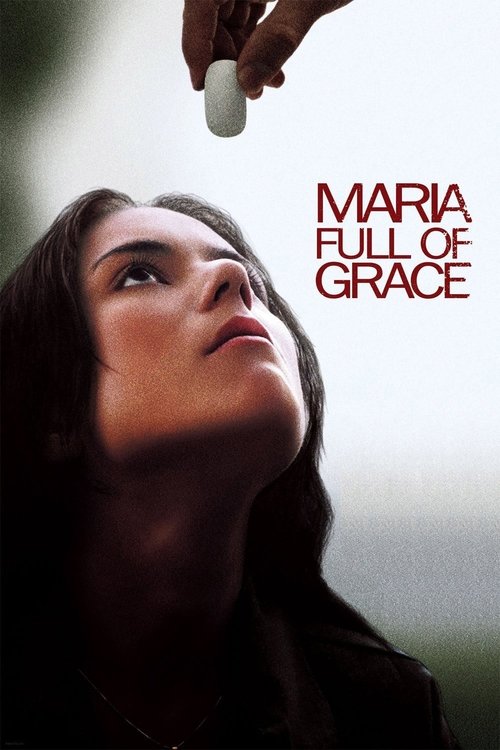
Maria Full of Grace
2004 · Joshua Marston
When you want to feel something real — a film that turns a news headline into one specific, unforgettable person. Emotionally demanding but never gratuitous; the tension alone makes it gripping even as pure drama.
What it's about
Maria is seventeen, pregnant, and stuck stripping thorns off roses on a Colombian flower plantation for wages that can't support her family. When she quits, the only real money on offer comes with a terrible catch: swallow dozens of latex pellets of heroin and carry them in her stomach on a flight to New York. The film follows her preparation, the flight, and what waits on the other side — every step of a journey where one burst pellet means death.
The experience
Quiet, precise, and almost unbearably tense — the suspense comes not from chases but from a girl's body becoming contraband, and every airport line and customs glance tightens your chest. It's compassionate without ever being soft, and it stays with you.
Performances
Catalina Sandino Moreno, in her first film role, is astonishing — stubborn, watchful, and so alive that the film feels documentary-true. Her performance earned an Academy Award nomination and carries virtually every frame.
The craft
Built on extensive first-hand research into how the drug trade actually uses human couriers, the film has a procedural authenticity that makes the danger feel physical — the swallowing scenes alone are masterful, wordless filmmaking. Marston shoots in unadorned, handheld Spanish-language realism that never lets style get between you and Maria.
Why it matters
One of the defining American independent films of its decade, it proved a U.S. indie could tell a Latin American story in Spanish with rigor and respect, and launched Catalina Sandino Moreno onto the world stage.
Snapshot
Maria Full of Grace (María, llena eres de gracia) is the feature debut of American writer-director Joshua Marston, a Spanish-language drama that follows a seventeen-year-old Colombian, Maria Álvarez, who quits a dead-end job stripping thorns from roses on a flower plantation and, pregnant and broke, agrees to swallow dozens of latex pellets of heroin and carry them by air to New York. The film's title invokes the Catholic "Ave Maria" ("Hail Mary, full of grace"), and the irony is exact and unsentimental: this Maria is filled not with grace but with poison she has ingested, her own body conscripted as a smuggling vessel even as it carries a child. Built on extensive first-hand research and anchored by a startling debut performance from Catalina Sandino Moreno, the film became one of the defining American independent successes of its year — celebrated at Sundance and the Berlinale, and the source of the first Academy Award acting nomination for a Colombian performer. Its lasting reputation rests on a refusal of melodrama: it treats the drug "mule" not as a genre type but as a young woman making rational choices inside an irrational economy.
Industry & production
The film was an independent American production realized as a U.S.–Colombian collaboration, financed and distributed within the orbit of HBO and Fine Line Features (the specialty arm of New Line Cinema). It belongs to the early-2000s ecosystem in which premium cable and studio "indie" labels co-financed director-driven, modestly budgeted films aimed at the festival-to-arthouse pipeline. Produced by Paul Mezey, among others, it was made on a small budget characteristic of first features, with the economy of means visible in its locations, cast of largely non-professional and unknown actors, and lean shooting schedule.
A defining production fact is geographic: although the story is Colombian, the Colombian-set portions were not shot in Colombia. For security and logistical reasons the production filmed those sequences in Ecuador, with the New York sequences shot on location in Queens — particularly Jackson Heights, the neighborhood long known as a hub of Colombian immigrant life. This split shoot is inseparable from the film's politics and its realism: the production itself had to route around the very conditions of danger the narrative depicts.
Marston's path to the material was journalistic before it was cinematic. The screenplay grew out of interviews and reporting, and the production drew on community knowledge in Jackson Heights. Most consequentially, Orlando Tobón — a real-life fixture of the Colombian community in Queens, known for helping arrange the repatriation of the bodies of mules who died with pellets ruptured inside them — served as a consultant and appears in the film as Don Fernando, a version of his own role. That blending of documentary source and fiction is central to how the film was built.
Technology
Maria Full of Grace was made with the unobtrusive, portable apparatus typical of early-2000s independent realism: available and practical light, location sound, handheld and shoulder-mounted camerawork that favors proximity over spectacle. The image has the grain and intimacy associated with small-gauge or modestly resourced shooting rather than the polish of a studio production; I want to be careful not to overstate the precise capture format, which is the kind of granular technical detail the public record does not always fix with confidence. What is clear is that the technological choices are subordinated to a single aim — keeping the camera close to faces and bodies in real spaces — and that the film predates the full digital-cinema transition, sitting at the tail end of the era when independent features of this scale still defaulted to film stock. The pellet-swallowing sequences depend less on visual-effects technology than on staging, performance, and editing; their dread is manufactured through duration and framing, not optical trickery.
Technique
Cinematography
The cinematography is by Jim Denault, a cinematographer associated with American independent realism. His approach here is observational and hand-held, privileging the actor's face and the texture of unglamorous environments — the flower greenhouse, a cramped apartment, the recycled-air interior of an airliner, the fluorescent banality of an airport and a customs holding room. The camera tends to stay with Maria, often in close or medium shots that bind us to her point of view and her physical sensations. Crucially, the film resists exoticizing Colombia or sensationalizing the drug trade; the visual register is plain, attentive, and patient. Tension is generated by restriction of information and by holding on bodies under stress rather than by stylized coverage.
Editing
The editing — credited to Anne McCabe and Lee Percy — is paced to the logic of suspense-through-realism. The film's most discussed set piece is the swallowing of the pellets and the subsequent flight, where cutting controls how much the viewer knows and feels: the queasy anticipation of ingestion, the unbearable wait in the air, the threat that a pellet might burst inside the body. The cutting is disciplined rather than flashy, letting scenes run long enough to accrue dread and then withholding release. This restraint is what keeps the film on the side of drama rather than thriller mechanics.
Mise-en-scène / staging
The staging is built on contrasts of confinement and exposure. The flower plantation's rows, the small domestic interiors crowded with family obligation, the sealed cabin of the plane, and the institutional spaces of arrival all press in on Maria. The body becomes the film's central locus of staging — the act of swallowing, the discomfort of carrying, the fear of detection are all rendered through how the actors occupy and move through tight spaces. The Jackson Heights sequences open the frame somewhat, exchanging rural enclosure for the disorientation of an immigrant city, but the sense of precariousness never lifts.
Sound
The film relies heavily on location sound and a restrained musical presence. The score is credited to the Mexican composers Jacobo Lieberman and Leonardo Heiblum, whose work is used sparingly rather than as emotional underlining; the film generally trusts ambient sound and silence to carry tension. Dialogue is predominantly in Colombian Spanish, with the New York scenes shifting registers as Maria enters an English-language environment she cannot fully navigate — a linguistic dislocation the sound design lets us feel.
Performance
Performance is the film's foundation. Catalina Sandino Moreno, then a newcomer with stage experience but no prior film career, plays Maria with a watchful, undemonstrative intelligence — neither victim nor antiheroine but a young woman whose composure is itself a survival strategy. The supporting playing is in the same naturalist key: Yenny Paola Vega as Maria's friend Blanca; Guilied López as Lucy, the more experienced mule whose fate marks the film's moral turn; and the ensemble of Maria's family and the trafficking network. Orlando Tobón's presence as Don Fernando carries documentary weight, since he is in effect playing the social function he performs in real life. The casting of unknowns and non-professionals is integral to the realist contract.
Narrative & dramatic mode
The film operates in a mode of social realism inflected with suspense. Its narrative is linear and tightly focused on a single protagonist's decision and its consequences, structured as a journey: plantation to Bogotá, Bogotá to the air, the air to New York, and finally a fork between returning and staying. The dramatic engine is economic and bodily rather than psychological melodrama — Maria's choices follow from material pressures (a wage that cannot support her, a pregnancy, a family that depends on her) presented without editorializing. The film withholds the consolations of genre: there is no master-criminal antagonist to defeat, no romance to redeem the ordeal, no tidy punishment or rescue. The mode is observational and ethical, asking the viewer to sit inside a situation rather than to be reassured by its resolution.
Genre & cycle
Nominally a crime-thriller about drug smuggling, the film deliberately subverts the trafficking genre. Where the drug-trade film often trades in spectacle, kingpins, and violence, Maria Full of Grace relocates the story to the lowest, most expendable rung of the supply chain — the mule — and treats it as labor. It belongs more truly to a cycle of early-2000s transnational realist cinema concerned with migration, informal economies, and bodies in transit across borders. Within American independent film it sits alongside the immigrant-experience dramas of its period; within a hemispheric frame it can be read beside the wave of Latin American films that brought global attention to the region in these years, though Marston's outsider authorship distinguishes his project from those made from within. It is also, pointedly, a women-centered entry in a male-dominated genre.
Authorship & method
Joshua Marston is the film's author in the fullest sense — director and sole credited screenwriter — and Maria Full of Grace is his calling card. An American without Colombian background, Marston grounded his authority in research: reporting on and interviewing people connected to the mule trade, and embedding the production in the Jackson Heights community whose knowledge (above all Orlando Tobón's) shaped the script's authenticity. His method foregrounds an ethic of fidelity to lived experience over invention, and a discipline of restraint over directorial flourish. His key collaborators define the film's texture: cinematographer Jim Denault's intimate hand-held image; editors Anne McCabe and Lee Percy's suspense-through-patience cutting; composers Jacobo Lieberman and Leonardo Heiblum's spare score; and, indispensably, Catalina Sandino Moreno, whose performance is so central that the authorship feels genuinely shared between director and lead. Marston's subsequent features — The Forgiveness of Blood (2011), set in Albania and again steeped in local research, and Complete Unknown (2016) — confirmed the cross-cultural, research-driven sensibility that this debut announced, alongside television work.
Movement / national cinema
The film resists clean national categorization, and that ambiguity is part of its interest. It is an American independent film by an American director, financed through U.S. companies and partly shot in the United States; yet it is Spanish-language, Colombian in subject, and shot (for its "Colombian" scenes) in Ecuador. It is frequently discussed within Colombian cinema and as a landmark for Colombian representation — not least because of Sandino Moreno's breakthrough — even as it is more accurately a transnational co-production. It exemplifies a globalized strain of independent filmmaking in which authorship, financing, language, and setting no longer line up under a single flag, and in which festival circuits rather than national industries function as the primary home.
Era / period
Made and released in 2004, the film is a product of the golden period of the American "indie" specialty division, when labels like Fine Line and partners like HBO Films cultivated director-driven work for festivals and arthouses. It also reflects the early-2000s moment of intensified attention to immigration and to the human cost of the international drug economy. Technologically it sits on the cusp of the digital transition, still rooted in the small-scale film-based independent production that the following decade's digital tools would transform. Its festival trajectory — a Sundance launch and a strong Berlinale showing — is itself emblematic of how films of this kind reached audiences in the period.
Themes
The film's governing theme is the body as commodity and container: Maria's labor, her pregnancy, and her smuggling all turn her body into something used by others and by economic necessity. Tightly bound to this is economic desperation and the absence of viable choices — the film insists that becoming a mule is a rational response to structural conditions, not a moral failing. Migration and dislocation run throughout, culminating in the Queens sequences where Maria confronts the immigrant's predicament directly. Female agency is central: against a genre that renders women as victims or accessories, the film grants Maria deliberation, error, and self-determination. The religious resonance of the title threads through as ironic counterpoint — grace, sin, sacrifice, and a possible secular redemption. And mortality is ever-present, embodied in the mule whose pellets rupture and in Don Fernando's grim work of sending bodies home.
Reception, canon & influence
Critically, Maria Full of Grace was widely praised on release for its realism, its refusal of sensationalism, and above all for Catalina Sandino Moreno's performance. Its festival reception was a major part of the story: it premiered at the Sundance Film Festival in 2004, where it took the Audience Award in the dramatic competition, and it played at the Berlinale, where Sandino Moreno won the Silver Bear for Best Actress (shared, that year, with Charlize Theron for Monster) and the film received the Alfred Bauer Prize, awarded for opening new perspectives. Sandino Moreno went on to a nomination for the Academy Award for Best Actress — historically significant as the first such acting nomination for a Colombian — and the film was recognized in the independent-film awards landscape as a standout debut. (Where exact award-by-award tallies are concerned, I'm flagging that the full ledger is more than I can responsibly enumerate from memory; the festival results above are the securely established ones.)
Looking backward, the film's influences lie less in stylistic homage than in a documentary-realist tradition — the practice of researching a milieu and casting unknowns to inhabit it — and in the broader social-realist current of world cinema that privileges the ordinary person caught in larger systems. Looking forward, its legacy is twofold. It launched Catalina Sandino Moreno into an international career and stood as a milestone for Colombian and Latina visibility in American and global cinema. And it offered an influential template for telling drug-trade stories from the bottom of the chain — humanizing the mule, treating trafficking as labor and migration rather than as action spectacle — an approach whose echoes can be felt in subsequent films and series that resist the kingpin-centered conventions of the genre. Its enduring standing is that of a model independent debut: small in budget, exact in observation, and disproportionate in its impact on how a difficult subject could be filmed with dignity.
A Deleuzian reading
A girl sits at a kitchen table with a glass of water and a row of latex pellets, each the size of a thumb.
The full Deleuzian reading of Maria Full of Grace →
Reception
It arrived as a festival darling — Sundance's Audience Award, a Berlin acting prize, an Oscar nomination — and while it never got a big reappraisal, it's quietly held its ground as one of the 2000s indie era's most respected debuts, still the film people reach for when the subject of drug mules comes up.
How Maria Full of Grace was received, from release to now →
Influences: the films it descends from and the films it influenced
- Bicycle Thieves (1948) — De Sica and Zavattini's neorealist practice of casting non-actors and building drama from one ordinary person's economic entrapment is the bedrock of Marston's unknown-led location realism.
- La Promesse (1996) — The Dardennes' handheld observation of migration and human trafficking as exploited labor, filmed without sensation, is the template for treating the mule trade as work rather than spectacle.
- Rosetta (1999) — The body-close camera shadowing a young working-class woman, wringing suspense from mundane precarity instead of plot, is directly echoed in Jim Denault's intimate following of María.
- Pixote (1981) — Babenco cast real marginalized youth to inhabit a Latin American criminal underworld from its lowest rung, grounding fiction in a lived milieu the way Marston embeds his script in researched testimony.
- Bread and Roses (2000) — Loach's reporting-and-interview method dramatizing undocumented Latina labor with naturalist casting is the Anglophone precedent for Marston's reportorial fidelity to a community's knowledge.
- El Norte (1983) — Structures a Colombian protagonist's crossing to the US as the same ironic anti-American dream El Norte defined: arrival provides survival but not liberation, with naturalistic non-professional performance producing the testimonial texture El Norte established for immigrant cinema's central register.
- Frozen River (2008) — Hunt films women as smuggling mules whose border crossings are framed as economic desperation, the most direct inheritance of Maria's trafficking-as-labor lens.
- Sin Nombre (2009) — Fukunaga extends the dignified, ground-level migration drama, observing the northbound journey through gang and freight-train peril without action-genre gloss.
- Fish Tank (2009) — Arnold's close handheld POV and boxed-in Academy ratio track a working-class young woman's body and bid for agency, extending the confinement-and-exposure staging.
- Winter's Bone (2010) — Granik's regionally-researched casting of locals around a tenacious young woman navigating a criminal economy is a clear female-agency, embedded-realism descendant.
- Miss Bala (2011) — Naranjo keeps the mule's-eye view, following a young woman swept into the cartel as an expendable body, inheriting Maria's refusal of the kingpin perspective.
- The Golden Dream (2013) — Quemada-Díez casts non-professional Central American youth migrating north, inheriting the embedded-research, non-actor migration template wholesale.
- City of God (2002) — Meirelles cast non-professional favela residents to depict the drug trade from its foot-soldiers up, a parallel commitment to humanizing the bottom of the chain over the kingpin.
- Traffic (2000) — Soderbergh's grain, available-light handheld, and bottom-to-top cross-section of trafficking shares the labor-and-migration framing, even as Maria narrows the systemic mosaic to a single mule's body.
- 4 Months, 3 Weeks and 2 Days (2007) — Mungiu builds suspense-through-realism around a woman's imperiled body in long-take restraint, the same tension-from-the-quotidian and body-as-locus that drives María's pellet-swallowing ordeal.
- The Forgiveness of Blood (2011) — Marston's own restatement of his embedded-research, local-language, non-professional-cast method, transplanted to an Albanian blood-feud, confirms the authorial discipline this debut announced.
- Under the Same Moon (2007) — Grounded, face-forward Spanish-language Latin American migration realism that proved a subtitled Latino-experience film could hold U.S. theatrical audiences — the industrial precedent Riggen's Sundance success consolidated.
Similar films
- Traffic (2000) — influence & lineage
- 4 Months, 3 Weeks and 2 Days (2007) — influence & lineage
- Fish Tank (2009) — influence & lineage · same viewing thread
- Christiane F. (1981) — same viewing thread
- Prayers for the Stolen (2021) — shared sensibility
- Birds of Passage (2018) — shared sensibility
- El Norte (1983) — shared sensibility
- Central Station (1998) — shared sensibility
All the films related to Maria Full of Grace →
Watch it with: curated runs of related films
- No One Coming to Save Her — Watch these in a run for the same unblinking gaze on girls left to fend for themselves — abandoned by their mothers, circled by predatory men, and armed with nothing but their own nerve.