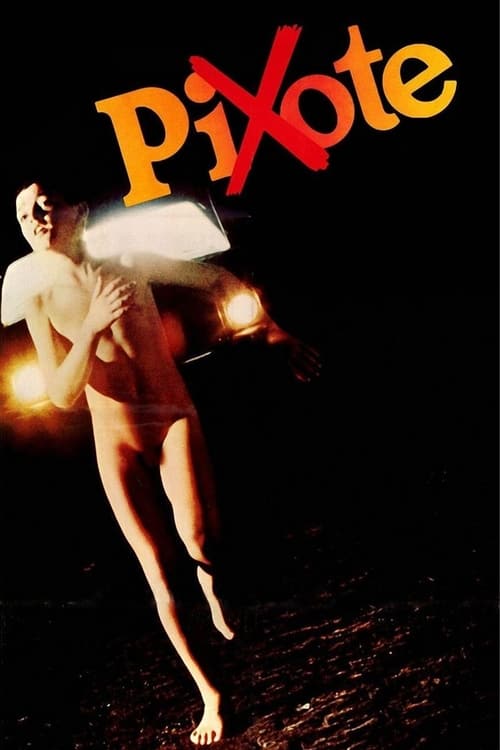
Pixote
1980 · Héctor Babenco
Strictly for when you're ready to be challenged and shaken, not comforted — the kind of film you watch because you want cinema to tell the truth. Not a casual weeknight pick, and absolutely not a family one.
What it's about
A ten-year-old boy nicknamed Pixote is swept into a Brazilian juvenile detention center, a place of beatings, corruption, and worse, where the guards are more dangerous than the inmates. After a breakout he falls in with a makeshift family of fugitive kids — including Lilica, a seventeen-year-old trans hustler — surviving on the streets of São Paulo and Rio through petty crime that keeps escalating beyond their control.
The experience
Harrowing and unflinching — this is one of the toughest watches in world cinema, made almost unbearable by how matter-of-fact it is. There's real tenderness among the kids, which makes the brutality around them cut even deeper. It stays with you for a long time.
Performances
Fernando Ramos da Silva, a real child of the streets cast at around ten years old, gives one of the most haunting child performances ever filmed — not acting so much as being. The tragedy of his own life after the film has become inseparable from its legacy.
The craft
Héctor Babenco shoots with documentary directness, casting actual street kids and real locations, so the line between fiction and reportage almost disappears. There's no stylistic cushioning — the plainness of the filmmaking is the point, and it's devastating.
Why it matters
Released as Brazil's dictatorship was loosening its grip, it became an international sensation and a national scandal — a landmark of social-realist cinema that forced the world to look at Brazil's abandoned children, and it opened Babenco's path to an international career.
Snapshot
Pixote: a Lei do Mais Fraco ("Pixote: the Law of the Weakest") is Héctor Babenco's harrowing account of abandoned children moving through Brazil's juvenile-detention apparatus and into the street economy of crime, prostitution, and violence in São Paulo and Rio de Janeiro. Adapted from José Louzeiro's documentary-novel Infância dos Mortos ("Childhood of the Dead"), the film follows a ten-year-old (Fernando Ramos da Silva) through a reformatory marked by beatings, sexual coercion, and extrajudicial killing, and then through an escape into a makeshift family of fugitive minors whose survival hardens into delinquency and death. Released in the final years of Brazil's military dictatorship, during the slow political thaw known as the abertura, the film became one of the most internationally visible Brazilian works of its era and a touchstone for the cinema of urban marginality. Its reputation rests on two intertwined achievements: an almost documentary immediacy built from non-professional child actors, and the volcanic performance of Marília Pêra as the prostitute Sueli. The film's afterlife was darkened by the fate of its young lead, killed by police in 1987 at nineteen — a coda that collapsed the distance between fiction and the reality it indicted.
Industry & production
The project's origin is central to its form. Babenco, an Argentine émigré who had settled in Brazil and was building a career in the late-1970s industry, initially sought to make a documentary about the Fundação Estadual do Bem-Estar do Menor (FEBEM), the state institution charged with juvenile welfare. Denied the access he wanted to film inside the system, he reconceived the material as fiction, retaining the investigative impulse. The decision to cast actual street children and youths from poor communities in the principal roles — rather than trained performers — followed from that reorientation: the film would simulate documentary truth through bodies that carried it.
Production was independent and modestly resourced by international standards, made through Babenco's own production base rather than as a glossy studio undertaking; the Brazilian industry of the period operated under the orbit of the state agency Embrafilme, though Pixote's hardest, most transgressive material sits at a deliberate remove from official respectability. The exact financing and producer credits are less thoroughly documented in English-language sources than the film's artistic reception, and I will not invent specifics; what is well established is that the shoot used real locations — favelas, the streets of São Paulo and Rio, institutional interiors standing in for the reformatory — and depended on Babenco's capacity to direct children who were often improvising around situations drawn from their own lives.
The film's release coincided with a Brazilian cinema increasingly willing to confront the social wreckage of the dictatorship as censorship loosened. Internationally, Pixote traveled the festival and art-house circuit and was picked up for distribution in the United States and Europe, where it found unusually passionate critical advocates.
Technology
Pixote is a film of conventional period technology turned toward raw ends: 35mm color photography, location sound and post-synchronization typical of Brazilian production of the time, and lightweight enough camera handling to follow children through cramped institutional corridors and open streets. There is no technological showmanship; the apparatus is subordinated to access and proximity. The aesthetic interest lies not in any novel tool but in the refusal of glamour that the available tools made possible — available light or near-available light, real interiors, and a willingness to let image quality serve immediacy rather than polish.
Technique
Cinematography
The photography, by Rodolfo Sánchez, favors a grounded, observational register over expressive stylization. The camera frequently sits at the children's height, producing a low, enclosing vantage that makes institutional and adult spaces loom. Handheld mobility tracks figures through corridors and crowds, and the framing keeps bodies in their squalid environments rather than isolating them in clean compositions. Color is muted and unromantic — the palette of concrete, dirty light, and night streets. The look deliberately courts a newsreel or vérité texture, so that staged violence reads with the flatness of the actual. Where the film does heighten, it tends to do so through duration and held proximity rather than overt lighting effects.
Editing
The cutting builds the film's two-part architecture — institution, then street — and modulates between passages of near-documentary accumulation and sequences of sudden, ugly violence. The editing does not aestheticize the brutality with rapid montage; deaths and beatings tend to be rendered with a bluntness that withholds catharsis. In the later, episodic stretches, the rhythm tracks the drift and improvisation of the children's lives, allowing scenes to run toward discomfort. The film is credited to editor Luiz Elias; the most discussed cutting choices concern the long takes that give the performances room rather than any bravura compression.
Mise-en-scène / staging
Babenco stages the action inside real and realistic spaces and lets the social environment do much of the work: overcrowded dormitories, holding cells, bars, cheap rooms, and the open city. The staging repeatedly places small children inside adult systems — courts, police, brothels — to dramatize a world in which childhood offers no protection. The film's most celebrated set pieces are intimate two-handers rather than spectacle: the negotiations and intimacies among the fugitive band, and above all the scenes between Pixote and Sueli. Props and costume carry documentary weight — the institutional uniformity of the reformatory against the improvised, adult-mimicking dress of the street.
Sound
The soundtrack mixes the ambient density of institutions and streets with a score by John Neschling, the Brazilian composer-conductor who collaborated with Babenco across several films. The music is used sparingly relative to the film's running time, supporting the bleakness without overwhelming the naturalistic soundscape. Dialogue, much of it inflected by the children's own speech and slang, contributes to the sense that the film is recording rather than scripting; the title itself, pixote, is Brazilian slang for a small child or runt, and the verbal texture is part of the film's claim to authenticity.
Performance
Performance is the film's greatest and most fraught achievement. Fernando Ramos da Silva, an untrained child from a poor family, plays the title role with a watchful, often near-blank affect that becomes devastating precisely because it withholds the sentiment a professional child actor might supply; the camera reads survival in his stillness. Around him, the young ensemble — including Jorge Julião as Lilica, the seventeen-year-old trans hustler, and Gilberto Moura as Dito — sustains a frightening plausibility. Against this field of non-professionals, Marília Pêra's Sueli is the one fully professional star turn, and the contrast is generative rather than jarring: her theatricality reads as a survivor's performance of self. The extended sequences between Sueli and Pixote — culminating in a startling moment of maternal regression in which the boy nurses at her breast — fuse tenderness and degradation in a way critics singled out as among the great screen performances of its decade.
Narrative & dramatic mode
The film operates in a social-realist, quasi-documentary mode, opening — in its most discussed framing device — with Babenco himself addressing the camera to place the fiction within the documented reality of Brazil's abandoned children. This prologue declares the film's investigative ambitions and inoculates the drama against being read as mere genre. The narrative then proceeds in two movements: an institutional first act of confinement and abuse, and a picaresque, downward-spiraling second act of escape and street survival. The dramaturgy is episodic and accretive rather than tightly plotted, accumulating incident until the violence feels structural rather than authored. There is no redemptive arc; the "law of the weakest" of the subtitle is the film's thesis, dramatized as a closed system from which the children cannot climb out.
Genre & cycle
Pixote sits at the intersection of crime film and social-problem drama, but its lineage runs through the international tradition of neorealist films about destitute children rather than through genre entertainment. It belongs to a recognizable cycle of works that use the child or adolescent as the moral lens on a brutalizing society. Within Brazilian cinema it extends the social-witness impulse of the Cinema Novo generation into the late-dictatorship moment, and within world cinema it joins a transnational current of films exposing institutional and street violence against the young. Its crime elements — theft, hustling, killing — are presented as the inevitable economy of abandonment rather than as the pleasures of a gangster picture.
Authorship & method
Babenco is the film's clear author, and Pixote is the work in which his method — proximity to marginal worlds, casting for authenticity, melodrama disciplined by social observation — crystallized. He co-wrote the screenplay with Jorge Durán, adapting José Louzeiro's Infância dos Mortos; the adaptation transposes the novel's reportage into a fiction that retains its documentary conscience. His key collaborators include cinematographer Rodolfo Sánchez, whose grounded camerawork anchors the realism; composer John Neschling, a recurring musical partner; and editor Luiz Elias. The director's most distinctive choice was procedural rather than stylistic: building the film around children who carried the experience he was depicting, and accepting the ethical exposure that entailed. That method links Pixote to Babenco's broader trajectory — he would go on to international prominence with Kiss of the Spider Woman (1985) and the Hollywood production Ironweed (1987) — and it remains the through-line of his filmography's concern with the imprisoned, the outcast, and the institutionally damned.
Movement / national cinema
Pixote is a landmark of Brazilian national cinema and is best understood as an heir to Cinema Novo's commitment to filming national reality — Glauber Rocha's "aesthetic of hunger" — translated into the urban, late-authoritarian present. It is not a Cinema Novo film in the strict movement-historical sense; it arrives later, after the movement's peak, in the period of abertura when Brazilian filmmakers were testing the loosening limits of permissible critique. As the work of an Argentine-born director working in Brazil, it also sits within the broader Latin American current of socially engaged cinema. Its international success made it, for many foreign audiences, the emblematic Brazilian film of its decade — a status it held until the next great wave of films about Brazilian marginality two decades later.
Era / period
The film is inseparable from its moment: Brazil under a military regime in slow retreat, its cities swelling with displaced poverty, its juvenile-welfare institutions notorious for the abuses the film stages. Pixote reads the abandoned child as the symptom of a developmental order that produces surplus populations and then criminalizes them. The period context also shaped its reception abroad, where it was received as testimony from a society in crisis. The era's reality reasserted itself with brutal literalism in 1987, when Fernando Ramos da Silva — unable to sustain an acting career and returned to the precarity the film depicted — was killed by police; the event was widely understood as confirmation of the film's diagnosis and is documented in the later film Quem Matou Pixote? ("Who Killed Pixote?", 1996).
Themes
The film's governing theme is the social production of the "disposable" child: abandonment, institutional violence, and the criminal economy as a single continuous machine. Childhood is presented not as innocence to be corrupted but as a condition stripped of protection from the outset. Surrogate family — the fugitive band, and especially the warped maternal bond between Sueli and Pixote — emerges as the only available form of care, and even that is shot through with exploitation. Gender and sexuality figure pointedly in Lilica's trans identity and the predatory sexual order of both institution and street. Above all the film insists on systemic culpability: the police, the state, and the indifferent society are the agents of the violence, and the children's crimes are its issue, not its cause. The subtitle's "law of the weakest" names the inverted moral universe the film anatomizes.
Reception, canon & influence
Critically, Pixote was among the most acclaimed foreign films of the early 1980s in the Anglophone world. Pauline Kael was a prominent champion, and Marília Pêra's performance drew exceptional praise, including recognition from U.S. critics' bodies — she was honored by American film-critics' organizations for her work, a notable distinction for a foreign-language supporting performance, though I'd flag that the precise tally of awards is worth verifying against a reference rather than asserted in detail here. The film's international festival and critical standing established Babenco as a director of global stature and cemented Pixote in the canon of socially committed world cinema.
Looking backward, the film's influences are clear and acknowledged within its tradition: the neorealist children's films of the postwar period — Vittorio De Sica's Shoeshine (Sciuscià, 1946) is a frequent comparison — and, most insistently, Luis Buñuel's Los Olvidados (1950), whose unsentimental vision of delinquent Mexican youth Pixote clearly extends. Domestically it draws on Cinema Novo's ethic of confronting national misery and on Louzeiro's reportorial source.
Looking forward, Pixote became the reference point for later cinema of Brazilian and Latin American urban poverty and youth violence. It is routinely cited as a forerunner of Fernando Meirelles and Kátia Lund's City of God (Cidade de Deus, 2002), which revisited similar terrain of childhood, favela, and crime for a new generation, and more broadly it stands behind a wider current of films using non-professional youths to document marginal worlds. Its method — and the tragedy of its lead — also made it a recurring case study in debates about the ethics of casting real, vulnerable people in fictions about their own suffering. That combination of artistic achievement and unresolved ethical charge is precisely what has kept Pixote alive in the conversation: it remains both a masterwork of social cinema and a permanent question about what such cinema costs the people it films.
A Deleuzian reading
Start with the face.
The full Deleuzian reading of Pixote →
Reception
An international sensation on release — New York and Los Angeles critics named it 1981's best foreign film, and it put Brazilian cinema back on the world map — it's since hardened into canon as the unflinching granddaddy of the street-kid film, the movie City of God gets measured against.
How Pixote was received, from release to now →
Influences: the films it descends from and the films it influenced
- Los Olvidados (1950) — Supplies the model of refusing to redeem delinquent slum children — the fatalist episodic structure that strands its boy in an anonymous death, which Pixote extends almost as homage.
- Shoeshine (1946) — Casts real street boys and routes them through an institution that betrays them, the neorealist children-behind-bars template Pixote adopts for its reformatory prologue.
- Bicycle Thieves (1948) — Zavattini's method of non-professional leads and authentic location shooting to make the economy of poverty visible, the realist discipline underwriting Pixote's street scenes.
- Rome, Open City (1945) — Pioneers documentary-grade handheld shooting in actual streets that blurs fiction with reportage — the verite proximity Rodolfo Sánchez's camera reproduces.
- Rio, 40 Graus (1955) — Founds the Cinema Novo template of filming favela non-professionals across real Rio locations, the direct Brazilian lineage Pixote inherits.
- Vidas Secas (1963) — Establishes Cinema Novo's harsh muted-palette realism and refusal of melodramatic relief in depicting national destitution, an ethic Pixote disciplines its melodrama against.
- Black God, White Devil (1964) — Codifies the 'aesthetics of hunger' — confronting Brazilian misery as political form rather than spectacle — the Cinema Novo conscience Pixote carries into the abertura era.
- The 400 Blows (1959) — Models the child's-eye observation of a boy funneled through reform institutions toward an unresolved ending, the youth-perspective structure Pixote darkens.
- Lúcio Flávio (1977) — Babenco's own earlier adaptation of a José Louzeiro crime reportage, where he first fused melodrama with documentary conscience and his proximity-to-the-marginal method.
- Black Orpheus (1959) — Babenco cast actual street children as non-professional leads using the same physiognomy-over-psychology method Camus established, but refused mythological aestheticization: where Camus used non-professional physiognomy to authenticate a lyric myth, Babenco used it to document social abandonment, extending the performance method while inverting its ethical register.
- Manila in the Claws of Light (1975) — Casts real street children and shoots the megacity as a machine that consumes poor migrant youth, extending Brocka's neorealist-casting-plus-melodrama method into São Paulo's underworld.
- Insiang (1976) — Extends the slum-realist melodrama with nonprofessional street youth and unflinching tenement brutality, carrying Insiang's method into 1980s Latin American cinema.
- City of God (2002) — Casts non-professional favela children as armed gang members through a workshop process, directly revisiting Pixote's terrain of childhood, crime, and disposability for a new generation.
- Salaam Bombay! (1988) — Workshops actual Bombay street children into a fiction of urban child survival, transposing Pixote's non-professional casting and no-redemption arc to India.
- Kids (1995) — Uses non-professional teenagers and verite proximity to document delinquent youth without moralizing, extending Pixote's refusal to frame its children as objects of pity.
- Gomorrah (2008) — Shoots non-professional locals handheld in real housing projects to show children absorbed into organized crime, continuing the social-realist-crime register Pixote established.
- Central Station (1998) — Carries Brazilian post-Pixote realism forward by pairing a non-actor child with a veteran actress across authentic locations, echoing the Pixote/Marília Pêra child-and-woman dynamic.
- Carandiru (2003) — Babenco returns to the imprisoned and institutionally damned, extending his own surrogate-family-in-confinement method and documentary-sourced adaptation from Pixote's reformatory to an adult prison.
- Slumdog Millionaire (2008) — Casts real slum children and shoots child-height through actual slums, inheriting Pixote's procedure of building a film around kids who carry the experience depicted.
- Y Tu Mamá También (2001) — Babenco's casting of actual street children and his refusal to beautify Brazilian marginality — letting poverty look exactly like poverty without aesthetic mediation — establishes the fiction-documentary ethics of location that Cuarón uses for the Oaxacan road passages where rural Mexico enters frame without being framed.
- Pusher (1996) — Babenco's 16mm guerrilla production among Brazil's criminal underclass — documentary-intimate close framings of semi-professional performers in found locations, ambient sound preserved, economic desperation rendered as physical fact — establishes the method Refn applies in a Nordic context.
- A Prophet (2009) — Babenco casts actual juvenile detainees in a criminal-bildungsroman set inside a Brazilian reformatory, where non-professional performers carry authentic institutional knowledge in their bodies — establishing the casting and performance logic Audiard inherits: the institution legible in the performer's comportment, not acted but inhabited.
- The Florida Project (2017) — Near-documentary use of actual street children performing versions of their own precarity, the non-professional casting ethic Baker inherits.
- Bus 174 (2002) — Traces an abandoned Brazilian street child back to the carceral and welfare institutions that manufacture him — the social-autopsy causality Padilha rebuilds for Sandro.
- La Haine (1995) — Applies handheld verite among marginalized banlieue youth with the same fatalist, redemption-denied trajectory toward sudden violence.
- El Norte (1983) — Babenco's casting of actual street children to perform their own precarity — blurring documentary and fiction in a way that makes structural violence legible without spectacle — shares El Norte's ethical commitment to non-professional performance as testimonial form for subjects the industry renders expendable.
- Memories of Prison (1984) — Babenco's reformatory dormitories, cast from street children and staged as over-populated institutional space where the camera keeps looking past the nominal subject, run the same documentary-inflected fiction ethic in the same abertura moment.
Similar films
- The Young and the Damned (1950) — influence & lineage · same viewing thread · often watched together
- City of God (2002) — influence & lineage · same viewing thread · often watched together
- The 400 Blows (1959) — influence & lineage · same viewing thread · often watched together
- Carandiru (2003) — influence & lineage · same viewing thread
- Salaam Bombay! (1988) — influence & lineage · same viewing thread
- Bicycle Thieves (1948) — influence & lineage · often watched together
- La Haine (1995) — influence & lineage · same viewing thread · often watched together
- Barren Lives (1963) — influence & lineage
All the films related to Pixote →
Watch it with: curated runs of related films
- Cinema of the Dispossessed — A run of slum-and-favela dramas — Rio, Mexico City, Mumbai, the Paris banlieue — where children survive by their wits and the city itself is the antagonist.