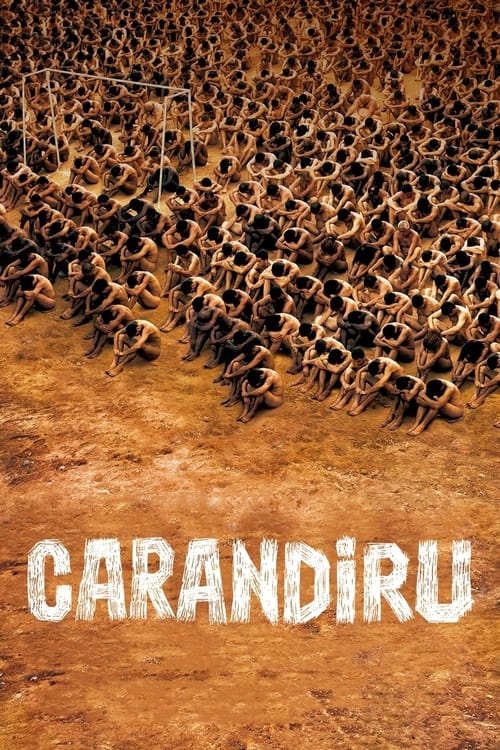
Carandiru
2003 · Héctor Babenco
For when you want a big, humane epic about people the world wrote off — challenging subject matter told with surprising tenderness, best for a night when you're ready to feel a lot.
What it's about
A doctor volunteers to run an AIDS-prevention program inside Carandiru, then the largest prison in Latin America — an overcrowded city within São Paulo where the inmates largely govern themselves. As he makes his rounds, the prisoners tell him their stories: love affairs, feuds, families, the crimes that landed them there. All of it unfolds in the shadow of a real event — the 1992 police invasion in which 111 inmates were killed.
The experience
Warm, rowdy, and human for most of its length — closer to a mosaic of lives than a grim prison drama — which makes the darkness it's headed toward land with real weight. You leave shaken, but you also leave knowing these men.
The craft
Héctor Babenco structures it as a gallery of interlocking stories held together by the doctor's rounds, drawn from the real memoir of the physician who lived it. The teeming, lived-in production design makes the prison feel like a genuine city — crowded frames, improvised homes, a whole economy behind bars.
Why it matters
A major cultural event in Brazil that forced the Carandiru massacre back into public reckoning, and part of the early-2000s wave that put Brazilian cinema's confrontation with violence and inequality on world screens.
Snapshot
Carandiru is Héctor Babenco's reckoning with one of the defining atrocities of modern Brazilian history: the massacre of 2 October 1992, when the military police of São Paulo stormed the Casa de Detenção — the prison popularly known as Carandiru, then the largest penitentiary in Latin America — and killed 111 inmates, none of the dead being officers. Adapted from Estação Carandiru (1999), the bestselling memoir by the physician and oncologist Dráuzio Varella, the film frames its account through the figure of a doctor who enters the prison to run a voluntary AIDS-prevention and treatment program and, in the course of his rounds, becomes the listener to whom the inmates tell their lives. The structure is essentially that of a portmanteau or anthology: a gallery of individual stories — love affairs, betrayals, petty crimes, family ruptures — accumulates into a collective portrait of the prison as a self-governing human society, before the film's long, controlled final movement delivers the slaughter. Babenco, who had already made the prison and the marginalized his great subject in Pixote (1981) and Kiss of the Spider Woman (1985), returns here with a deliberately humanist, anti-sensationalist method: he wants the viewer to know the men as men before the state reduces them to statistics. Released to enormous commercial success in Brazil and screened at the Cannes Film Festival, Carandiru remains the canonical cinematic treatment of the massacre and a central document of the Brazilian cinema of the early 2000s.
Industry & production
Carandiru was a major production by the standards of Brazilian cinema, mounted at the height of the Retomada — the "revival" of the national film industry that followed the near-total collapse of state-supported production at the start of the 1990s and the subsequent rebuilding under tax-incentive legislation. It was produced through Babenco's own company, HB Filmes, in partnership with Globo Filmes (the film arm of the Globo media conglomerate, whose involvement was by then decisive in giving Brazilian features both finance and promotional reach) and with the participation of Columbia TriStar, which lent the project international distribution muscle. The combination of a famous director, a bestselling source book, the backing of Globo, and a subject of raw national significance made Carandiru one of the most prominent Brazilian releases of its year, and it drew very large domestic audiences; while exact admission figures should not be asserted from memory, it is well established that the film was among the biggest Brazilian box-office successes of the period.
The project's origins lie in a genuine biographical intersection. Varella, the author of the source memoir, was an oncologist, and the working relationship that produced the film grew out of Babenco's own experience as a cancer patient — Babenco had been treated for lymphoma — which connected the director to Varella's world and to the material. The screenplay was developed by Babenco with collaborators including Fernando Bonassi and Victor Navas, adapting Varella's episodic, first-person reportage into a dramatic structure that preserved the book's documentary texture and its chorus of voices.
The single most consequential production fact is that Carandiru was filmed in large part within the actual Casa de Detenção. The prison was decommissioned and demolished at the end of 2002, and Babenco was able to shoot inside the condemned complex itself, using its real cell blocks, corridors, and yards. This lent the film an authenticity of place that no set could reproduce, and it gives the production a documentary weight — these are the spaces where the events occurred, captured shortly before they were razed.
Technology
Carandiru is a conventionally photographed early-2000s feature, shot on 35mm film, and it makes no claim to technological novelty; its resources are those of mature naturalistic narrative cinema deployed in an exceptionally difficult real location. The technical achievement lies less in apparatus than in logistics and craft: lighting and moving a camera through the genuine, cramped, decaying architecture of a condemned prison, and orchestrating very large numbers of performers and extras in the overcrowded cell blocks and in the climactic massacre. The film's visual identity comes from the photochemical rendering of real, degraded surfaces — the grime, the painted concrete, the improvised domesticity of the cells — rather than from any optical or digital innovation. The record offers no indication of unusual technical systems, and it would be invention to claim otherwise; the film's power is a matter of staging and observation realized with standard professional means.
Technique
Cinematography
The cinematography is by Walter Carvalho, one of the foremost Brazilian directors of photography of his generation, whose credits include Walter Salles's Central Station and Behind the Sun. Carvalho's work on Carandiru faces the central problem of a film set almost entirely within a prison: how to make a confined, repetitive, visually oppressive environment legible and varied without prettifying it. His solution is a flexible, often handheld and mobile camera that moves with the doctor through the labyrinth of the institution, accumulating the textures of the place, and that adapts its register to each inmate's interpolated story — the flashbacks to life outside opening up, by contrast, into the streets, homes, and color of the world the men have lost. The palette honors the institutional drabness of the cell blocks while the recollected stories admit warmth and light. In the final massacre sequence the photography turns to a harsher, more chaotic mode, the camera caught amid the violence, conveying the terror and disorientation of men trapped in their cells as the police advance.
Editing
The film's editing, credited to Mauro Alice, must solve an unusual structural task: it has to interleave a large number of self-contained character vignettes with the framing narrative of the doctor's rounds, sustaining momentum across a fundamentally episodic design. The cutting therefore works associatively, moving between the present of the prison and the pasts the inmates narrate, so that the institution is built up cumulatively as a community of histories rather than driven by a single throughline. This patient, mosaic construction is a deliberate strategy: it earns the viewer's investment in the inmates as individuals across the film's substantial running time, so that the concluding massacre lands as the destruction of people the audience has come to know. The shift in the final act — from the leisurely, accreting rhythm of the story-gathering to the compressed, escalating tempo of the assault — is the film's principal editorial gesture.
Mise-en-scène / staging
Babenco's staging is the film's deepest achievement. He renders the prison as a functioning society with its own economy, hierarchies, codes of honor, domestic arrangements, and rituals — conjugal visits, soccer, religion, commerce, friendship, and the inmates' own systems of justice. The mise-en-scène emphasizes overcrowding and improvisation: cells personalized into homes, corridors thick with bodies, the constant negotiated proximity of men living atop one another. The use of the real, doomed Casa de Detenção saturates every frame with authenticity, and the production design dresses these genuine spaces into the lived-in clutter of an inhabited prison. The massacre is staged with a controlled, cumulative horror — the police entering the blocks, the inmates stripped of any defense, the killing methodical — and Babenco's framing insists throughout on the inmates' humanity against the state's reduction of them to targets. The contrast between the densely populated, intimate world the film patiently constructs and the depopulating violence that ends it is the structural meaning of the staging.
Sound
The sound design grounds the film in the dense acoustic reality of a vast prison — the perpetual noise of voices, radios, footsteps, gates, and the collective hum of thousands of confined men — which is itself a primary characterization of the institution as an overcrowded organism. The musical score is credited to André Abujamra, and the film also draws on Brazilian popular music in the manner characteristic of the national cinema, the songs locating the inmates' lives within a shared culture. In the massacre, the sound turns to gunfire, screaming, and the terrible reverberation of violence within concrete cell blocks. Beyond these well-established features, specifics of the sound mix should not be asserted from memory.
Performance
Carandiru rests on a large ensemble, and its performances are central to its humanist project. The doctor — the surrogate for Varella and the film's point of entry — is played by Luiz Carlos Vasconcelos as a quiet, attentive presence, less a protagonist than a witness whose function is to draw out and dignify the inmates' testimony. Around him the film assembles a gallery of vividly individuated inmates, and the casting brought together established Brazilian actors and emerging talents: among them Milton Gonçalves, Ivan de Almeida, Ailton Graça, Rodrigo Santoro, Caio Blat, Gero Camilo, Wagner Moura, and Maria Luísa Mendonça, with several of the recollected stories built around love and betrayal that give the actors substantial dramatic arcs. The ensemble's task is to make each man legible and sympathetic in limited screen time, so that the collective portrait coheres; the film's emotional success is inseparable from the conviction of these individual turns. (Specific awards and individual citations should be checked against the record rather than asserted here.)
Narrative & dramatic mode
The dramatic mode of Carandiru is documentary-inflected humanist realism organized as an anthology. Rather than a single causal plot, the film offers a frame — the doctor's entry into the prison and his accumulating acquaintance with its inhabitants — within which a series of discrete life stories is told, each a small self-contained drama of how a man came to be imprisoned and who he is. This structure derives directly from Varella's memoir, itself a physician's collection of cases and encounters, and it serves a clear rhetorical purpose: by withholding a conventional protagonist and instead distributing attention across many lives, the film constructs the prison population as a community and resists the reduction of inmates to a faceless criminal mass. The mode is essentially testimonial and choral. Its dramatic climax is not the resolution of a plot but the eruption of history into the fiction: the 1992 massacre, toward which the whole film has been building and which retroactively reframes every preceding story as the life of a man about to be killed or to survive a slaughter. The film's power comes precisely from this collision between the patient, novelistic accumulation of ordinary human detail and the sudden, overwhelming arrival of state violence.
Genre & cycle
Carandiru is a prison film and a fact-based historical drama, and it belongs simultaneously to two larger currents. Within the prison-film genre it is unusual for its anthological, sociological emphasis — less concerned with escape or with a single inmate's ordeal than with the prison as a whole society — though it shares the genre's classic attention to hierarchy, code, and the relations between the confined and the institution. More importantly, it belongs to the early-2000s cycle of Brazilian films that turned an unflinching eye on crime, poverty, incarceration, and state and gang violence in the country's urban margins. The most famous of these, Fernando Meirelles's City of God (2002), had appeared the year before to international acclaim, and Carandiru arrived as part of the same wave of socially urgent Brazilian filmmaking that compelled domestic and foreign audiences to confront the realities of the favela, the prison, and the violence that linked them. Within Babenco's own career it forms a clear trilogy of incarceration and marginality with Pixote, his landmark film about abandoned children and the brutal institutions that process them, and Kiss of the Spider Woman, his international success set largely within a single prison cell.
Authorship & method
Carandiru is unmistakably a Héctor Babenco film, and it consummates the central project of his authorship: the dignified, unsentimental representation of society's outcasts and of the institutions — orphanages, prisons, the apparatus of the state — that contain and destroy them. Argentine by birth and Brazilian by adoption, Babenco had announced this preoccupation with Pixote's devastating portrait of street children and deepened it with Kiss of the Spider Woman; Carandiru returns to the prison as both literal place and social metaphor with the authority of a director who had made the subject his life's work. His method here is fidelity to lived testimony — the adaptation of a participant's memoir, the insistence on the real location, the refusal of editorializing villainy in favor of accumulated human detail — so that the indictment of the massacre emerges from the viewer's prior attachment to the men rather than from rhetoric.
The decisive collaboration was with Dráuzio Varella, whose book and whose actual experience as the prison's volunteer physician supplied both the structure and the moral viewpoint; the film is in effect a transposition of Varella's witnessing into Babenco's images. Among the key craft collaborators, cinematographer Walter Carvalho gave the film its mobile, textured naturalism and managed the formidable challenge of shooting in the condemned prison; editor Mauro Alice shaped the mosaic of stories into a coherent cumulative form; and the screenplay, developed by Babenco with collaborators including Fernando Bonassi and Victor Navas, performed the considerable labor of converting episodic reportage into dramatic narrative. The score is credited to André Abujamra. Above all, the film's authorship is a meeting of a director's lifelong subject with a true and terrible event, mediated by the testimony of the doctor who lived it.
Movement / national cinema
Carandiru is a significant work of the Retomada, the resurgence of Brazilian cinema from the mid-1990s onward after the dismantling of the state film body Embrafilme and the production drought of the early decade. This revival, enabled by audiovisual tax-incentive laws and increasingly by the participation of Globo Filmes, produced a body of ambitious features that reached large domestic audiences and, in cases like Central Station and City of God, substantial international recognition. Carandiru exemplifies the movement's defining tendency: a return to national subjects of social and historical urgency — inequality, violence, the lives of the poor and the imprisoned — treated with both popular accessibility and serious purpose. It also represents the late-career return of one of Brazil's most internationally esteemed directors to home production and to his foundational themes. As national cinema it is inseparable from a specifically Brazilian historical wound, and its very existence — a major, widely seen film compelling the country to look at the massacre — is part of how Brazilian cinema of the period took up the work of national self-examination.
Era / period
The film is rooted in two moments. Its events belong to 1992 and the years around it — the era of the overcrowded Casa de Detenção, of an under-resourced and brutal carceral system, of the AIDS epidemic reaching into the prisons (the doctor's program is a response to precisely that crisis), and of a military police culture capable of the October massacre. The film's depiction of conjugal visits, of the prison's internal economy, and of the public-health emergency situates it firmly in that early-1990s Brazilian reality. Its moment of production and release, 2002–2003, is equally pointed: the film was shot in the actual prison in the final period before its demolition at the end of 2002, capturing the condemned building as a kind of cinematic exhumation, and it reached audiences in the early 2000s when the massacre's legal and political aftermath — questions of accountability for the police action — remained unresolved and publicly contentious. The film thus speaks from a present still living with the unhealed consequences of the past it depicts.
Themes
The governing theme of Carandiru is the humanity of the incarcerated — the insistence that the men killed on 2 October 1992 were individuals with histories, loves, loyalties, and dignity, not the disposable criminal mass that the violence treated them as. From this flows the film's indictment of state violence and impunity: the massacre is presented as the catastrophe toward which a brutal, neglectful carceral system tends, and the film's accumulated portraiture is the rhetorical means by which it makes that violence intolerable. The prison itself is a major theme as a paradoxical space — at once oppressive and, in the inmates' improvisations of family, commerce, faith, and justice, a functioning human society with its own moral order. The film engages, too, with public health and the AIDS epidemic, the doctor's preventive mission embodying a thread of care running against the system's cruelty. Around these center the recurrent human subjects of the interpolated stories — love and jealousy, betrayal, family, the petty origins of criminal lives, the codes of honor that govern men in confinement. Underlying everything is the relationship between the marginalized individual and the institutions of the state, the Babenco theme par excellence, here brought to its most explicitly historical and political expression.
Reception, canon & influence
Carandiru was a substantial commercial success in Brazil, drawing very large audiences and standing among the most-seen Brazilian films of its time, and it carried the country's confrontation with the massacre to a mass public in a way no other single work had. It was selected for the Cannes Film Festival, confirming Babenco's continued international standing, and it was widely received as a serious and affecting treatment of a national trauma. Critical response engaged both its considerable strengths — the humanity of its ensemble, the authenticity of its location, the moral seriousness of its purpose — and the formal questions raised by its episodic structure; precise critical verdicts and awards should be confirmed against the record rather than asserted from memory, but its status as the definitive cinematic account of the Carandiru massacre is not in doubt.
Influences on the film run backward, first, to Dráuzio Varella's memoir, the testimonial source that shaped its structure and viewpoint, and to the real history of the massacre itself; and, within film, to Babenco's own Pixote and Kiss of the Spider Woman, whose preoccupation with prisons and outcasts Carandiru extends, as well as to the broader documentary-realist tradition of Brazilian and Latin American socially engaged cinema. It is also legible alongside the contemporaneous City of God, with which it shares the early-2000s Brazilian impulse to dramatize urban crime and violence with unsparing realism.
Its influence forward is felt primarily in its consolidation of the Carandiru massacre as a fixed point of national memory and in its contribution to the cycle of Brazilian films and subsequent media — including later television treatment of the same material — that continued to examine the prison and the events of 1992. As a high-profile, widely seen film about a state atrocity, it helped sustain the public reckoning with police violence and carceral conditions that remained, and remains, a live issue in Brazilian society. Within Babenco's body of work it stands as the late, definitive statement of the prison theme he had pursued across his career, and within the canon of the Retomada it remains one of the era's most significant and most consequential films.
A Deleuzian reading
Start with the doctor in the doorway.
The full Deleuzian reading of Carandiru →
Reception
A phenomenon at home — one of the biggest Brazilian box-office hits of its era and a Cannes 2003 competition title — it got a cooler international reception, with critics calling its episodic sprawl unwieldy next to City of God's rush. Today it's settled in as a landmark of the Brazilian cinema revival, and the humanist looseness once held against it reads as the point.
How Carandiru was received, from release to now →
Influences: the films it descends from and the films it influenced
- Pixote (1981) — Babenco's earlier method of casting actual marginalized youth and observing total institutions with documentary restraint, which Carandiru transposes onto adult inmates in a real prison.
- Kiss of the Spider Woman (1985) — Babenco's use of the prison cell as a stage where private, confessional storytelling becomes political testimony — the structural seed of Carandiru's interlocking inmate vignettes.
- Rio, 40 Graus (1955) — The founding Cinema Novo template of weaving multiple marginal street lives into a single mosaic city-portrait shot on real locations, the socially-engaged realist tradition Carandiru inherits.
- The Battle of Algiers (1966) — Reconstructs a real state atrocity with handheld, newsreel-grain camerawork and an anonymous ensemble so the indictment accumulates from witness rather than editorializing villainy — Carandiru's exact moral strategy.
- Brute Force (1947) — The prison-as-society architecture that introduces inmates through individual flashback backstories before erupting into a guard-led massacre — precisely Carandiru's dramatic shape.
- Salvatore Giuliano (1962) — Rosi's fact-based choral reconstruction that refuses a single protagonist and assembles a political killing from fragmented, investigatory viewpoints, the model for dramatizing a massacre as collective event.
- Short Cuts (1993) — Altman's mosaic editing of discrete character vignettes into a cumulative ensemble portrait, the portmanteau construction Mauro Alice uses to bind Carandiru's stories into one form.
- Memories of Prison (1984) — Adapts Dráuzio Varella's first-person account with the same architecture — an observing witness who mostly listens while the cell-block delivers its picaresque inset stories — shot in the actual condemned pavilion with a population-scale ensemble.
- Elite Squad (2007) — Extends the Carandiru cycle's brutal procedural realism about Rio's police and carceral apparatus into hard-edged fiction, continuing the public reckoning with state violence.
- A Prophet (2009) — Builds an entire stratified social order — ethnic factions, economies, hierarchies — inside the prison walls, the 'prison-as-society' conceit Carandiru foregrounds, carried by a large inmate ensemble.
- Hunger (2008) — McQueen's bodily, real-location depiction of state violence enacted on incarcerated men, where the indictment is built through physical accumulation and texture rather than speech, as in Carandiru's location naturalism.
- Amores Perros (2000) — The contemporaneous Latin American hyperlink structure braiding separate stories of urban violence around a single catastrophic event, paralleling Carandiru's anthology-around-a-massacre design.
- Central Station (1998) — Shares cinematographer Walter Carvalho, whose mobile, textured, handheld naturalism defines both Retomada landmarks' on-the-ground intimacy.
- Behind the Sun (2001) — Carvalho's painterly handheld camerawork again — the Retomada house style of natural light and roving frame that he carried into the condemned Carandiru location.
- City of God (2002) — The parallel early-2000s Retomada impulse to dramatize urban crime with unsparing kinetic realism and a sprawling cast of the marginalized, released alongside Carandiru.
- O Prisioneiro da Grade de Ferro (2003) — A documentary shot inside the same condemned Carandiru by inmates wielding the cameras themselves — the nonfiction twin of Babenco's reconstruction, sharing the literal location and demolition timeline.
- Bus 174 (2002) — Padilha's testimonial documentary indicting Brazilian carceral and police violence by reconstructing a marginalized man's life-history, the same evidence-from-biography method applied to state atrocity.
- Mango Yellow (2002) — Adjacent abject-institutional ensemble of the Brazilian underclass, packing a teeming cast into a fetid enclosed space with grotesque-naturalist performance.
- Brainstorm (2001) — Extends the same Brazilian total-institution critique into the prison, using an ensemble of the confined and a reformist gaze to expose systemic dehumanization — the carceral-institution portrait Brainstorm applies to the clinic.
- Ó Paí, Ó: Look at This (2007) — Builds a feature entirely from vignettes inside one confined architecture, introducing each inmate as a self-contained comic or melodramatic turn before the collective catastrophe binds them — the same enclosed-location mosaic with popular typing that Ó Paí, Ó runs on a tenement instead of a prison block.
Similar films
- Bus 174 (2002) — influence & lineage · same viewing thread
- City of God (2002) — influence & lineage · same viewing thread
- Elite Squad (2007) — influence & lineage
- Kiss of the Spider Woman (1985) — influence & lineage
- Amores Perros (2000) — influence & lineage · same viewing thread
- Pixote (1980) — same viewing thread
- Brainstorm (2001) — shared sensibility
- Elite Squad: The Enemy Within (2010) — shared sensibility
All the films related to Carandiru →
Watch it with: curated runs of related films
- Cinema of the Dispossessed — A run of slum-and-favela dramas — Rio, Mexico City, Mumbai, the Paris banlieue — where children survive by their wits and the city itself is the antagonist.