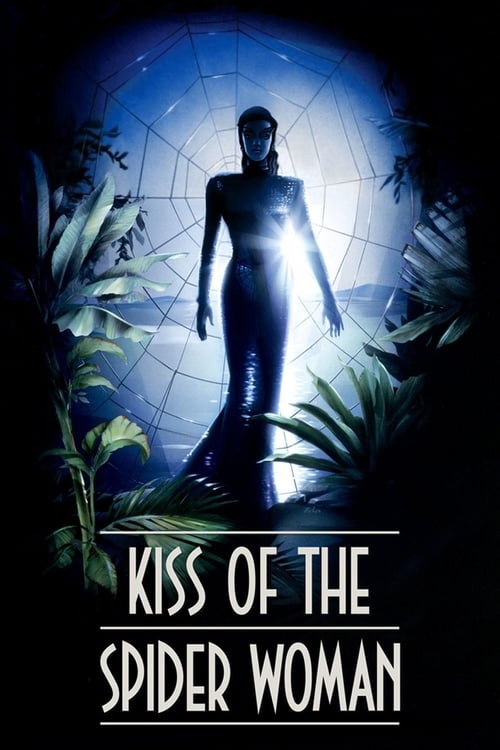
Kiss of the Spider Woman
1985 · Héctor Babenco
For a serious night when you want a film about human connection under pressure — something to watch closely and argue about after. It asks patience and pays it back with real feeling.
What it's about
Two men share a cell in a Latin American prison under a dictatorship: Valentín, a leftist journalist being tortured for his politics, and Molina, a gay window-dresser jailed on a morals charge. To get them both through the nights, Molina retells the plot of a lush old romantic movie from memory, and the film drifts between the grim cell and those gauzy, silvered fantasy interludes. Out of that friction — commitment versus escapism, contempt versus tenderness — an unlikely intimacy grows.
The experience
Intimate, talky, and quietly transporting. It has the concentrated intensity of a two-character play, but the movie-within-the-movie keeps opening trapdoors into dream — you're pulled between harshness and velvet until the two start to bleed together. It sneaks up on you emotionally.
Performances
William Hurt won the Academy Award for Best Actor as Molina, a performance of flamboyance gradually revealing bedrock dignity, and Raúl Juliá matches him beat for beat as Valentín, letting a hard ideologue's certainty soften without ever going sentimental. The film is essentially the two of them, and they hold it completely.
The craft
Adapted from Manuel Puig's novel, the film alternates two visual worlds — the drab, close-quarters realism of the cell and the deliberately artificial glamour of Molina's remembered melodrama — and the cutting between them is the movie's whole argument about why we need stories. Independently financed and shot in Brazil, it wrings remarkable variety from a single room.
Why it matters
An unlikely art-house landmark: an independent Latin American co-production that landed a Best Picture nomination and won Hurt the Oscar, and a milestone for queer representation in mainstream-adjacent cinema at a time when such a central gay character was vanishingly rare.
Snapshot
Kiss of the Spider Woman is a two-hander set almost entirely inside a single prison cell in an unnamed Latin American country, adapted from Manuel Puig's 1976 novel El beso de la mujer araña. It stars William Hurt as Luis Molina, a gay window-dresser jailed on a morals charge, and Raúl Juliá as Valentín Arregui, a Marxist revolutionary held and tortured for his politics. To pass the time, Molina narrates the plot of a lush old melodrama — in the film, a Nazi-era propaganda romance — and the picture cuts between the drab cell and these gauzy fantasy interludes. The film became an unlikely art-house landmark: independently financed, shot in Brazil, and eventually a Best Picture nominee that delivered William Hurt the Academy Award for Best Actor. It sits at the intersection of political cinema, queer representation, and a sustained argument about what movies themselves are for.
Industry & production
The film was a genuinely independent, transnational production rather than a studio picture, and its financing history is part of its legend as a project that nearly did not get made. It was assembled outside the Hollywood system, produced by David Weisman and shot largely in São Paulo, Brazil, on a modest budget. Babenco, an Argentine-born filmmaker who had built his career in Brazil, had drawn international attention with Pixote (1981), and that reputation helped carry the project. Distribution in the United States came through the specialty distributor Island Alive, which handled its platform release.
Its commercial and awards trajectory was unusual for a low-budget foreign-inflected drama. Hurt won Best Actor at the 1985 Cannes Film Festival, and the film went on to receive four Academy Award nominations for the 1985 season — Best Picture, Best Director (Babenco), Best Actor (Hurt, the winner), and Best Adapted Screenplay (Leonard Schrader). The Best Picture nomination in particular was remarkable for an independently produced and distributed film of its scale, and it is frequently cited as an early signal of the specialty-film wave that would define the late 1980s and 1990s. I am wary of citing precise box-office figures, as the reported numbers vary and I cannot verify them reliably; the safe claim is that its awards success far outstripped expectations for its budget.
Technology
Technically the film is conventional for its moment: it was shot on 35mm and relies on photochemical, in-camera and lighting-based effects rather than any novel apparatus. Its most pointed technological gesture is aesthetic rather than mechanical — the fantasy sequences are rendered in a deliberately artificial, high-gloss idiom (softened light, richer color, "old movie" texture) that contrasts with the flat, grimy realism of the prison. This is achieved through lighting, staging, filtration and set design, not through any experimental process. The film belongs to a pre-digital, purely analog production world, and nothing about its toolkit was cutting-edge; its innovation is in application, not hardware.
Technique
Cinematography
The cinematography, credited to Rodolfo Sánchez, is built on a governing contrast between two visual registers. The cell scenes are close, muted, and physically constrained — cramped framings that keep the two men in near-constant proximity, low ambient light, and a palette drained toward gray and ochre that communicates confinement and fatigue. The fantasy interludes reverse every one of these choices: brighter, softer, more mobile, keyed to the visual clichés of studio-era romance and propaganda spectacle. The camera thereby dramatizes the film's central theme at the level of image — the difference between the world as it is (the cell) and the world as Molina needs to imagine it (the movie). Because so much of the film unfolds in one room, blocking and lens choice do a great deal of the storytelling work, tracking the shifting emotional distance between the two prisoners.
Editing
The editing's principal task is to manage the intercutting between "reality" and "fantasy" so that Molina's narration and the images it conjures feel continuous rather than gimmicky. The film returns to the cell as its anchor and uses the fantasy sequences as expanding, then collapsing, digressions — sometimes the movie-within-the-movie takes over the screen entirely, sometimes it is punctured by Valentín's skeptical interruptions. The rhythm is patient and theatrical, matched to a chamber-drama structure. I am not fully certain of the editor's credit and will not assert a name I cannot verify; the salient point is structural: the cutting is organized around Molina's voice, so that the audience experiences the old melodrama the way Valentín does — as something narrated to them in the dark.
Mise-en-scène / staging
This is one of the film's strongest dimensions. The prison cell is a single, enclosing set whose props become emotionally loaded over the course of the film — the shared food, the bedding, the small domestic rituals Molina imposes on the space. Babenco stages the relationship almost as theater, letting the two bodies negotiate a confined geography that slowly shifts from hostility to intimacy. The fantasy world is staged in flagrant contrast: costumed, glamorous, self-consciously "cinematic." Sonia Braga's presence across multiple roles — the film-within-the-film heroine, Valentín's absent lover Marta, and the titular Spider Woman — is a mise-en-scène strategy as much as a performance one, visually binding Molina's fantasies, Valentín's memories, and the film's mythic frame into a single recurring figure.
Sound
Sound reinforces the two-world structure. The cell is largely a world of voices, silence, and off-screen menace (the sounds of the prison beyond the door, the aftermath of torture), while the fantasy sequences are scored and orchestrated in the manner of the melodrama they imitate. The score is credited to the Brazilian composer John Neschling. Molina's narration is the film's connective tissue — the spoken word is what summons the images — so the sound design is organized around the primacy of storytelling, of one man's voice filling a dark room.
Performance
Performance is the film's engine and its most celebrated achievement. William Hurt's Molina is a study in constructed femininity and romantic self-invention; the role earned him the Oscar and the Cannes prize, and it remains the film's defining legacy. The performance has also become a locus of ongoing debate about whether it trades in stereotype and about the casting of a straight actor in a defining gay role — a critical conversation that has intensified in the decades since. Raúl Juliá's Valentín is the necessary counterweight: rigid, principled, physically depleted, and slowly humanized. The film lives or dies on the chemistry and gradual thaw between the two, and the performances carry that arc across a nearly single-location running time.
Narrative & dramatic mode
The dramatic mode is chamber drama crossed with framed storytelling — a two-character confinement play punctuated by an embedded, narrated film. The central engine is dialogue and slow relational transformation: two men who represent opposed value systems (Molina's apolitical devotion to romance and beauty; Valentín's revolutionary asceticism) are forced into intimacy and each begins to move toward the other. Overlaid on this is a thriller mechanism — Molina has been placed in the cell as an informer, tasked by the authorities with extracting information, and the film sustains tension around whether his growing love will override that arrangement. The ending's ambiguity, and the melancholy irony of its outcomes, are essential to its dramatic effect. The film adapts a famously experimental novel — Puig wrote much of the book in unattributed dialogue and interpolated pseudo-academic footnotes on theories of sexuality — and Leonard Schrader's screenplay makes the pragmatic choice to externalize the interior material into a single dramatized fantasy film, trading the novel's formal daring for cinematic legibility.
Genre & cycle
The film resists a single genre label, which is part of its identity. It is at once a prison drama, a political film about state repression in Latin America, a love story, and a meta-cinematic essay on melodrama. It belongs loosely to a 1980s cycle of serious, adult, art-house dramas that took queer experience as central subject matter and pushed it toward mainstream awards recognition — a movement toward visibility that the film both advanced and complicated. It also participates in the long tradition of the "film about films," using an embedded movie to interrogate the pleasures and dangers of cinematic fantasy, including the discomfiting fact that Molina's beloved picture is a fascist propaganda piece.
Authorship & method
Héctor Babenco (director) approached the material as a director already associated with socially engaged realism through Pixote, and his method here fuses that gritty sensibility with an unabashed embrace of theatrical artifice in the fantasy sequences. The authorship of the film is unusually shared, however. The source is Manuel Puig, whose novel supplies both the plot and the film's governing idea about cinema-as-refuge; the record indicates there were tensions around the adaptation and that Puig had his own relationship to how the material should be handled, though I would not overstate specifics I cannot verify. Leonard Schrader (brother of Paul Schrader) wrote the adapted screenplay, and his central structural decision — collapsing the novel's several narrated films into one Nazi-era romance — reshapes the story's meaning. The cinematographer Rodolfo Sánchez and composer John Neschling supplied the two-register visual and musical grammar. And in a real sense the film's authorship is completed by its two leads, whose performances are so determinative that the picture is inseparable from them.
Movement / national cinema
The film occupies an ambiguous, productively hybrid place in national-cinema terms. Babenco was Argentine by birth but had become a leading figure in Brazilian cinema, and the film was shot in Brazil with Brazilian creative personnel (Braga, Neschling), yet it is largely English-language and adapts an Argentine novelist working out of the experience of Southern Cone political repression. It is best understood as a transnational Latin American production that used international (largely American) financing and talent to reach a global art-house audience. Its unnamed setting deliberately universalizes the specific Argentine context of Puig's novel — the "dirty war" milieu of political disappearance and torture — into a broader statement about authoritarianism.
Era / period
Made in 1985, the film is very much of the mid-1980s: a moment when Latin American nations were emerging from or still reckoning with periods of military dictatorship, and when the international art-house market was newly receptive to serious political and sexual subject matter. It also arrives at the dawn of the modern American independent film era and helped demonstrate that an independently produced picture could compete for the industry's top honors. Its handling of homosexuality belongs to a specific pre-1990s moment of increasing but still fraught mainstream visibility, which is why its representational choices are read so differently now than at release.
Themes
The film's overriding theme is the power of fantasy — specifically cinematic fantasy — to sustain, seduce, and deceive. Molina uses the movies as escape and as moral shelter, and the film neither simply endorses nor simply condemns this: the picture he loves is politically monstrous, yet his storytelling becomes an act of genuine care. Around this sits a cluster of interlocking oppositions: the personal versus the political; romantic love versus revolutionary duty; performed femininity versus enforced machismo; imprisonment versus imagined freedom. The relationship dramatizes the possibility that each man's rigid worldview can be softened by the other — Valentín learning tenderness, Molina finding a cause worth acting for. Betrayal, coercion, and the ethics of intimacy under surveillance run throughout, since Molina's affection is entangled with his role as an informer. Finally, the Spider Woman figure encodes an ambivalence about desire itself — alluring and potentially fatal, love as both liberation and entrapment.
Reception, canon & influence
On release the film was a critical event, propelled above all by Hurt's performance, which won at Cannes and then the Academy Award, and by the surprise of its Best Picture nomination. Its reputation rests on the daring of centering a gay protagonist in a serious awards-caliber drama and on the intelligence of its two-world structure. Over time the critical conversation has grown more complicated: later commentators have debated Molina as a potentially stereotyped figure and questioned the casting, and the film is now often taught as a case study in the history and politics of queer screen representation as much as for its intrinsic achievements.
Looking backward, the film draws on the novel's formal experiments and on the entire tradition of classical melodrama and studio-era romance that Molina's narrated film pastiches — its fantasy sequences are a knowing homage to a cinema of glamour and artifice. Looking forward, its most concrete legacy is adaptive: Puig's story, via this film's popularization, became the basis for the acclaimed Kander and Ebb / Terrence McNally Broadway musical of the early 1990s, and the property was revisited again in a 2025 screen musical directed by Bill Condon. Within film history the picture stands as a marker of the emerging American independent movement and as one of the 1980s' pivotal works of queer cinema — a film whose influence runs less through direct stylistic imitation than through the door it helped open for serious, prestige-level treatment of gay lives on screen.
A Deleuzian reading
A man lies on a bunk in a gray room, describing a dress.
The full Deleuzian reading of Kiss of the Spider Woman →
Reception
A prestige sensation in 1985 — William Hurt won Best Actor at both Cannes and the Oscars, and the film landed a Best Picture nomination as a scrappy independent production. Today it's honored as a queer-cinema landmark but viewed with more complicated eyes, its once-daring casting now a talking point rather than a triumph.
How Kiss of the Spider Woman was received, from release to now →
Influences: the films it descends from and the films it influenced
- Pixote (1981) — Babenco's own vérité social-realist method for confinement and marginalized bodies supplies the grimy documentary register that grounds the prison cell against the fantasy sequences.
- Casablanca (1942) — The studio-era, Nazi-occupation romance of doomed lovers and sacrifice is precisely the classical-Hollywood template Molina's narrated film pastiches, glamour lighting and all.
- Shanghai Express (1932) — Von Sternberg's diaphanous, veil-and-shadow glamour lighting of Dietrich is the visual grammar reproduced in Sonia Braga's Spider Woman fantasy figure.
- A Streetcar Named Desire (1951) — A hothouse single-set stage adaptation whose power rests on one Method actor's total physical transformation — the model for Hurt's immersive, mannered embodiment of Molina.
- The Defiant Ones (1958) — Two ideological opposites forced into physical confinement, where their reluctant intimacy is the vehicle that carries the film's political argument.
- Cabaret (1972) — Kander and Ebb's method of intercutting decadent staged performance against encroaching fascism seeds both this film's fantasy grammar and the later Kander/Ebb stage adaptation.
- The Boys in the Band (1970) — An early prestige-adjacent, single-location chamber drama built entirely around openly gay characters, opening the door to serious screen treatment of queer lives.
- The Place Without Limits (1978) — Adapts Manuel Puig — a reported screenplay contributor here — extending the same fusion of queer dignity, popular-melodrama fantasy, and enclosure into a two-hander confined space.
- Law of Desire (1987) — Extends Puig's melodrama-as-refuge sensibility, deploying heightened Sirkian artifice to render queer desire with mainstream emotional seriousness.
- Philadelphia (1993) — The direct heir to prestige, awards-caliber drama centered on a gay lead carried by an Oscar-winning performance — the door Kiss of the Spider Woman helped open.
- The Shawshank Redemption (1994) — A prison two-hander in which narrated Hollywood glamour (Rita Hayworth) becomes the literal instrument of imaginative escape from incarceration.
- Talk to Her (2002) — A melodrama of two men bonding in confinement that shifts emotional register through an embedded film-within-a-film, extending Puig's cinema-as-refuge device.
- Chicago (2002) — Kander and Ebb numbers staged as intercut fantasy escapes from a jailed reality — the same intercutting-reality-and-fantasy engine, scripted by Bill Condon.
- Before Night Falls (2000) — Carries forward the transnational Latin-American story of queer political imprisonment where art and imagination are the means of psychic survival.
- Kiss of the Spider Woman (2025) — The direct screen-musical readaptation of Puig by way of the Kander/Ebb/McNally stage show, literalizing Molina's narrated film as full production numbers.
- Carandiru (2003) — Babenco's use of the prison cell as a stage where private, confessional storytelling becomes political testimony — the structural seed of Carandiru's interlocking inmate vignettes.
- My Dinner with André (1981) — Sustains an entire feature on two men talking in a single location, proving the chamber two-hander can hold feature length through voice alone.
- Dancer in the Dark (2000) — Builds imagined musical numbers intercut as a fantasy refuge from a grim, prison-bound reality — the two-register reality/fantasy structure pushed to its limit.
- The Purple Rose of Cairo (1985) — A same-year film built on cinema as refuge, in which a prisoner survives by retelling a glamorous fictional movie that bleeds into and reshapes his grim reality.
Similar films
- Talk to Her (2002) — influence & lineage
- Before Night Falls (2000) — influence & lineage
- Law of Desire (1987) — influence & lineage
- Last Tango in Paris (1972) — shared sensibility
- Queer (2024) — shared sensibility
- A Twelve-Year Night (2018) — shared sensibility
- Great Freedom (2021) — shared sensibility
- Interrogation (1989) — shared sensibility