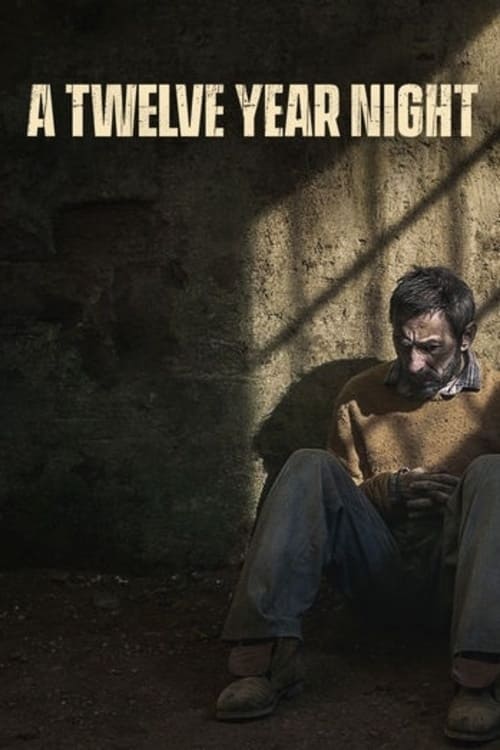
A Twelve-Year Night
2018 · Álvaro Brechner
For when you want a survival story that's about endurance of spirit rather than action — challenging viewing that pays off in genuine awe at what people can withstand. Reach for it when you want to come out the other side moved rather than crushed.
What it's about
Uruguay, 1973: after the military seizes power, three captured Tupamaro guerrillas — among them José 'Pepe' Mujica, who would one day be the country's president — are locked away as hostages of the dictatorship. Held in near-total isolation, moved from pit to cell to barracks for twelve years, they must keep their minds intact when everything else has been taken. The film is drawn from the men's own memoirs of those years.
The experience
Claustrophobic and grueling in stretches, as it should be, but shot through with dark humor, tenderness, and startling moments of imagination — the mind's escape routes become the film's. It leaves you shaken and strangely uplifted.
Performances
Antonio de la Torre leads the trio as Mujica with a physically committed, largely wordless performance, and all three actors chart the slide toward madness and the fight back from it with harrowing conviction.
The craft
The film turns deprivation into a sensory experience: sound design does enormous work, since the prisoners are forbidden to speak, and the camera finds ways to make darkness, hunger, and hallucination visceral without exploitation. Its structure — small acts of communication and invention against an ocean of empty time — gives a twelve-year ordeal real narrative pulse.
Why it matters
It brought one of Latin America's defining dictatorship-era stories to international audiences, made more resonant by its subjects' later lives — one became Uruguay's famously humble president, another its defense minister, a third a celebrated poet.
Snapshot
A Twelve-Year Night (La noche de 12 años) is Uruguayan director Álvaro Brechner's third feature, a historical prison drama that reconstructs the twelve years of near-total isolation endured by three imprisoned Tupamaro guerrillas during Uruguay's civic-military dictatorship (1973–1985). Its subjects are among the most consequential figures in modern Uruguayan history: José "Pepe" Mujica, later president of Uruguay; the playwright and poet Mauricio Rosencof; and Eleuterio Fernández Huidobro, later the country's defense minister. The film adapts the men's own accounts, principally the memoir Memorias del calabozo co-authored by Rosencof and Fernández Huidobro, into a sensory chamber piece about deprivation, madness held at bay, and the small acts of imagination through which the mind survives when the body is caged. Premiering at the 75th Venice Film Festival in 2018 and selected as Uruguay's submission for the Academy Award for Best Foreign Language Film, it stands as one of the most internationally visible Uruguayan productions of the decade and a signal example of the Southern Cone's continuing cinematic reckoning with its dictatorship era.
Industry & production
The film was mounted as a multinational co-production, drawing together financing and talent from Uruguay, Spain, Argentina, and France — the now-standard architecture for ambitious "art-house-with-scale" cinema from a country whose domestic market cannot underwrite a period production of this size on its own. Uruguay's film industry is small and heavily dependent on co-production treaties, festival funding bodies, and Ibero-American mechanisms such as the Programa Ibermedia; a picture requiring period reconstruction, prison sets, and a name international cast necessarily reaches across borders for its budget. The casting itself encodes that transnationalism: the Spanish actor Antonio de la Torre plays Mujica, the Argentine Chino Darín (son of Ricardo Darín) plays Rosencof, and the Uruguayan actor Alfonso Tort plays Fernández Huidobro — a distribution of nationalities that mirrors the co-production's own map. Brechner, though Uruguayan, has built much of his career from Spain, which situates the film within the well-worn Montevideo–Madrid axis that has shaped Uruguayan auteur cinema since the 2000s. International distribution extended the film's reach well beyond the festival circuit; it circulated widely on streaming, which for a Uruguayan film of serious subject matter represented an unusually large potential audience. Precise budget and box-office figures are not something I can state reliably, and I will not invent them; the film's significance lies less in commercial performance than in visibility and prestige positioning.
Technology
The production is a work of contemporary digital cinema, and its most consequential technological choice is the exploitation of modern low-light sensor capability. The film lives, for long stretches, in near-darkness — the men are held in cells so lightless that vision itself becomes unreliable — and the ability of current digital cameras to register image information at the threshold of blackness is what makes such sequences legible without betraying their darkness through artificial fill. Where an earlier generation of emulsion would have forced compromise (either lighting the cell into visibility or losing the image entirely), digital capture allows the film to hold the audience inside a gloom that is dramatically truthful. Digital post-production similarly enables the film's controlled, desaturated grading and its handling of the abrupt shifts between suffocating interiors and the rare, overexposed shock of daylight. I do not have a reliable record of the specific camera or lens systems used and will not guess at model names; the salient point is not the hardware but the aesthetic license that current image technology grants — the freedom to build an entire film around what is only barely seen.
Technique
Cinematography
The photography, credited to Carlos Catalán, is the film's central expressive instrument. The visual strategy is one of confinement made physical: tight framings, low ceilings pressing into the top of the image, and a palette drained toward gray, ochre, and the blue-black of unlit stone. The camera frequently adopts the prisoners' constrained field of vision — the world reduced to a hatch, a sliver of wall, the underside of a hood — so that the audience is denied the establishing, orienting views that conventional coverage provides. Chiaroscuro is used not decoratively but as a dramatic condition: faces emerge partially from darkness and recede again, and light becomes a scarce resource whose arrival is felt as an event. When the film does open onto exteriors or memory, the contrast in scale and brightness is deliberately disorienting, reproducing for the viewer the physiological shock the prisoners describe on the rare occasions they were moved or exposed to sky.
Editing
The editing confronts a structural problem intrinsic to the material: how to render twelve years — an ocean of undifferentiated, deliberately featureless time — as drama. The solution is elliptical. The film compresses and fragments chronology, marking the passage of years through physical deterioration, shifts in confinement, and recurring motifs rather than through explicit signposting, and it braids the three men's parallel, mostly separate ordeals into a single rhythm of endurance. Isolation is conveyed formally by withholding the cross-cutting reassurance that the men are near one another; connection, when the cutting finally grants it, lands as relief. I cannot confidently attribute the editing to a specific credited editor and will not guess at a name, but the constructive logic — duration rendered through omission — is clearly the film's, and one of its most sophisticated achievements.
Mise-en-scène / staging
Brechner's staging is built on subtraction. The dominant playing space is the cell — a set defined by its smallness, its filth, its lack of anything to look at — and the mise-en-scène wrings meaning from a near-total absence of props and movement. Bodies become the primary scenic material: how a man sits, paces the two available steps, folds himself against a wall, or is manipulated by guards. Objects that would be trivial elsewhere — a scrap of paper, a beetle, a fragment of song tapped through stone — acquire enormous dramatic weight precisely because the world has been stripped so bare. The guards and interrogators are staged as depersonalized instruments of the state, often shot to emphasize the asymmetry of standing power over crouched captivity. This is a cinema of the withheld, in which the design's austerity is the point.
Sound
Sound is arguably the film's second protagonist. Deprived of sight, the prisoners live in an aural world, and the film honors that: the amplified drip of water, the scrape of a bolt, footsteps in a corridor, the clandestine tapping through walls by which the men communicated all carry narrative and emotional freight. Silence is used as an active texture, a pressure rather than an absence, and the sound design repeatedly places the audience inside the prisoners' hyper-attuned, sensorily starved perception. Federico Jusid's score works in restraint, entering to lift or deepen rather than to instruct, and much of the film's most affecting sound is diegetic and near-subliminal — the small noises that, to a man in the dark, constitute the entire universe.
Performance
The performances are the film's ethical and emotional core, and they are governed by physical transformation and interiority rather than rhetoric. Antonio de la Torre's Mujica is a study in a mind under siege, veering toward derangement and clawing back; Chino Darín's Rosencof channels the survival strategy of imagination and language — the writer keeping himself alive by composing in his head; Alfonso Tort's Fernández Huidobro grounds the trio with a more contained resilience. The acting must register deprivation, weight loss, sensory disorientation, and the erosion and reconstitution of the self, often with minimal dialogue and in extreme physical postures. That the three actors sustain distinct inner lives across a film so deliberately monotonous in setting is central to its success.
Narrative & dramatic mode
The film operates in the mode of the survival-endurance drama rather than the plot-driven prison-break thriller. There is no escape to organize the narrative around; the dramatic question is not "will they get out" but "will they remain human," and the film's suspense is psychological and moral. Its structure is episodic and subjective, privileging perception and inner experience over incident, and it repeatedly dissolves the boundary between the men's reality and their hallucinations, dreams, and memories — a formal choice that dramatizes the disintegration of the sensing self under isolation. It is also, quietly, a film of testimony: because it adapts the survivors' own memoir, it carries the weight of documentary truth beneath its fictional surface, and its dramatic mode is inseparable from an act of historical witness.
Genre & cycle
The film sits at the intersection of the prison film, the historical dictatorship drama, and the political biopic-in-embryo (its subjects being figures who would later shape the Uruguayan state). Within the prison-film tradition it belongs to the introspective, endurance-centered wing — closer to studies of solitary confinement and the psychology of captivity than to the escape narrative or the ensemble prison-yard drama. More importantly, it belongs to a distinct and substantial regional cycle: the Southern Cone cinema of memory, the decades-long body of Argentine, Chilean, Uruguayan, and Brazilian films confronting the crimes of the 1970s–80s military regimes. That cycle encompasses everything from tribunal dramas to films about the disappeared to intimate accounts of survivors, and A Twelve-Year Night extends it into the specific, comparatively under-filmed Uruguayan case.
Authorship & method
Álvaro Brechner (b. 1976) is a Uruguayan filmmaker whose earlier features — Bad Day to Go Fishing (Mal día para pescar, 2009) and Mr. Kaplan (2014) — established him as one of his generation's leading Uruguayan directors, working often between Montevideo and Spain. A Twelve-Year Night marks a tonal and formal deepening: a move from his earlier register into austere, historically freighted material. Brechner adapted the screenplay himself from the survivors' memoir and testimony, and his method here is one of research-grounded restraint — a refusal of sensationalism in favor of sensory fidelity to the experience of confinement. His key collaborators shape the film decisively: cinematographer Carlos Catalán, whose management of darkness defines its visual identity, and composer Federico Jusid, an Argentine known for scoring Southern Cone and Spanish-language prestige cinema, whose restrained work here serves the film's silences. The editing and additional creative credits are less securely documented in the sources available to me, and rather than attach names I cannot verify, I note only that the film's constructive intelligence — its handling of duration and its braiding of three isolated lives — is consistent with a tightly controlled authorial vision.
Movement / national cinema
The film is a landmark of the "new Uruguayan cinema," the wave that since the early 2000s has given a country with a tiny industry an outsized festival presence — a tradition that includes internationally recognized works of deadpan minimalism and genre reinvention. Within that context, A Twelve-Year Night represents Uruguayan cinema turning its most ambitious resources onto the nation's foundational modern trauma. It is simultaneously a work of transnational Ibero-American cinema, its Spanish and Argentine partnerships and cast binding it to the wider Spanish-language production ecosystem. The film thus occupies a double position: a national statement about Uruguay's own history, made possible only through the transnational co-production model that sustains small-nation art cinema.
Era / period
The film is set across 1973–1985, the years of Uruguay's civic-military dictatorship, and its subject is a particular and monstrous refinement of that regime's practice: the selection of nine Tupamaro leaders as "hostages," held in prolonged solitary confinement under threat of execution should the defeated guerrilla movement resume activity. This was not incarceration in the ordinary sense but a form of slow, calibrated psychological destruction — the men moved repeatedly among prisons, denied reading, writing, adequate light, and human contact. The film's period specificity matters: it dramatizes a mechanism of state terror distinct from the mass "disappearances" more associated with neighboring Argentina and Chile, and it does so at a moment — the film's own 2018 release — when the surviving protagonists had become elder statesmen, giving the historical material an extraordinary living resonance.
Themes
The film's governing themes are endurance and the survival of the self under conditions designed to annihilate it. It is centrally concerned with the resources of the interior life — imagination, memory, language, faith, humor, the tapped code between walls — as the instruments by which the mind refuses the state's project of erasure. It meditates on the thin, permeable border between sanity and madness, and on solidarity sustained across isolation. Beneath these runs a political and ethical argument about dignity: that the regime's true aim was not merely to imprison bodies but to unmake persons, and that survival was therefore itself a form of resistance. Finally, because its subjects went on to help rebuild the democratic state, the film carries an implicit theme of historical continuity — the passage from the dungeon to the republic, from victim to citizen.
Reception, canon & influence
Critically, the film was received as a serious, formally rigorous addition to the Southern Cone's cinema of memory, praised in particular for its performances and for the discipline of its sensory approach to confinement; its Venice premiere and selection as Uruguay's Oscar submission marked it as a work of consequence, though I do not have a reliable ledger of specific festival prizes and awards outcomes and will not manufacture one. Its influences run backward into two lineages: the international prison-film tradition of solitary endurance and psychological survival, and the established Southern Cone body of dictatorship testimony that preceded it. Above all it is grounded in a primary documentary source — the survivors' own memoir and testimony — which gives it an authority that fictional treatments of such material often lack. Its forward legacy is best understood as consolidation and visibility: the film brought the specifically Uruguayan chapter of the region's dictatorship history to a large international audience, reinforced Brechner's standing as a leading Uruguayan auteur, and offered a durable, humane model for dramatizing captivity through restraint rather than spectacle. Its lasting cultural charge is inseparable from the afterlives of its subjects — men who emerged from those cells to shape the country that had tried to destroy them — a real-world coda that no invented ending could match.
Reception
Premiered quietly in Venice's Orizzonti sidebar in 2018 and missed the Oscar nomination Uruguay hoped for — then Netflix picked it up and turned it into a slow-burn word-of-mouth title, now one of the most-watched Uruguayan films ever made.
How A Twelve-Year Night was received, from release to now →
Influences: the films it descends from and the films it influenced
- A Man Escaped (1956) — Establishes the model of rendering an unseen prison through diegetic sound alone — scraping metal, distant footsteps, keys — while paring gesture and framing to austere essentials, the exact sound-as-architecture and subtraction discipline Brechner adopts for the hooded, sightless prisoners.
- Le Trou (1960) — Pioneers near-real-time confinement built from the tactile diegetic soundscape of bodies laboring in silence, using non-actors' physical exertion rather than score to generate tension — a direct precedent for the film's texture of scraping, breathing and withheld music.
- Papillon (1973) — Codifies the solitary-confinement endurance film in which sensory deprivation tips into subjective hallucination, the durational 'survival of self' architecture that structures each prisoner's isolated collapse and recovery.
- Come and See (1985) — Model for subjective-hallucination cinema in which trauma is transmitted through distorted sound design and a face pushed past realism, licensing the film's slide from documentary austerity into a prisoner's ruptured, hallucinated interior.
- The Official Story (1985) — Founding text of Southern Cone dictatorship-memory drama that dramatizes state terror through domestic restraint rather than atrocity spectacle, setting the regional template of humane understatement Brechner works within.
- Garage Olimpo (1999) — Southern Cone clandestine-detention film whose craft debt is the low-light, spatially constrained framing of the secret cell — confinement conveyed by what the frame withholds, prefiguring Catalán's management of near-total darkness.
- Chronicle of an Escape (2006) — Adapts a survivor's first-person memoir of dictatorship captivity into naturalistic low-light endurance, grounding fiction in testimony and foregrounding the physically degraded body — the same memoir-testimony authority and bodily emphasis Brechner claims.
- The Diving Bell and the Butterfly (2007) — Builds an entire aesthetic of confined subjectivity — POV camera, imagination and memory as the only escape from an immobilized body — the interiorized 'hallucination as survival' technique the isolated cells demand.
- Hunger (2008) — Sets the contemporary benchmark for prison endurance rendered through the visibly transformed, wasting body and extended-duration austerity, the physical-transformation and formal-rigor lineage the performances here descend from.
- Argentina, 1985 (2022) — Continues the Southern Cone testimony tradition's project of bringing dictatorship reckoning to a large international audience through restraint and archival fidelity rather than spectacle, the consolidating civic-cinema role Brechner's film modeled.
- 1976 (2022) — Later Southern Cone dictatorship film that renders state terror through austere subtraction, muted low-light palette and off-screen menace, extending the same restraint-over-atrocity grammar into a Chilean register.
- Mr. Kaplan (2014) — Brechner's prior feature, sharing his research-grounded adaptation method and Uruguayan-Spanish production base; A Twelve-Year Night deepens the same authorial control of tone into austere historical register.
- The Secret in Their Eyes (2009) — Scored by Federico Jusid, whose restrained, silence-serving prestige-cinema scoring method Brechner reuses — the collaborator debt is Jusid's discipline of underscoring rather than swelling over Southern Cone trauma.
- Son of Saul (2015) — Extends constrained framing to its limit — shallow-focus lock onto a single body while horror occurs off-frame, delivered through sound — the same 'withheld' visual strategy that keeps atrocity at the edge of the cell.
- Buried (2010) — A Spanish-language experiment in single confined dark space sustained by silence and low-light-digital claustrophobia, a formal cousin in wringing endurance drama from near-total spatial and visual restriction.
- The Lighthouse (2019) — Shares chiaroscuro low-light photography and the two-hander of confinement dissolving into shared hallucination, using darkness and constrained framing as the engine of psychological unraveling.
Similar films
- The Official Story (1985) — influence & lineage · same viewing thread
- The Secret in Their Eyes (2009) — influence & lineage
- Argentina 1985 (2022) — influence & lineage · same viewing thread
- I'm Still Here (2024) — same viewing thread
- Twenty Years Later (1984) — same viewing thread
- The Secret Agent (2025) — same viewing thread
- Soundtrack to a Coup d'Etat (2024) — same viewing thread
- Time for Revenge (1981) — shared sensibility
All the films related to A Twelve-Year Night →
Watch it with: curated runs of related films
- The Long Shadow of the Coup — A run of films tracing political violence from the mutiny and the massacre through martial law to the decades-long reckoning that follows — watch them near each other and the same machinery of power keeps rhyming across continents and eras.