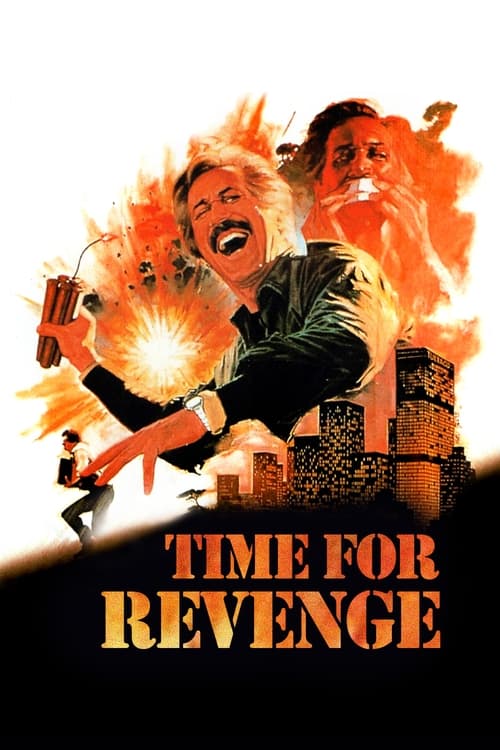
Time for Revenge
1981 · Adolfo Aristarain
For when you want a serious, grown-up thriller about one man against a rotten system — something tense and morally charged that trusts you to read between the lines.
What it's about
Pedro Bengoa, a blacklisted former union militant, takes a job under a false name at a corrupt mining-and-demolition company. A coworker pulls him into a scheme: stage a fake accident, extort a settlement. When the plan goes wrong, Bengoa carries it forward alone — pretending the blast has left him mute, and holding that silence with iron discipline through lawyers, bribes, and threats. Made in Argentina under the military junta, it's a crime thriller that is also, unmistakably, about a country forced to hold its tongue.
The experience
Slow-burn tension of the most disciplined kind — the suspense isn't whether he'll be caught but whether he'll crack, and the film makes his silence feel physically heavy. It's gripping, bitter, and quietly furious.
Performances
Federico Luppi is remarkable as Bengoa, doing much of the film's second half with his voice taken away — everything lives in his eyes, his stillness, and the discipline of a man who has turned refusal into a weapon.
The craft
Adolfo Aristarain wraps political allegory inside airtight genre machinery — every beat works as pure noir even as it doubles as commentary the dictatorship's censors couldn't quite pin down. The plotting is lean and the ending has real force.
Why it matters
A landmark of Argentine cinema made during the junta years, it showed how genre film could smuggle dissent past a dictatorship, and it stands as the defining work of Aristarain's career.
Snapshot
Tiempo de revancha is an Argentine crime thriller that doubles, unmistakably, as a parable of dictatorship-era silence. A blacklisted former labor militant, Pedro Bengoa, takes work under a false name at a mining-and-demolition concern and is drawn into a coworker's scheme to fake an industrial accident and extort a settlement. When the plan turns fatal, Bengoa carries it forward alone by feigning that the blast has left him mute — and then holds that silence with monastic discipline through the legal ordeal, the bribes, and the threats that follow. What begins as a con hardens into an existential stand: the refusal to speak becomes the man's last uncorrupted weapon. Made and released during the Argentine military junta known as the Proceso, the film wraps genre machinery around a study of resistance, complicity, and the price of integrity, and it remains one of the most admired Argentine films of its era and a cornerstone of director Adolfo Aristarain's reputation. The synopsis's "two coworkers blackmail a corrupt company" is accurate as far as it goes, but it undersells the film's central formal gambit — a protagonist who spends most of the picture saying nothing at all.
Industry & production
The film belongs to the last, tense years of Argentina's 1976–1983 dictatorship, a period in which the domestic film industry operated under overt state censorship and an atmosphere of fear, disappearance, and self-policing. Commercial cinema continued — the studios needed product and audiences wanted entertainment — but political speech had to be smuggled in through indirection. Tiempo de revancha is a textbook case of that strategy: it is genre first (a heist-turned-legal-thriller with noir bones) and allegory second, which is precisely how it reached screens intact.
Aristarain came up through the commercial system as an assistant director and genre craftsman before establishing himself as a writer-director, and his early features were made within Argentina's established production apparatus. Tiempo de revancha is generally associated with Aries Cinematográfica Argentina, the prolific company built by Fernando Ayala and Héctor Olivera that produced a large share of the country's mainstream output in this period; readers should treat the exact contractual/production-company details as the kind of credit worth verifying against a primary source, but the film's placement inside that mainstream, studio-adjacent industry is not in doubt. The picture was a substantial critical and popular success at home and traveled internationally on the festival circuit, where it collected awards; I can state that it was widely honored (including recognition from the Argentine critics' Cóndor de Plata and abroad) without being able to reproduce a verified, itemized prize list here, and I will not invent one.
Technology
This is a 35mm color production shot and finished with the conventional photochemical technology of early-1980s commercial filmmaking: anamorphic or spherical lensing (the film reads as widescreen), sync-sound location and studio work, optical/photochemical color timing, and magnetic-then-optical sound transfer for release prints. Nothing about the film is technologically experimental, and that is the point — Aristarain's cinema is built on classical, dependable tools deployed with precision rather than on novelty. The one technology worth foregrounding is not a camera or a stock but a dramaturgical one: the deliberate suppression of the human voice on the soundtrack for long stretches, which throws unusual weight onto every other channel — room tone, effects, music, and the mechanical noise of the industrial world the characters inhabit.
Technique
Cinematography
The visual scheme is functional-realist with a hard, unglamorous edge suited to the material: quarries, work sites, offices, courtrooms, and domestic interiors rendered without prettification. The camera favors clear, legible compositions and controlled coverage over flourish, keeping the audience oriented in a plot that hinges on procedure and proof. I'm not able to attribute the cinematography to a specific director of photography with confidence, so rather than guess I'll describe the effect: the imagery is sober and observational, using the widescreen frame to isolate Bengoa within institutional and industrial spaces, and to register — in close-up — the labor of a face that must communicate everything while the mouth stays shut. That reliance on the actor's eyes and micro-expression is the film's defining photographic demand.
Editing
The cutting is patient and accumulative, built for suspense-by-procedure rather than by action. Because the protagonist cannot speak, the editing must carry meaning that dialogue would normally deliver: reaction shots, glances, the timing of a look held a beat too long, the withholding of a cut so the audience sits inside Bengoa's silence with him. The film's tension is largely a matter of duration — how long a man can not-speak under pressure — and the editorial rhythm is tuned to that endurance test.
Mise-en-scène / staging
Aristarain stages the film around thresholds of power: the shop floor versus the boardroom, the worker versus the lawyer, the individual versus the apparatus. The industrial setting (explosives, demolition, mining) is both literal workplace and metaphor — a world where things are blown apart and buried. Crucially, the film's geography is kept somewhat unfixed; the setting reads as generic-Argentine or even placeless, an ambiguity that let the picture pass censorship while broadening its allegory beyond any single, prosecutable target. Staging repeatedly places Bengoa physically surrounded — by company men, by doctors, by interrogators — so that his stillness and silence become a spatial as well as a moral fact.
Sound
Sound is the film's masterstroke. By making its hero mute, Tiempo de revancha turns silence into an active dramatic force rather than an absence. The soundtrack foregrounds ambient and industrial noise, the speech of everyone around the protagonist, and the pointed gaps where his voice should be. The score — a driving, suspense-oriented accompaniment that Argentine sources commonly credit to composer Emilio Kauderer, a recurring Aristarain collaborator — works with those silences rather than papering over them. The result is a film in which not-speaking is the loudest thing on the track.
Performance
Federico Luppi's Pedro Bengoa is the film's engine and its glory, one of the great performances of Argentine cinema precisely because it is achieved almost entirely without dialogue. Luppi must convey a lifetime of political history, calculation, fear, grief, and finally something like transcendence through posture, gaze, and restraint. Ulises Dumont, as the coworker who hatches the scheme, supplies the volatile, talkative energy that Bengoa's silence will later negate. The surrounding ensemble — company executives, lawyers, doctors, and Bengoa's wife — functions as a chorus of voices pressing against the protagonist's chosen muteness, and the film's power comes from the contrast between their words and his refusal of them.
Narrative & dramatic mode
Structurally the film is a two-part machine. The first movement is a heist/con setup: the recruitment, the scheme, the staging of a fraudulent accident. The second, longer movement mutates into a legal and psychological thriller — a war of attrition between one silent man and an institution determined to expose him as a fraud. The dramatic mode is realist and morally serious, closer to a Costa-Gavras-style political thriller than to escapist crime cinema, but Aristarain keeps the genre pleasures (suspense, reversal, the pleasure of a plan) fully operative. The narrative irony is bitter and precise: a lie about lost speech becomes, over time, an authentic and total silence, and the "revenge" of the title curdles into something more ambiguous than triumph.
Genre & cycle
Tiempo de revancha sits at the intersection of the crime/heist film, the courtroom-adjacent legal thriller, and the political-allegory film. Within Aristarain's own output it belongs to a run of genre-driven, morally weighted thrillers — it is frequently paired with his La parte del león (1978) and his subsequent Últimos días de la víctima (1982) as the work that established him as Argentina's foremost practitioner of intelligent, adult genre cinema. More broadly it belongs to an international cycle of 1970s–80s political thrillers that used the machinery of suspense to speak about repression, corporate/state power, and individual conscience under regimes where direct speech was dangerous.
Authorship & method
Aristarain (b. 1943) is the film's decisive author: he directed and wrote it, and its concerns — masculine codes of honor, the lone man of integrity against a corrupt system, the moral cost of principle — recur across his career, from this film through Un lugar en el mundo (1992), Martín (Hache) (1997), and Lugares comunes (2002). His method fuses classical Hollywood-inflected craft (he was a devoted student of genre) with a European art cinema's ethical seriousness; he is the rare filmmaker who treats suspense and philosophy as compatible.
The central creative partnership visible here is with Federico Luppi, who became Aristarain's on-screen alter ego and the embodiment of his recurring hero type; Tiempo de revancha is the foundation of that lifelong collaboration. Among other key collaborators, composer Emilio Kauderer is the name most often attached to the film's score and to Aristarain's work of this period. For the cinematography and editing credits I would rather flag a genuine gap in what I can verify than attach a name I'm unsure of — the technical crew of the film is not something I can attribute reliably from memory, and those credits should be confirmed against the film's titles or an authoritative database. The screenplay, however, is squarely Aristarain's own, and the film's voice is unmistakably his.
Movement / national cinema
The film is a signal work of Argentine cinema made under the last dictatorship — distinct from, but a bridge toward, the more openly reckoning cinema that flowered after the 1983 return to democracy (the moment of films like La historia oficial). Where post-dictatorship films could name the horror directly, Tiempo de revancha had to encode it, and its greatness is partly the greatness of a work that says the unsayable by dramatizing the impossibility of saying it. It stands within a strong national tradition of literate, socially engaged filmmaking and is routinely cited in surveys and critics' polls of the best Argentine films ever made.
Era / period
1981 is late-Proceso Argentina: economic strain mounting, the Malvinas/Falklands adventure and the regime's collapse still a year or two off, censorship and fear pervasive. The film is a direct expression of that moment's texture — the necessity of masks and false names, the danger of speech, the corrosion of institutions, the way survival could require complicity. Its choice to keep time and place slightly abstract is itself a period artifact: the aesthetics of indirection that authoritarian conditions imposed on serious artists.
Themes
The governing theme is silence as resistance and as cost. Bengoa's muteness begins as fraud and becomes conviction: it is the one thing the system cannot buy, coerce, or refute, and therefore the one place his integrity can survive — but it consumes his marriage, his voice, and arguably his self. Around that core the film develops complicity and corruption (a company, and by extension a society, rotten enough that only a lie can extract justice), the persistence of a political past (Bengoa's militant history shadows every choice), masculine honor and self-sacrifice (the Aristarain hero who pays in full for his principles), and the impossibility of clean victory under an unjust order. The title's promised "revenge" is finally indistinguishable from self-immolation.
Reception, canon & influence
Critically and popularly, Tiempo de revancha was a major success on release and has only grown in stature; it is consistently ranked among the finest Argentine films and is treated as the picture that made Aristarain's name and cemented Luppi as a leading actor of Latin American cinema. It was recognized with awards at home and abroad — I can affirm that it was widely honored without reproducing a precise, verified award ledger, which I won't fabricate.
Looking backward, the film draws on the international political-thriller tradition and on classical American genre construction that Aristarain openly admired, filtered through the specific pressures of dictatorship-era allegory; its lineage runs through the socially conscious suspense cinema of the 1970s more than through any single named source I can document with certainty.
Looking forward, its legacy is threefold. It launched the Aristarain–Luppi partnership that would define both careers and shape a strand of Argentine cinema devoted to the morally uncompromising individual. It stands as a durable model of how to make political cinema under censorship — genre as camouflage, silence as statement — studied and cited well beyond Argentina. And its central conceit, the protagonist who wins by refusing to speak, remains one of the most distinctive dramatic devices in Latin American film, a reference point whenever critics discuss silence, testimony, and resistance on screen. Where the granular production record is thin in this account, I've said so; the film's canonical standing and its influence on Aristarain's subsequent work are not in doubt.
A Deleuzian reading
A man sits in a room full of people who want him to talk.
The full Deleuzian reading of Time for Revenge →
Reception
A box-office hit and critics' darling in Argentina on release in 1981 — remarkable given it came out under the military junta — and it has only climbed since, now a fixture near the top of best-Argentine-films-ever polls.
How Time for Revenge was received, from release to now →
How to watch Time for Revenge: what to notice on a first viewing
- Watch Luppi communicate everything without speaking a word. Bengoa claims to have lost his voice in the blast, and Luppi conveys calculation, fear, and grief afterward almost entirely through posture, gaze, and stillness. The performance turns silence into the loudest thing in the film.
- Listen for how much dialogue happens around Bengoa, not from him. Everyone else, doctors, lawyers, executives, keeps talking at and about him while the soundtrack foregrounds ambient and industrial noise in the gaps where his voice should be. The contrast between their words and his refusal of them is where the film's tension lives.
- Notice the widescreen frame isolating Bengoa in institutional rooms. The camera holds Bengoa alone within offices, courtrooms, and quarries, using close-up on his face to register what dialogue cannot since he will not speak. His isolation in these frames makes the institutional pressure on him visible as physical space.
- Watch Bengoa get physically surrounded in nearly every scene. Aristarain repeatedly stages company men, doctors, and interrogators closing in around him, so his stillness becomes a spatial fact as much as a moral one. Being surrounded and staying silent anyway is the film's real image of resistance.
- Watch how long a held look is allowed to run. The editing sits inside Bengoa's silence rather than cutting away from it, timing reaction shots and pauses to test how long a man can not-speak under pressure. The duration of the cut is doing the work dialogue usually would in a thriller like this.
The whole guide to watching Time for Revenge, with the keys for a rewatch →
Influences: the films it descends from and the films it influenced
- The Wages of Fear (1953) — Its suspense architecture — dread stretched across real-time physical labor among men exploited by a corporate employer — is the slow-burn, duration-driven tension model Aristarain builds the demolition-expert's ordeal on.
- On the Waterfront (1954) — Supplies the classical-Hollywood structure of the working man who redeems himself by testifying against corrupt power, a testimony-as-climax convention Aristarain deliberately inverts by making his hero win through refusing to speak.
- Le Samouraï (1967) — Models the near-dialogue-free, honor-bound loner whose silence is itself the characterization and the code, the taciturn-lead grammar Luppi's performance descends from.
- Once Upon a Time in the West (1968) — Foregrounded silence and deliberately stretched duration as the engine of suspense, plus widescreen framing that isolates the stoic near-mute protagonist — both formal devices Aristarain adopts for his scope compositions.
- Z (1969) — Established the method of using genre suspense mechanics as camouflage to smuggle explicit anti-authoritarian content past censors and audiences, the 'genre as disguise for dissent' template central to Tiempo de revancha.
- State of Siege (1972) — Provides the specifically Latin American political-thriller template in which state and corporate violence is dramatized through cold procedural tension rather than melodrama.
- Illustrious Corpses (1976) — Its investigative-thriller exposure of state–corporate collusion through a somber, functional-realist mise-en-scène prefigures Aristarain's restrained visual approach to institutional corruption.
- Serpico (1973) — The lone man of integrity ground down by an entire corrupt institution, dramatized as sustained moral endurance, is the protagonist archetype Aristarain transplants into a dictatorship-era allegory.
- The Parallax View (1974) — Builds paranoid dread through duration and the spatial isolation of a lone investigator, a suspense-by-isolation technique echoed in the surveillance and entrapment of Aristarain's silent litigant.
- Un lugar en el mundo (1992) — Extends the same authored hero-type — the morally uncompromising individual against a corrupt system — carried by the same Luppi partnership first forged here.
- Martín (Hache) (1997) — Continues the Aristarain–Luppi collaboration and the signature fusion of genre craft with European art-cinema ethical seriousness, treating suspense and philosophy as compatible exactly as its ancestor did.
- Lugares comunes (2002) — Culminates the Luppi man-of-integrity persona built in Tiempo de revancha, the author's recurring lone-man-of-honor closing his career-long variation.
- Cronos (1993) — Recruits the specific Luppi persona Aristarain constructed — the dignified, wounded patriarch of honor — as the film's moral center, importing a collaborator's forged screen identity.
- The Devil's Backbone (2001) — Casts Luppi as the honorable elder amid political violence, again leaning on the gravitas persona first defined in Aristarain's film to anchor a story of atrocity and resistance.
- The Secret in Their Eyes (2009) — Directly inherits the genre-as-camouflage method, smuggling a reckoning with dictatorship-era impunity inside a crime-and-legal thriller whose suspense is built by duration and withheld testimony.
- The Official Story (1985) — An Argentine contemporary that likewise uses an accessible, legible dramatic form as camouflage to confront the dictatorship's crimes, sharing the strategy of testimony-and-silence surfacing repressed truth.
- No habrá más penas ni olvido (1983) — A parallel Argentine political allegory made at the edge of the Proceso, weaponizing recognizable genre construction to critique authoritarian power under censorship.
Similar films
- State of Siege (1972) — influence & lineage
- Z (1969) — influence & lineage
- The Official Story (1985) — influence & lineage
- The Secret in Their Eyes (2009) — influence & lineage
- Martin (Hache) (1997) — influence & lineage
- The Wages of Fear (1953) — influence & lineage
- A Twelve-Year Night (2018) — shared sensibility
- Argentina 1985 (2022) — shared sensibility