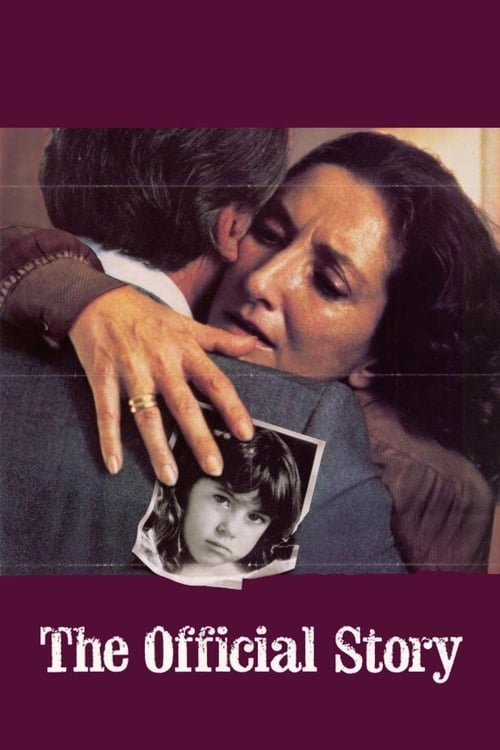
The Official Story
1985 · Luis Puenzo
For when you want a film to chew on for days — a serious, emotionally heavy drama about complicity and the cost of finally looking. Choose it when you're ready to be moved and unsettled, not distracted.
What it's about
Buenos Aires, 1983, as Argentina's military dictatorship crumbles. Alicia is a comfortable high-school history teacher — the kind who teaches the official version of events — with a loving husband and an adored adopted daughter, Gaby. When she begins to ask where Gaby actually came from, the question leads toward the regime's darkest secret: the children of the disappeared, taken from imprisoned mothers and handed to families connected to power.
The experience
A slow, devastating tightening of the screws — it plays as an intimate domestic drama while a whole country's buried history presses in at the edges. You feel Alicia's comfort curdle into doubt and then into moral reckoning, and it stays with you long after.
Performances
Norma Aleandro is extraordinary as Alicia — she charts a woman's entire moral awakening in small shifts of the face, from insulated contentment to dawning horror, and the performance anchors every scene.
The craft
Luis Puenzo tells a national atrocity at kitchen-table scale: classrooms, dinner parties, and living rooms carry the weight, so the politics arrive through marriage and motherhood rather than speeches. The restraint is the power — it trusts a look or a song to land what a lecture couldn't.
Why it matters
Released while Argentina was publicly trying its junta commanders, it became the film through which the world learned about the country's stolen children — and the first Latin American feature to win the Oscar for Best Foreign Language Film.
Snapshot
La historia oficial is the film through which Argentina told the world about its stolen children. Released in April 1985 — barely sixteen months after the military junta relinquished power and in the same year as the Juicio a las Juntas, the landmark public trial of the commanders — it dramatizes the awakening of Alicia (Norma Aleandro), a comfortable Buenos Aires history teacher who slowly comes to suspect that her adopted daughter Gaby was born to a desaparecida: one of the pregnant women detained, tortured, and murdered by the state, their infants handed to regime-friendly families. The film converts a nation's largest unspoken atrocity into an intimate domestic drama of complicity and knowledge, and in doing so became the first Latin American feature to win the Academy Award for Best Foreign Language Film. It remains the canonical cinematic account of the apropiación of children under the 1976–83 dictatorship and a touchstone of transitional-justice cinema worldwide.
Industry & production
The film is a product of the apertura — the sudden cultural opening that followed the collapse of the junta in December 1983 and the inauguration of Raúl Alfonsín's civilian government. Under the dictatorship, Argentine cinema had been throttled by censorship, blacklists, and the exile of many of its writers and directors; the return to democracy dismantled the censorship apparatus almost overnight and unleashed a wave of films confronting the recent past, of which La historia oficial is the most internationally celebrated example.
Luis Puenzo came to the project from a successful career in advertising, where he ran his own production house (Cinemania). This gave him an unusual degree of independence: he was able to mount the film through his own company rather than depending wholly on the state film institute, though the exact financing structure is not something I can detail precisely from the public record without risking invention. What is clear is that the film was made quickly and relatively cheaply, and that its commercial polish — a legacy of Puenzo's advertising craft — was part of its strategy: it looks and moves like a mainstream drama, not an underground testimony, which is precisely how it reached audiences unaccustomed to political cinema.
The timing was extraordinary and to some degree deliberate. The film reached Argentine screens as the trial of the junta commanders was underway and as the Abuelas de Plaza de Mayo — the Grandmothers of the Plaza de Mayo, who had been searching for their abducted grandchildren since the late 1970s — were becoming an internationally recognized human-rights movement. The film did not create that context; it rode it, and amplified it. Its international breakthrough came at the 1985 Cannes Film Festival, where Norma Aleandro won the Best Actress prize (shared with Cher). It went on to take the Golden Globe and then the Academy Award for Best Foreign Language Film at the March 1986 ceremony, with Puenzo and co-writer Aída Bortnik also earning an Oscar nomination for Best Original Screenplay.
Technology
La historia oficial is a conventional 35mm color production of its moment, and its interest lies less in any technological novelty than in the deliberate ordinariness of its means. There is no formal experimentation with the image, no stylistic distancing device; the film uses the standard tools of narrative realism — location and studio interiors, naturalistic color, a classical continuity system — because its argument depends on looking like the everyday bourgeois world it is indicting. This is a case where restraint of technique is itself the technological choice: the machinery of filmmaking is kept invisible so that the domestic surface can appear seamless until it cracks.
Technique
Cinematography
The cinematography is by Félix Monti, one of the most distinguished Argentine directors of photography of his generation, who would go on to shoot for Fernando Solanas and María Luisa Bemberg among others. Monti's work here is restrained and observational, built around the well-appointed apartment that is Alicia's world: warm, upholstered interiors, controlled available-light naturalism, framings that keep the family unit whole in the early scenes and then progressively isolate Alicia as her certainty dissolves. The camera favors the human face — this is fundamentally a film of looks, recognitions, and things not said — and Monti lights Aleandro to register the micro-shifts of a woman thinking her way toward a truth she does not want. The visual scheme is designed to make comfort feel claustrophobic: the bourgeois home, photographed with affection, becomes a place of concealment.
Editing
The editing organizes the film as a gradual epistemological unraveling. Rather than a thriller's accelerating montage, the cutting tends to hold on performances and let realizations land in real time, then punctuate them with the intrusion of the outside world — the street, the demonstration, the classroom, the friend returned from exile. The film's rhythm is that of accumulating doubt: scene by scene, information is deposited and the domestic idyll is revised in retrospect. I would not want to over-specify individual editorial decisions beyond what is verifiable, but the governing logic is clear — the montage withholds and then discloses, mirroring Alicia's own movement from not-knowing to knowing.
Mise-en-scène / staging
The mise-en-scène draws a hard line between two spaces: the sealed, tasteful interior of the family apartment and the charged public sphere of Buenos Aires in 1983 — the classroom where students challenge the "official" version of history, the Plaza de Mayo where the mothers and grandmothers circle with photographs of the missing. The staging repeatedly brings the political into the domestic through thresholds: a door, a telephone, a returning friend, a stranger's face. The film's most famous structuring device is Alicia's profession itself — she teaches official history and insists to her students that history is written from documents — so that her private investigation becomes a rebuke of her own pedagogy. The child Gaby is staged as the innocent center around whom the adults' guilt organizes; the recurring nursery song "En el país de Nomeacuerdo" ("In the Land of I-Don't-Remember") by María Elena Walsh operates as a mise-en-scène element charged with irony — a children's rhyme about forgetting, sung in a country built on enforced amnesia.
Sound
The score is by Atilio Stampone, a tango pianist and composer of the Piazzolla generation, and the film's sonic identity is bound up with that tango lineage and with the Walsh song threaded through the drama. The sound design otherwise privileges the naturalism of the domestic and the street — the murmur of a dinner party, the chants of a demonstration, the silences that fall between husband and wife as knowledge becomes unavoidable. Sound is used less for suspense than for the texture of a specific place and time.
Performance
Performance is the film's supreme instrument. Norma Aleandro's Alicia is one of the great screen studies of moral awakening: she plays the part almost entirely through the face and the body's growing unease, moving from a well-defended incuriosity to devastation without ever tipping into the melodramatic register the material could have invited. Héctor Alterio, as her husband Roberto — a businessman whose fortunes are tied to the regime — gives the film its counterweight: a man who chose not to ask where the child came from and who turns violent when his wife finally does. The supporting performances anchor the film's testimonial dimension: Chunchuna Villafañe as Ana, the friend returned from exile whose account of torture and of babies taken from detained women is the hinge of Alicia's suspicion; and Chela Ruíz as Sara, the grandmother searching for her lost descendants, whose scenes give a face to the Abuelas movement. The young Analía Castro plays Gaby.
Narrative & dramatic mode
The dramatic mode is domestic melodrama repurposed as political inquiry. The film adopts the shape of a woman's-picture — a wife and mother whose settled world is destabilized — and pushes it toward tragedy and indictment. Crucially, it is built as a detective story in which the investigator is also, unknowingly, an accessory: Alicia's search for Gaby's origins is simultaneously an investigation into her own willed ignorance and her husband's guilt. This gives the narrative its distinctive doubling — every fact she uncovers about the disappeared is also a fact about herself. The film withholds full confirmation and resists tidy resolution; it ends not with restitution but with rupture, leaving the audience to sit inside the unresolved horror rather than releasing them from it.
Genre & cycle
La historia oficial belongs to the wave of post-dictatorship Argentine "cine de la democracia" — films made in the immediate aftermath of 1983 that reckoned directly with state terror, alongside works such as Solanas's later Sur and Bemberg's historically minded dramas. More broadly it is a foundational work in the international cycle of transitional-justice and "memory" cinema: films that dramatize how societies confront atrocity committed by their own governments. Within that field it occupies a specific niche — the drama of the bystander and the beneficiary, the citizen who did not pull the trigger but who lived comfortably off the silence.
Authorship & method
The film is authored jointly by Puenzo and screenwriter Aída Bortnik, and their collaboration is central to understanding it. Bortnik was among the most respected screenwriters in Argentine cinema (earlier associated with the acclaimed La tregua) and had experienced the dictatorship's repression firsthand; her contribution grounds the film's political testimony and its precise sense of how complicity is lived at the level of dinner conversation and marital habit. Puenzo, arriving from advertising, brought the commercial fluency that made the film legible to a mass and international audience — a method that some critics have read as the source of both the film's reach and its occasional conventionality. His key collaborators — cinematographer Félix Monti, composer Atilio Stampone, and his cast, above all Aleandro and Alterio — execute a strategy of realist restraint in which the horror is delivered through recognizable, upholstered normalcy rather than spectacle. Puenzo's subsequent career (including the English-language Old Gringo in 1989) never again reached this cultural resonance, which marks La historia oficial as the defining work of his authorship.
Movement / national cinema
The film is inseparable from the rebirth of Argentine national cinema after 1983. The dictatorship had exiled, silenced, or killed a generation of filmmakers and writers; the democratic transition produced both an audience hungry to see its recent history addressed and an industry newly free to address it. La historia oficial became the emblem of that moment internationally — the film that announced Argentine cinema's return to the world stage and that tied national cinema explicitly to the project of national memory and accountability. Its Oscar was received at home as a validation not only of a film but of a democratic reckoning still in progress.
Era / period
The film is set with pointed precision in 1983, in the "last and turbulent days" of the junta, and made in 1984–85 as those events were still raw and legally live. This near-simultaneity of subject and production is essential: the film is not a historical reconstruction of a settled past but an intervention in an unfolding present, released while the commanders were on trial and while the Abuelas were locating stolen grandchildren through the earliest uses of genetic testing. It captures a society in the act of deciding whether to remember or to forget — the "official story" of the title being precisely the sanctioned amnesia the film refuses.
Themes
Its central themes are complicity and the ethics of not-knowing: the film's real subject is not the torturers but the class that benefited from and averted its eyes from the terror. It interrogates history and truth — who authors the official record, and at what human cost — through Alicia's own profession as a history teacher. It dramatizes motherhood as a moral battleground, setting the love of an adoptive mother against the claim of a murdered biological one and the searching grandmother. And it insists on memory as a political act, treating forgetting (encapsulated in the Walsh lullaby about "the land of I-don't-remember") as the mechanism by which atrocity is normalized. Underlying all of these is the question of individual responsibility within collective guilt.
Reception, canon & influence
Critically, the film was received as a breakthrough — the international press treated it as the voice of a traumatized nation finding words for its wound — and its awards (Cannes Best Actress for Aleandro, the Golden Globe, and the 1986 Academy Award for Best Foreign Language Film, plus the Original Screenplay nomination) cemented its global standing. Some later critical reassessment has noted the tension between its human-rights urgency and its conventional melodramatic form, but its historical importance is undisputed.
Its influences run backward to the traditions of Latin American melodrama and to the testimonial impulse of the human-rights movements — above all the Abuelas de Plaza de Mayo, whose real-world search for stolen children is the film's factual bedrock. Forward, its legacy is substantial: it established the "stolen children" of the dictatorship as a subject of world cinema and prefigured a long line of Argentine memory films, culminating in works like The Secret in Their Eyes (2009), which likewise fused genre storytelling with the reckoning of state terror and likewise won the Foreign Language Oscar. More broadly, La historia oficial became a global reference point for how a national cinema can metabolize atrocity into art in real time — studied in courses on human rights, Latin American history, and transitional justice as much as in film curricula. It is, finally, remembered as the film that made the abstraction of "the disappeared" unbearably concrete for audiences who had the luxury of not knowing.
A Deleuzian reading
A history teacher stands at the front of a Buenos Aires classroom in 1983 and tells her students that history is written from documents.
The full Deleuzian reading of The Official Story →
Reception
An instant landmark in 1985 — Cannes prizes, then the first Latin American film ever to win the Best Foreign Language Film Oscar — it's since been slightly reframed by critics as the polished, 'respectable' face of post-dictatorship Argentine cinema, even as its historical importance keeps growing.
How The Official Story was received, from release to now →
How to watch The Official Story: what to notice on a first viewing
- Watch how the apartment stays sealed while the street stays loud. The film keeps a hard line between the tasteful, quiet family apartment and a charged public Buenos Aires of classrooms and demonstrations. The contrast tells you which world this family has chosen to live inside.
- Listen for the nursery song about a land of not remembering. María Elena Walsh's 'En el país de Nomeacuerdo' recurs through the film, a children's rhyme about forgetting sung inside a country built on enforced amnesia. A lullaby is doing the film's political work while nobody in the scene notices.
- Watch Alicia's face more than her words in every classroom scene. Monti lights and frames Norma Aleandro to register small shifts of thought, so her growing unease reads on her face well before she says anything. You can watch her figuring something out before the plot ever confirms it.
- Notice every threshold in the film: doors, phones, a returning friend. The film keeps bringing the outside world into the apartment through specific crossings, a doorway, a phone call, a visitor, rather than through exposition. Each threshold is where the political stops being abstract and becomes something standing in the room.
- Watch how the film frames Alicia teaching history to her students. Alicia insists to her class that history is written from documents, a claim the film stages early and then quietly tests against her. Her own profession becomes the standard her private investigation will eventually be measured against.
The whole guide to watching The Official Story, with the keys for a rewatch →
Influences: the films it descends from and the films it influenced
- La tregua (1974) — Aída Bortnik co-wrote it and Héctor Alterio starred, establishing the Argentine domestic-realist register — political feeling registered through marriage, routine and quiet dialogue — that Bortnik sharpens here into complicity lived at the dinner table.
- Z (1969) — Its procedural cutting reconstructs a state crime fact by fact, each revelation retroactively reframing the last — the model for the film's 'epistemological-unraveling' editing in which Alicia's discoveries dismantle her own certainty.
- Missing (1982) — Dramatizes a complacent conservative citizen forced by a personal search to recognize a Latin American junta's disappearances — the exact 'detective-as-accessory' arc, transposed onto a family member who begins as an unwitting accomplice to not-knowing.
- The Spirit of the Beehive (1973) — Refracts dictatorship entirely through a hushed domestic interior and a child's uncomprehending gaze, delivering political horror via available-light stillness rather than spectacle — the grammar of terror-in-upholstered-normalcy Monti and Puenzo adopt.
- Rome, Open City (1945) — The neorealist template of available-light naturalism fused with melodrama-as-testimony — shooting atrocity inside ordinary apartments and domestic routine — is the realist-restraint method Félix Monti's cinematography descends from.
- Memories of Underdevelopment (1968) — New Latin American Cinema's anatomy of bourgeois complicity — the comfortable intellectual who fails to see the history around him — supplies the class critique the film aims at Alicia and Roberto's insulated household.
- The Battle of Chile (1975) — Its testimonial-documentary method, treating the camera as evidentiary witness to state terror and the survivor's account as historical record, feeds the film's grounding in real Abuelas testimony and its ethic of memory-as-evidence.
- Imitation of Life (1959) — Weaponizes the upholstered domestic mise-en-scène of melodrama into social critique, proving that the 'conventional melodramatic form' can carry a subversive charge — the strategy that lets Puenzo's advertising fluency smuggle political inquiry into a mass-legible tearjerker.
- The Secret in Their Eyes (2009) — Fuses a genre engine (detective thriller plus thwarted romance) with reckoning over dictatorship-era impunity and, like this film, structures the plot so investigation implicates the investigator — the two Argentine Foreign-Language Oscar winners bookend the strategy.
- Cautiva (2003) — Takes the Abuelas 'stolen children' plot this film introduced to world cinema and retells it from the child's point of view — a teenager discovering she was appropriated from disappeared parents — inverting Alicia's maternal search into the adoptee's.
- Kamchatka (2002) — Focalizes the junta through a young boy as his family goes into hiding, staging disappearance against domestic normalcy — extending the film's 'domestic-vs-public-sphere' method of registering state terror through household detail.
- Infancia clandestina (2011) — Second-generation memory film that lives the dictatorship inside a clandestine household through a child's daily routine, prolonging the film's insistence that history is metabolized at the level of the dinner table and the marital habit.
- Wakolda (The German Doctor) (2013) — Directed by Puenzo's daughter, it delivers evil through bourgeois domestic normalcy — a genteel family unknowingly harboring Mengele — directly inheriting the paternal method of horror-through-recognizable-upholstered-normalcy and complicit not-knowing.
- Argentina, 1985 (2022) — Makes the film's 'transitional-justice-cinema' strain literal by dramatizing the Trial of the Juntas, turning legal reckoning into popular narrative — the culmination of Puenzo's project of converting atrocity into mass-legible drama in near-real time.
- Los rubios (2003) — A self-reflexive memory film that foregrounds 'memory-as-political-act' by interrogating its own reconstruction — reacting against this film's realist melodramatic certainty and exposing the seams the earlier work smooths over.
- Four Days in September (1997) — Shares cinematographer Félix Monti, whose grave, restrained naturalism and testimonial dignity in dramatizing dictatorship guilt carry directly into Barreto's lighting and framing.
- I'm Still Here (2024) — Renders dictatorship terror entirely from inside a bourgeois home through a woman's slow dawning comprehension, the interior/domestic vantage on desaparecidos that Salles adopts over any torture-chamber depiction.
- Son of the Bride (2001) — Norma Aleandro's face-first, close-held performance of a woman undergoing a private reckoning is the exact register Campanella recruits for her dementia turn, importing the Argentine prestige tradition of routing national trauma through one household's kitchen-and-dinner-table intimacy.
- Innocent Voices (2005) — Template for Latin American dirty-war testimonial cinema that translates state terror into a legible domestic melodrama — the accessible-witness register, and the reservation about simplification, that Voces inocentes shares.
- A Twelve-Year Night (2018) — Founding text of Southern Cone dictatorship-memory drama that dramatizes state terror through domestic restraint rather than atrocity spectacle, setting the regional template of humane understatement Brechner works within.
- Machuca (2004) — Registers the Chilean coup through a child's-eye domestic melodrama of class and friendship, deploying the same strategy of witnessing state violence via private household and schoolyard normalcy in the neighboring national cinema.
- Nostalgia for the Light (2010) — Builds its form around mothers searching a desert for the remains of the disappeared, treating memory as an active political and moral labor — the same testimonial search-for-the-vanished that anchors the film's debt to the Plaza de Mayo movement.
- Quo Vadis, Aida? (2021) — An ordinary person's dawning confrontation with an institution's crimes, structured as a slow reckoning that detonates in its final act.
- Time for Revenge (1981) — An Argentine contemporary that likewise uses an accessible, legible dramatic form as camouflage to confront the dictatorship's crimes, sharing the strategy of testimony-and-silence surfacing repressed truth.
- Red Dawn (1990) — Uses the domestic interior as the stage on which state crime and disappearance are slowly disclosed, contracting national trauma to a single household's reckoning.
Similar films
- Argentina 1985 (2022) — influence & lineage · same viewing thread
- Missing (1982) — influence & lineage · same viewing thread
- Z (1969) — influence & lineage · same viewing thread
- The Secret in Their Eyes (2009) — influence & lineage
- I'm Still Here (2024) — same viewing thread
- Twenty Years Later (1984) — same viewing thread
- Sambizanga (1973) — same viewing thread
- A Twelve-Year Night (2018) — same viewing thread
All the films related to The Official Story →
Watch it with: curated runs of related films
- The Long Shadow of the Coup — A run of films tracing political violence from the mutiny and the massacre through martial law to the decades-long reckoning that follows — watch them near each other and the same machinery of power keeps rhyming across continents and eras.