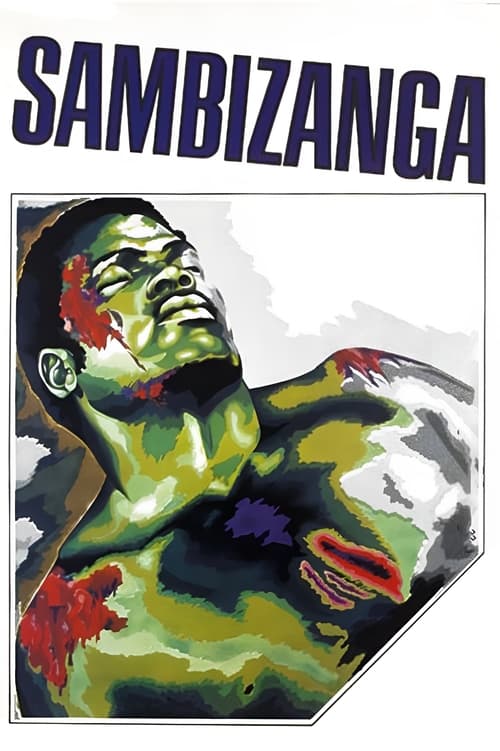
Sambizanga
1973 · Sarah Maldoror
For when you want cinema that matters — a film to watch when you're ready to be moved and angered, and to think about it for days. Challenge over comfort, and worth it.
What it's about
Angola, on the eve of the 1961 uprising against Portuguese rule. Domingos, a tractor driver secretly aiding the independence movement, is seized by the secret police — and his wife Maria walks from jail to jail with their baby on her back, asking each official the same question: where is he? Her search becomes a portrait of a whole colonized society on the edge of revolt.
The experience
Gripping and sorrowful, but never grim in the way you'd expect — it's full of saturated color, work songs, and communal life, so the injustice hits harder because the world at stake feels so alive. It builds with the weight of a march.
The craft
Sarah Maldoror, trained in Moscow and an assistant on The Battle of Algiers, refused agitprop austerity: she shot in defiant, saturated color, filled the soundtrack with work songs, and cast exiled Angolan militants while the war was still being fought, filming across the border in Congo-Brazzaville. It's political cinema that insists on beauty.
Why it matters
One of the first features directed by a woman of African descent and the first great fiction film of the African liberation struggles — a founding work that generations of political filmmakers have looked back to.
Sarah Maldoror — born in France to Guadeloupean roots, trained in Moscow alongside Ousmane Sembène, an assistant on The Battle of Algiers — made the first great fiction feature of the African liberation struggles, and one of the first features directed by a woman of African descent anywhere. Adapting José Luandino Vieira's novella, written in a Portuguese prison, she follows Maria, whose husband, a tractor driver secretly aiding the independence movement, is seized by the secret police on the eve of Angola's 1961 uprising; Maria walks from jail to jail with a baby on her back, asking where he is. With Angola still at war, Maldoror shot in Congo-Brazzaville, casting exiled militants — she was married to MPLA leader Mário Pinto de Andrade — yet she refused agitprop austerity, insisting revolution be rendered in saturated color, work songs, faces, and a woman's stamina rather than gunfire. It won the Tanit d'Or at Carthage in 1972, then spent decades nearly impossible to see, until a 2021 restoration by the African Film Heritage Project returned it to circulation.
A Deleuzian reading
A woman walks.
The full Deleuzian reading of Sambizanga →
Reception
Feted abroad on release — it took the Tanit d'Or at Carthage in 1972 — while banned in Portuguese-ruled Angola itself, then drifted out of circulation for decades; the 2021 4K restoration (via The Film Foundation's African Film Heritage Project) turned it from a footnote into a rediscovered classic.
How Sambizanga was received, from release to now →
Influences: the films it descends from and the films it influenced
- The Battle of Algiers (1966) — Maldoror trained on its set as an assistant director and carried over its newsreel-grain docufiction texture and its casting of nonprofessionals as revolutionaries and detainees.
- Rome, Open City (1945) — Supplies the neorealist template — real streets, nonprofessional faces, and a woman's-eye view of life under occupation — that Pontecorvo transmitted directly into Maldoror's method.
- Monangambeee (1968) — Her own debut short, also adapted from Luandino Vieira, first works out the prison-visit-and-waiting structure and the Angolan-detainee subject that Sambizanga expands to feature length.
- Black Girl (La Noire de...) (1966) — Founds the francophone African feature by anchoring the film in an African woman's interior perspective through a spare, literary short-story adaptation — Sambizanga's exact narrative posture.
- The Hour of the Furnaces (1968) — Codifies the Third Cinema aesthetic of militant address and the collective, anti-Hollywood cinematic grammar within which Sambizanga positions its political drama.
- Les statues meurent aussi (1953) — The anticolonial essay-film from Maldoror's Parisian négritude milieu, indicting colonialism's cultural violence — the intellectual precondition for her liberation cinema.
- Sarraounia (1986) — Extends African liberation cinema into an anticolonial historical epic of armed resistance, keeping the nonprofessional ensemble and location-realist staging.
- Camp de Thiaroye (1988) — Carries the political-drama-of-colonial-injustice tradition forward with an ensemble nonprofessional cast reconstructing a real atrocity on substitute locations.
- Flame (1996) — Tells Zimbabwe's liberation war explicitly through its women combatants — the direct heir to Sambizanga's insistence on viewing armed struggle from a woman's perspective.
- Lumumba (2000) — Dramatizes African independence-era political martyrdom with the same anticolonial-tragedy arc, dignifying a doomed liberation figure through restrained, fact-anchored staging.
- Atlantics (2019) — A Senegalese woman's-perspective drama whose maker openly reclaims this francophone-African political-cinema lineage, recentering the emotional cost of struggle on the women left behind.
- Leila and the Wolves (1986) — Maldoror routes anti-colonial armed struggle through a woman's point of view with lyrical, saturated compositions, the woman-as-resistance framing Srour extends across four historical epochs.
- Sugar Cane Alley (1983) — Maldoror's method of filming anticolonial politics entirely through domestic and village geography — a woman walking prison to prison, repression registered as spatial obstruction rather than depicted violence — is the staging principle behind Palcy's plantation, where the béké house, the overseer's shop and the cases are laid out as a map of power.
- Soleil Ô (1970) — Contemporaneous francophone-African anticolonial feature built on nonprofessional performers and a fragmented, agitational style aimed at colonial dehumanization.
- Lucía (1968) — Cuban revolutionary cinema that narrates historical struggle explicitly through women's perspectives, the same gendered vantage Sambizanga takes on the Angolan revolt.
- Emitaï (1971) — Anticolonial resistance drama scored by collective work and resistance songs and staged with a rural nonprofessional cast — shared sound and casting craft.
- Harvest: 3,000 Years (1976) — Peasant-labor drama using a nonprofessional cast, work-song sound, and saturated on-location realism to render structural oppression concretely.
- Moolaadé (2004) — A woman's political awakening carried by a single female protagonist's journey makes it the earlier African social-advocacy film centering feminine agency that Moolaadé answers.
- West Indies: The Fugitive Slaves of Liberty (1979) — From Hondo's same Paris-based pan-African militant milieu, it dramatizes anti-colonial struggle with lyrical, processional staging of oppression and mourning as collective ritual.
- Soleil O (1973) — Emerges from the same Paris-based Compagnie des Griots personnel pool as Hondo and Robert Liensol, and shares its casting method: trained Black stage actors directed toward frontal, withheld stillness instead of naturalist behavior.
Similar films
- Camp de Thiaroye (1988) — influence & lineage
- Foreign Land (1996) — same viewing thread
- Soundtrack to a Coup d'Etat (2024) — same viewing thread
- I'm Still Here (2024) — same viewing thread
- The Official Story (1985) — same viewing thread
- Twenty Years Later (1984) — same viewing thread
- The Given Word (1962) — often watched together
- Emitaï (1973) — shared sensibility
All the films related to Sambizanga →
Watch it with: curated runs of related films
- The Long Shadow of the Coup — A run of films tracing political violence from the mutiny and the massacre through martial law to the decades-long reckoning that follows — watch them near each other and the same machinery of power keeps rhyming across continents and eras.