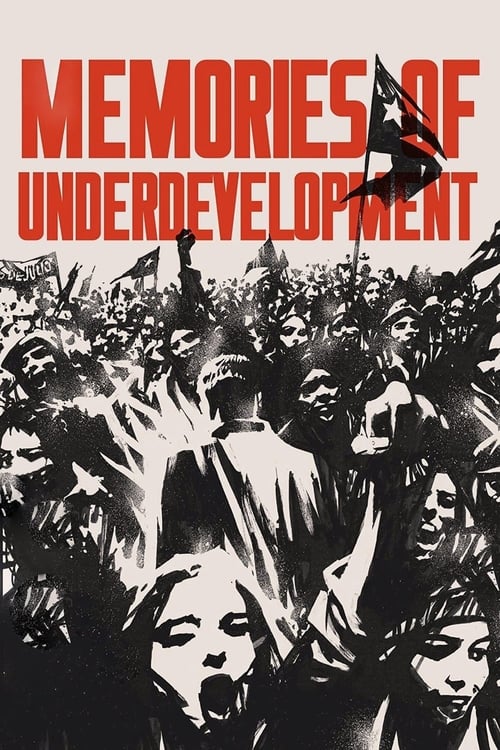
Memories of Underdevelopment
1968 · Tomás Gutiérrez Alea
When you want a film to argue with — something smart, morally slippery, and made to be chewed on for days rather than comfort food. It asks a little work of you and pays it back.
What it's about
Havana, just after the Bay of Pigs. Sergio, a comfortable bourgeois with literary ambitions, puts his wife and parents on a plane to Miami and stays behind — not out of conviction, but curiosity and inertia. From his high-rise apartment he watches the Revolution remake the city, drifts through affairs with younger women, and gets entangled with Elena, a girl he tries to reshape into his own image of sophistication.
The experience
Cool, ironic, and quietly devastating — you're locked inside the head of a man too intelligent to fool himself and too paralyzed to change. It moves like a restless essay, mixing his private musings with bursts of newsreel and street life, and it leaves you unsettled about where your own sympathies sit.
Performances
Sergio Corrieri carries nearly every frame as Sergio, making detachment itself magnetic — witty and seductive on the surface, with the hollowness always visible underneath.
The craft
Alea splices fiction with documentary footage, photographs, and overheard debate so seamlessly that Sergio's private world and Cuba's public upheaval keep bleeding into each other. The freewheeling structure — voiceover, flashback, real newsreels — feels startlingly modern, and the black-and-white images of emptying Havana are haunting in themselves.
Why it matters
It became the defining work of post-revolutionary Cuban cinema and a landmark of Latin American film worldwide — proof that a revolution's own film institute could produce self-questioning art rather than simple propaganda.
Snapshot
Memorias del subdesarrollo is the film through which the Cuban Revolution learned to look at itself with irony. Adapted from Edmundo Desnoes's short novel, it follows Sergio, a bourgeois would-be writer who declines to flee to Miami with his wife and parents after the Bay of Pigs, and instead lingers in a Havana emptying of his own class. From his high apartment he watches — through a telescope, through plate glass, through the scrim of his own cultivated detachment — a society remaking itself without him. The film's greatness lies in its refusal to resolve the contradiction it stages: Sergio is lucid, cruel, and self-aware enough to diagnose the "underdevelopment" of everyone around him, yet paralyzed by the same condition, unable to act, love, or belong. Alea builds this portrait not as straight fiction but as a collage — dramatized scenes braided with newsreel, still photography, an on-screen intellectual round table, and a torrent of interior monologue — so that the private malaise of one man is continually measured against the public event of a revolution. It remains the most internationally celebrated work of post-1959 Cuban cinema and one of the essential films of the New Latin American Cinema.
Industry & production
The film is a product of ICAIC, the Instituto Cubano del Arte e Industria Cinematográficos, established in March 1959 as one of the revolutionary government's first cultural acts. ICAIC concentrated Cuban film production, distribution, and (in principle) exhibition under a single state institution, and Alea — a founding figure, back from studies at Rome's Centro Sperimentale di Cinematografia — was among its central directors. Memorias was made within this state framework rather than a commercial one: there was no box office to answer to in the Western sense, and the picture's economy was shaped by the U.S. embargo, which constrained access to film stock, equipment, and foreign markets while paradoxically freeing directors from profit imperatives.
The screenplay was written by Alea together with Desnoes, adapting Desnoes's 1965 novel (published in English as Inconsolable Memories). The collaboration is unusually close to its source in voice while transforming its method: Desnoes's first-person literary monologue becomes a multi-textured audiovisual essay. Documentation of precise budget figures and shooting schedules is thin in the widely available record, and I won't invent them; what is well established is that the film was produced entirely within ICAIC's resources and shot on location in a Havana that provides much of its documentary charge.
Technology
Memorias was shot in 35mm black-and-white, a choice both aesthetic and material: monochrome suited the film's newsreel intertextuality and its austere, essayistic register, and it aligned with the resource realities of embargo-era ICAIC. The production's most consequential "technology" is arguably archival: Alea and his editor integrate found footage — wartime and revolutionary newsreels, photographs of atrocity and of Havana life, media images of the missile-crisis brinkmanship — so that the apparatus of the film includes the whole documentary record it quotes. Optical and editorial means (freeze frames, photographic stills held on screen, the interruption of drama by document) do much of the expressive work that a color palette or elaborate camera rigs might in another production. The film thus demonstrates the "imperfect cinema" premise that meaning could be generated from montage and juxtaposition rather than from technical polish or expensive spectacle.
Technique
Cinematography
Ramón F. Suárez's camerawork is central to the film's structure of looking. Sergio is defined by vision-at-a-distance — the telescope panning across rooftops, the long-lens gaze that turns the city and its women into objects of contemplation — and Suárez repeatedly frames him behind glass, on balconies, or isolated in the deep space of his apartment, visual correlatives of his estrangement. Elsewhere the film shifts registers entirely, adopting a loose, hand-observed, quasi-documentary immediacy for street footage that could pass for newsreel. This oscillation between composed, reflective framing and grabbed reality is deliberate: the camera's mode itself dramatizes the gap between the intellectual's aestheticized distance and the revolution's lived texture.
Editing
The editing, by Nelson Rodríguez — one of Alea's most important long-term collaborators — is the film's signature achievement. Memorias is built on collision: dramatized scenes cut against archival footage, memory against present, Sergio's fantasy against fact. The montage is essayistic and dialectical, closer to the tradition of Soviet intellectual cinema and the modernist essay-film than to seamless continuity. Voiceover frequently ironizes the image, or the image undercuts the voiceover; a private recollection dissolves into a public catastrophe. The famous set pieces — the intellectual round table on "literature and underdevelopment," the flashbacks to Sergio's marriage, the concluding legal proceedings — are stitched into this associative fabric so that the film reads as a mind in the act of composition, sorting and failing to master its materials.
Mise-en-scène / staging
Space in Memorias is a moral diagram. Sergio's apartment — high, cluttered with the abandoned objects of a departed class, walled in glass — is a vantage and a prison, the perch of a spectator who cannot descend into history. The city below, shot on location, supplies the reality he holds at arm's length. Staging repeatedly places Sergio as observer at the edge of the frame or the event: watching, recording, curating. Against this, the film inserts documentary spaces — the round table, the streets, sites of the revolution's mobilization — where he is a visitor rather than a participant. The recurring props of vision (telescope, camera, mirrors, plate glass) organize the staging around the theme of a gaze that substitutes for engagement.
Sound
The soundtrack is dominated by Sergio's interior monologue, an almost continuous first-person voiceover that carries the novel's confessional intimacy and its unsparing irony. This narration is the film's most literary element and its most treacherous: it seduces the viewer into Sergio's clever perspective even as the images and montage expose its limits. Leo Brouwer's score — spare, modernist, at times dissonant — refuses lush emotional underscoring, keeping the film's affect cool and analytical. Ambient and documentary sound (crowds, radio, the media clamor of the missile crisis) breaks in to reassert the public world against the private voice.
Performance
Sergio Corrieri, in the central role, gives one of Latin American cinema's landmark performances: urbane, sardonic, physically composed, and quietly hollow. The achievement is to make Sergio magnetic without exonerating him — the audience is drawn to his intelligence and repelled by his coldness in the same gesture. Daisy Granados plays Elena, the young woman Sergio pursues and tries to remake in the image of his lost wife; her performance registers the character both as Sergio condescendingly sees her (unformed, "underdeveloped," inconsistent) and as a person exceeding his framing. Eslinda Núñez appears as Noemí. The mixing of professional actors with documentary faces reinforces the film's shuttling between fiction and record.
Narrative & dramatic mode
The film's mode is the reflexive essay-fiction. Its through-line — Sergio's drift from the Bay of Pigs (April 1961) toward the Cuban Missile Crisis (October 1962), his affair with Elena, and the ensuing accusation and trial — is deliberately loose, subordinated to a structure of memory, digression, and commentary. Interior monologue governs the temporality, so the film moves by association rather than causation, folding flashbacks to Sergio's marriage and his émigré family into his present idleness. Brechtian distanciation is fundamental: rather than absorbing us into Sergio's plight, Alea keeps interrupting identification — with document, with the round table's abstractions, with montage that judges the protagonist. The result is a first-person film that is also a critique of its first person, an intimate narration continually placed under historical arrest.
Genre & cycle
Nominally a drama, Memorias belongs less to a genre than to a moment: the international modernist art cinema of the 1960s and, more specifically, the revolutionary cinema of underdevelopment. Its portrait of ennui, sexual restlessness, and intellectual paralysis converses openly with European modernism — the alienation studies of Antonioni, the essayistic reflexivity of the French New Wave, the documentary-fiction hybrids of the period. But Alea repurposes that vocabulary for a decolonizing, revolutionary end, turning the bourgeois-alienation film against the bourgeois himself. Within Cuban cinema it stands at the head of a cycle of politically searching, formally adventurous features that ICAIC produced in its first fertile decade, and beside Alea's own later masterworks of ironic historical reckoning.
Authorship & method
Alea (1928–1996), nicknamed "Titón," was the pivotal figure of revolutionary Cuban cinema, and Memorias is the clearest early statement of his method: an unwavering commitment to the Revolution paired with an insistence that revolutionary art must be critical, dialectical, and unafraid of contradiction. He later theorized this stance in his essay Dialéctica del espectador (The Viewer's Dialectics, 1982), which argues for a cinema that provokes active, critical spectatorship rather than passive consumption — a program Memorias enacts fifteen years earlier.
His key collaborators are inseparable from the achievement. Edmundo Desnoes, as novelist and co-screenwriter, supplied the corrosive first-person voice and even appears within the film's round-table sequence, a reflexive gesture that folds the author into the fiction. Cinematographer Ramón F. Suárez built the film's grammar of distanced looking. Editor Nelson Rodríguez realized its dialectical montage. Composer Leo Brouwer — a major figure of twentieth-century guitar and concert music, and a central presence in ICAIC's music department — provided a modern, unsentimental score. This is auteur cinema in the fullest sense, but an auteurism embedded in a collective, state-institutional practice.
Movement / national cinema
Memorias is a cornerstone of the Nuevo Cine Latinoamericano — the New Latin American Cinema — and of the broader Third Cinema impulse that sought an anti-imperialist, decolonizing alternative to both Hollywood ("first cinema") and European auteur cinema ("second cinema"). It is closely associated with the Cuban theory of "imperfect cinema" articulated by Alea's colleague Julio García Espinosa in Por un cine imperfecto (1969), which prized process, engagement, and montage-of-reality over technical perfection and spectacle. As the international showpiece of ICAIC, the film became, for audiences abroad, the emblem of what a revolutionary national cinema could be: intellectually rigorous, formally daring, and self-critical rather than propagandistic.
Era / period
The film is doubly of its era. Diegetically it is anchored to the most dangerous window of the Cuban Revolution — from the failed Bay of Pigs invasion through the nuclear brinkmanship of October 1962 — and it uses period media and newsreel to keep that history pressing on Sergio's private drift. Produced in 1968, it also belongs to the high tide of global 1960s political and cinematic ferment, and to the confident first decade of ICAIC, before the cultural retrenchment of the early-to-mid 1970s (the so-called quinquenio gris) narrowed the space for such openly ambivalent work. That it was made when it was — critical yet committed — is itself a historical marker of that comparatively open period.
Themes
"Underdevelopment," the film's governing term, is at once economic, cultural, and psychological. Sergio wields it as a diagnosis of his countrymen's supposed inconsistency and immaturity, but the film turns it back on him: his own inability to sustain a thought, a relationship, or a commitment is the truest underdevelopment on screen. Around this pivot cluster the film's other themes — alienation and the failure of the intellectual to join collective life; the gaze as substitute for action, and the objectification of women (Elena as raw material to be "molded" into a lost ideal); class privilege surviving into a society that has repudiated it; memory as both refuge and trap; and the individual's smallness against the scale of historical events. Crucially, Alea does not simply condemn Sergio: the film indicts his paralysis while granting the seductiveness of his perspective, implicating the educated spectator who shares his ironies.
Reception, canon & influence
Read backward, the film's influences are legible in its very form: Italian neorealism (Alea's Roman training), the reflexive modernism of the French New Wave, Antonioni's cinema of alienation, the Brechtian theater of estrangement, and the Soviet tradition of intellectual montage — all metabolized into a distinctly Cuban, revolutionary essay-film, and grounded in Desnoes's novel.
Its reception abroad was shaped by Cold War politics. Distributed in the United States in the early 1970s despite the embargo, Memorias was embraced by leading American critics as a revelation; the National Society of Film Critics moved to honor it, but Alea was reportedly denied a U.S. visa by the State Department, a controversy that itself dramatized the film's themes of blockade and estrangement. (The specifics of citations and dates vary across accounts, and I flag that the fine detail here is not uniformly documented.) Over subsequent decades its stature only grew; it is routinely named among the greatest films of Latin America and appears on international critics' polls of the best films ever made. A restoration undertaken with the support of Martin Scorsese's World Cinema Project and the Cineteca di Bologna returned it to circulation for new audiences.
Forward, its legacy is broad. It confirmed that a revolutionary cinema could be self-critical and formally experimental at once, licensing a mode of politically committed art-cinema across Latin America and beyond. It cemented Alea's international reputation and prepared the ground for his later triumphs of ironic historical and social critique. And as a touchstone of the essay-film and of hybrid documentary-fiction, it continues to be taught and cited wherever filmmakers braid archival reality with dramatized interiority to ask how a private consciousness stands — or fails to stand — inside history.
A Deleuzian reading
Start with the telescope.
The full Deleuzian reading of Memories of Underdevelopment →
Reception
Hailed abroad from the start, but the US embargo kept it out of American theaters until 1973 — where critics promptly named it one of the year's best films. Since its Scorsese-backed World Cinema Project restoration and Criterion release, it's settled comfortably into the world-cinema canon as *the* Cuban film.
How Memories of Underdevelopment was received, from release to now →
How to watch Memories of Underdevelopment: what to notice on a first viewing
- Watch how often Sergio looks at Havana through glass or a telescope. Ramon Suarez keeps placing him on balconies and behind plate glass, the long lens turning the street and its women into a private slideshow he never joins. He can see everything and still do nothing with it. Watching becomes his way of avoiding the street below.
- Notice the furniture and belongings crowding Sergio's apartment. These are the leftovers of his family's flight to Miami, furniture and glassware, the abandoned trappings of a class that has already left the country. The clutter turns his home into a lookout post and a trap he does not leave.
- Listen for how constantly Sergio narrates his own thoughts. The voiceover is smooth, confessional, and almost nonstop, laid over images of the city and the people he watches. It draws you into his point of view. You start trusting his clever voice, which is the trap the film wants you to notice.
- Watch Corrieri's calm, unhurried manner around every woman he meets. Sergio Corrieri plays him as urbane and magnetic, never raising his voice or rushing a scene, so his coldness reads as polish rather than cruelty. His charm is real, which is what lets you like him and distrust him in the same instant.
- Watch for newsreel and still photographs breaking into the story. Alea cuts documentary images, archival stills, and radio bulletins against the dramatized scenes, so private moments keep colliding with the public record of the Revolution. The collisions keep testing Sergio's private view of himself against the larger history he tries to sit outside of.
The whole guide to watching Memories of Underdevelopment, with the keys for a rewatch →
Influences: the films it descends from and the films it influenced
- Black God, White Devil (1964) — Carries forward the collision-based, essayistic editing and Brechtian self-reflexivity as a Latin American political-modernist idiom sparked by Cinema Novo's example.
- Before Night Falls (2000) — The foundational Cuban first-person essay-film, collaging fiction with documentary fragments and an intellectual's interior voiceover over Havana — the testimonial montage idiom Schnabel draws on for the Cuban material.
- One Way or Another (1977) — Alea's essayistic intercutting of ICAIC newsreel and archival footage into a staged fiction is the exact collage method Gómez adopts — and he helped complete her film after her death.
- Canoa: A Shameful Memory (1976) — Demonstrates the braiding of documentary/newsreel fragments into a fiction so the political frame and the dramatized life inform each other — Canoa's documentary/drama weave.
- The Official Story (1985) — New Latin American Cinema's anatomy of bourgeois complicity — the comfortable intellectual who fails to see the history around him — supplies the class critique the film aims at Alicia and Roberto's insulated household.
- Che: Part Two (2008) — The ICAIC method of splicing actual documentary and radio material into fiction, so the newsreel texture and the staged texture become indistinguishable, underwrites Che's shortwave-radio and broadcast-static layer as a sound-design substitute for score.
- Rome, Open City (1945) — Alea's Roman training at the Centro Sperimentale is repaid in the neorealist practice of shooting Havana's real streets and rooftops with newsreel immediacy, letting documented location stand in for constructed set.
- Umberto D. (1952) — Bequeaths the neorealist observation of a solitary man's dead time, whose passive everyday drift Alea inverts into Sergio's bourgeois idleness as an object of critique rather than pathos.
- L'Eclisse (1962) — Model for the long-lens gaze that isolates an alienated protagonist against architecture, where looking replaces acting and the frame itself dramatizes emotional and political paralysis.
- Battleship Potemkin (1925) — Source of the intellectual/dialectical montage Alea and editor Nelson Rodríguez deploy, cutting image against image so the collision generates an argument rather than a continuity.
- Hiroshima mon amour (1959) — Establishes the braiding of first-person interior-monologue voiceover with documentary and archival footage, treating memory itself as a montage principle that Sergio's narration reworks.
- Letter from Siberia (1957) — Founding template for the essay-film: ironic first-person commentary laid over found footage, including the same reel re-edited three ways to force the spectator's active, dialectical judgment.
- Breathless (1960) — Supplies the Nouvelle Vague reflexivity—handheld shooting on live streets, jump cuts, and a self-aware relation to genre—that Alea metabolizes into documentary-fiction hybridity.
- La Chinoise (1967) — Sibling in Brechtian distanciation: direct-address and lecture/round-table staging that interrupt identification, mirrored in Alea's literary-panel sequence where author Desnoes folds into the fiction.
- The Hour of the Furnaces (1968) — Sibling Third Cinema essay built from agitational found-footage collage and intertitles, sharing Alea's method of assembling archival reality into a militant, argument-driven montage.
- Lucía (1968) — ICAIC sibling from the same year applying modernist, handheld, historically dialectical form to the Cuban Revolution, confirming a state cinema could be formally experimental and self-critical.
- Entranced Earth (1967) — Cinema Novo sibling centered on the paralyzed intellectual-in-crisis, using Brechtian estrangement and operatic rupture to anatomize a Latin American consciousness stranded inside history.
- I Am Cuba (1964) — Cuban-set sibling whose virtuoso subjective long takes embed the viewer inside revolutionary reality, an ICAIC-adjacent experiment in camera-as-consciousness contemporaneous with Alea's.
Similar films
- I Am Cuba (1964) — influence & lineage
- Sans Soleil (1983) — influence & lineage
- Hiroshima Mon Amour (1959) — influence & lineage
- One Way or Another (1977) — shared sensibility
- Twenty Years Later (1984) — shared sensibility
- The Motorcycle Diaries (2004) — shared sensibility
- The Secret Formula (1965) — shared sensibility
- I'm Still Here (2024) — shared sensibility