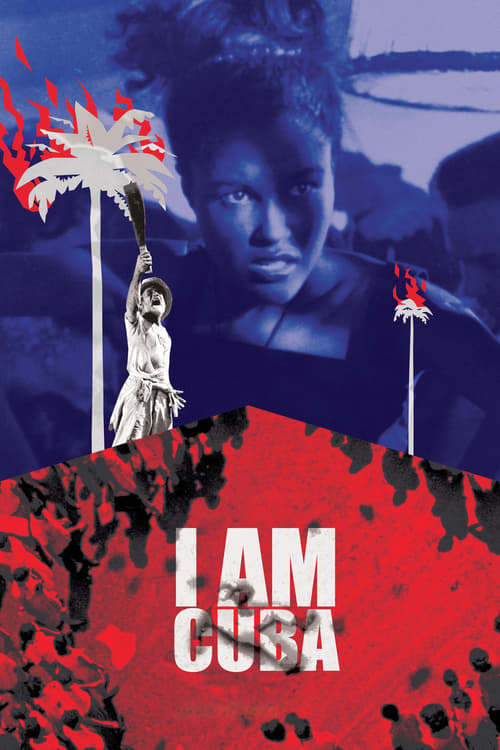
I Am Cuba
1964 · Mikheil Kalatozishvili
For a night when you want to be awed by pure filmmaking — put the phone away and surrender. This is a challenge-and-reward watch, not comfort viewing, best when you're patient and curious.
What it's about
Four stories from Cuba on the eve of its 1959 revolution: a young woman drawn into the glittering orbit of an American-owned Havana casino, a tenant farmer pushed to a desperate act on the sugar land he works, university students swept up in political unrest in the capital, and a peasant family in the hills pulled toward the guerrilla fight. Together they sketch a country moving from humiliation to revolt.
The experience
It watches like a fever dream — slow, hypnotic, and rapturous, with camera moves so impossible-looking you'll sit up and ask how they did it. Less a plot to follow than a swelling mood of injustice and awakening, and it earns its running time through sheer sensory force.
The craft
Sergei Urusevsky's black-and-white cinematography is the whole show: wide-angle lenses, infrared film that turns palm trees ghost-white, and unbroken tracking shots that float down hotel facades, through crowds, and over rooftops as if gravity were optional. Made decades before drones or digital trickery, every shot was engineered by hand. It demands the biggest screen you can find.
Why it matters
A Soviet-Cuban propaganda project that flopped in both countries, it was rediscovered in the 1990s with the backing of major American directors and is now revered as one of the most virtuosic pieces of camerawork ever filmed.
Snapshot
I Am Cuba (Russian Ya Kuba, Spanish Soy Cuba) is a Soviet–Cuban co-production conceived as a cinematic hymn to the 1959 revolution and released in 1964, five years after Fidel Castro's forces took Havana. Directed by the Georgian-Soviet filmmaker Mikhail Kalatozov (Mikheil Kalatozishvili) and photographed by Sergei Urusevsky — the same partnership that had won the Palme d'Or with The Cranes Are Flying (1957) — the film is structured as four loosely linked episodes, each dramatizing a different facet of pre-revolutionary suffering and dawning revolt: a prostitute degraded in the orbit of an American casino; a tenant sugar farmer who burns his own crop rather than surrender it to United Fruit; students radicalized amid Batista's repression in Havana; and a peasant family in the Sierra Maestra swept into the guerrilla struggle. A female narrator speaks in the first person as Cuba itself. The film was a double disappointment on release — too formally extravagant for Soviet propaganda needs, too exoticizing for Cuban audiences — and fell into near-total obscurity for three decades before its rediscovery and restoration in the mid-1990s reframed it as one of the most astonishing feats of camera virtuosity in the history of the medium.
Industry & production
The film emerged from the warming of Soviet–Cuban relations in the early 1960s, after the Cuban Missile Crisis bound Havana and Moscow into close ideological and material alliance. It was a joint undertaking of Mosfilm and the Instituto Cubano del Arte e Industria Cinematográficos (ICAIC), the Cuban film institute founded in 1959 under Alfredo Guevara, and was intended as a prestige collaboration celebrating revolutionary solidarity. The screenplay was written by the Soviet poet Yevgeny Yevtushenko — then one of the most internationally visible figures of the post-Stalin "Thaw" generation — together with the Cuban writer Enrique Pineda Barnet, who also served as a liaison to local realities and language.
The production was lengthy and logistically demanding, shot on location across Havana and the Cuban countryside over roughly a year and a half, with a mixed Soviet and Cuban crew. Precise budget figures are not part of the reliable public record, and I will not invent them; what is well attested is that the shoot was ambitious in scale, employing large numbers of extras and elaborate, purpose-built camera rigging to achieve its signature unbroken takes. The collaboration was uneasy. Cuban participants reportedly felt the Soviet team rendered their country as a tropical fantasia of cabarets and palm-fringed sensuality; Soviet officials, for their part, found the result insufficiently legible as agitprop. After a muted release in both countries the film essentially vanished from circulation — a fate that makes the contemporaneous documentary record thinner than for most major works of the era.
Technology
I Am Cuba is, above all, a laboratory of black-and-white image-making pushed to extremes. Urusevsky and his team exploited high-contrast orthochromatic and, crucially, infrared-sensitive film stock to transform the Cuban landscape: shot on infrared, green sugarcane and palm fronds register as luminous, ghostly white while skies go to deep, dramatic black, lending the rural episodes a hallucinatory, otherworldly tonality. The filmmakers paired this with very wide-angle lenses that exaggerate depth, bend the edges of the frame, and allow foreground and far background to hold simultaneous sharp focus.
The most celebrated technical achievements are the elaborate camera-movement rigs devised to carry the camera through space without cuts — across rooftops, down into a swimming pool, and up the exterior of a building before sailing out over a street. These effects were achieved photochemically and mechanically, with custom pulleys, platforms, and handoffs between operators, in an era decades before the Steadicam (introduced in 1975), aerial drones, or digital stabilization. Waterproof housings, periscopic and prism arrangements, and hand-rigged cableways stand in for technologies that did not yet exist. The result is a film whose "impossible" shots were genuinely engineered in-camera, on location, with the materials of the early 1960s.
Technique
Cinematography
The cinematography of I Am Cuba is its reason for canonization, and Sergei Urusevsky is as much its author as Kalatozov. Two set-pieces are routinely cited as among the greatest single shots ever filmed. In the first, the camera glides across a rooftop terrace and a glamorous poolside party, descends to follow bathers, and finally submerges into the swimming pool itself, continuing underwater — all in one apparently unbroken movement. In the second, during a martyred student's funeral procession, the camera rises several storys up the face of a building, passes through a cigar-rolling workshop, emerges from a window, and then floats out and forward above the marching crowd, seemingly weightless. These are not merely stunts: the relentless mobility expresses the film's central conceit of an omniscient, embodied national consciousness moving freely among the people.
Urusevsky's handheld camera elsewhere lurches, tilts, and spins with subjective intensity, as in the disorienting nightclub sequence that dramatizes Western decadence through vertiginous motion. The extreme wide angles and deep focus, the white foliage of the infrared exteriors, the chiaroscuro of faces against blown-out skies — all serve a poetics of estrangement, making the familiar tropical world strange and monumental. Few films before or since have so fully subordinated narrative to the kinetic and tonal possibilities of the moving image.
Editing
Editing in I Am Cuba is paradoxically defined by its restraint within shots and its boldness between them. Because so much screen time is given over to long, choreographed takes, the cut is reserved as a structural and rhythmic device rather than a moment-to-moment tool. The four-episode architecture is itself an editorial conception, with each story given its own arc and the whole bound by the recurring narration and motifs of land, water, and crowd. Within episodes, montage accelerates at moments of crisis and confrontation — the student demonstrations, the climactic mobilization of the peasantry — drawing on the Soviet montage tradition's faith in cutting as emotional and ideological argument. The film thus holds two editing philosophies in tension: the unbroken long take as immersion, and the assembled fragment as rhetoric.
Mise-en-scène / staging
Staging is monumental and frequently allegorical. Crowds are deployed as sculptural masses; individual figures are posed against sky and sea as emblems rather than naturalistic characters. The contrast between worlds is built into the décor: the air-conditioned glitter of casinos, neon, and rooftop pools set against the dirt, cane fields, and thatched huts of the rural poor. The famous tracking shots demand staging of extraordinary precision, with dozens of performers hitting marks in continuous coordination so the camera can pass among them. Compositions favor the diagonal, the low angle that makes peasants and revolutionaries loom heroically, and the careful placement of the human figure within vast natural or architectural space — a visual grammar that elevates the everyday into the epic.
Sound
The soundtrack is a dense, expressive weave of music, ambient texture, and the first-person voice-over narration that gives the film its title and unifying device — "I am Cuba" — spoken as the voice of the land and its people. The original score is by the Cuban composer Carlos Fariñas, and the film draws on Afro-Cuban rhythm and song alongside the orchestral idiom. Diegetic music — the cabaret bands, the radios, the chants of demonstrators — is integrated into the emotional architecture. As a Soviet production of its period, the film was post-synchronized rather than recorded with live sync sound, and it circulated in Russian and Spanish versions; the layered narration is integral to the poetic, declamatory register that distinguishes it from straightforward realism.
Performance
Performance is the most subordinated of the film's elements, by design. The cast is largely non-star and includes Cuban and Soviet players, with figures functioning as types — the corrupted woman, the dispossessed farmer, the idealistic student, the awakening peasant — rather than psychologically rounded individuals. Acting tends toward the emblematic and the operatic, gestural and externalized to match the heightened visual scheme. This is consistent with the film's allegorical ambitions: bodies are expressive instruments within the composition more than vehicles for interior drama. Detailed, verifiable biographical information on much of the cast is sparse in the standard English-language record, and I will not embellish it.
Narrative & dramatic mode
The film operates in a poetic-allegorical mode rather than a conventional dramatic one. Its four episodes are not causally linked; they are thematic variations on a single thesis — that exploitation under Batista-era capitalism and American influence made revolution inevitable and righteous. Each moves from suffering or complicity toward awakening: the woman's degradation, the farmer's despairing arson, the student's martyrdom, the peasant's enlistment. The first-person narration personifies the nation, addressing the audience directly and binding the fragments into a lyric whole. This is cinema as sung manifesto, closer to poetry and oratory than to the well-made plot. The mode's risk — sentimentality and didacticism — is real and was part of contemporary objections; its reward is an emotional and visual grandeur unconstrained by narrative plausibility.
Genre & cycle
I Am Cuba sits at the intersection of the revolutionary epic, the propaganda film, and the cinematic poem. It belongs to the broad Soviet tradition of celebratory historical-political cinema descending from Eisenstein and Dovzhenko, and to the specific early-1960s cycle of works commemorating socialist revolution. Simultaneously it stands at the threshold of the New Latin American Cinema, the militant, politically engaged film movement crystallizing across the continent in the 1960s, of which ICAIC was a central engine. As drama, the TMDB classification is accurate but reductive; the film is more precisely an anthology-form revolutionary tone poem, a hybrid that has few true generic siblings.
Authorship & method
Authorship here is genuinely shared and best understood as a collaboration of equals between director and cinematographer. Mikhail Kalatozov (1903–1973), Georgian-born, had begun as a cameraman himself before directing, and brought to the project the international prestige of The Cranes Are Flying; his sensibility favored emotional intensity and bravura camerawork over sober realism. Sergei Urusevsky (1908–1974), his cinematographer on Cranes and Letter Never Sent (1960), is the film's co-author in the fullest sense — its visual conception is inseparable from his innovations in mobile, handheld, wide-angle, infrared photography. The screenplay was the joint work of the celebrated Soviet poet Yevgeny Yevtushenko and the Cuban writer Enrique Pineda Barnet, a pairing that accounts for both the film's lyrical, declamatory voice and its (contested) grasp of Cuban texture. The score came from the Cuban composer Carlos Fariñas. Among the camera operators who helped execute the celebrated continuous takes was Alexander Calzatti (Aleksandr Kalzati), later a credited figure in the film's 1990s rediscovery. The working method — long location shoots, purpose-built rigs, choreographed long takes — placed the camera at the absolute center of the creative process.
Movement / national cinema
The film is a hyphenated artifact of two national cinemas. From the Soviet side it is a late flowering of the Khrushchev Thaw, when filmmakers enjoyed expanded formal latitude, and a descendant of the montage and poetic-realist traditions. From the Cuban side it is an early product of ICAIC, the institution that would shortly produce Tomás Gutiérrez Alea's Memories of Underdevelopment (1968) and Humberto Solás's Lucía (1968) and anchor the politically committed New Latin American Cinema. I Am Cuba belongs fully to neither and awkwardly to both — which is precisely why it satisfied the cultural authorities of neither country, and why its afterlife as a rediscovered "orphan" masterpiece is so fitting.
Era / period
Made in 1964, the film is a document of a specific geopolitical moment: the immediate aftermath of the 1962 Missile Crisis, when Cuba's alignment with the Soviet bloc was newly sealed and the revolution's self-image was being codified. It looks back to the pre-1959 Batista era it depicts and forward to the socialist future it prophesies, while bearing the marks of the Thaw's artistic permissiveness. Its formal audacity reflects a window in Soviet culture before the Brezhnev-era retrenchment; its political certitude reflects the high revolutionary optimism of Cuba in the early 1960s. The film is thus doubly dated in the best sense — legible only against the precise pressures of its instant of creation.
Themes
The governing theme is the moral inevitability of revolution as the response to exploitation. Cuba is figured as a violated body — feminized in the narration and in the first episode's story of a woman degraded for foreign pleasure — whose dignity can be reclaimed only through collective uprising. Recurrent motifs include land and dispossession (the farmer's bond to soil he does not own), water (the sea, the pool, rain, baptismal and corrupting by turns), the contrast of decadent wealth and authentic poverty, and martyrdom as the seed of mass awakening. American imperialism and capitalist excess are the antagonists; the people, the land, and the awakening conscience are the heroes. Underlying everything is a near-religious faith in transformation, rendered through imagery of swelling crowds and rising camera movements that literally lift the gaze toward a redeemed future.
Reception, canon & influence
On release the film satisfied almost no one. Soviet officials reportedly found it too aestheticized and insufficiently effective as propaganda; many Cubans felt it rendered their revolution as picturesque spectacle, an outsider's tropical reverie. It received only limited circulation and was nicknamed, in later accounts, something close to a beautiful failure — and then disappeared for nearly thirty years, scarcely seen outside archives.
Its influences run backward to the Soviet montage masters — Eisenstein's mass choreography, Dovzhenko's lyrical agrarian imagery — and to Kalatozov and Urusevsky's own earlier breakthroughs in expressive, mobile camerawork. Its forward legacy, however, is the more remarkable story. In the early-to-mid 1990s the film was rediscovered and restored, and championed by Martin Scorsese and Francis Ford Coppola, whose names presented the restoration that Milestone Films released in the United States in 1995. That re-release transformed the film's reputation overnight from forgotten curio to acknowledged landmark of cinematography. Its continuous-take bravura has since been cited as an inspiration by filmmakers drawn to the long take and elaborate camera movement — the lineage routinely invoked includes Paul Thomas Anderson and Alexander Sokurov among others, though such attributions should be read as critical genealogy rather than documented direct citation. Today I Am Cuba stands as a paradoxical classic: a propaganda film that outlived its politics to survive as pure cinema, and one of the enduring proofs of what the camera, in the hands of Kalatozov and Urusevsky, could be made to do.
A Deleuzian reading
Watch the camera at the rooftop party.
The full Deleuzian reading of I Am Cuba →
Reception
Rejected on release by both its co-producers — Cubans found it exoticizing, Soviets found it insufficiently rousing — it sat in obscurity for three decades until a 1995 US re-release presented by Martin Scorsese and Francis Ford Coppola turned it into a canonical object of cinephile awe.
How I Am Cuba was received, from release to now →
Influences: the films it descends from and the films it influenced
- Battleship Potemkin (1925) — The Odessa Steps sequence's choreography of the crowd-as-protagonist and rhythmic montage of emblematic faces is the grammar Kalatozov reworks in his allegorical mass scenes (the funeral march, the burning sugarcane).
- Earth (1930) — Dovzhenko's lyrical low-angle compositions of peasants against sky and his treatment of land and bodies as poetic allegory directly seed the film's agrarian rapture and declamatory pastoral imagery.
- Man with a Movie Camera (1929) — Vertov's conception of the camera as a kinetic, self-emancipated participant — mounted on every conceivable rig — licenses Urusevsky's custom apparatus and the camera's gravity-defying autonomy.
- October (1928) — The principle of typage — casting non-actors as emblematic social types rather than individuals — underlies the film's gallery of representative figures (the prostitute, the cane-cutter, the student).
- The Cranes Are Flying (1957) — The spiraling handheld ascent of the staircase and the circling camera around Veronika are the direct Kalatozov–Urusevsky prototype for I Am Cuba's untethered, vertiginous mobile camera.
- Letter Never Sent (1960) — Urusevsky's immersion of the handheld wide-angle camera inside fire and wilderness, fusing operator and landscape, refines the in-the-elements technique extended in the cane-field blaze.
- Ballad of a Soldier (1959) — Pushes the Kalatozov–Urusevsky untethered, gravity-defying subjective camera to its extreme, carrying forward the mobile-lyrical and inverted-perspective grammar Ballad shares from Cranes.
- Goodfellas (1990) — The Copacabana Steadicam long take threading the camera through kitchens and corridors descends from the continuous-take bravura Scorsese championed when presenting the film's restoration.
- Boogie Nights (1997) — Anderson's extended single-take openings that glide unbroken between characters and rooms extend the showpiece continuous-take ethos critics trace back to Urusevsky.
- Russian Ark (2002) — Sokurov pushes the unbroken-take logic to its absolute limit — an entire feature in one Steadicam shot — realizing the totalizing camera-flow that I Am Cuba only attempts in set-pieces.
- Children of Men (2006) — Cuarón and Lubezki's choreographed handheld long takes plunging through battle and chaos inherit the technique of a single mobile camera navigating an entire eventful space without a cut.
- Atonement (2007) — The five-minute Dunkirk beach take, a continuous crane-and-Steadicam tour across a vast choreographed tableau, is a direct heir to the famous funeral-procession shot that climbs a building and floats over the street.
- Birdman (2014) — The film's construction as one apparently seamless take, the camera weaving through backstage corridors and out into the street, is the contemporary apotheosis of I Am Cuba's untethered continuous camera.
- Come and See (1985) — Sergei Urusevsky's technique of holding ultra-wide-angle lenses close to moving human faces, distorting and elongating features in motion, is the direct technical precursor to Aleksei Rodionov's facial distortion cinematography, which Klimov radicalizes as a physiological register of traumatic damage.
- The Secret in Their Eyes (2009) — Pioneers the seemingly impossible continuous crane descent that swoops from an aerial vantage down into a dense human crowd, the exact spatial gesture of the stadium plunge.
- War and Peace, Part II: Natasha Rostova (1966) — The impossible continuous take that hands the camera between operators to pass through crowds, doorways and levels without a cut establishes the 'apparently unsupported mobile long take through populated space' that Bondarchuk executes at large format in the ball and hunt sequences.
- The Red and the White (1967) — Urusevsky's uninterrupted mobile takes traveling through crowds and terrain prove the moving camera can itself deliver the political argument; Jancsó adopts the continuity and discards the handheld lyricism for flat, impersonal traversal.
- The Battle of Algiers (1966) — Pontecorvo's faux-newsreel handheld coverage of revolutionary crowds as a collective emblematic mass pursues the same fusion of agitprop allegory and documentary immediacy from the opposite, grainy-realist pole.
- Memories of Underdevelopment (1968) — A founding New Latin American Cinema work that, like I Am Cuba, braids first-person voiceover subjectivity with documentary texture to render revolutionary Cuba, but interrogates rather than celebrates it.
- Lucía (1968) — Cinematographer Jorge Herrera's bravura roving handheld camera across three revolutionary epochs is the most direct Cuban inheritance of Urusevsky's restless mobile lens and emblematic-types staging.
- The Hour of the Furnaces (1968) — Solanas's Third Cinema montage of agitational imagery and declamatory voiceover shares I Am Cuba's anthology structure and revolutionary-epic address, militant where Kalatozov is aestheticized.
- Shadows of Forgotten Ancestors (1965) — Contemporary apex of the ecstatic, gravity-defying unbroken mobile take that treats the camera as an autonomous roaming consciousness, the same impulse Ilyenko realizes through the Carpathian forest.
Similar films
- Battleship Potemkin (1925) — influence & lineage · same viewing thread
- Memories of Underdevelopment (1968) — influence & lineage
- The Cranes Are Flying (1957) — influence & lineage
- Man with a Movie Camera (1929) — influence & lineage
- Russian Ark (2002) — influence & lineage
- Earth (1930) — influence & lineage
- Soundtrack to a Coup d'Etat (2024) — same viewing thread
- Twenty Years Later (1984) — same viewing thread
All the films related to I Am Cuba →
Watch it with: curated runs of related films
- The Long Shadow of the Coup — A run of films tracing political violence from the mutiny and the massacre through martial law to the decades-long reckoning that follows — watch them near each other and the same machinery of power keeps rhyming across continents and eras.