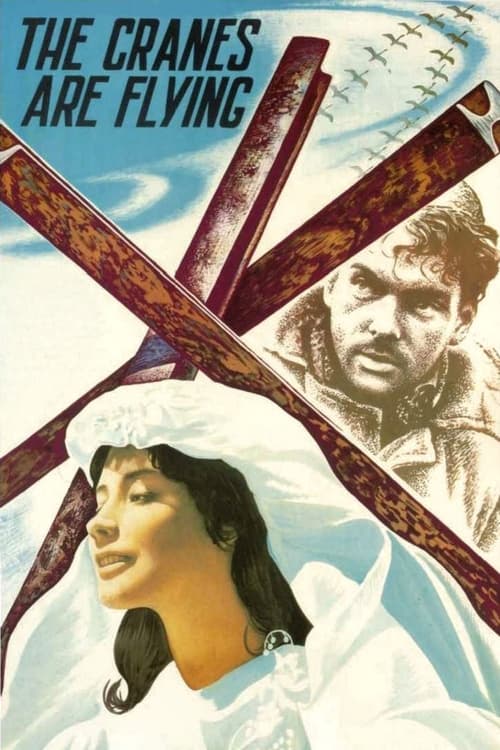
The Cranes Are Flying
1957 · Mikheil Kalatozishvili
For when you need a good cry and want it earned — a ravishing, wounded love story rather than a battle picture. Demanding on the heart, but it gives back everything it takes.
What it's about
Moscow, just before the German invasion: Veronika and Boris are young and in love, watching cranes fly over the river and planning a future. Then Boris volunteers for the front, they miss their farewell, and Veronika is left behind in a city of air raids, bombed-out homes, and his family's uneasy charity — including a cousin whose attentions she never asked for. It's a war story told from the side of the one who waits.
The experience
Emotionally overwhelming in the best way — tender, then devastating, with a camera that swoops and runs and spins until you feel the characters' joy and terror in your own body. Scenes of crowds, farewells, and air raids hit with an intensity that hasn't aged a day.
Performances
Tatyana Samoylova is unforgettable as Veronika — luminous, stubborn, and heartbreakingly human — refusing to play either the faithful saint or the fallen woman the story around her expects.
The craft
Sergei Urusevsky's camera is the star turn: handheld sprints through crowds, dizzying spirals up staircases, faces caught mid-catastrophe — black-and-white images of astonishing invention. It turned a wartime melodrama into one of the most visually thrilling films of its decade, and it deserves a big screen.
Why it matters
The film that announced the post-Stalin cultural Thaw to the world, it won the Palme d'Or at Cannes — still the only Soviet feature to do so — by daring to tell the sacred war story through a flawed, forgivable heroine.
Snapshot
The Cranes Are Flying (Letyat zhuravli) is the film that announced the cultural Thaw to the world. Made at Mosfilm in 1957 and awarded the Palme d'Or at Cannes in 1958 — to this day the only Soviet feature to win that prize — it took the most sacralized subject in Soviet life, the Great Patriotic War, and refused to tell it heroically. Instead it follows Veronika (Tatyana Samoylova), a young Moscow woman whose fiancé Boris (Aleksei Batalov) volunteers and is killed at the front, and who, in his absence and amid the collapse of her world, marries his cousin Mark under coercion. The film's revolution is double: a moral one, in centering a heroine who is neither faithful nor punished but simply human; and a formal one, in Sergei Urusevsky's delirious, untethered camera, which turned the war melodrama into a vehicle for pure kinetic expression. It is at once an intimate love story, a home-front tragedy, and a manifesto for a renewed Soviet poetic cinema.
Industry & production
The film was produced by Mosfilm, the flagship Soviet studio, in 1957 — the symbolic midpoint of the Khrushchev Thaw that followed the 1956 "Secret Speech" denouncing Stalin. Its source was Viktor Rozov's play Vechno zhivye ("The Eternally Living" / "Forever Alive"), written during the war but unstaged until the Thaw, when it became the inaugural production of Oleg Yefremov's Sovremennik Theatre in 1956. Rozov adapted his own play for the screen, opening up its chamber structure and sharpening its central provocation. The studio assigned the project to Mikhail Kalatozov, a veteran Georgian director (his name appears here in its Georgian form, Kalatozishvili) whose career had been shaped and constrained across the Stalin decades, and who had latterly served in film-administration posts. The pairing of Kalatozov with cinematographer Sergei Urusevsky proved decisive; their creative partnership, begun on the 1950s features that preceded this film, would culminate here and continue through The Unsent Letter (1959) and the Soviet-Cuban I Am Cuba (1964). Precise budget and box-office figures are not part of the reliably documented record I can cite, and I will not invent them; what is certain is the film's institutional standing — a prestige Mosfilm production that the state subsequently sent to Cannes, where its triumph made it an unexpected instrument of cultural diplomacy.
Technology
The film was shot in black-and-white on 35mm in the Academy ratio, the standard Soviet format of the period, and its achievement lies in what Urusevsky coaxed from conventional means rather than in novel hardware. Working largely without the stabilizing apparatus that would later become routine, he privileged the handheld camera and short-focus wide-angle lenses, which let him press close into faces and crowds while keeping deep space legible and distorting it expressively at the edges. For the film's two most celebrated movements, the production built bespoke rigs: a circular track that allowed the camera to revolve continuously, used for the vertiginous death sequence, and a spiral arrangement around a staircase that let the camera climb and turn with the actors. These were custom mechanical solutions — dollies, cranes, and rotating mounts engineered to a shot — rather than off-the-shelf systems, and the physical demands of operating a heavy camera by hand through such maneuvers were considerable. The artistry is in the marriage of period-standard stock and optics to a mobility that the technology was not designed to deliver.
Technique
Cinematography
Urusevsky's camerawork is the film's signature and its lasting bequest to world cinema. Two sequences are canonical. In the first, Boris climbs the staircase of Veronika's apartment building; the camera ascends and spirals with him in a single sustained movement that compresses urgency, longing, and architecture into one breath. In the second — Boris's death in a birch wood — he is shot, staggers, and the camera spins upward into the whirling crowns of the birch trees, which dissolve into the imagined wedding he will never have. The rotating canopy is one of the most quoted images in the medium. Throughout, Urusevsky favors extreme proximity, oblique angles, and a restless mobility that binds the spectator to Veronika's subjectivity: the famous run to the front through a churning crowd, the camera carried into the press of bodies; the bombing of her family's apartment, rendered through fractured framing and a window shattering into white. Light is sculpted with high contrast and luminous whites, faces emerging from and dissolving into a charged darkness. The camera is never a neutral recorder but a participant — grieving, searching, exalting.
Editing
Cut by Mariya Timofeyeva, the film moves between two registers. Long, unbroken kinetic takes — the staircase, the run, the death — are set against passages of rapid, associative montage that externalize Veronika's inner states: superimpositions, dissolves, and the collision of memory with present action. The editing inherits the Soviet montage tradition of the 1920s but turns its intellectual rhetoric toward the lyric and the psychological. The death sequence is the keystone, splicing the spinning birches to the phantom wedding so that loss and what-might-have-been occupy the same instant. The cutting is emotional rather than analytic, organizing the film around Veronika's consciousness rather than around plot mechanics.
Mise-en-scène / staging
The film's spaces carry its meanings. The Borozdin family apartment — warm, cluttered, bourgeois-domestic — becomes a stage for intimacy and betrayal alike; it is here that Mark assaults Veronika during an air raid, the scene built around the violent counterpoint of bombs outside and the breaking of a window. The river embankment where the lovers watch the cranes at dawn bookends the film, a pastoral of possibility against which the war's devastation registers. Crowds are staged with great density — the volunteers' departure, the soldiers' return — so that the individual is perpetually at risk of being lost in the mass, which is precisely the film's dramatic anxiety. Objects accrue weight: the toy squirrel Boris gives Veronika, the note hidden inside it, surface late as instruments of recognition.
Sound
Moisei Vainberg (Mieczysław Weinberg), the Polish-born Soviet composer and close associate of Shostakovich, supplied the score, weaving the romantic theme through the film's swings between elation and grief. As important is the expressive sound design of the set pieces: the layered roar and concussion of the air-raid sequence, the trampling crowds, the abstracted aural rush of the death scene. Sound and image are tightly fused so that the subjective camera finds its counterpart in a subjective soundtrack.
Performance
Tatyana Samoylova's Veronika is among the great screen performances of the postwar era — a face of startling mobility, capable of radiant joy and stricken numbness, that the camera treats as a landscape. Her refusal to play the heroine as either martyr or sinner is the film's moral engine. Aleksei Batalov brings an unaffected gentleness to Boris that makes his death land without bombast. Vasili Merkuryev grounds the film as Fyodor Ivanovich, Boris's father and a doctor whose humane authority becomes its conscience, while Aleksandr Shvorin gives Mark a weak, insinuating opportunism. The ensemble playing of the Borozdin household lends the melodrama a lived texture.
Narrative & dramatic mode
The film operates as lyric melodrama disciplined by psychological realism. Its narration is organized around Veronika's subjectivity; objective events — Boris's death, the front, the war's progress — reach us refracted through her perception, withheld and revealed to wrench maximum feeling. The dramatic crux is deliberately uncomfortable: Veronika's marriage to Mark, the product of trauma and coercion rather than infidelity in any ordinary sense, denies the audience the clean moral coordinates that Stalinist war narrative had trained them to expect. The film neither condemns nor wholly exonerates her; it asks instead to be understood. Its resolution is famously anti-triumphant — Boris does not return, and the homecoming sequence gives the celebration of victory to others while Veronika distributes flowers to strangers, her private grief subsumed into a collective survival. The cranes that open and close the film convert this private loss into an elegiac figure for an entire generation's dead.
Genre & cycle
It belongs to the Soviet war film, but stands as the decisive break within that genre. Where the Stalinist war film monumentalized the state, the army, and the leader, The Cranes Are Flying relocates the war to the home front and the wounded individual. It thereby inaugurated the cycle of Thaw-era war films that humanized the conflict — most directly Grigori Chukhrai's Ballad of a Soldier (1959) and, in a more austere key, The Fate of a Man and later Ivan's Childhood — works that measured the war in personal grief rather than national glory. As melodrama, it elevates the form's emotional directness with modernist visual means, prefiguring the international art-cinema melodramas of the coming decade.
Authorship & method
The film is best understood as a dual authorship. Kalatozov, the Georgian director whose own early work as a cinematographer (the 1930 Salt for Svanetia) had been formally radical before the strictures of Socialist Realism narrowed his options, supplied the dramatic architecture, the work with actors, and the overall conception; the Thaw restored to him a freedom his middle career had lacked. Sergei Urusevsky, trained in the visual arts and steeped in the montage tradition, supplied the kinetic imagination that made the film epochal — to the degree that it is often discussed as a cinematographer's film. Their collaboration was genuinely co-creative and continued through The Unsent Letter and I Am Cuba. Viktor Rozov's screenplay, adapted from his own play, contributed the morally daring narrative core and the humane, anti-rhetorical dialogue characteristic of Thaw drama. Vainberg's score and Timofeyeva's editing complete a method in which every element bends toward subjective, emotional expression rather than ideological statement.
Movement / national cinema
This is a cornerstone of Thaw cinema, the loosening of Soviet film culture after 1956 that recovered the experimental energies of the 1920s avant-garde while turning them toward private feeling. It revived a strain that might be called Soviet poetic cinema — image-driven, lyric, subjective — that would run forward through Sergei Parajanov and Andrei Tarkovsky. Internationally, it placed Soviet cinema back at the center of the art-film conversation at the very moment the European new waves were forming, and it did so by demonstrating that formal daring and emotional immediacy need not be opposed.
Era / period
The film is inseparable from its moment: produced in 1957, premiered at home and then crowned at Cannes in 1958, it is a document of de-Stalinization in real time. Its rehabilitation of the morally complex individual, its skepticism toward heroic rhetoric, and its grief for the war dead were all newly speakable after 1956. It looks back to the Great Patriotic War of 1941–45 as lived experience and forward to the cultural opening of the late 1950s, embodying the brief window in which Soviet artists could interrogate the official narrative without yet meeting the renewed constraints of the Brezhnev years.
Themes
At its heart lie love and fidelity tested past breaking, and the film's insistence that fidelity of the heart can survive a betrayal of the body. It is an elegy for a generation consumed by war, the cranes serving as its central symbol of departed souls and seasonal return. It explores grief and survival — the labor of going on living when the beloved is dead — and the moral ambiguity of conduct under extremity, refusing to judge Veronika by peacetime measures. Against the collective triumphalism the era demanded, it asserts the primacy of individual suffering, locating history's meaning in a single grieving face rather than in the march of the state.
Reception, canon & influence
The film's reception transformed its makers' standing. Its 1958 Palme d'Or made it an international sensation and a point of national pride at home; Samoylova in particular became an emblem of a new Soviet cinema, and her face circulated as the image of the Thaw. Critically it has only grown in stature, regularly cited among the supreme achievements of Soviet film and a touchstone for the expressive possibilities of the mobile camera.
Looking backward, the film draws on the Soviet montage school of Eisenstein, Pudovkin, Vertov, and Dovzhenko — its associative cutting and its faith in the image as an instrument of meaning are that tradition's inheritance — even as it redirects those means from political rhetoric to lyric subjectivity. Rozov's Thaw-era theatrical realism supplies its human grain.
Looking forward, its influence is broad and durable. The Kalatozov–Urusevsky camera fed directly into the visual ambitions of the international art cinema; their own I Am Cuba pushed the same kinetic principles to a baroque extreme that, decades later, would be championed by Martin Scorsese and Francis Ford Coppola. Within Soviet cinema the film opened the path for the poetic war films of Chukhrai and the early Tarkovsky. A widely repeated account holds that the young Claude Lelouch, visiting the Mosfilm set, was so moved that he resolved to become a filmmaker; I flag it as the well-known anecdote it is rather than as a fully documented fact. What is beyond dispute is the line of descent running from this film's spiraling, breathing, grieving camera to every subsequent director who has tried to make the lens itself an organ of feeling.
A Deleuzian reading
Start with the birches.
The full Deleuzian reading of The Cranes Are Flying →
Reception
A sensation from the start — a massive hit in the Soviet Union and the toast of Cannes in 1958 — it's since only climbed, canonized as the crown jewel of Thaw-era cinema and a film cinephiles keep rediscovering for its jaw-dropping camerawork.
How The Cranes Are Flying was received, from release to now →
Influences: the films it descends from and the films it influenced
- I Am Cuba (1964) — The same team's baroque extreme of Cranes' kinetic principle — impossibly continuous crane-to-handheld takes — later championed by Scorsese and Coppola.
- Ivan's Childhood (1962) — Inherits Cranes' lyric subjectivity and dream-superimpositions, making the war film an interior poetic landscape rather than a battle chronicle.
- Come and See (1985) — Soviet descendant that fuses Cranes' subjective handheld and the rotating, vertiginous camera with sustained first-person POV to render war as sensory derangement.
- Dear Comrades! (2020) — Kalatozov's Thaw-era formula—a woman's search for a missing man used to focalize collective Soviet trauma in Academy-ratio monochrome—is the structural prototype Dear Comrades! consciously inverts by making its protagonist complicit rather than victimized.
- Cold War (2018) — Soviet-bloc wartime romance in which bravura expressive monochrome camerawork registers history physically crushing the lovers — the Eastern European 'history-destroys-love' template.
- The Ascent (1977) — Urusevsky's expressionist, subjectively mobile camera and blown-out white skies established the Thaw-era Soviet war image Shepitko inherits, then freezes into stillness on the Belarusian snowfields.
- Shadows of Forgotten Ancestors (1965) — Sergei Urusevsky's whirling, vertiginous handheld camera bonded to a character's subjective emotion is the direct technical parent of Ilyenko's subjective-kinetic camera in Shadows.
- War and Peace, Part II: Natasha Rostova (1966) — Urusevsky's handheld wide-angle subjective camera — the staircase spiral, the whip-panning delirium, the lens shoved into a face until architecture distorts around it — is the Thaw technique Petritsky rescales to 70mm for Natasha's flushed passages through crowded rooms.
- Battleship Potemkin (1925) — Source of the associative, collision-based montage and the faith in the cut as an emotional rather than narrative instrument that Urusevsky's editing converts from political rhetoric to private grief.
- Earth (1930) — Bequeaths the Soviet 'poetic cinema' lyricism — landscape, faces and bodies shot as ecstatic plastic forms — that underlies Cranes' superimpositions and elegiac lyric register.
- Man with a Movie Camera (1929) — Pioneers the unchained, athletic camera and in-camera superimposition that Urusevsky industrializes into custom rigs, circular tracks and the rotating-canopy/spiral-staircase shots.
- The Last Laugh (1924) — Origin of the 'entfesselte Kamera' (unchained subjective camera) — Freund's strapped-on and moving rigs — that Cranes extends into fully subjective, vertiginous handheld point-of-view.
- Mother (1926) — Models montage built on the emotional state of a single suffering protagonist rather than the mass, the precedent for Cranes' subjective war drama centered on Veronika.
- Salt for Svanetia (1930) — Kalatozov's own radically composed, extreme-angle silent ethnographic camerawork that the Thaw let him resume and amplify two decades later in Cranes.
- The Unsent Letter (1959) — Direct continuation of the Kalatozov–Urusevsky method, pushing the handheld, weather-battered subjective camera through a Siberian taiga as an organ of feeling.
- Ballad of a Soldier (1959) — Extends Cranes' Thaw-era anti-rhetorical war film — the inverted/rotating subjective camera and humane focus on private sacrifice over ideological triumph.
- Ashes and Diamonds (1958) — Sibling in the Eastern Bloc Thaw: a morally ambiguous protagonist and expressionistic deep-focus camera redirecting montage heritage toward private tragedy.
- The Red and the White (1967) — Carries the choreographed long-take mobile camera over war landscapes into rigorous sequence-shot formalism descended from Urusevsky's traveling apparatus.
- Raging Bull (1980) — Scorsese's avowed debt to Kalatozov–Urusevsky surfaces in the subjective, gliding and lunging camera that makes the lens an extension of the protagonist's perception.
- Apocalypse Now (1979) — Coppola's championing of I Am Cuba feeds the immersive, kinetically mobile war camerawork that treats movement itself as delirious subjective experience.
Similar films
- Ballad of a Soldier (1959) — influence & lineage · same viewing thread
- The Red and the White (1967) — influence & lineage · same viewing thread
- Come and See (1985) — influence & lineage · often watched together
- Battleship Potemkin (1925) — influence & lineage · often watched together
- Man with a Movie Camera (1929) — influence & lineage · often watched together
- Ivan's Childhood (1962) — influence & lineage
- I Am Cuba (1964) — influence & lineage
- Earth (1930) — influence & lineage
All the films related to The Cranes Are Flying →
Watch it with: curated runs of related films
- The Futility of War — A run of films about ordinary men fed into war's machinery — from the trenches to the Casbah to the Warsaw sewers — where the futility and human cost rhyme across a century and a dozen conflicts.