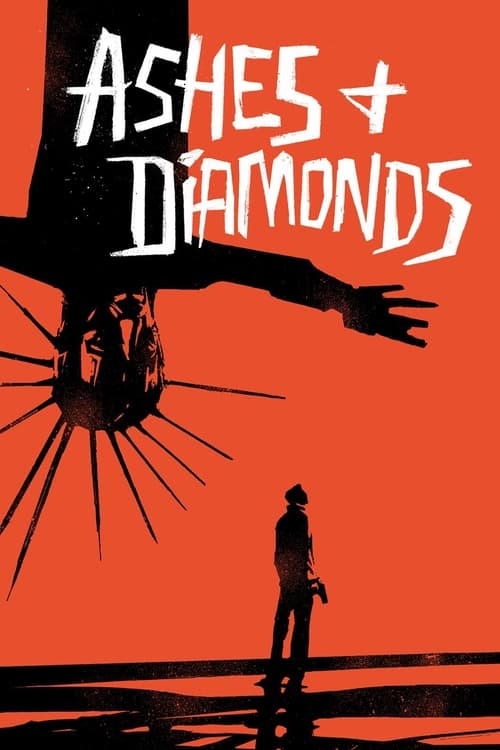
Ashes and Diamonds
1958 · Andrzej Wajda
For when you want a serious, beautiful film that earns its heartbreak — a night for something classic and weighty, not comfort viewing but the kind of sadness that feels worth it.
What it's about
On the last night of World War II in a small Polish town, a young resistance fighter named Maciek is ordered to assassinate a local communist party official. The first attempt goes wrong, and as he waits at a hotel to finish the job, he falls hard for Krystyna, the barmaid — a few stolen hours that make him question everything the war has asked of him. One night, one town, one impossible choice between the fight he was raised in and the ordinary life suddenly within reach.
The experience
Smoky, romantic, and quietly devastating — it moves like a thriller but aches like a love story, and the tension between duty and desire tightens scene by scene. It leaves you mourning a whole generation through one man.
Performances
Zbigniew Cybulski, in dark glasses and a restless slouch, is magnetic — a performance so alive and modern it made him an international icon and still feels like it wandered in from decades later.
The craft
The black-and-white photography is startlingly expressive — inverted crucifixes, fireworks over ruins, a bar lined with flaming glasses of spirits — images that burn into memory. Wajda packs enormous moral weight into a single night's running time, and the compositions reward a big, dark screen.
Why it matters
The defining film of the Polish Film School and a cornerstone of postwar European cinema, it capped Wajda's War Trilogy and turned Cybulski into a legend.
Snapshot
The concluding panel of Andrzej Wajda's War Trilogy — following A Generation (1955) and Kanal (1957) — Ashes and Diamonds is the defining film of the Polish Film School and one of the essential works of postwar European cinema. Set during the final hours of the Second World War in Poland (the night of 8–9 May 1945, VE Day), it follows Maciek Chelmicki, a young Home Army insurgent ordered to assassinate a local communist party secretary, who falls into a brief, ruinous love with a hotel barmaid. Through a script of compacted moral weight, cinematography of unprecedented expressiveness within Polish cinema, and a star performance that made Zbigniew Cybulski an international icon, the film transforms a single turbulent night into an elegy for an entire generation — those who fought for a free Poland and found themselves stranded on the wrong side of the new order.
Industry & production
Ashes and Diamonds was produced by Wytwórnia Filmów Fabularnych (WFF), the feature-fiction arm of the state studio Film Polski, in Wrocław and at studio facilities in Łódź. The Polish state film industry, centralised after 1945, had operated under rigid Stalinist cultural doctrine through the early 1950s; the political thaw following Stalin's death in 1953 and Khrushchev's de-Stalinisation speech of 1956 opened a brief window of relative creative freedom. Wajda completed the film in this window, and the production navigated a genuine ideological tightrope: the novel source, Jerzy Andrzejewski's Popiół i diament (1948), had been written under communist auspices and cast the Home Army (Armia Krajowa) fighters as unredeemed reactionary killers; Wajda and co-scenarist Andrzejewski revised the material substantially to render Maciek sympathetic and morally complex, making him a figure of tragic heroism rather than villainy — a revision that attracted criticism from party cultural authorities even as the film passed censorship. The production was relatively modest by Western European standards, typical of Eastern Bloc industrial film-making: controlled budgets, studio-assigned crews, and a production apparatus in which the director's artistic authority was nonetheless, in this thaw period, substantial. The script went through significant revision between Andrzejewski's source and the screen; Wajda has described in interviews how he and the novelist worked together to shift the novel's political center of gravity, though the precise archival record of those revisions is not fully public.
Technology
Shot on 35mm black-and-white film stock, the production used standard professional-gauge cinematography consistent with late-1950s Eastern European practice. No widescreen process was employed; the film's aspect ratio is the Academy 1.37:1 frame, which Wójcik's compositions exploit for intimate, compressed staging within hotel interiors. The film's remarkable tonal range — from the blinding outdoor sunlight of the opening ambush to the deep, pooling shadows of the hotel bar — was achieved through careful choice of fast stocks and controlled artificial lighting rather than any novel technical system. Location shooting in Wrocław (including the actual Hotel Monopol, which provides the film's primary setting) was combined with studio-built interiors. The technical infrastructure available to Film Polski was comparable to that of other mid-tier European industries of the period; the film's visual distinction derives from craft and artistic vision rather than technological novelty.
Technique
Cinematography
Jerzy Wójcik's black-and-white cinematography is among the most celebrated achievements of 1950s European cinema. Wójcik — a Łódź Film School graduate working here in one of his most prominent early credits — developed a high-contrast expressionist approach that owes visible debts to the chiaroscuro tradition of American film noir and to the deep-focus grammar of Orson Welles, while integrating both into a distinctly Central European sensibility. His handling of the hotel bar sequences is masterly: pools of harsh light surrounded by absolute shadow, Maciek's face half-consumed by darkness in medium close-up, the play of flame and reflection across wet surfaces. The famous inverted-crucifix sequence — in which glasses of alcohol are lit and held aloft in an improvised memorial toast, casting flickering crosses against the bar mirror — is a set piece of controlled symbolism: a memorably composed shot that functions simultaneously as documentary observation (a real custom) and theological commentary on a generation for whom traditional faith has been shattered by war. The opening killing, by contrast, is staged in the hard daylight near a roadside chapel, creating a violent disjunction between pastoral Poland and sudden death that Wójcik renders without expressionist shadow: the violence is all the more brutal for being brightly lit. Wójcik also manages a loose, unstable hand quality in certain sequences — particularly the love scene between Maciek and Krystyna — that anticipates the handheld grammar the French New Wave was simultaneously developing; whether this represents direct cross-influence or parallel development remains a matter of film-historical discussion.
Editing
The editing, credited to Halina Nawrocka, sustains the film's compressed, single-night temporal arc with disciplined rhythm. Cuts tend to be motivated by action and eyeline, remaining within classical continuity conventions; the film does not pursue montage experimentation. What distinguishes the editing is its management of tempo: slow, held shots during the intimate scenes between Maciek and Krystyna are cross-cut with the political gathering of party functionaries in the hotel ballroom, the intercutting producing ironic counterpoint rather than suspense in the thriller sense. The finale — Maciek's stumbling, protracted death on the ash-heap, intercut with the fireworks of the official VE Day celebration and the hotel ballroom's bright festivities — is the editing's defining passage: a structural irony that produces the film's most concentrated tragic meaning.
Mise-en-scène / staging
The Hotel Monopol provides an ideal theatrical microcosm: a single building contains, over the course of one night, the communist party secretary Szczuka, the opportunist mayor Swiecki, the insurgents Maciek and Andrzej, the barmaid Krystyna, a drunken veteran, and a wedding party. Wajda's staging exploits the hotel's spatial hierarchy — corridors, stairwells, the bar, the ballroom — to produce chance encounters that feel simultaneously improbable and historically inevitable. A white horse, wandering through the hotel corridor in one surreal interlude, is one of several moments where Wajda permits pure visual symbolism to erupt through the film's realist surface: the horse, a traditional Polish symbol of freedom and national mythology, has no naturalistic explanation and needs none. The debris and ash heaps of bombed-out Wrocław (shot on actual postwar rubble) function as the landscape of historical destruction against which Maciek's final journey takes on its literal and metaphorical charge: he dies on ash, one of the "diamonds" the Norwid poem promises may or may not emerge from national catastrophe.
Sound
The film's sound design uses ambient noise — distant artillery, fireworks, jazz from the hotel ballroom — to anchor the single-night setting and supply ironic counterpoint. The celebratory music from the ballroom bleeds into scenes of violence and grief with deliberate effect; the fireworks that burst over Maciek's death function as a sustained sonic metaphor, the world's joyful noise indifferent to individual sacrifice. The film's use of diegetic music is notable: the jazz orchestra in the ballroom, the radio, the sounds of an improvised peace celebration. The precise identity of the film's composer and the extent to which any original score was commissioned versus the use of pre-existing or adapted musical material is not fully detailed in the sources available to me; I note this rather than attribute.
Performance
Zbigniew Cybulski's performance as Maciek Chelmicki is the film's animating force and the primary vehicle of its international impact. Cybulski, a stage-trained actor who had co-founded the Bim-Bom theater in Gdańsk, brought to the role an improvisatory physicality and emotional volatility that reviewers immediately aligned with Marlon Brando and James Dean — comparisons Cybulski attracted throughout his career and that are not wholly misleading, though they can obscure the performance's distinctly Polish cultural register. The dark glasses Cybulski wore throughout (ostensibly a character choice; reportedly adopted to cope with light sensitivity but retained as a defining visual signature) became his trademark and a symbol of postwar disaffection. Wajda has described giving Cybulski substantial latitude in the development of the role, and there is a quality of controlled spontaneity in the performance — particularly in the bar scenes and in the love passage with Krystyna — that reads as partially improvised within fixed blocking. Adam Pawlikowski, as Maciek's commanding officer Andrzej, provides a necessary counterpoint of rigidity and ideological constraint. Wacław Zastrzeżyński as Szczuka plays the communist official with genuine gravity and sorrow — the film's determination to render him a human being rather than a villain was a significant artistic and political act.
Narrative & dramatic mode
Ashes and Diamonds observes a rigorous unity of time, compressing its action into approximately sixteen hours — from an afternoon roadside killing to a morning death in the rubble — with the Hotel Monopol serving as the unity of place. This classical compression is not merely structural economy; it produces the specific tragic mode of the film, in which every choice Maciek makes is circumscribed by the approaching dawn that will render impossible all alternatives. The narrative runs two parallel protagonists — Maciek the assassin and Szczuka the target — whose convergence is both political inevitability and human tragedy: the film's architecture is that of a collision course, and Wajda ensures the audience understands both men as possessed of legitimate interiority before the fatal meeting. The love story with Krystyna is not incidental: it functions as the axis on which the whole tragic irony turns. For the first time, Maciek has a reason not to kill — and he kills anyway, and is killed in turn.
Genre & cycle
The film operates within and against the postwar European war film, a genre whose conventions — heroism, sacrifice, national identity — it systematically complicates. Within Polish cinema specifically, it belongs to the "moral anxiety film" strain that emerged during the thaw: films less concerned with heroic action than with the ethical wreckage left by occupation and resistance. The war film, the political thriller, the romantic melodrama, and the existentialist character study are each present and each insufficient on their own to describe the film. Its mode is closer to Greek tragedy — or to the Polish Romantic dramatic tradition of Mickiewicz and Słowacki — than to Hollywood genre conventions, and this is part of why it was received as art cinema in the West while remaining legible as a national cinema statement at home.
Authorship & method
Andrzej Wajda (1926–2016) was himself a child of the generation he depicts: born in Radom, son of an officer killed at Katyń, he joined the wartime Polish underground as a teenager. He trained at the Łódź Film School — the institution that would produce virtually the entire Polish Film School generation — studying painting before cinema, a background visible in his compositional instincts throughout his career. Ashes and Diamonds is his third feature and his first to achieve wide international distribution; it consolidated the concerns that would define his subsequent work: the burden of Polish history, the ethical claims of competing loyalties, the tragedy of defeated or exhausted idealism. His method in this film was collaborative in ways that go beyond standard director-as-auteur framing: Andrzejewski's involvement in the screenplay adaptation was substantive; Cybulski's performance was developed in genuine dialogue with the director; and Wójcik's visual intelligence shaped the film's specific aesthetic register.
Jerzy Wójcik (b. 1930), director of photography, was among the most gifted cinematographers produced by the Łódź school. His collaboration with Wajda on this film was central to the Polish Film School's visual identity; he subsequently developed a long independent career as both cinematographer and director.
Jerzy Andrzejewski (1909–1983), novelist and co-scenarist, was one of the most significant Polish prose writers of the century. His original novel had been shaped by the political atmosphere of 1948 and represented a more schematic condemnation of the Home Army than the film would ultimately deliver; his willingness to revise the material for Wajda's screen version represents a significant creative accommodation.
Zbigniew Cybulski (1927–1967) remains, alongside the film itself, the primary artistic legacy of this production. His death — falling under a moving train at Wrocław station while attempting to board — had the ironic quality of a scene from one of his films and made him a figure of permanent cultural mourning in Poland. Wajda would later address Cybulski's death directly in Everything for Sale (1969).
Movement / national cinema
Ashes and Diamonds is the signature film of the Polish Film School (polska szkoła filmowa), the movement that flourished roughly from 1955 to 1963 and included, alongside Wajda, directors such as Andrzej Munk (Eroica, 1958; Bad Luck, 1960) and Jerzy Kawalerowicz (Night Train, 1959; Mother Joan of the Angels, 1961). The School was not a manifesto movement with an agreed aesthetic program; it was rather a generational cohort sharing a set of thematic obsessions — the Second World War and its moral aftermath, the Polish national character under historical pressure, the individual conscience versus collective political obligation — and a broadly realist visual inheritance modified by expressionist and psychological impulses. Within this movement, Wajda occupied the most prominent and internationally visible position. The Polish Film School drew on both Western European cinema (Italian neorealism, French poetic realism, German Expressionism as mediated through Hollywood noir) and on the specific tradition of Polish Romantic literature and its characteristic concern with noble futility, heroic failure, and national martyrdom (martyrologia in Polish critical discourse).
Era / period
The film belongs to the post-Stalinist thaw moment in Eastern European culture: a brief, productive window opened by the political relaxation of 1956 in which Polish filmmakers, writers, and intellectuals could address subjects — the Home Army, the moral ambiguities of the resistance, the tragedy of those on the "wrong" side of the new order — that had been structurally forbidden under High Stalinism. This window would narrow again in the early 1960s. The film's international release (1959 in France and the West) coincided with the full emergence of the French New Wave, and the two movements were received as contemporaneous but distinct manifestations of a new seriousness in world cinema. The thaw context also explains the film's curious double audience: in Poland it was read as a statement about national identity and historical grief; in the West it was read as art cinema, existentialist drama, a formal and stylistic event.
Themes
The condemned generation. Maciek belongs to the cohort of young Poles who came of age during the occupation, whose formative experience was clandestine war, and who find themselves, at the moment of nominal liberation, without a legitimate place in the new order. The film's tragedy is that fighting gave Maciek a purpose and an identity, and victory — someone else's victory — renders both obsolete.
Loyalty and freedom. The film stages, with unusual rigor, the conflict between the claim of the oath (to the underground, to the cause, to comrades) and the claim of personal desire (love, survival, a private future). Maciek's inability to refuse the assassination order in the face of everything Krystyna offers him is presented neither as heroism nor as political fanaticism but as a kind of existential entrapment: he cannot become someone other than who the war made him.
The Norwid poem. The title's source — a poem by Cyprian Kamil Norwid (1821–1883), the great late Romantic poet — poses the central question the film dramatizes: of the ashes left by fire, will a diamond remain? The poem is quoted within the film, and the final images — Maciek dying on rubble and ash — literalise the metaphor in tragic rather than redemptive mode. Whether the diamond remains is the film's unanswered question.
Moral equivalence and human cost. The parallel construction of Maciek and Szczuka — both men who believe, both men who have lost things irreplaceable — refuses the propagandist convenience of making either a simple villain. Szczuka's search for his son, his evident sincerity, his own grief: these complicate the audience's relationship to the assassination in ways that were politically uncomfortable in 1958 and remain aesthetically powerful today.
Reception, canon & influence
Critical reception. Ashes and Diamonds was awarded the FIPRESCI Prize at the Venice Film Festival in 1959, the occasion of its major international exposure; the prize brought Wajda to the attention of critics who had not yet encountered the Polish Film School. French critical reception was particularly enthusiastic; the Cahiers du cinéma circle, then consolidating its own New Wave project, engaged seriously with the film. Bolesław Michałek and other Polish critics wrote extensively on the film as a national monument; its reception within Poland was more ambivalent among party cultural authorities, who noted with discomfort the film's sympathetic treatment of the AK.
Influences on the film (backward). Italian neorealism — particularly the moral gravity of Rossellini and the physical textures of De Sica — is a direct precursor; Wajda was thoroughly educated in Italian cinema through his Łódź training. American film noir contributed to Wójcik's chiaroscuro visual grammar, and the existentialist literary tradition (Camus's The Stranger is a plausible if unverified parallel) informs the film's construction of a protagonist who acts against what he dimly perceives as his own interest. The Polish Romantic theatrical tradition — particularly the great dramatic poem Dziady of Mickiewicz and Wyspiański's The Wedding — furnishes the symbolic register and the sense of history as an inescapable force acting upon individuals.
Legacy and forward influence. The film's influence on subsequent Polish cinema is difficult to overstate: it established a template for the serious treatment of wartime moral ambiguity that subsequent Polish directors would negotiate for decades. Wajda himself returned repeatedly to its concerns, most directly in Everything for Sale (1969). The Cybulski persona — the sunglassed, hyperkinetic, emotionally volatile young man stranded between action and reflection — became a recurrent figure in Polish cultural life, and the actor's own mythology was folded back into the film's. More broadly, Ashes and Diamonds contributed to the international legitimation of Eastern European cinema as a serious cinematic tradition, opening distribution and critical attention for the Czech New Wave, the Hungarian cinema of Jancsó and Szabó, and other movements that followed in the early 1960s. For Wajda specifically, the film initiated an international career that would continue through Man of Marble (1977), Man of Iron (1981), and Katyń (2007) — works of increasingly direct political address, all in some sense rooted in the moral and formal questions Ashes and Diamonds first posed.
A Deleuzian reading
He wears dark glasses indoors, at night.
The full Deleuzian reading of Ashes and Diamonds →
Reception
Polish authorities were so uneasy about it in 1958 that it went to Venice without official fanfare — where it promptly won the FIPRESCI critics' prize — and it has only risen since, now sitting as the consensus summit of Polish cinema and the crown jewel of Scorsese's Masterpieces of Polish Cinema program.
How Ashes and Diamonds was received, from release to now →
Influences: the films it descends from and the films it influenced
- The Grand Illusion (1937) — Renoir's single-building social microcosm housing parallel protagonists on opposing sides of a political divide is the structural model for Wajda's hotel-as-compressed-world, where party functionaries and insurgents share the same space on the night history shifts.
- Citizen Kane (1941) — Wójcik's pooling-shadow chiaroscuro—faces half-consumed by darkness in medium close-up—directly inherits Gregg Toland's deep-focus expressionist grammar; the production dossier explicitly names this debt.
- The Killers (1946) — Siodmak's film noir hitman template—nocturnal hotel milieu, a contract killer whose fatalism is coded in pooled chiaroscuro, a compressed single-night arc building toward inevitable death—is the generic scaffolding Wajda both inherits and subverts.
- Germany Year Zero (1948) — Rossellini's rubble-film grammar—post-war ruins as expressive moral landscape, a youth ideologically orphaned by the collapse of the system that formed him—directly informs Wajda's staging of Maciek amid a Poland that no longer requires his existence.
- The Third Man (1949) — Robert Krasker's expressionist black-and-white photography—post-war European rubble rendered in oblique angles and deep shadow—is the immediate visual prototype for Wójcik's hotel-noir cinematography, translating the Vienna sewers into the Polish hotel corridor.
- Rebel Without a Cause (1955) — Cybulski's performance code—sunglasses as existential mask, bravado thinning into fatalist despair, death embraced as romantic gesture—is explicitly constructed against the James Dean template; Wajda staged Cybulski as Poland's answer to Ray's doomed-youth iconography.
- Kanal (1957) — Wajda's immediately preceding War Trilogy panel established the spatial compression device—an enclosed killing ground from which there is no exit—that Ashes refines: the hotel microcosm replaces the sewer labyrinth, but the structural logic of entrapment-unto-death is identical.
- Knife in the Water (1962) — Polanski's debut directly extends Polish Film School compression: a unity-of-time pressure cooker with a minimal cast and single location, psychological moral anxiety replacing overt political allegory, mobile handheld-anticipation camerawork inherited from Wójcik's idiom.
- Apocalypse Now (1979) — Coppola and Storaro's war-film subversion deploys the ironic-finale structure Wajda established—a soldier completing his assigned killing at the exact moment his own moral collapse becomes total—with chiaroscuro expressionism extending the pooling-shadow grammar into color.
- Man of Marble (1977) — Wajda extends his own structural-irony editing and moral-anxiety-film grammar into the Solidarity era, now applying the ironic-cross-cutting device between official propaganda footage and personal testimony to interrogate the People's Republic that Maciek died to prevent.
- Come and See (1985) — Klimov's Eastern European war-film-subversion extends the lost-generation-elegy grammar Wajda established: Aleksei Rodionov's deep-shadow expressionist cinematography inherits the Wójcik chiaroscuro tradition, while the ironic-finale logic—survival that renders the survivor unrecognizable—literalizes Maciek's fatal predicament.
- The Girl with the Needle (2024) — The foundational Polish Film School grammar of high-contrast monochrome as moral visual vocabulary — bodies in charged architectural space under historical institutional pressure — is the tradition von Horn absorbed at Łódź and this film fully activates, including the aestheticization of violence as ethical problem rather than aesthetic pleasure.
- Ida (2013) — The Polish Film School idiom of deep-focus black-and-white compositions reckoning with wartime guilt and national memory is the native tradition Pawlikowski returns to.
- Europa Europa (1990) — Wajda, Holland's direct mentor, modeled the technique of compressing national catastrophe into a single young man's ironic, doomed performance of survival — the moral-anxiety register Holland inherited.
- The Pianist (2002) — The Polish wartime tradition's anti-heroic protagonist set against a morally exhausted occupation landscape.
- Cold War (2018) — Polish deep-focus monochrome staging of doomed individuals trapped inside the new Stalinist political machinery — the national art-cinema lineage and the Stalinist-Poland mise-en-scène Cold War works within.
- The Saragossa Manuscript (1966) — Has casts Zbigniew Cybulski and deliberately plays against the tinted-sunglasses, doomed-romantic star persona Wajda had forged, using the actor's own iconography as an ironic counterweight.
- Mother Joan of the Angels (1961) — Polish Film School sibling text sharing Jerzy Wójcik-school deep-focus, glossy high-contrast photography loaded with symbolic objects and stark tonal separation.
- Green Border (2023) — Its high-contrast, deep-focus black-and-white photography of individuals crushed between political machineries is the visual grammar Holland deliberately revives to strip the border crisis of 'news' color.
- Hiroshima Mon Amour (1959) — Resnais developed the diegetic-counterpoint editing logic simultaneously: a doomed brief love affair cross-cut against irrupting historical catastrophe, with a structurally ironic finale that refuses consolation—the same post-war thaw grammar applied to French-Japanese memory rather than Polish resistance.
- Breathless (1960) — Godard's handheld-anticipation camera grammar and film-noir-inflected doomed-young-man aesthetics developed in parallel with Wójcik's loose mobile work in the Maciek/Krystyna sequences; the dossier explicitly raises the question of cross-influence versus simultaneous discovery across the two movements.
- Closely Watched Trains (1966) — Menzel inherits the Eastern European thaw-cinema war-film-subversion grammar directly: diegetic counterpoint in which official history is scored against carnal life, culminating in a bittersweet ironic finale that converts a heroic resistance act into absurd, accidental death.
- Ivan's Childhood (1962) — Working in parallel within the Eastern European state-cinema context, Wajda deploys high-contrast night photography — burning spirits, blinding light inside ruined interiors — as a moral register for wartime aftermath, establishing the visual grammar of ruin-as-symbol that Tarkovsky's Yusov extends into deep-focus darkness.
- The Cranes Are Flying (1957) — Sibling in the Eastern Bloc Thaw: a morally ambiguous protagonist and expressionistic deep-focus camera redirecting montage heritage toward private tragedy.
- Passenger (1963) — Polish School expressive deep-focus monochrome and ironic anti-heroism, deployed to complicate rather than celebrate national myths of resistance.
- Two Half-Times in Hell (1961) — A contemporaneous Eastern-Bloc-thaw work using high-contrast monochrome and a doomed protagonist on a tragic countdown, with festivity-versus-menace (the polonaise finale) mirroring Fábri's sound design of celebration curdling into dread.
- Ballad of a Soldier (1959) — The Eastern-bloc Thaw impulse to humanize war's aftermath through one uncertain young man, carried on expressive, poetically lit monochrome rather than battle spectacle.
Similar films
- Kanal (1957) — influence & lineage
- Come and See (1985) — influence & lineage
- Hiroshima Mon Amour (1959) — influence & lineage
- Germany, Year Zero (1948) — influence & lineage · often watched together
- The Fifth Seal (1976) — often watched together
- The Third Part of the Night (1972) — often watched together
- Le Doulos (1962) — often watched together
- Cold War (2018) — shared sensibility
All the films related to Ashes and Diamonds →