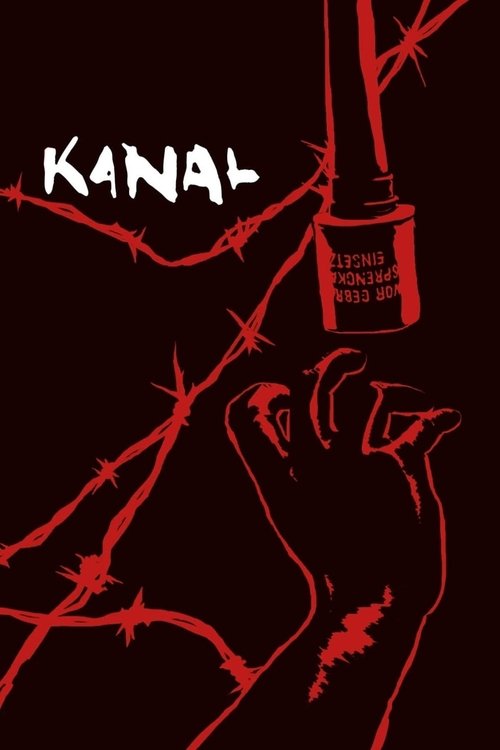
Kanal
1957 · Andrzej Wajda
For when you want cinema at its most serious — a war film with zero triumph in it, chosen on a night you're ready to be wrecked. This is challenge, not comfort, and it's worth it.
What it's about
Warsaw, 1944, the last days of the doomed uprising against the Nazi occupation. A dwindling company of Polish resistance fighters — soldiers, lovers, a musician, a messenger girl — is ordered to retreat through the city's sewers to reach friendly lines. The film tells you in its opening minutes to watch these people closely, for these are the final hours of their lives, and then descends with them into the dark.
The experience
Claustrophobic and unshakable — the surface battles give way to a lightless underworld of filth, echoes, and slowly fraying minds. It's a hard, sorrowful watch that moves like a nightmare you can't wake from, and it stays with you for days.
The craft
The sewer sequences remain astonishing: real muck, groping torchlight, black-and-white cinematography that makes darkness itself the enemy, and sound design where every drip and distant voice tightens the vise. Wajda stages the above-ground ruins with documentary conviction before pulling the film underground into something close to myth.
Why it matters
A prizewinner at Cannes that announced the Polish school of filmmaking to the world, and the central panel of Wajda's war trilogy — one of cinema's defining acts of national mourning, whose descent-into-darkness structure echoes through decades of war films.
Snapshot
Kanal (also rendered Kanał, "Sewer") is the central panel of Andrzej Wajda's informal "war trilogy," bracketed by A Generation (1955) and Ashes and Diamonds (1958). Set during the final days of the 1944 Warsaw Uprising, it follows a dwindling company of Home Army (Armia Krajowa) insurgents who, cut off and overwhelmed, descend into the city's sewer network hoping to reach positions still held by the resistance. The film's governing gesture is announced in its opening narration, which instructs the viewer to watch the characters closely because these are the last hours of their lives — a fatalistic frame that converts the entire film into an extended march toward foreknown death. It is at once a work of national mourning, a claustrophobic descent-into-the-underworld allegory, and one of the founding statements of the Polish Film School. It shared the Special Jury Prize at the 1957 Cannes Film Festival, the breakthrough that carried Wajda and postwar Polish cinema to international attention.
Industry & production
Kanal was produced within the state-controlled Polish film industry (Film Polski) through the "Kadr" film unit (Zespół Filmowy "Kadr"), the semi-autonomous production collective most closely associated with the emergence of the Polish Film School and generally identified with the documentarist Jerzy Bossak as its artistic head. The film's making is inseparable from the political thaw that followed Stalin's death and, more sharply, the Polish October of 1956 and Władysław Gomułka's rise, which loosened the ideological controls of Socialist Realism. That loosening is what made Kanal's subject possible at all: the Warsaw Uprising had been a politically radioactive topic, because the Home Army answered to the anti-communist Polish government-in-exile in London, and because the Red Army had halted on the far bank of the Vistula while the Germans destroyed the city. To put insurgents of the AK on screen as tragic protagonists was, in 1957, a pointed act.
The screenplay was adapted by Jerzy Stefan Stawiński from his own short story "Kanał." Stawiński was himself a veteran of the Uprising who had passed through the sewers, and this firsthand authority underwrites the film's specificity — the geography of manholes and junctions, the disorientation, the debate over which channel leads where. Wajda, who had served in the resistance as a youth and whose father was among the Polish officers murdered at Katyn, brought his own biographical proximity to the material. Precise budget and box-office figures for a state-financed Polish production of this period are not something the reliable record readily supplies, and I won't invent them.
Technology
Kanal was shot on 35mm black-and-white film in the standard Academy ratio. Its technical challenge was overwhelmingly one of lighting and space rather than novel apparatus: much of the film unfolds in near-total darkness, in cramped tunnels where the only motivated light sources are torches, lamps, and the pale disc of a distant manhole. Portions were staged on constructed sewer sets — allowing controlled placement of light and camera in spaces a real sewer would forbid — intercut with location work in and around Warsaw for the above-ground siege and the manhole entrances. The production leans on the expressive capacities of monochrome and low-key illumination rather than on any technological innovation, and its power comes precisely from working at the threshold of visibility that the film stock and lighting of the period could register.
Technique
Cinematography
The photography is by Jerzy Lipman, one of the defining cinematographers of the Polish Film School. The film divides into two visual registers. The above-ground opening — a bravura extended sequence introducing the company amid the rubble of the collapsing insurrection — moves with mobile, almost documentary fluidity through ruined streets, establishing the characters in continuous motion. Once the company descends, Lipman shifts to a chiaroscuro of extreme darkness pierced by hard, local light: faces emerging from and dissolving into black, silhouettes against the faint glow of an exit, water surfaces catching stray reflection. The compositions grow tighter and more oppressive as hope contracts, using the sewer's low ceilings and narrowing passages as a built-in vise. It is a cinematography of deprivation — of how little the eye is allowed to see — and the withholding of the image becomes the film's central expressive tool.
Editing
The film is credited in standard references to editor Halina Nawrocka. The cutting supports the two-part structure: relatively continuous, propulsive assembly above ground, then a fragmentation below that mirrors the company's dispersal. Once in the sewers the narrative splinters into separate strands — Zadra's group, the wounded Korab guided by Daisy, the composer wandering alone — and the editing cross-cuts between these threads as they lose contact with one another, so that the audience, like the characters, can no longer be sure who is where or who survives. The pacing is deliberately attritional; time seems to thicken underground, and the film lets scenes of groping progress run long enough to induce the exhaustion it depicts.
Mise-en-scène / staging
Staging is the film's great achievement. The sewer is realized as a genuine labyrinth — a mythic underworld rendered in filth and stone — where every choice of direction is potentially fatal and no vantage offers orientation. Wajda choreographs bodies wading through muck, pressed against walls, distributed along tunnels that recede into darkness, so that the physical arrangement of the frame constantly communicates entrapment. Recurrent motifs organize the staging: the manhole as a disc of unreachable daylight; the barred grate opening onto the Vistula through which freedom is visible but sealed off; the branching junctions where the group fractures. The above-ground prologue, by contrast, is staged amid authentic-looking ruin to establish a world already ending before the descent begins.
Sound
Sound is used with striking economy and force. In the tunnels, the acoustic world contracts to dripping water, echoing footfalls, distant explosions, disembodied voices, and — most memorably — the ocarina played by the shell-shocked composer, whose music drifts through the sewer as an eerie, disembodied thread that other characters follow or flee. Jan Krenz's score works with rather than over this soundscape, and the film repeatedly lets the tunnels' natural reverberation carry the dread. The opening voice-over narration is itself a crucial sonic device, imposing its death sentence over the images before the drama has begun.
Performance
The ensemble performances favor a grave, understated realism against which flashes of hysteria and breakdown register all the more sharply. Wieńczysław Gliński plays the commander Lieutenant Zadra with a worn authority that curdles into anguish; Tadeusz Janczar is the wounded Korab, whose deterioration anchors one of the film's most harrowing strands; Teresa Iżewska plays Daisy (Stokrotka), the messenger who leads the failing Korab through the sewers, giving the film its most tender and most despairing thread. Władysław (Vladek) Sheybal is unforgettable as the composer whose mind gives way, his ocarina-playing wandering the tunnels. The acting mode belongs recognizably to the school's blend of neorealist restraint and romantic intensity.
Narrative & dramatic mode
Kanal is structured as a tragedy in the strict sense: its outcome is announced at the outset, and the drama consists not of suspense about whether the characters will die but of watching how they meet an end already fixed. This foreknowledge transforms every subsequent scene into dramatic irony and elegy at once. Formally the film moves from a compressed, near-continuous opening that establishes the collective, into a dispersed second half in which the group fragments into parallel storylines that the film cross-cuts. The mode is unremittingly bleak — there is no redemptive escape, no rescue — and the individual fates rhyme into a single image of doom: the exit that opens onto water but is barred, the commander who climbs out only to descend again when he finds his men gone. It is a war film whose dramatic engine is not action but endurance and the slow foreclosure of hope.
Genre & cycle
The film sits at the intersection of the war film and national tragedy, and belongs to a specific cycle: the wave of ambitious, revisionist Polish war films that appeared with the post-1956 thaw and constituted the Polish Film School. Within Wajda's own output it is the middle film of the war trilogy, taking up the generational and insurrectionary material of A Generation and handing it forward to the disillusioned postwar reckoning of Ashes and Diamonds. Against the Socialist-Realist war film's heroic optimism, Kanal substitutes defeat, sacrifice without recompense, and a mordant skepticism about triumphal narratives — a reorientation that helped define what the war film could mean in People's Poland.
Authorship & method
The dossier's key authorial constellation:
- Andrzej Wajda (director). Kanal is an early, decisive statement of Wajda's lifelong method: history refracted through romantic tragedy, national trauma addressed obliquely enough to pass censorship yet unmistakably in its sympathies, and a symbolic image-making that turns the concrete (a sewer, a manhole, an ocarina) into emblem. His own resistance-era youth and family history of wartime loss inform the film's intimacy with defeat.
- Jerzy Stefan Stawiński (screenwriter). Adapting his own story from lived experience of the Uprising and the sewers, Stawiński supplies the documentary substratum of detail and the tragic architecture.
- Jerzy Lipman (cinematographer). His command of darkness and low-key light is the film's expressive core.
- Jan Krenz (composer). His score and the film's use of diegetic music — the ocarina above all — bind sound to dread.
- Halina Nawrocka (editor), as credited in standard references, shapes the shift from continuous prologue to fractured underground cross-cutting.
The young Kazimierz Kutz — later a major director of the Polish school in his own right — worked as Wajda's assistant on the production, one of the connective threads binding the school's figures together.
Movement / national cinema
Kanal is a foundational film of the Polish Film School (Polska Szkoła Filmowa), the loose movement of the mid-1950s to early 1960s that included Wajda, Andrzej Munk, Wojciech Has, and Kutz, among others. The school's shared concerns — the war and Occupation, the fate of the wartime generation, the tension between heroic myth and human cost, a settling of accounts with recent history newly possible after the thaw — are all present here. Stylistically it fuses Italian neorealism's location realism and social gravity with a distinctly Polish romantic-symbolic tradition, and Kanal is often cited as the film in which that fusion first achieved international recognition, marking the arrival of a serious national cinema on the world stage.
Era / period
The film is doubly located in time. Diegetically it belongs to the final days of the Warsaw Uprising in the autumn of 1944, one of the war's most catastrophic episodes for the Polish resistance and the city itself. As an artifact it belongs to 1957 and the specific opening created by de-Stalinization: the Polish October, Gomułka's ascent, and the retreat of Socialist Realism, which together permitted a film to treat the Home Army as tragic protagonists rather than as ideological adversaries. Kanal is thus a document of the thaw as much as of the war — its candor about defeat and its sympathy for the AK are legible as a reclaiming of suppressed national memory the moment that reclamation became possible.
Themes
The film's dominant theme is doom foretold — heroism drained of triumph, sacrifice that purchases nothing, the tragedy of a resistance abandoned to annihilation. The descent into the sewers gives this a mythic-allegorical dimension: a katabasis, a passage through an underworld of filth and darkness toward an exit that proves sealed, so that the labyrinth becomes an image of the historical trap Poland found itself in. Related motifs run throughout: entrapment and disorientation, the loss of solidarity as the collective fractures into isolated, dying individuals; madness as a response to unbearable circumstance, embodied by the composer; and the bitter proximity of freedom glimpsed but withheld, crystallized in the grate that opens onto the Vistula with the far shore in view. Beneath all of it runs an elegiac national mourning for the destroyed city and its lost generation.
Reception, canon & influence
Critically, Kanal was the film that internationalized Wajda and postwar Polish cinema. Its Special Jury Prize at the 1957 Cannes Film Festival signaled to Western audiences that a distinctive, serious cinema had emerged from behind the Iron Curtain, and the film has held a durable place in the canon as both a Polish national touchstone and a landmark war film. At home its reception was inevitably entangled with politics — a film about the Home Army was a charged intervention — but it was embraced as a work that spoke a long-suppressed grief.
Influences on the film (backward): it draws on Italian neorealism for its location realism and unheroic gravity; on the Polish romantic tradition of doomed insurrection and national martyrdom for its tragic temperature; and, most concretely, on the eyewitness testimony carried by Stawiński's own story and screenplay, which ground the sewer ordeal in remembered fact.
Legacy (forward): Kanal helped establish the template of the Polish Film School's reckoning with the war, feeding directly into Ashes and Diamonds, the trilogy's culmination and Wajda's most celebrated film. It shaped Wajda's own decades-long project of putting Polish history on screen, a project that would return to the same wounds across his career and eventually to the murder of his father in Katyń (2007). More broadly it stands as an enduring model of the war film as tragedy rather than triumph — the descent-into-the-labyrinth, death-foretold structure, and its refusal of consolation have made it a persistent reference point for cinema about resistance and defeat. Its precise, downstream influence on individual later filmmakers is harder to document with certainty than its general canonical standing, and I flag that as a genuine limit of the record rather than filling it with attributions I cannot support.
A Deleuzian reading
Deep in *Kanal* there is a grate.
The full Deleuzian reading of Kanal →
Reception
Polish audiences in 1957 — many of them Uprising survivors — bristled at seeing their heroes sent into the muck rather than mythologized, while Cannes handed it a prize; today that unflinching honesty is exactly why it's canon.
How Kanal was received, from release to now →
How to watch Kanal: what to notice on a first viewing
- Listen to the narrator tell you these are their last hours. Before the story even starts, a voiceover states plainly that you are about to watch these people in the final hours of their lives. Every scene after that becomes about how, not whether, since the outcome is already settled.
- Notice how little light reaches the sewer tunnels. Once the group descends, faces keep emerging from and dissolving back into black, with only hard local light breaking the darkness. How little you're allowed to see becomes the film's main tool for building dread.
- Watch for a circle of daylight above the tunnel. Manholes and grates keep appearing overhead throughout the film, small discs of the world above that the group can see but not always reach. Freedom stays visible the whole time, which makes its distance worse, not better.
- Listen for an ocarina drifting through the tunnels. A shell-shocked composer plays a small wandering tune that other characters follow toward him or flee from, depending on what they need. One fragile, aimless sound becomes the thread other people use to navigate an unmappable space.
- Notice how often the film cuts between separated groups. Once the company splits up in the tunnels, the editing keeps jumping between the different strands, so you lose track of who is where along with them. You end up sharing the group's own disorientation instead of just watching it from outside.
The whole guide to watching Kanal, with the keys for a rewatch →
Influences: the films it descends from and the films it influenced
- Rome, Open City (1945) — Supplies the neorealist template Kanal adopts wholesale — real-location shooting and a resistance narrative that ends in capture and execution rather than victory, the 'unheroic gravity' that lets a war film be tragedy.
- Bicycle Thieves (1948) — Models the neorealist performance restraint and the downbeat descending structure of ordinary people ground toward defeat that Wajda directs his cast to reproduce in the sewers.
- La Terra Trema (1948) — Precedent for the neorealist chronicle of a doomed collective struggle photographed with documentary texture, the group-defeat dramaturgy Kanal transfers to an insurgent unit.
- M (1931) — Origin of the low-key expressionist chiaroscuro and the underworld-labyrinth manhunt, plus the diegetic whistled leitmotif used as a sonic harbinger of death — the exact function Kanal assigns the ocarina.
- The Third Man (1949) — The most direct precursor: a climactic flight through a city's sewer system staged in stark low-key chiaroscuro with a single diegetic instrument (Karas's zither) binding sound to dread, prefiguring Kanal's tunnels and ocarina.
- Intolerance (1916) — Codified the parallel cross-cutting that accelerates toward a foretold catastrophe, the editing grammar Halina Nawrocka deploys once the film fractures into separate groups underground.
- The Wages of Fear (1953) — Builds suspense from confinement and the near-certainty of doom, the death-foretold ordeal structure in which the audience's dread is that these men cannot all survive the passage.
- A Generation (1955) — Wajda's own first war-trilogy film, establishing the method Kanal refines — Polish history refracted through romantic tragedy and neorealist location work — with the young Kutz already in the production orbit.
- Ashes and Diamonds (1958) — The trilogy's culmination extends Kanal's death-foretold structure and its turning of the concrete into emblem (the white horse, the dying on a rubbish heap), with Jerzy Wójcik's deep chiaroscuro pushing Lipman's darkness further.
- Ivan's Childhood (1962) — Refracts war as poetic elegy of loss in low-key expressionist light, extending Kanal's insistence that the war film register grief and defeat rather than heroic triumph.
- Das Boot (1981) — Inherits the trapped-in-a-labyrinth dramaturgy — a doomed crew inside a constructed confined vessel with the camera prowling cramped purpose-built sets, the claustrophobic-tunnel ordeal Kanal pioneered with its sewer sets.
- Come and See (1985) — Takes Kanal's katabasis structure to sensory extremity — war as a subjective descent into hell that grants no consolation and no survival-as-victory, the refusal-of-consolation stance made total.
- Katyń (2007) — Wajda's late return to the same wound, restating the foretold-massacre narrative and voice-over/death-foretold frame of Kanal, national mourning staged as a march toward an ending the audience already knows.
- 1917 (2019) — Stages a doomed-feeling foretold mission as immersive passage through a trench-and-tunnel underworld, extending Kanal's descent-into-the-labyrinth dramaturgy with a mobile camera threading constructed subterranean space.
- The Pianist (2002) — The Polish School's rubble-and-sewer staging of Warsaw's destruction and its pointed refusal of redemptive uplift.
- Green Border (2023) — Holland's mentor built the template she reuses: trapping ordinary people in a hostile physical environment (the sewers here, the swamp-forest in Green Border) where the terrain itself becomes the instrument of doom.
- The Third Part of the Night (1972) — Its claustrophobic subjective descent through wartime hell in high-contrast chiaroscuro models the perpetual-crisis staging Żuławski pushes past the point of breakdown.
- Knights of the Teutonic Order (1960) — Jerzy Stefan Stawiński's screenplay architecture — a doomed collective tracked through parallel small groups toward a foreknown convergence — is the narrative skeleton the same writer then supplies to Ford, the ironist's structure carried inside the monument.
- Eroica (1957) — The Polish Film School counter-voice released the same year, treating the identical Warsaw Uprising martyrdom myth with corrosive irony rather than Wajda's romantic tragedy — the two poles of the school's war reckoning.
- Night Train (1959) — A Polish School contemporary generating dread from a single confined space (a train) and acoustic minimalism — Andrzej Trzaskowski's spare scat vocal doing what Krenz's sparse score and ocarina do for Kanal.
- Passenger (1963) — Shares the Polish School's claustrophobic wartime realism and high-contrast monochrome, but Munk answers Wajda's tragic romanticism with cold, deflating irony.
- Two Half-Times in Hell (1961) — Extends the confinement-versus-unreachable-openness dialectic — trapped bodies inching toward a light they cannot reach — driven by cross-cutting toward a foreknown doom, the same spatial and editorial dread Fábri organizes around the match.
Similar films
- Ashes and Diamonds (1958) — influence & lineage
- Come and See (1985) — influence & lineage
- Das Boot (1981) — influence & lineage · same viewing thread
- 1917 (2019) — influence & lineage · same viewing thread
- Paths of Glory (1957) — same viewing thread
- The Battle of Algiers (1966) — same viewing thread
- A Man Escaped (1956) — same viewing thread
- Rome, Open City (1945) — influence & lineage · often watched together
All the films related to Kanal →
Watch it with: curated runs of related films
- The Futility of War — A run of films about ordinary men fed into war's machinery — from the trenches to the Casbah to the Warsaw sewers — where the futility and human cost rhyme across a century and a dozen conflicts.