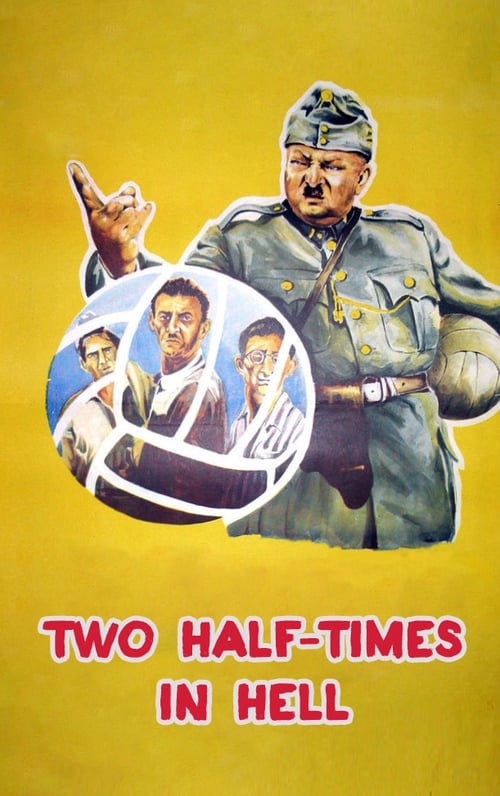
Two Half-Times in Hell
1961 · Zoltán Fábri
For when you want a war film that's about conscience rather than combat — a challenge, not a comfort, and one that will sit with you after the final whistle. Reach for it when you're ready to be genuinely shaken.
What it's about
In a Nazi forced-labor camp, the German commandant orders up entertainment for Hitler's birthday: a football match between his garrison and a team of Hungarian political prisoners. A famous pre-war football star, now an inmate, is put in charge of assembling and training the side. The captives are expected to lose gracefully — but a game played for the guards' amusement slowly becomes a contest over dignity, defiance, and what winning might cost.
The experience
Bleak, tense, and morally merciless, with flashes of gallows humor as starving men argue tactics. The match itself plays like a slow-tightening vise — you watch a simple game acquire life-and-death stakes, and the film never lets you forget who holds the guns.
The craft
Fábri shoots the camp and the pitch in stark black and white, using the geometry of the field — lines, goalposts, watching guards — to turn sport into a stage for power. The film builds its structure around the two 'halves' of the match, a formal gamble that pays off in mounting dread.
Why it matters
One of cinema's earliest and bleakest treatments of the wartime 'death match' legend, from a senior figure of postwar Hungarian cinema — a story premise that later, better-known films would revisit in softer form.
Snapshot
Two Half-Times in Hell (Hungarian: Két félidő a pokolban) is a black-and-white war drama by Zoltán Fábri, one of the senior figures of postwar Hungarian cinema. Its premise is deceptively simple and morally merciless: in a forced-labor camp, a German commandant proposes a football match between his garrison and a scratch team of Hungarian prisoners, staged as entertainment for Hitler's birthday. A pre-war national football star, interned among the prisoners, is charged with assembling and drilling the side. What begins as a humiliating command performance — the captives expected to lose gracefully and gratefully — becomes, over the film's two "halves," a contest over dignity, defiance, and the price of winning. The film is one of cinema's earliest and bleakest treatments of the "death match" legend, the widely circulated story of a wartime football game whose players supposedly paid with their lives for beating their captors. Where later, better-known versions of that legend soften the ending, Fábri drives it toward catastrophe. The result is a sports film that refuses the consolations of the sports film, using the grammar of the game — training, teamwork, the roar of a crowd, the whistle — to stage a parable about resistance under totalitarianism.
Industry & production
The film was made within Hungary's state-run studio system, which by the early 1960s was consolidated under a centrally planned production model in Budapest. This was a period of cautious cultural loosening following the crushing of the 1956 uprising: the Kádár regime's gradual accommodation ("goulash communism") permitted a cinema that could examine fascism, war, and moral compromise with some seriousness, provided it stayed within acceptable ideological bounds. An anti-fascist war subject like Két félidő a pokolban was, in this sense, both artistically serious and institutionally safe — the villains are Nazis, the martyrs are the oppressed — which gave a director of Fábri's standing room to work at scale. Fábri was by 1961 an established, prestige director, and the film mobilizes the resources such standing commanded: crowd scenes, a constructed camp environment, and a large ensemble of prisoners and guards. Detailed English-language documentation of the production — budget, shooting schedule, studio logistics — is thin, and I will not invent figures; what is clear from the film itself is that it was a substantial studio undertaking rather than a marginal one, staged with the manpower and set-building a football-match climax demands.
Technology
The film was shot on black-and-white 35mm and presented in the standard theatrical format of Hungarian studio production of the era. The monochrome is not a limitation but a chosen register: it suits the mud, barbed wire, and overcast institutional grays of a labor camp, and it aligns the film with the sober, documentary-inflected realism that European war cinema of the period favoured over spectacle. There is no evidence of technical showmanship for its own sake — no widescreen novelty or color — and the film's technological profile is that of a mature national studio operating at a high craft standard rather than at the frontier of innovation. Its ambitions are dramatic and moral rather than technical.
Technique
Cinematography
Fábri, trained originally as a designer and stage director, brought a strong architectural eye to the frame, and the film's visual strategy is built on contrast: the confinement of the camp against the sudden, exposed openness of the pitch. The camera treats the football ground as a stage and a killing field at once — a rectangle of order imposed on a landscape of disorder. Compositions exploit the geometry of fences, watchtowers, and lines of standing men to press the theme of surveillance and enclosure. In the match sequences the film must do something difficult: convey the kinetic excitement of sport while never letting the viewer forget the guns ringing the field. I want to be candid that the specific cinematographer credit is not something I can confirm from reliable English-language sources, and I will not attach a name to the work speculatively; what can be described with confidence is the style — high-contrast monochrome, an emphasis on faces in the crowd, and a spatial logic that keeps captor and captive perpetually in the same frame.
Editing
The film's structure is announced in its title: two halves, a game with a clock. The editing exploits this built-in dramatic engine, using the rhythm of a football match — the alternation of play, stoppage, and the mounting pressure toward a final whistle — as a suspense mechanism. Cross-cutting between the action on the pitch, the reactions of the watching prisoners, and the tightening faces of the German officers converts sport into dread. As with the other technical credits, I cannot responsibly name the editor from memory, but the design of the film's back half is legible on screen: it accelerates and constricts as the game approaches its end, so that the closing of the match and the closing of the trap become the same movement.
Mise-en-scène / staging
This is the film's strongest dimension and the clearest signature of Fábri's theatrical background. The camp is staged as a total environment — a world of routine humiliation into which the absurd premise of a football match intrudes. Fábri choreographs mass: rows of prisoners, ranks of guards, the crowd as a single trembling body. The match itself is a set piece of staging, with the pitch functioning as a stage-within-the-film on which the prisoners perform for their oppressors while performing, secretly, for themselves. Props and costume carry meaning without underlining — the improvised kit, the star player's remembered technique surfacing through a wasted body, the ceremonial trappings of the Nazi occasion. The recurring visual motif of men arranged in lines, whether as a team, as labourers, or as targets, binds the film's world together.
Sound
The soundtrack works the contrast between festivity and menace: the manufactured cheer surrounding a fascist celebration set against the silence and barked orders of camp discipline. Crowd noise, whistle, and the percussive sounds of the game build the match's tension, while the intrusion of martial and ceremonial sound marks the Nazi occasion as grotesque theater. I am not able to confirm the composer credit from dependable sources and will not guess at a name; the score's function, however, is clear — it underscores the irony of celebration staged over an abyss, rather than swelling into conventional sports-film uplift.
Performance
The film rests on its ensemble and, above all, on the figure of the imprisoned football star, whose weary authority anchors the drama; the role is generally identified with the prominent Hungarian actor Imre Sinkovits, though readers should treat casting specifics against a primary source. The performance style is grounded and unglamorous, in keeping with the film's realism: the prisoners are individuated as a range of temperaments — the fatalist, the eager, the frightened, the defiant — rather than reduced to a mass, and the German officers are played as bureaucrats of cruelty rather than cartoons. The emotional power comes from restraint, from men calculating in real time whether survival lies in losing or in the unbearable pride of winning.
Narrative & dramatic mode
The film operates in the mode of tragic irony. Its structure is a countdown: the audience senses early that no good outcome is available, that victory and defeat may be equally fatal, and the drama lies in watching men reason their way toward a choice that is really no choice. Fábri uses the sports-contest template — recruitment, training, the underdogs' improving cohesion, the climactic match — precisely so that he can detonate it. Every genre expectation the training montage raises (the triumphant comeback, the vindicating goal) is set up to be betrayed. The narrative thus works on two levels simultaneously: as a straightforward, suspenseful account of a football match, and as an allegory of resistance in which to play well is to assert one's humanity and to assert one's humanity is to invite annihilation.
Genre & cycle
Két félidő a pokolban sits at the intersection of the war film, the prison/camp drama, and the sports film, and its distinction lies in how it turns the last of these against type. It belongs to the broad postwar European cycle of anti-fascist and camp-set films that reckoned with the recent past, but it is unusual in choosing the football match as its central device. In doing so it inaugurated, or at least gave enduring cinematic form to, a small but persistent sub-genre: the wartime "death match" film, in which sport becomes a proxy battlefield between the powerless and their captors. Within that lineage Fábri's film is the austere, tragic pole, defined against the more heroic and redemptive treatments the same legend would later receive.
Authorship & method
Zoltán Fábri (1917–1994) is the film's decisive author. Trained at the Hungarian Academy of Fine Arts and active in theater as a director and designer before turning to film, Fábri brought to cinema a painter's compositional sense and a stage director's command of ensemble and space — qualities everywhere evident here. His career, from Merry-Go-Round (Körhinta, 1956) through the Academy Award–nominated The Fifth Seal (Az ötödik pecsét, 1976) and Hungarians (Magyarok, 1978), returns repeatedly to moral tests under duress: how individuals behave when history corners them. Két félidő a pokolban is a characteristic Fábri subject in that respect, a controlled moral experiment dressed as a genre story.
On the writing, the film is generally associated with the screenwriter Péter Bacsó — later celebrated as the director of the satirical classic The Witness (A tanú) — working in collaboration on the script; readers should verify the exact writing credits against a primary source, as I am relaying an attribution I cannot fully confirm here. For the cinematographer, composer, and editor, I have chosen not to supply names, because the reliable English-language record is sparse and inventing credits would violate the standard this dossier holds itself to. What can be said about method with confidence is that the film is auteur-driven in the fullest sense: its power flows from Fábri's staging intelligence and his willingness to weaponize a crowd-pleasing form.
Movement / national cinema
The film is a product of Hungarian national cinema in a transitional moment. It precedes, and in some ways prepares the ground for, the internationally celebrated Hungarian New Wave of the mid-to-late 1960s associated with Miklós Jancsó, István Szabó, and others, whose formal radicalism (long takes, choreographed mass movement, historical allegory) would soon redraw the map of the country's film culture. Fábri belonged to the preceding, more classically realist generation, but his preoccupations — collective behavior, the individual crushed or ennobled by history, the moral anatomy of oppression — clearly anticipate New Wave themes. Két félidő a pokolban thus occupies an instructive place: a mature, classically constructed film by an established master, made on the eve of a stylistic revolution it helped make thinkable.
Era / period
Produced in 1961, the film reflects the specific conditions of early-1960s Hungary: a society governed by a regime that had violently reasserted control in 1956 but was beginning to permit a somewhat freer cultural life. Anti-fascist war narratives were ideologically sanctioned, which allowed serious filmmakers to explore questions of complicity, courage, and survival with a candor that more contemporary subjects would not have been granted. Set roughly two decades before its making, the film participates in the era's wider European project of processing the Second World War on screen — but its labor-camp setting and its refusal of uplift give it a harder edge than much of the officially encouraged war cinema of the Eastern Bloc.
Themes
At its core the film is about dignity as resistance — the idea that to perform well, to insist on one's excellence and humanity, is itself an act of defiance under a system designed to strip both away. Bound to this is a bleak meditation on the impossible calculus of survival: whether it is safer to lose than to win, and what is left of a person who chooses safety over pride. The football match functions as an extended metaphor for the totalitarian condition, in which the oppressed are compelled to play by rules rigged against them and are damned whether they comply or excel. Spectacle and complicity form another thread — the staging of the game as fascist entertainment implicates the watching crowd and, uncomfortably, the film's own audience. And underlying everything is the theme of collective versus individual fate: the team as a fragile solidarity forged under threat, and the question of whether solidarity can be anything more than a shared way of facing the end.
Reception, canon & influence
Within Hungarian film history, Két félidő a pokolban is regarded as one of Fábri's significant works and a notable entry in European anti-fascist cinema, though its international profile has always been smaller than that of the legend it dramatizes. I do not have reliable documentation of specific festival awards or contemporary box-office figures for the film, and I will not manufacture them; its standing rests on its craft, its unflinching ending, and its place in a distinguished directorial career rather than on a well-known prize record.
Looking backward, the film's principal influence is the historical "death match" legend — most famously associated with a 1942 game in occupied Kyiv, in which a team of former professional footballers reportedly defeated an occupiers' side and several players later died in captivity. Fábri and his collaborators transposed and reimagined this material into a Hungarian labor-camp setting, drawing also on the broader European tradition of camp drama and postwar moral reckoning.
Looking forward, the film is frequently cited as a precursor to later, more famous screen treatments of the same legend — most conspicuously John Huston's Escape to Victory (1981), which shares the death-match premise but replaces Fábri's tragedy with an escape-thriller's triumphant catharsis. The lineage should be understood as a shared descent from the underlying legend and a frequently drawn comparison rather than a documented direct adaptation, and the contrast is the point: set beside the crowd-pleasing Hollywood version, Fábri's film stands as the sterner, more honest reckoning with what it might actually have cost to win a game against men who held all the guns. That contrast is the surest measure of its lasting value — a reminder that the same story can be told as consolation or as indictment, and that Fábri chose the harder truth.
Reception
Barely seen outside Hungary on release, it's now steadily rediscovered by cinephiles as the dark, uncompromising original behind a much glossier Hollywood story — a quiet canon climber in the Fábri revival.
How Two Half-Times in Hell was received, from release to now →
How to watch Two Half-Times in Hell: what to notice on a first viewing
- Watch how the guards and prisoners are always framed together. Fábri keeps captor and captive inside the same shot, using fences, watchtowers, and lines of standing men to build a spatial logic of surveillance and enclosure. The framing never lets you forget who is holding the guns, even during the match itself.
- Notice the shift from cramped camp shots to the open pitch. The camera treats the football ground as both a stage and a killing field, a sudden exposed rectangle after the tight geometry of the camp. The openness of the pitch feels like exposure, not relief, because the guns still ring the field.
- Listen for cheering that never turns into celebration. The soundtrack sets manufactured festive cheer for the Nazi occasion against the silence and barked orders of camp discipline, so joy and menace share the same scene. The mismatch between the sound of celebration and what you know is happening turns cheer into a threat.
- Track the match clock as the film cuts between pitch and prisoners. The match's own clock supplies the film's structure, with the cutting speeding up as time on the clock runs down. The game's rules set the pace of the film.
- Watch how each prisoner reacts differently to playing well. Fábri individuates the team as a range of temperaments, the fatalist, the eager, the frightened, the defiant, rather than staging them as one undifferentiated mass of prisoners. Each man calculates in his own way whether survival lies in losing or in the pride of winning.
The whole guide to watching Two Half-Times in Hell, with the keys for a rewatch →
Influences: the films it descends from and the films it influenced
- Grand Illusion (1937) — Established the POW-camp-as-theater template Fábri inherits — prisoners staging a performance under the captors' gaze, where dignity is asserted through spectacle the guards permit, the direct root of his stage-within-film device.
- Olympia (1938) — Codified the choreographed, heroic athletic body in high-contrast monochrome; Fábri weaponizes exactly this fascist sports-spectacle grammar, filming the match with its worshipful vocabulary so the form itself becomes the indictment.
- Battleship Potemkin (1925) — The Odessa Steps model of the mass-as-protagonist cross-cut against an oncoming implacable force is the rhythmic engine behind Fábri's crowd-versus-guards staging and his match-clock montage of mounting dread.
- Rome, Open City (1945) — Set the neorealist anti-fascist template of a moral reckoning ending in execution rendered with grounded restraint rather than melodrama — the tonal discipline Fábri applies to his unflinching final whistle.
- Merry-Go-Round (1956) — Fábri's own earlier film develops the painterly composition and choreographed mass movement (the carousel) and tight ensemble staging in enclosed space that he transposes onto the pitch here.
- A Man Escaped (1956) — Built captivity tension procedurally from restrained, near-affectless performance and off-screen menace rather than spectacle — the model for Fábri's grounded-restraint acting register and his suspense-through-withholding.
- The Bridge on the River Kwai (1957) — Prisoners performing forced labor as a point of pride under their captors, structured as a tragic-irony countdown where the moral test is dressed inside a crowd-pleasing genre frame — the same architecture Fábri employs.
- The Round-Up (1966) — Fulfils what Fábri anticipates — the Hungarian New Wave's confinement-versus-openness staging and choreographed mass movement across a stark high-contrast plain, where power is exercised through spatial control and ritualized humiliation.
- The Red and the White (1967) — Radicalizes the choreographed-mass and cross-cutting-of-executioners-and-victims grammar into long-take ballets of arbitrary killing across open terrain, extending Fábri's death-by-decree dread into pure formal system.
- The Longest Yard (1974) — Turns the prisoners-versus-guards match into a literal power struggle with match-clock suspense over a rigged game, inheriting the subverted-sports-film premise where the outcome is a matter of survival, not points.
- Escape to Victory (1981) — Draws on the identical death-match legend but inverts Fábri's tragedy into escape-thriller catharsis — the defining contrast case, the same story told as consolation where Fábri told it as indictment.
- Mephisto (1981) — Carries forward the stage-within-film device and the idea of performance-as-survival under a regime, staging theatricality itself as the site of the moral test that Fábri first embedded in a public spectacle before an occupying audience.
- Son of Saul (2015) — Extends the Hungarian camp-drama lineage of dignity-as-resistance built from grounded restraint and claustrophobic confinement, pursuing a single grim act to its end with the same refusal of consolation Fábri modeled.
- Ashes and Diamonds (1958) — A contemporaneous Eastern-Bloc-thaw work using high-contrast monochrome and a doomed protagonist on a tragic countdown, with festivity-versus-menace (the polonaise finale) mirroring Fábri's sound design of celebration curdling into dread.
- Kanal (1957) — Extends the confinement-versus-unreachable-openness dialectic — trapped bodies inching toward a light they cannot reach — driven by cross-cutting toward a foreknown doom, the same spatial and editorial dread Fábri organizes around the match.
- Kapò (1960) — A near-simultaneous camp drama testing dignity and complicity to the point of self-destruction at the fatal fence, sharing Fábri's project of the labor-camp as a controlled moral experiment about how people behave when cornered.
Similar films
- Mephisto (1981) — influence & lineage
- Son of Saul (2015) — influence & lineage
- Grand Illusion (1937) — influence & lineage
- The Red and the White (1967) — influence & lineage
- A Man Escaped (1956) — influence & lineage
- The Fifth Seal (1976) — shared sensibility
- The Pianist (2002) — shared sensibility
- Great Freedom (2021) — shared sensibility