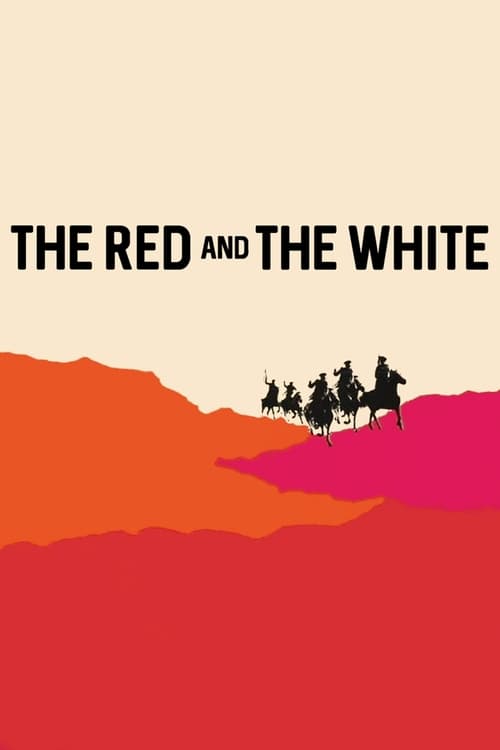
The Red and the White
1967 · Miklós Jancsó
When you want a war film that refuses every war-movie comfort — no heroes, no sides, no catharsis — and you're ready to sit with that. One to chew on for days, ideally with someone to argue about it with afterward.
What it's about
In the Russian Civil War of 1919, Hungarian volunteers fight alongside the Bolshevik Reds against the Czarist Whites in the river country near the Volga. A monastery and a field hospital pass from one side to the other and back, and with each reversal the same rituals repeat: capture, interrogation, stripping, execution. Nobody stays in power long enough to be the hero.
The experience
Cold, gripping, and quietly devastating — long, gliding takes watch men herded across open landscapes with the detachment of a hawk, and the effect is more unnerving than any close-up of violence. You come out shaken by how orderly, arbitrary, and absurd it all looks.
The craft
Jancsó choreographs entire battles and mass executions in sweeping, minutes-long takes across widescreen plains, so power reads as pure geometry: who stands, who kneels, who walks and in which direction. The black-and-white landscape photography is stunning, and the ballet-like camera movement genuinely needs a big screen to register.
Why it matters
Commissioned as a fiftieth-anniversary tribute to the Revolution, it delivered something so unsparing about power itself that it was effectively suppressed in the Soviet Union, and it made Jancsó's choreographic long-take style one of world cinema's most distinctive signatures.
Snapshot
The Red and the White — Hungarian title Csillagosok, katonák, "Stars and Soldiers," taken from a soldiers' song, the English title a distributor's coinage that borrows Stendhal's cadence — is the film in which Miklós Jancsó's method arrived fully formed and unhoused. Commissioned within a Hungarian–Soviet co-production framework tied to the fiftieth anniversary of the October Revolution, it takes as its ostensible subject the Hungarian internationalists who fought alongside the Bolsheviks in the Russian Civil War of 1919. What Jancsó delivered instead of an anniversary tribute is one of cinema's most rigorous demonstrations that power is a form, not a content: a ninety-minute study of a stretch of river country and a monastery changing hands, in which Reds and Whites perform the same rituals of capture, stripping, humiliation, and execution with an interchangeability that dissolves the commemorative premise from inside.
The film has no protagonist, almost no dialogue that functions as characterization, and no dramatic architecture of the kind war films are built from. It has instead a camera that never stops moving, a landscape flattened into an arena, and a moral proposition delivered entirely through blocking. It is, alongside The Round-Up (Szegénylegények, 1966), the founding text of Jancsó's international reputation and one of the decisive works of the Hungarian New Wave.
Industry & production
The film was produced by Mafilm on the Hungarian side and Mosfilm on the Soviet, within the network of bilateral co-productions that Eastern Bloc studios used through the 1960s to pool resources and, in this case, to mark the revolutionary jubilee. The arrangement is essential to the film's texture. A Hungarian production alone could not have mustered cavalry at this scale, the uniform stock of two armies, or the sustained access to open terrain that Jancsó's long takes require; the Soviet partnership supplied a production apparatus commensurate with the ambition. The screenplay is credited to Jancsó's indispensable writing partner Gyula Hernádi with Soviet collaboration — Georgi Mdivani is credited on the Soviet side — a joint authorship typical of such treaties, in which each partner nominally guaranteed its own national interest in the material.
The cast is likewise binational: Hungarian actors including József Madaras, Tibor Molnár, András Kozák and Jácint Juhász alongside Soviet performers such as Sergei Nikonenko, Mikhail Kozakov, Anatoli Yabbarov and Viktor Avdyushko, with the Polish actress Krystyna Mikołajewska among the nurses. That the film is genuinely bilingual is not incidental: the Hungarians are foreigners in this war, volunteers in someone else's civil conflict, and the friction of two languages under one command structure is part of the argument.
The reception on the Soviet side is the production's most-repeated story and also its least precisely documented. It is widely reported that Soviet authorities were displeased with a jubilee film that declined to heroize the Red side, and that the film's Soviet circulation was curtailed or its Soviet version altered. The specifics — what was cut, by whom, for which release — remain murky in the accessible record, and it is worth saying plainly that the frequently repeated account of outright suppression is more often asserted than sourced. What is not in doubt is that the film was embraced in Hungary and in the West as a major work almost immediately, and that it consolidated the reputation The Round-Up had established a year earlier.
Technology
Technically the film is conservative in its means and radical in their deployment. It is shot on 35mm black-and-white stock in anamorphic widescreen — the roughly 2.35:1 frame that Jancsó and his cinematographer had already used on The Round-Up — and the choice of scope for a film with no spectacle in the conventional sense is itself a thesis. The wide frame here is not for armies or vistas but for the horizontal: for showing that a man walking away from the camera has nowhere to go, that the plain offers no cover, that two groups can occupy the same rectangle in a relation of absolute asymmetry.
The film's real technological substrate is movement equipment. Sustained takes of this length and complexity depend on cranes, dollies, laid track across uneven ground, and hand-held or shoulder-carried work for the passages that follow figures on foot; the achievement is less a matter of any single device than of a production willing to spend its schedule on rehearsal and repositioning rather than on coverage. Sound was post-synchronized, standard practice in both Hungarian and Soviet production of the period, which freed the camera entirely from the microphone — a precondition for the kind of unbroken movement across open ground the film performs.
Technique
Cinematography
Tamás Somló's camerawork is the film's authorial instrument as much as Jancsó's staging. Somló had shot My Way Home (1965) and The Round-Up before this; János Kende would take over from Silence and Cry (1968) onward and become the more famous Jancsó collaborator, but the grammar is established here. The camera pans, tracks, cranes and circles continuously, frequently completing full rotations that reveal the space behind it to be as populated and as dangerous as the space in front. Figures enter and exit frame constantly; the camera declines to follow the person we expect it to follow and picks up another, and the one it abandoned is often dead by the time we return.
The tonal register is high-key and hard: white sky, pale grass, black uniforms, the birch grove's vertical striping. There is almost no chiaroscuro and very little conventional expressive lighting. This flatness is deliberate — it refuses the moral shading that lighting normally supplies, denying us the visual cue that would tell us whose side the film is on.
Most consequentially, there are essentially no close-ups. The camera holds at medium and long range, and the human figure is legible as posture, gait, and position relative to others rather than as face. Interiority is not withheld for effect; it is declared irrelevant to the subject.
Editing
Zoltán Farkas, Jancsó's long-standing editor, cuts a film that resists cutting. Precise shot counts vary between sources, but every account agrees on the essential fact: a feature of roughly ninety minutes built from an unusually small number of takes, many of them running several minutes, yielding an average shot length many times the norm of the period. The cut, being rare, becomes a major event. Jancsó and Farkas typically place it at a moment of transfer — a change of position, a change of occupying force — so that the edit itself carries the film's central idea of reversal. Where Soviet montage cinema, the tradition this jubilee film was nominally honoring, generated meaning by collision between shots, Jancsó generates it within the shot and uses the cut as a hinge between regimes. The refusal of montage on a fiftieth-anniversary Revolution picture is close to a polemic.
Mise-en-scène / staging
This is where the film lives. Jancsó choreographs bodies in depth across open ground with the precision of a ballet master and the vocabulary of a drill sergeant: men are marched, halted, separated into groups, ordered to strip, ordered to run, ordered to dance. The staging is geometric — lines, columns, circles, dispersals — and it is the geometry, not the dialogue, that tells us who currently holds power. A recurring figure is the arbitrary reprieve: prisoners told they are free to go, released into the field, then shot, or told to run to a treeline within a stated interval. Freedom is granted as a formal move within a game whose rules the holder of the rifle sets and revises.
Two sequences have become canonical. In one, nurses are taken by White officers into a birch grove, made to put on dresses, and made to waltz — the coerced aestheticization of captivity, violence conducted as an etiquette. In another, the naked and the half-clothed are driven across landscape, the removal of the uniform reducing political identity to bare body. The monastery and field hospital of the synopsis function less as locations than as tokens exchanged: whoever holds the building performs the same liturgy inside it.
Sound
There is no composed score. Jancsó works with the ambient and the diegetic — wind across grass, hooves, boots, shouted commands, the flat report of rifles in open air, and the periodic intrusion of music that is always being played or performed within the scene, most memorably in the forced dance. The absence of non-diegetic scoring removes the standard mechanism by which war films tell audiences how to feel about a death; deaths here arrive without musical preparation and pass without musical comment. The film's closing movement, in which the surviving Hungarians form up and march toward a vastly superior force with a saber raised in salute, is accompanied by the Marseillaise — the anthem of the international workers' movement in that era — a gesture whose irony is left entirely undirected. It can be read as tribute or as epitaph, and the film declines to choose.
Performance
Jancsó's actors are given almost nothing that resembles a part. Names are barely established, backstory is absent, and the long-take method means performers must sustain complex physical choreography over minutes without the compensation of a reaction shot. What is asked of them is bearing: how a man stands when disarmed, how quickly he obeys, how he holds his body when told to run. The mixed Hungarian and Soviet ensemble is used almost as material. This anti-psychological approach was central to the film's contemporary shock, and it is the aspect of Jancsó's cinema that most divides audiences: to some it is the source of the film's cold moral clarity, to others its limitation.
Narrative & dramatic mode
The film has no plot in the ordinary sense. It has a territory, a period, and a mechanism. Control of the river country passes back and forth; each transfer initiates a repetition of the previous occupier's procedures with the roles inverted. Point of view passes down a relay of figures, each held long enough to be provisionally identified with and then killed, often off-handedly and out of the frame's center. There is no arc, no reversal in the Aristotelian sense, no recognition, and — crucially — no accumulation. Nothing that happens makes the next thing more or less likely.
This is a dramaturgy of position rather than of character, and it produces a specific viewing experience: the constant, low-level anxiety of not knowing who currently commands the space, combined with the certainty that whoever does will behave the same way as the last one. The film converts the war film's usual suspense — will he survive? — into something structural: the question is never whether but by which side, this time.
Genre & cycle
Formally it belongs to the war film and, more locally, to the Eastern Bloc's revolutionary-anniversary cycle: the historical-commemorative picture, of which the Soviet and satellite industries produced a great many around 1967. The Red and the White occupies that slot and hollows it out. It has the raw materials of the genre — cavalry, uniforms, a contested position, a doomed detachment — and systematically withholds the genre's operations: identification with a unit, escalation toward a battle, a death that means something.
It sits more comfortably in a different cycle: the 1960s European art film's engagement with history as structure rather than story, alongside the political modernism that ran from Antonioni's spatial abstraction through Godard's late-decade work and Bertolucci's early features. Within Jancsó's own output it is the second panel of a sequence — The Round-Up, The Red and the White, Silence and Cry (1968), The Confrontation (1969), Agnus Dei (1970), Red Psalm (1972) — in which the same apparatus is applied to different Hungarian and revolutionary histories, growing progressively more abstract and ritualized until, in the color films, it approaches pageant.
Authorship & method
Jancsó (1921–2014) came to fiction late and sideways. He studied law and had a serious grounding in ethnography before entering the Budapest film academy, graduating around 1950, and spent much of the following decade making newsreels and documentary shorts. Both formations are legible in the finished work: the ethnographer's attention to ritual as the visible form of social order, and the newsreel operator's habit of observing an event from a fixed professional distance rather than dramatizing it from within. His first features in the early 1960s were comparatively conventional; The Round-Up in 1966 was the break, and The Red and the White took its interrogation-room dynamics outdoors into unbounded space.
Gyula Hernádi, the novelist who co-wrote nearly all of Jancsó's major films across decades, is the essential collaborator. Their scripts function less as dialogue documents than as scenarios of movement and power-transfer — closer to the plan of a maneuver than to a play. Tamás Somló's camera and Zoltán Farkas's cutting complete the system; the absence of a composer is itself a collaborative decision, replacing the score's emotional guidance with the indifference of ambient sound. Jancsó's method depended on extensive pre-planning and rehearsal of movement, with the crew, the cavalry, and the extras choreographed jointly — the take as a single mechanism that either works entire or not at all.
Movement / national cinema
The film is a central document of the Hungarian New Wave, the wave of formally ambitious filmmaking that emerged in the decade after 1956 under the relative permissiveness of Kádár's "goulash communism," supported institutionally by Mafilm's studio units and by the Béla Balázs Studio, which gave young filmmakers space to work outside immediate commercial obligation. Jancsó's contemporaries — Zoltán Fábri, András Kovács, István Gaál, Ferenc Kósa, and shortly after, István Szabó and Márta Mészáros — pursued a range of approaches, but Jancsó's became the international signature of Hungarian cinema.
The national dimension is not only institutional. The Hungarian plain, the puszta, is Jancsó's fundamental image: an unenclosed horizontal on which nothing can be hidden and to which nobody has title. Even standing in for the Volga country, it is a landscape of Hungarian historical meaning, and Jancsó's recurrent subject — the crushing of a revolution, the interval after defeat when authority reasserts itself through procedure — is the recurrent subject of modern Hungarian historical consciousness. Contemporary and later critics have consistently argued that his 1919 and 1869 settings are displacements through which 1956 could be addressed at a permitted distance. The films never state this; the structure carries it.
Era / period
Two periods intersect. The depicted one is the Russian Civil War of 1919, a genuinely chaotic conflict of shifting fronts and improvised authority, in which Hungarian prisoners of war from the Eastern Front did in fact join the Bolshevik cause in significant numbers — a history that connects to Hungary's own short-lived Soviet Republic that same year. The film's refusal of a clear front line is historically defensible as well as formally motivated.
The period of production is the mid-1960s thaw: post-Stalinist, pre-1968, a moment when a Hungarian director could make a Soviet co-production that quietly declined its assignment and expect to release it. The film arrives at the end of that window. The following year's events in Czechoslovakia would narrow what was sayable across the bloc, and Jancsó's subsequent work grew more allegorical and more stylized — a trajectory it is hard not to read partly as adaptation to changed conditions.
Themes
The governing theme is power as ritual. Authority in this film does not persuade, argue, or even much explain; it stages. It arranges bodies, issues commands whose content matters less than the fact of obedience, and grants mercies that turn out to be moves in a game. Because the rituals are identical on both sides, the film's implicit claim is that the form of coercive power survives every change in its content — a claim with obvious application to any state that came to power promising the opposite.
Related strands run through it. The uniform and the naked body: the film repeatedly strips people, and what is exposed is not individuality but interchangeability. Space as power: whoever controls the open ground controls who may walk on it and how fast. The obliteration of the heroic: soldiers die mid-gesture, without last words or framing, and the film's one unambiguously heroic image — the final salute — is delivered at such a scale of futility that heroism reads as a formal courtesy paid to annihilation. And beneath all of it, an anti-teleological view of revolutionary history: this is a Revolution jubilee film in which nothing progresses toward anything.
Reception, canon & influence
Critical reception. The film was received in Hungary and Western Europe as a confirmation of Jancsó's importance, and it remains, with The Round-Up and Red Psalm, one of the three titles by which he is known internationally. Anglophone critics have written on it consistently since, and analysts of film style — David Bordwell prominent among them — have used Jancsó's staging and camera movement as a primary case in the history of the long take, alongside Mizoguchi, Welles, and Angelopoulos. The dissenting position, aired since the beginning, is that the rigor is also a coldness: that a cinema which refuses interiority so completely can slide from moral seriousness into aestheticized formalism, a charge pressed harder against the more ceremonial color films that followed. Jancsó's institutional standing is not in doubt — he won Best Director at Cannes for Red Psalm in 1972 and was honored there again later in the decade for his body of work.
Influences on the film (backward). Three lineages converge. The Soviet revolutionary tradition supplies the subject and is answered by inversion — Jancsó adopts the collective protagonist of Eisenstein and Pudovkin while discarding montage, the mechanism that gave the collective its rhetorical force. The European art cinema of the early 1960s, above all Antonioni's use of landscape and duration to express relations rather than psychology, supplies the confidence to hold a shot past the point of narrative necessity. And Jancsó's own decade in newsreel and documentary supplies the observational distance, the sense of a camera that is present at events rather than authoring them. His ethnographic training accounts for the film's central intuition that a society reveals itself most fully in what it does ceremonially.
Legacy (forward). The Red and the White is one of the origin points of the modern long-take tradition. Theo Angelopoulos's cinema of duration and choreographed historical tableaux is the closest and most frequently drawn comparison; Béla Tarr's extended takes belong to a related Hungarian lineage, and the persistence of that lineage in later Hungarian work — most visibly in László Nemes's Son of Saul (2015), which sustains an unbroken proximity to a body moving through atrocity — testifies to how thoroughly Jancsó set the national grammar. Critics have also read Jancsó's political tableaux into Bertolucci's historical films of the 1970s, though direct lines of transmission there are argued rather than documented.
Its more diffuse legacy is conceptual. The idea that a war film can be made without a protagonist, that violence is most disturbing when staged at a distance and left unscored, and that the camera's continuous movement through contested space can be the political argument rather than illustrate it — these are now available options in world cinema, and they were not before Jancsó demonstrated them at this pitch. That he did so inside a state-sponsored anniversary commission, using the resources of the very apparatus his film quietly indicts, remains the most remarkable fact about it.
A Deleuzian reading
A man walks away from the camera across open grass.
The full Deleuzian reading of The Red and the White →
Reception
Commissioned as a Soviet–Hungarian co-production to mark the 50th anniversary of the October Revolution, it delivered the opposite of the heroic tribute Moscow wanted and was effectively suppressed in the USSR — while the West hailed it, and it's since become a fixture of greatest-war-film lists and Jancsó's best-known work.
How The Red and the White was received, from release to now →
How to watch The Red and the White: what to notice on a first viewing
- Watch a man walk away with nowhere to hide. The widescreen frame holds pale field running out to open sky, proving there is no wall, ditch, or treeline close enough to matter. The emptiness of the ground is doing the same work fear usually does in a war film.
- Watch officers make prisoners dance in a birch grove. Nurses are put into dresses and made to waltz under armed supervision, violence conducted as etiquette rather than as an obvious act of force. Two people turning in three-four time under a rifle is the whole power arrangement, with nobody explaining it.
- Watch for the rare cut land exactly when power changes. Farkas builds the film from an unusually small number of long takes, so the cut becomes a major event placed right at a change of occupying force. The edit itself performs the reversal instead of just marking it.
- Watch how quickly a man obeys when disarmed. Actors are given no names and no backstory, only bearing to perform, how a body stands, moves, and complies under command. Watching how a body obeys turns out to tell you more than any line of dialogue could.
- Listen for the complete absence of any music score. Jancso works only with wind, hooves, boots, and shouted commands, so nothing musical ever prepares you for a death or comments on one. Without a score to guide your feelings, you're left responsible for deciding how to feel about each death.
The whole guide to watching The Red and the White, with the keys for a rewatch →
Influences: the films it descends from and the films it influenced
- Battleship Potemkin (1925) — Supplies the collective protagonist and typage — a mass with no individuated hero — which Jancsó retains while stripping out the montage machinery that gave the collective its rhetorical charge, so the crowd is observed rather than orchestrated.
- Chapayev (1934) — Establishes the Soviet Civil War film's genre grammar — legible Red/White uniforms, a charismatic commander, victory-shaped narrative accumulation — which The Red and the White negates point by point, making uniforms swappable and command anonymous.
- Ugetsu (1953) — The canonical precedent for 'one scene, one shot' staging in which a crane-and-track camera reframes figures moving in depth and the cut is withheld; Bordwell places Jancsó's plan-séquence directly in this line.
- Paths of Glory (1957) — The lateral tracking shot through military space used as a moral survey rather than an identification device — the camera keeps pace with men walking to their deaths instead of cutting into their faces.
- L'Avventura (1960) — Licenses holding a shot past the point of narrative necessity and letting depopulated landscape carry the relations between figures, so that duration and empty space, not psychology, become the expressive material.
- I Am Cuba (1964) — Urusevsky's uninterrupted mobile takes traveling through crowds and terrain prove the moving camera can itself deliver the political argument; Jancsó adopts the continuity and discards the handheld lyricism for flat, impersonal traversal.
- My Way Home (1965) — First sustained work with cinematographer Tamás Somló: an anti-psychological captor/captive encounter played in open high-key country with the camera at conversational distance, the exact optical vocabulary reused two years later.
- The Round-Up (1966) — The immediate template — whitewashed geometric enclosures, stripping and humiliation staged as bureaucratic procedure, orders issued by unnamed functionaries — which The Red and the White takes out of the courtyard into unbounded steppe.
- Two Half-Times in Hell (1961) — Radicalizes the choreographed-mass and cross-cutting-of-executioners-and-victims grammar into long-take ballets of arbitrary killing across open terrain, extending Fábri's death-by-decree dread into pure formal system.
- Red Psalm (1972) — The system taken to its limit: roughly two dozen shots for the whole film, folk song replacing score entirely, and ritual movement in open landscape carrying all narrative function — the choreography is now the text.
- The Travelling Players (1975) — Adopts the choreographed historical tableau in which a single panning take crosses years of political time and the troupe functions as collective protagonist, with violence and executions kept at a refusing distance.
- 1900 (1976) — Stages mass political struggle as choreographed peasant crowds moving through wide landscape in sustained camera movements — the Jancsó tableau absorbed into Storaro's operatic frame, an argued rather than documented transmission.
- Sátántangó (1994) — Extends the Hungarian long take into a non-accumulative structure where extended takes of figures trudging across mud plains substitute duration for plot progress, the shot outlasting any event it contains.
- Russian Ark (2002) — Takes the premise that continuous camera movement through contested historical space can be the argument itself, and makes it absolute — one unbroken traversal in which history is encountered as ceremony rather than narrated.
- Elephant (2003) — Steadicam long takes follow interchangeable bodies through corridors with no protagonist and no accumulation, and the killings are staged at flat observational distance without dramatizing coverage or scored emphasis.
- Son of Saul (2015) — Inverts the distance while keeping the grammar: unbroken takes locked to one body moving through atrocity, with the horror pushed to the shallow-focus edge of the frame and carried by diegetic sound, proving how thoroughly Jancsó set the Hungarian national syntax.
- Damnation (1988) — Codifies the Hungarian sequence-shot as a structural principle — the choreographed long mobile take across open terrain that Tarr converts from political ballet into existential drift.
- Underground (1995) — Central-European precedent for the choreographed, continuously mobile camera sweeping across historical wartime violence, staging bodies and terrain as a single kinetic tableau.
- Ulysses' Gaze (1995) — The choreographed, endlessly reframing tracking long take across open plains, with armies and history flowing through the frame, is the source of Angelopoulos's landscape-as-stage plan-séquence.
- Hard to Be a God (2014) — The ambulatory long take as an anti-hierarchical instrument — the camera walks past executions and orders without privileging any of them, letting figures enter and exit the frame's depth so that no shot tells you who the protagonist is.
- Culloden (1964) — Independently arrives at the deheroized battle observed by an ostensibly present, reportorial camera, refusing the hero's-eye combat grammar; Watkins gets there via faked newsreel handheld where Jancsó uses the sustained scope take.
- Silence and Cry (1968) — Kende's takes tighten the same system indoors and on the plain — power exercised through who is made to walk where — pushing the anti-psychological performance register to near-total behavioral opacity.
- The Confrontation (1969) — Converts the choreographed blocking into explicit circle-dance and song, extending the coerced-waltz device into a whole film where ideological argument is conducted as ceremonial motion in front of a circling camera.
- The Cranes Are Flying (1957) — Carries the choreographed long-take mobile camera over war landscapes into rigorous sequence-shot formalism descended from Urusevsky's traveling apparatus.
- Eternity and a Day (1998) — Its extended choreographed plan-sequences, sweeping camera and massed figures across open landscape in unbroken takes, are the template for Angelopoulos's crowd-orchestrated tableau-in-motion.
- Entranced Earth (1967) — Choreographed long-take tableaux of shifting authority and ritual humiliation — an allied formalization of the theatricalization of power.
Similar films
- Paths of Glory (1957) — influence & lineage · same viewing thread
- Battleship Potemkin (1925) — influence & lineage · often watched together
- Satantango (1994) — influence & lineage
- Russian Ark (2002) — influence & lineage
- I Am Cuba (1964) — influence & lineage
- The Travelling Players (1975) — influence & lineage
- The Cranes Are Flying (1957) — same viewing thread
- Ballad of a Soldier (1959) — same viewing thread
All the films related to The Red and the White →
Watch it with: curated runs of related films
- The Futility of War — A run of films about ordinary men fed into war's machinery — from the trenches to the Casbah to the Warsaw sewers — where the futility and human cost rhyme across a century and a dozen conflicts.