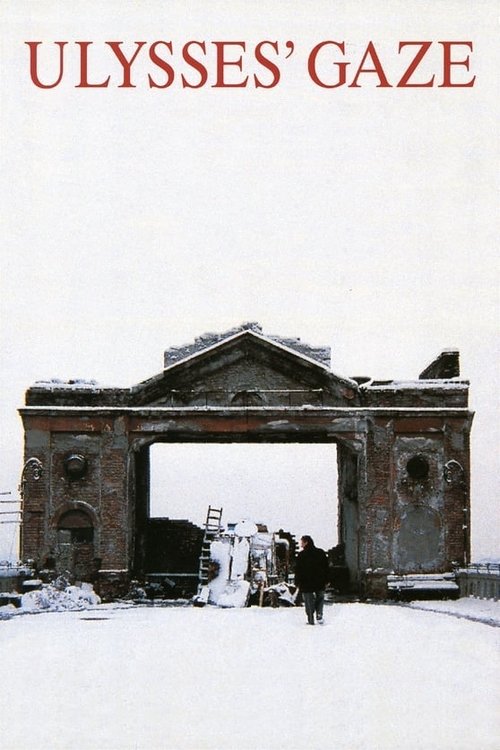
Ulysses' Gaze
1995 · Theo Angelopoulos
For when you want cinema as pilgrimage — a demanding, contemplative epic to sink into alone, phone off, when you're in the mood to be haunted rather than entertained. This is the challenge end of the spectrum, and it rewards it.
What it's about
A Greek-American filmmaker known only as "A" returns from exile and sets off across the collapsing Balkans of the early 1990s — Albania, Macedonia, Bulgaria, Romania, Serbia, and finally besieged Sarajevo — hunting three reels of undeveloped film shot by the region's first filmmakers a century earlier. The lost footage becomes a kind of grail: an innocent way of seeing from before the wars, pursued through borders, checkpoints, and ghosts of his own past.
The experience
Slow, vast, and hypnotic — nearly three hours of long drifting takes, fog, rivers, and ruins, punctuated by images of startling power. It asks for surrender rather than attention; give it that and it works on you like a trance, mournful and enormous.
Performances
Harvey Keitel is fascinatingly out of place and uses it — a raw American presence adrift in a European elegy — while Maia Morgenstern appears as several different women across the journey, giving the odyssey its recurring, dreamlike faces.
The craft
Angelopoulos builds the film from monumental sequence shots in which time itself seems to bend — single unbroken takes that slide across decades, and set pieces of astonishing scale, including a dismantled statue of Lenin drifting down the Danube by barge. The images are composed like history paintings; see it on the biggest screen you can.
Why it matters
A prize-winner at Cannes and the centerpiece of Angelopoulos's border trilogy, it stands as European art cinema's great reckoning with the Yugoslav wars — made while Sarajevo was still under siege.
Snapshot
Ulysses' Gaze (Greek: Το Βλέμμα του Οδυσσέα, To Vlemma tou Odyssea) is a nearly three-hour odyssey through the collapsing Balkans of the early 1990s, in which a Greek-American filmmaker known only as "A" (Harvey Keitel) travels from northern Greece through Albania, the newly independent Republic of Macedonia, Bulgaria, Romania, and Serbia to war-besieged Sarajevo, in search of three reels of undeveloped film shot by the pioneering Manakis brothers at the dawn of Balkan cinema. Structured explicitly on Homer's Odyssey, the film treats this lost footage as the "first gaze" — an innocent, pre-ideological way of seeing — and makes its recovery a meditation on a century of Balkan violence, exile, and the fate of the image. It is the central panel of Angelopoulos's loosely grouped "Trilogy of Borders," between The Suspended Step of the Stork (1991) and Eternity and a Day (1998), and it won the Grand Prix (the runner-up prize to the Palme d'Or) at the 1995 Cannes Film Festival, alongside the FIPRESCI award. It stands among the most ambitious works of one of European art cinema's most rigorous stylists.
Industry & production
The film was a multinational European co-production, the standard financing model for Angelopoulos's late work, drawing together Greek, French, and Italian partners under the director's own production banner together with French and Italian companies. Such arrangements — pooling national subsidies, television pre-sales, and Eurimages-style pan-European funds — were essential to bankrolling a picture of this scale and geographic sprawl, shot across several countries in the immediate aftermath of the Cold War and during an active war in Bosnia. The casting of Harvey Keitel, an American star then at a career high after Reservoir Dogs, Bad Lieutenant, and The Piano, was itself an industrial calculation: an internationally bankable lead who could anchor a demanding art film and widen its distribution, while thematically embodying the exiled Greek who has become an American. Production spanned the Balkan corridor the narrative traces, and the logistics of filming near or amid the Yugoslav wars made this one of the more hazardous shoots in Angelopoulos's career; the specific security arrangements for the Sarajevo-set material are not something I can document precisely here without risking invention, so I flag it as thin. The runtime — roughly 176 minutes — and the film's austere long-take grammar placed it squarely in the festival-and-arthouse economy rather than any commercial mainstream.
Technology
Ulysses' Gaze was shot on 35mm film in anamorphic widescreen, the format Angelopoulos favored for its capacity to hold figures within vast, deep landscapes. The technological substrate of the film is inseparable from its subject: this is a movie about the material history of the moving image, framed around actual undeveloped nitrate-era footage and the archival apparatus that preserves or loses it. It opens with genuine black-and-white images associated with the Manakis brothers — Ottoman-era photographers and cinematographers whose 1905 film of women weaving is widely regarded as the first film shot in the Balkans — and the plot literally hinges on the chemistry of development: three reels that have never been printed, an image latent but unseen. Angelopoulos exploits the full expressive range of his medium — natural fog and mist as an atmospheric and dramatic instrument, extended camera moves executed with cranes and dollies, and long-lens compression of deep space. The film also makes pointed use of film-within-film and archival texture to stage cinema's own memory of itself.
Technique
Cinematography
The images were created by Giorgos (Yorgos) Arvanitis, Angelopoulos's long-standing director of photography, working with Andreas Sinanos. The signature is the plan-séquence — the elaborately choreographed long take in which camera, actors, and history move together within a single unbroken shot. Two sequences are justly celebrated. In the first, a colossal dismantled statue of Lenin, laid in pieces on a barge, is floated down the Danube toward the West; as it passes, villagers along the banks stop and cross themselves, and Keitel's traveler drifts beside this beheaded god of the twentieth century — an image that condenses the entire collapse of the communist order into a slow river passage. In the second, a family New Year's gathering in a single room is carried across several years of postwar history without a cut, the camera and the changing tableau enacting the arrival of the new regime in one continuous, time-collapsing movement. Arvanitis's palette is wintry and desaturated, his framing monumental, the human figure characteristically small against snow, water, ruin, and fog.
Editing
Angelopoulos's aesthetic is fundamentally one of mise-en-scène over montage: meaning is generated within the shot rather than between shots, and the cut is used sparingly, as punctuation between long durational blocks. The editing therefore works at the level of the sequence and the ellipsis — the abrupt jumps across borders and decades that structure "A's" journey — rather than the rapid articulation of standard continuity cutting. (I am less than fully certain of the credited editor's name and will not state one I cannot verify; the governing principle, in any case, is duration preserved rather than fragmented.)
Mise-en-scène / staging
Staging is the film's true engine. Angelopoulos composes in depth and in the horizontal breadth of the anamorphic frame, arranging processions, crowds, borders, and lone travelers as choreography. Recurrent motifs organize the visual field: mist that both conceals and permits movement (most fatefully in the fog-shrouded Sarajevo climax), water and rivers as passages between worlds, snow, checkpoints, and the theatrical entrance and exit of figures across a fixed frame. The staging is frankly operatic and allegorical, treating landscape as historical stage.
Sound
The score is by Eleni Karaindrou, Angelopoulos's regular composer, whose grave, elegiac writing — strings and plaintive solo instruments in a mournful modal idiom — is one of the defining voices of his late cinema. The sound design is spare and often near-silent, letting wind, water, and distant war intrude on long stretches of quiet; music enters as lamentation rather than accompaniment, elevating the journey to the register of dirge.
Performance
Harvey Keitel plays "A" in a deliberately interiorized, weary key, his face and voice carrying the exile's displacement; the film asks him to be looked through as much as to act, a vessel for the gaze of the title. Maia Morgenstern plays the several women "A" meets along the road — Penelope, Calypso, and Circe figures folded into recurring incarnations by a single actress, a formal device that binds the erotic and the mythic. Erland Josephson, the Bergman veteran, appears in the pivotal late role of the Sarajevo film archivist who has kept and finally developed the reels, lending the film's meditation on preservation and loss enormous gravity. Thanassis Vengos, a beloved figure of Greek popular cinema, also features, his casting carrying its own resonance for Greek audiences.
Narrative & dramatic mode
The narrative is a quest-romance in the epic-allegorical mode, mapping the Odyssey onto a modern Balkan itinerary: a return home that is endlessly deferred, an exile passing through station after station toward a homecoming that arrives, if at all, only as catastrophe. Angelopoulos dissolves the borders of time as freely as those of nation — memory, dream, and history interpenetrate within single shots, so that the traveler steps out of the present into scenes from decades past. Dramatically the film is contemplative rather than propulsive; its "action" is movement across space and the slow accretion of historical and personal grief, culminating in an off-screen atrocity in the Sarajevo fog and a final, devastated monologue over the recovered image. The mode is essayistic and elegiac — cinema thinking about its own origins and its complicity in a century of looking.
Genre & cycle
Nominally Drama, History, and War, the film belongs most properly to the art-cinema tradition of the philosophical road film and the historical allegory. Within Angelopoulos's own filmography it forms the middle of the "Trilogy of Borders," extending the border-and-exile preoccupations of The Suspended Step of the Stork and looking ahead to the mortality and homecoming of Eternity and a Day. It also participates in a broader 1990s European cycle of films reckoning directly with the wars of Yugoslav dissolution — a cycle in which Emir Kusturica's Underground, the film that took the Palme d'Or over it at Cannes, is the most-cited counterpart, offering a carnivalesque vision against Angelopoulos's mournful one.
Authorship & method
Ulysses' Gaze is unmistakably an Angelopoulos film — the auteur's control extends from the long-take grammar to the mythic scaffolding, the border obsession, and the fusion of personal and national history. But his authorship was durably collaborative. The screenplay was written by Angelopoulos with Tonino Guerra — the great Italian screenwriter of Antonioni, Fellini, and Tarkovsky, a recurrent Angelopoulos collaborator — and the Greek writer Petros Markaris. Cinematographer Giorgos Arvanitis had shaped the director's visual style across many films, and composer Eleni Karaindrou supplied the emotional and tonal signature of his mature period; both are essential co-authors of the work's identity. Angelopoulos's method — meticulous pre-planning of each plan-séquence, staging across real and often difficult locations, patience with duration — subordinates every element to a unified, slow-breathing whole. The film is also self-reflexively autobiographical in a broad sense: the exiled filmmaker returning to interrogate the Balkans mirrors Angelopoulos's own lifelong subject.
Movement / national cinema
Angelopoulos is the towering figure of modern Greek art cinema and, more widely, of a European modernism descending from Antonioni, Jancsó, and Tarkovsky in its commitment to long takes, landscape, and historical reflection. Yet Ulysses' Gaze deliberately exceeds any single national frame: its subject is the Balkans as a shared, fractured space, and it reaches back to the Manakis brothers — Aromanian (Vlach) pioneers whose careers straddled the Ottoman and post-Ottoman borders of Greece and today's North Macedonia — to propose a pre-national, trans-Balkan origin for cinema in the region. The film thus belongs to Greek national cinema by authorship while arguing, formally and thematically, against the very borders that national cinemas presuppose.
Era / period
The film is a document of a precise historical moment: the immediate post-Cold War years, with communism's monuments literally being carted away (the Lenin barge) and the Yugoslav federation dissolving into war. Made and set in 1994–95, it captures the disorientation of a Europe between orders — old certainties toppled, new violence erupting — and reads the twentieth century backward through it, from the wars of the 1990s to the first flickering images of 1905. Its Sarajevo is the besieged city of the ongoing Bosnian War, and the film's despair is inseparable from that contemporaneity.
Themes
Its governing theme is the gaze itself — the innocent "first look" of early cinema, lost and sought, and the question of whether an uncorrupted way of seeing is still possible after a century of ideological and actual carnage. Around this cluster exile and the impossibility of homecoming; borders as wounds cut across a common Balkan body; memory and history as a single continuous fabric; the fragility and endurance of the film image as the century's conscience; and the Homeric archetype of the wanderer whose return is also a reckoning with the dead. Water, fog, and the river recur as thresholds between life and death, seeing and blindness, past and present.
Reception, canon & influence
At Cannes 1995 the film won the Grand Prix and the FIPRESCI prize, a major honor — yet Angelopoulos was famously wounded at losing the Palme d'Or to Kusturica's Underground, and his displeasure at the ceremony became part of the film's lore. Critical response divided along familiar lines: admirers hailed a monumental, deeply serious masterwork of European modernism, while detractors found it ponderous, solemn, and self-important, the long takes tipping toward the funereal. That split has persisted, and Ulysses' Gaze remains a touchstone in debates about the rewards and demands of slow, contemplative cinema.
Its lines of influence run backward to Homer above all, but cinematically to the historical long-take modernism of Miklós Jancsó, the metaphysical landscapes and durational faith of Andrei Tarkovsky, and the alienated architectures of Michelangelo Antonioni — the latter mediated through screenwriter Tonino Guerra, who links Angelopoulos directly to that lineage. The framing device honors the real Manakis brothers and, through them, the archival prehistory of the medium. Looking forward, the film consolidated Angelopoulos's international stature and prepared the ground for Eternity and a Day, which would take the Palme d'Or in 1998; more broadly it stands as a defining statement of 1990s Balkan art cinema and a recurring reference point for filmmakers and critics committed to the long take as a mode of historical and moral thought. Its precise imprint on any single later director is difficult to trace without overstatement, so I note its influence chiefly as a canonical exemplar rather than a demonstrable source for specific successors.
A Deleuzian reading
A stone head the size of a room comes down the Danube on a barge.
The full Deleuzian reading of Ulysses' Gaze →
Reception
At Cannes 1995 it took the Grand Prix but famously lost the Palme d'Or to Kusturica's Underground — and Angelopoulos made his displeasure plain from the podium — while critics split between 'masterpiece' and 'monument to tedium.' Three decades on it's settled in as a cornerstone of 1990s art cinema and the slow-cinema canon.
How Ulysses' Gaze was received, from release to now →
Influences: the films it descends from and the films it influenced
- The Travelling Players (1975) — Angelopoulos's own invention of the history-compressing plan-séquence, where a single continuous camera movement crosses years and regimes, is the exact grammar Ulysses' Gaze extends.
- Landscape in the Mist (1988) — Establishes his border-crossing odyssey structure and the fog-bound desaturated palette in which figures traverse a hostile map, the road-film template Ulysses' Gaze inherits.
- The Red and the White (1967) — The choreographed, endlessly reframing tracking long take across open plains, with armies and history flowing through the frame, is the source of Angelopoulos's landscape-as-stage plan-séquence.
- Nostalghia (1983) — Co-written by Tonino Guerra, its exiled artist wandering foreign ruins in slow durational takes is a direct structural and tonal template for the returning-exile at the film's center.
- Mirror (1975) — Casting one actress (Terekhova) as both mother and wife across time is the model for Maia Morgenstern's single-actress-multiple-roles device braided into temporal ellipsis.
- The Passenger (1975) — Guerra-scripted; its penultimate seven-minute plan-séquence and use of alienated architecture and landscape are the exact craft Guerra carried into Angelopoulos's mature grammar.
- L'Avventura (1960) — Co-written by Guerra, it makes landscape and dead time expressive of estrangement and stages narrative as an unresolved drifting search — the essayistic structure of wandering.
- The Weavers (Manaki brothers actuality) (1905) — The Manaki brothers' first Balkan actuality reels are literally the film's quest object, and Ulysses' Gaze descends from their archival documentary gaze as the medium's origin point.
- Amarcord (1973) — Guerra's co-written elegiac, essayistic memory-scripting — history refracted through personal recollection — is the writerly method Guerra transposes into Angelopoulos's elegiac voice.
- Eternity and a Day (1998) — The same Arvanitis camera, Karaindrou score, and Guerra pen refine the continuous take in which past and present coexist within one unbroken camera movement.
- Werckmeister Harmonies (2000) — Extended choreographed long takes gliding through town squares deploy the landscape/architecture-as-stage plan-séquence in the same slow-cinema register.
- Russian Ark (2002) — Extends the plan-séquence to feature length as a single unbroken traversal of history and national memory, the logical extremity of Angelopoulos's long-take-as-historical-thought.
- Once Upon a Time in Anatolia (2011) — Anamorphic widescreen nocturnal landscapes and extreme duration turn a convoy crossing terrain into moral inquiry, extending the landscape-as-stage road film.
- Platform (2000) — Static long-take wide shots stage decades of national change through a wandering performance troupe — a direct echo of Angelopoulos's Travelling Players lineage, landscape as stage.
- Sátántangó (1994) — Its durational long takes of figures walking across mud-bound terrain share the same faith in duration and landscape as bearers of historical and moral weight.
- Silent Light (2007) — Its durational landscape framing, bookended by real-time dawn/dusk long takes, shares the metaphysical patience and faith in duration of Angelopoulos's contemplative mode.
- Before the Rain (1994) — Pursues the identical thesis about the photographic image and Balkan violence — a filmmaker hunting undeveloped reels through the wars, ending in a massacre heard in fog and never framed — arriving at the same conclusion that the recording apparatus cannot stand outside what it records.
Similar films
- The Passenger (1975) — influence & lineage · often watched together
- L'Avventura (1960) — influence & lineage · often watched together
- Once Upon a Time in Anatolia (2011) — influence & lineage · often watched together
- The Travelling Players (1975) — influence & lineage
- Eternity and a Day (1998) — influence & lineage
- Landscape in the Mist (1988) — influence & lineage
- Amarcord (1973) — influence & lineage · often watched together
- The Red and the White (1967) — influence & lineage · often watched together