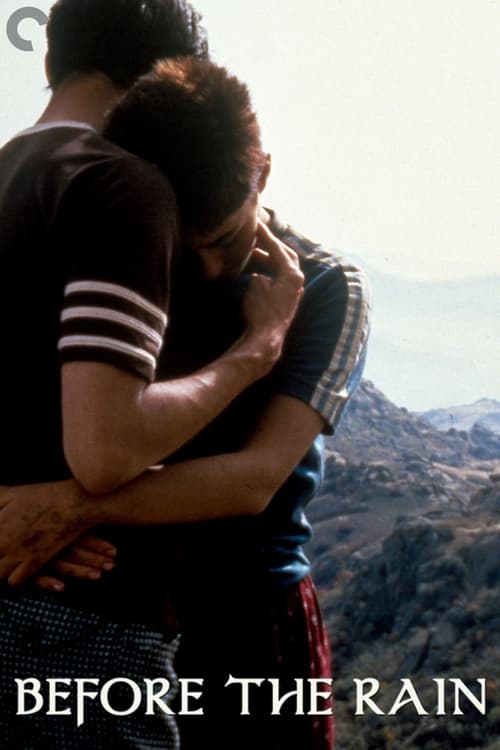
Before the Rain
1994 · Milcho Manchevski
When you want a film to chew on — something serious, beautiful, and formally daring that earns its heaviness. Not comfort viewing; reach for it when you're ready to be shaken and to think hard about how hatred perpetuates itself.
What it's about
Three stories loop into one another across two worlds: in the stony hills of Macedonia, a young Orthodox monk who has taken a vow of silence shelters an ethnic Albanian girl being hunted by armed men from his own village; in London, a pregnant photo editor tries to sort out her marriage over dinner in an upscale restaurant; and a famous war photographer, sick of what his camera has seen, comes home to a village splitting along ethnic lines. The stories don't line up the way you expect — the film circles on itself, and the circle is not round.
The experience
Stark and gorgeous one minute, shockingly abrupt the next — it moves with a slow, hymn-like calm that violence keeps tearing open. The looping structure works on you like a riddle; you leave rearranging the pieces, and the mood of gathering storm stays with you for days.
Performances
Rade Šerbedžija anchors the film as the world-weary photographer, carrying decades of guilt in a loose, charismatic frame, and Grégoire Colin makes the silent young monk expressive without a single word.
The craft
The Macedonian landscape is shot like scripture — golden hills, ancient churches, skies about to break — against the cold gloss of London, and the three-part structure is built with watchmaker precision so that images and phrases echo across the panels. It rewards close attention and a big screen; the compositions are genuinely painterly.
Why it matters
The first feature from newly independent Macedonia, it shared the Golden Lion at Venice and became the era's defining cinematic statement on the Balkan wars — proof that a small national cinema could announce itself with a formal experiment.
Snapshot
Before the Rain (Пред дождот) was the first feature film produced in the newly independent Republic of Macedonia, and it arrived on the international festival circuit in 1994 carrying an almost impossible weight: it was simultaneously a national cinema's founding statement, a formal experiment in circular narrative, and an argument about the war then consuming the neighboring Yugoslav republics. Milcho Manchevski — a Macedonian-born director who had spent years in the United States making documentaries and music videos, most visibly Arrested Development's "Tennessee" — returned to shoot a triptych whose three panels ("Words," "Faces," "Pictures") do not add up chronologically. Time, one character says, does not die; the circle is not round.
The film shared the Golden Lion at Venice in 1994 (with Tsai Ming-liang's Vive L'Amour) and was nominated for the Academy Award for Best Foreign Language Film, an extraordinary trajectory for a first feature from a country of two million that had, at that point, essentially no feature production infrastructure. What makes it durable three decades on is not its prophecy — Macedonia did not descend into the war it anticipated, at least not in 1994, though the 2001 insurgency gave the film a retroactive shiver — but its formal wager: that the shape of a story can be the argument about violence, rather than merely illustrate one.
Industry & production
The production was an international co-production in the fullest sense — Macedonian, British, and French financing, with the UK component anchored by Aim Productions and British Screen and Channel Four's involvement typical of the mid-1990s European art-film funding architecture. This structure is legible in the film itself: the London middle panel exists partly because the money did. That is not a criticism. Manchevski built the co-production's geographic split into the story's spine, so that the requirement to shoot in Britain became the mechanism by which the film argues that the Balkan war is not a distant ethnographic curiosity but something implicated in, and observed by, Western institutions — a photo agency, a restaurant, a marriage.
Macedonia in 1994 was a state under acute strain: it had declared independence in 1991, was operating under a Greek trade embargo over the name dispute, was not yet admitted to international bodies under its constitutional name, and hosted a UN preventive-deployment force (UNPREDEP) precisely because outside observers believed it might be next. There was no functioning feature-film industry to speak of; the Vardar Film infrastructure of the Yugoslav era had largely collapsed with the federation. Crews and equipment came substantially from outside. The film's existence is therefore itself an industrial fact worth stating plainly: it demonstrated that a small post-Yugoslav state could mount a festival-grade feature through European co-production, and it became the template that later Macedonian and regional productions followed.
The Venice Golden Lion converted the film into a global art-house release; in the United States it was distributed by Gramercy Pictures. Precise budget and gross figures are not reliably documented in the scholarly record and I will not invent them; what is clear is that the film played widely on the specialty circuit and secured the Oscar nomination that consolidated its visibility.
Technology
Before the Rain was shot on 35mm color negative and finished photochemically — the film sits just before the digital intermediate became available to features of this scale, and its look is achieved in-camera and in the lab rather than in a grading suite. This matters for how the Macedonian material reads: the hard, dry light of the Ohrid and Mavrovo landscapes, the deep shadow inside the monastery cells, and the stone-and-sky contrast are the product of exposure decisions and stock latitude, not of post-production sculpting.
Manchevski came to the feature from music video and documentary, which in 1994 meant fluency with a different technological culture — faster turnarounds, tolerance for grain and handheld, an editorial vocabulary built on the assumption that images can be juxtaposed rather than merely joined. The film keeps that fluency but declines the era's music-video signature moves; there is almost no aggressive optical effect, no step-printing, no ostentatious speed manipulation. What it takes from the form is a confidence about elliptical cutting and about the image-as-object.
The film's own subject includes an imaging technology: Aleksandar is a war photographer, and the London panel takes place in a photo agency where images of atrocity are edited, selected, and sold. The film is quietly precise about the apparatus of photojournalism circa 1994 — the light box, the contact sheet, the editorial judgment that turns a killing into a picture — and it stages Aleksandar's central confession around the moment his camera's presence became causal rather than observational.
Technique
Cinematography
Manolo Teijeiro's photography draws a hard distinction between the two worlds without resorting to caricature. The Macedonian panels are shot in high, unforgiving daylight — sun that flattens and bleaches, skies that press down, landscapes of rock and scrub where a figure crossing open ground is visible for miles and therefore vulnerable for miles. The famous imagery of turtles, of stone walls, of the monastery perched against a vast sky, works because the camera respects distance: it lets figures be small.
London, by contrast, is wet, close, and interior — restaurant light, office light, the diffuse gray of a city seen through glass. The two palettes are not simply "warm/cold" but differently legible: in Macedonia you can see everything and cannot stop it; in London you can see nothing and are implicated anyway.
The camera is mobile but not restless. Manchevski favours moves that reframe a standoff rather than dramatize it, and he holds on faces long enough that the pressure of unspoken decision becomes the content of the shot. Where the film does become kinetic — the restaurant sequence in "Faces," the pursuit passages in "Words" — the shift registers precisely because the baseline is composed.
Editing
The editing, credited to Nicolas Gaster, carries the film's central formal burden. Within scenes the cutting is patient and classical; the radical work happens at the level of the three-part structure. "Words," "Faces," and "Pictures" are internally coherent, but their arrangement produces a temporal impossibility: a character glimpsed dead in one panel is alive in a later one, an event referred to as past in one panel has not yet occurred in another. The loop does not close cleanly, and Manchevski has been explicit that the imperfection is the point — the circle is not round.
This is not the Möbius-strip puzzle-box of later 1990s narrative cinema, where the pleasure is in solving. The film offers no reconciling key. The gap forces a reading in which the sequence of events matters less than the inevitability of the pattern, and in which the viewer's instinct to repair the chronology becomes an experience of the same futility the characters face. The mechanism is closer to Faulkner or to certain Borges structures than to genre puzzle plotting.
Small motifs carry across the seams — the turtles, the rain that never quite arrives, the photograph, the phrase about time and the circle — functioning as rhymes rather than clues.
Mise-en-scène / staging
The three settings are chosen for what they permit as stage space. The monastery gives Manchevski enclosure, threshold, and the physical vocabulary of sanctuary: doorways, cells, walls that can hide a girl and then cannot. The village gives him the geometry of the mob — the way a crowd of relatives and neighbors forms, hardens, and becomes an executioner without any single person deciding to be one. The London restaurant gives him a room where violence can arrive as an interruption of civility, which is the precise inverse of the Macedonian staging where violence is the ambient condition and civility the interruption.
Weapons are staged with deliberate ordinariness. Guns are held by boys, by cousins, by people at a family table; they are objects of the household, not of the battlefield. The film's most quoted image — a young monk and a girl, sheltering in a cell, with armed men outside — works because Manchevski stages the men not as soldiers but as kin.
Sound
Anastasia's score is one of the film's most consequential elements and one of the reasons it lodged in international memory. The group — a Macedonian ensemble working with traditional instrumentation and modes alongside contemporary arrangement — produced music that is neither folkloric decoration nor conventional dramatic underscore. It functions as a continuous voice across the panels, and because it travels with the film to London it becomes the audible link between worlds that the plot keeps separating.
Equally important is the film's use of silence. The monk Kiril has taken a vow of silence, which converts an entire performance into listening and forces the sound design to carry what dialogue normally would: wind, footsteps, bells, the noise of men approaching. When Kiril finally speaks, the event is dramatic because the soundtrack has trained us for it.
The multilingualism — Macedonian, Albanian, English — is not incidental texture. The film is careful about who understands whom, and mutual incomprehension is staged as a condition of the violence rather than a subtitling convenience.
Performance
Rade Šerbedžija's Aleksandar anchors the film. Šerbedžija, a Croatian-born actor of enormous standing in Yugoslav theater and cinema whose own life was displaced by the wars, brings a specific gravity: he plays a man who has professionalized his distance from suffering and can no longer sustain it. The performance is built on weariness rather than anguish — Aleksandar's homecoming is not a catharsis but a man walking into a room he already knows the shape of.
Grégoire Colin's Kiril must act almost entirely without speech; the performance depends on attention and on the visible cost of decision. Labina Mitevska, in an early role, gives Zamira a wariness that refuses the position of pure symbol the plot could easily have assigned her. Katrin Cartlidge's Anne carries the London panel's burden — a woman being asked to choose while a war she edits for a living remains, to her, a set of images. Cartlidge's characteristic register, unsentimental and slightly abrasive, keeps the section from becoming the film's soft center.
Narrative & dramatic mode
The film's mode is tragic in a strict sense: the mechanism of destruction is set in motion by acts of decency. Kiril's shelter of Zamira leads to her death; Aleksandar's attempt to intervene leads to his. No character is punished for cruelty; they are destroyed for interrupting a cycle that does not tolerate interruption.
Structurally, the film is a triptych that pretends to be a loop. Each panel is a self-contained novella with its own protagonist, its own moral crisis, and its own violent resolution; the connective tissue is thin by design. What binds them is not plot causation but recurrence — the same situation (a person offering protection across an ethnic line, and paying) rendered three times, in three registers, across two countries.
The famous inscriptions — that time does not die, that the circle is not round — announce the film's stance directly. Some critics found this over-explicit. The counter-argument is that the film needs to state its thesis precisely because it is going to violate its own geometry; the flawed circle would otherwise read as a continuity error rather than a claim.
Manchevski also stages a persistent tension between the photograph (which stops time, isolates, sells) and the film (which cannot stop, which insists on before and after). Aleksandar's crisis is that he learned a photograph is not a neutral record — the picture required the event.
Genre & cycle
The film sits inside the wave of cinema responding to the disintegration of Yugoslavia — a cycle that includes Emir Kusturica's Underground (1995), Srđan Dragojević's Pretty Village, Pretty Flame (1996), Danis Tanović's No Man's Land (2001), and later work by Jasmila Žbanić — but it is deliberately unlike most of it. It has none of Kusturica's carnivalesque excess, none of Dragojević's black-comic ferocity. Its closest generic relatives are the international art-film triptych and the ensemble network narrative.
It is also, importantly, a film about a war it does not depict. The Bosnian war is offscreen, present as photographs, as news, as the thing that has made Aleksandar what he is. What the film depicts is a pre-war: the conditions in Macedonia under which the same thing could begin. Its genre affiliation, then, is less "war film" than "film about the antechamber to war" — a small, unusual category it substantially defined for the region.
Authorship & method
Manchevski wrote and directed, and the authorship claim is unusually strong: the structure, the aphorisms, the refusal to assign moral advantage to either ethnic community, and the decision to place a Western character inside the story are all his. His background — Macedonian upbringing, film education in the United States, a decade of documentary and music-video work in New York — produced a filmmaker positioned exactly like Aleksandar: able to see the place from outside, unable to be outside it.
His subsequent career has been deliberately unhurried and formally restless: Dust (2001), which yokes contemporary New York to the Macedonian struggle against the Ottomans through a similarly disjunctive structure and which met a far harsher critical reception; Shadows (2007); Mothers (2010), which mixes documentary and fiction; Willow (2019). He has also worked as a photographer and writer, and has been publicly resistant to readings of Before the Rain that reduce it to Balkan explanation.
Key collaborators: cinematographer Manuel "Manolo" Teijeiro, whose control of natural light in the Macedonian sequences is the film's visual signature; editor Nicolas Gaster, working from a British editorial tradition, who had to make the internal scenes classical enough that the structural rupture registers as intentional; and the ensemble Anastasia, whose score became widely known independently of the film. The casting of Šerbedžija — a Yugoslav star, from Croatia, in a Macedonian film about Macedonian-Albanian conflict — is itself an authorial statement about a shared cultural space the wars were dismantling.
Movement / national cinema
Before the Rain effectively inaugurated Macedonian national cinema as an international category. Before it, film production in the republic existed within the Yugoslav system; after it, Macedonia had a reference point, a director with festival standing, and a demonstrated route to European co-production money. Later international successes from the country — most conspicuously Tamara Kotevska and Ljubomir Stefanov's Honeyland (2019) — operate in a landscape the 1994 film helped make possible.
Regionally, the film belongs to the post-Yugoslav cinemas' shared project of narrating dissolution, but it occupies a distinctive position because Macedonia's dissolution was, in 1994, hypothetical. The film's relationship to nationalism is adversarial rather than expressive: it declines to make either the Macedonian Orthodox or the Albanian Muslim community the aggressor, distributing violence symmetrically. This even-handedness has drawn criticism from those who read it as false equivalence given the actual asymmetries of the period; it has been defended as the necessary condition for the film's argument that cyclical violence is structural rather than attributable.
Era / period
The film is precisely of 1994: after Vukovar and Sarajevo, during the Bosnian war, before Srebrenica, before Dayton. Western Europe at that moment was being publicly confronted with atrocity photographs from a war on its own continent while declining to intervene decisively — and the London panel is directly about that condition. Anne edits images of a war that is, geographically, close; the restaurant sequence collapses the imagined distance in the most literal possible way.
It also belongs to a mid-1990s international art cinema in which non-linear and multi-strand structures were becoming newly prominent — Pulp Fiction premiered the same year, Kieślowski's Trois couleurs trilogy was completing, Iñárritu's Amores Perros was six years off. Before the Rain is not part of a coordinated movement, but it participates in a shared moment of confidence that audiences could hold a fractured chronology.
Themes
Circularity and inevitability. The governing idea, stated and then formally enacted: violence reproduces itself, and its reproduction has the shape of a loop with a flaw in it.
Sanctuary and its cost. Every act of protection in the film is fatal to the protector. This is the film's harshest proposition — not that decency is absent, but that it is insufficient and expensive.
Language, silence, and incomprehension. A vow of silence, three languages, and a community that cannot speak across a line. Kiril's silence is a discipline; the village's is a refusal.
The image and complicity. Photography as the film's self-critique — the photograph that required the death, the atrocity image as commodity, the Western viewer's consumption of suffering as picture.
Home as unrecoverable. Aleksandar's return is the classic exile's return that finds the place both unchanged and unrecognizable, and finds that his outsider status offers no protection.
Kinship as the engine of violence. The men with guns are relatives. The film locates atrocity not in ideology but in the obligations of family and village.
Reception, canon & influence
The film's reception was immediate and largely enthusiastic. The Golden Lion at Venice 1994 (shared with Vive L'Amour) and the Academy Award nomination for Best Foreign Language Film established it internationally, and it was widely praised for the ambition of its structure, the score, and Šerbedžija's performance. Critical dissent focused on two points: that the aphorisms were too explicit, and that the symmetrical distribution of blame amounted to a political evasion — a debate that has continued in academic writing on post-Yugoslav cinema, where the film is a standard object of study precisely because it is contested. Manchevski has publicly pushed back on readings that treat the film as reportage about the Balkans.
Backward — what shaped it. The film's structural DNA is more literary than cinematic: modernist circular narration in the mode of Faulkner, and the paradox-loop of Borges. Cinematically, the influences are the international art-film tradition of the ensemble moral parable and, in its landscape and religious spaces, the tradition of Eastern European and Soviet cinema that treats stone, weather, and the Orthodox interior as moral environments — Tarkovsky is the frequently invoked reference, though Manchevski's tempo is far brisker. Angelopoulos's Balkan work — its border-crossings, its long durations, its treatment of the region as a space of historical repetition — is the closest regional antecedent, and Ulysses' Gaze would arrive the following year with a comparable preoccupation with the photographic/cinematic image and Balkan violence. Manchevski's music-video and documentary practice supplied the editorial confidence.
Forward — what it shaped. Three lines of influence are reasonably clear. First, on the industrial level, it made small-nation post-Yugoslav cinema legible to European festivals and funders, and its co-production model became a well-worn path. Second, it belongs to the group of mid-1990s films that normalized fractured, multi-strand chronology in serious international cinema — the network narrative that would flourish through the 2000s in Amores Perros, 21 Grams, Babel, and Crash, where separated strands and looping time are used to argue for interconnection. Before the Rain's specific contribution to that lineage is the flawed loop: the refusal to let the structure resolve, which distinguishes it from the tidier network films that followed. Third, it established a durable model for cinema about ethnic conflict that declines the war film's forms — no combat, no front line, only the social conditions in which neighbors become killers, a mode visible in later work by Žbanić and others.
The 2001 armed conflict in Macedonia gave the film a second life as apparent prophecy, a framing Manchevski has been notably reluctant to endorse. Its more lasting claim is formal: it remains one of the clearest cases in modern cinema of a film whose structure is not a container for its argument but the argument itself.
A Deleuzian reading
A figure crossing open hillside in flat, bleaching sun.
The full Deleuzian reading of Before the Rain →
Reception
It arrived a fully-formed sensation — Golden Lion at Venice 1994 (shared with Tsai Ming-liang's Vive L'Amour) and an Oscar nomination for a debut feature — then slowly slipped from mainstream memory as the Balkan wars receded from headlines. Criterion's 2008 edition re-cemented it as the essential Macedonian film, now more revered than actually watched.
How Before the Rain was received, from release to now →
How to watch Before the Rain: what to notice on a first viewing
- Watch how small people look against the open Macedonian hills. Teijeiro's camera doesn't move in to protect anyone, keeping figures small against rock and sky, visible for miles and vulnerable for miles. You can see danger coming from a long way off, and so can everyone in the shot.
- Notice how differently London and Macedonia are lit. Macedonia is high, flattening, unforgiving daylight, while London stays wet, close, and gray, seen mostly through glass and restaurant light. One place lets you see everything and stop nothing, the other lets you see nothing and still be involved.
- Listen for what fills the silence whenever the monk won't speak. Because Kiril has taken a vow of silence, the sound design carries what dialogue normally would, wind, footsteps, bells, the noise of men approaching. The film trains you to listen closely, so that when he finally does speak, it lands as an event.
- Watch how the armed men outside the cell are dressed like family, not soldiers. Manchevski stages guns as household objects, held by boys and cousins at a family table rather than by anyone in uniform. The threat comes from people who know each other, which is harder to watch than any anonymous army would be.
- Watch for the turtles, and for rain that keeps not arriving. Small recurring images, turtles, a photograph, an unfallen rain, keep surfacing across the film's different settings and characters. These small repeats work as rhymes tying the film together, not as clues to a puzzle.
The whole guide to watching Before the Rain, with the keys for a rewatch →
Influences: the films it descends from and the films it influenced
- Andrei Rublev (1966) — Supplies the exact device of the mute protagonist — a monk who takes a vow of silence after killing a man and is broken out of it by an innocent — along with the monastery treated as a porous stone sanctuary where weather, whitewash and icon-light do the moral work the dialogue refuses.
- La Jetée (1962) — The closed causal loop in which the hero is present at his own killing, built out of still photographs, is the paradox-engine Manchevski rebuilds in live action: an image that precedes the event it records and a chronology that cannot be flattened into a line.
- The Suspended Step of the Stork (1991) — Establishes the Balkan border as a painted line a single step crosses — filmed in wide, unhurried takes across bare highland landscape with a journalist protagonist searching for a vanished man — the regional grammar of frontier-as-arbitrary-fiction that Kiril's hillside and Aleksandar's return inherit.
- Under Fire (1983) — The war-photographer plot turned on the shutter itself: a faked photograph of a dead rebel leader changes the course of the conflict, making the camera an agent rather than a witness — the precise ethical mechanism behind Aleksandar's confession that he took a photograph and a man died.
- Ashes and Diamonds (1958) — Political killing staged entirely in civil, domesticated interiors — hotel bar, laundry line, banquet — by a gunman whose crisis is decency rather than ideology, the template for weapons handled casually inside kitchens and courtyards instead of on any front line.
- Come and See (1985) — Choreographs atrocity as social procedure: the herding, the shouted orders, the loose crowd hardening into a formation around a target — the mob geometry Manchevski restages in the village square, where neighbors arrange themselves into an execution without any military apparatus present.
- Amores Perros (2000) — Takes the three-panel design and the shared hinge event directly, running each strand to a separate ending that overlaps the others in time, though it resolves the joins cleanly where Manchevski deliberately leaves the seam broken.
- Code Unknown (2000) — Detonates one street incident into unconnected lives filmed in long unbroken takes, and makes untranslated language — French, Romanian, Malinké, sign — the medium of the failure, extending the multilingual incomprehension that keeps the film's Albanian and Macedonian speakers unable to hear each other.
- The Circle (2000) — Builds a literal narrative ring by handing the camera from one woman to the next until it arrives back at the opening situation, using circularity as an argument about a closed social system rather than as a puzzle to be solved.
- No Man's Land (2001) — Compresses the war into a trench chamber piece where a bouncing mine under a living man is the domesticated weapon and the UN officers, translators and TV crew talk past each other in four languages — the anti-combat war film Manchevski's model made available.
- Dust (2001) — The director's own escalation of his method: a disjunctive structure yoking contemporary New York to the Ottoman-era Macedonian uprising through an unreliable oral narrator, testing whether the broken-chronology device survives being stretched across a century.
- Elephant (2003) — Runs the same stretch of time repeatedly from different bodies, so figures pass each other twice at the same corridor moment — a formalization of temporal impossibility used, as here, to hold an audience in the antechamber before violence rather than in the violence.
- Babel (2006) — Carries the network form to its widest span with strands that do not actually align in time and a deliberate architecture of untranslated speech — Berber, Japanese sign, Spanish — where mistranslation, not malice, produces the casualties.
- Grbavica (2006) — Restricts an ethnic war entirely to its domestic aftermath — a mother, a daughter, a school trip fee — with the violence located in social texture and withheld documents rather than in any depicted combat, the post-Yugoslav mode Manchevski's refusal of the front line opened up.
- Pulp Fiction (1994) — Released the same year with the same structural provocation — titled chapters resequenced so a character killed in one segment walks alive through the next — normalizing the non-linear triptych in which the ending is not the last thing shown.
- Ulysses' Gaze (1995) — Pursues the identical thesis about the photographic image and Balkan violence — a filmmaker hunting undeveloped reels through the wars, ending in a massacre heard in fog and never framed — arriving at the same conclusion that the recording apparatus cannot stand outside what it records.
- Underground (1995) — The rival post-Yugoslav festival object, using temporal impossibility toward the opposite register: characters kept in a cellar in a falsified chronology, so history is dramatized as manufactured time rather than as a broken loop.
- Pretty Village, Pretty Flame (1996) — Braids present-tense entrapment with childhood flashbacks of the same two men, so the film's cutting pattern — not its dialogue — argues that the killers and the killed were formed as neighbors long before the shooting.
- Chungking Express (1994) — Manchevski's triptych of self-contained episodes that circulate rather than sequence—each generating an emotional field the others complete—is a contemporaneous formal experiment in the lyric-episodic multi-part structure Wong simultaneously developed.
Similar films
- Underground (1995) — influence & lineage
- Ulysses' Gaze (1995) — influence & lineage
- Andrei Rublev (1966) — influence & lineage
- From What Is Before (2014) — shared sensibility
- Pather Panchali (1955) — shared sensibility
- Beanpole (2019) — shared sensibility
- Spring, Summer, Fall, Winter... and Spring (2003) — shared sensibility
- Why Has Bodhi-Dharma Left for the East? (1989) — shared sensibility