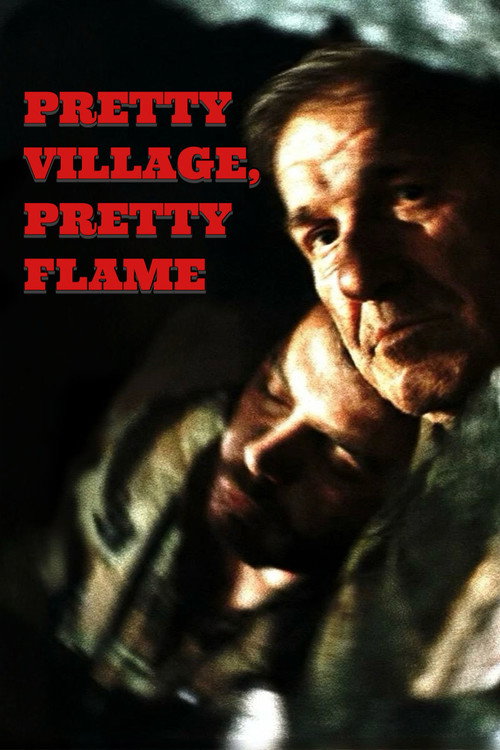
Pretty Village, Pretty Flame
1996 · Srđan Dragojević
When you want a war film that refuses to console you — not a heroic mission but a furious, darkly funny autopsy of how a country eats itself. This is a challenge, not comfort; save it for a night when you can handle it and want to argue about it after.
What it's about
As Yugoslavia tears itself apart in the early 1990s, a ragged band of Serb fighters gets pinned inside a road tunnel by a Bosniak unit — no way forward, no way back, ammunition and nerves running out in the dark. The film keeps cutting away from the siege: to a Tito-era childhood in a Bosnian village, where two boys — one Serb, one Muslim — grew up as best friends, and to a Belgrade military hospital where one of them, now wounded, lies obsessing over the other. It's the story of how neighbors became enemies, told from inside the wreckage.
The experience
Savage and disorienting in the best way — it lurches between pitch-black comedy, genuine terror, and aching nostalgia, sometimes within a single scene. The tunnel scenes are claustrophobic and sweaty; the flashbacks land like a punch because you know what's coming. It leaves you rattled and a little sick about how easily brotherhood curdles.
The craft
The non-linear structure is the film's weapon: at least four timelines braided together so that every irony detonates on schedule — the tunnel under siege was once dedicated to 'Brotherhood and Unity.' Dragojević shoots the siege with grimy, feverish intensity and the past with a warmth that makes the present feel obscene. Made astonishingly close to the events it depicts, which gives it a raw, dangerous energy few war films ever have.
Why it matters
One of the defining films about the Yugoslav wars, made while the wounds were still open, and fiercely debated for daring to show its Serb fighters as both perpetrators and human beings. It put Serbian cinema of the 1990s on the international map.
Snapshot
Pretty Village, Pretty Flame (Lepa sela lepo gore) is Srđan Dragojević's savage, non-linear anti-war film about the disintegration of Yugoslavia, told through the friendship-turned-enmity of two men who grew up in the same Bosnian village. Its dramatic engine is a siege: a ragged group of Serb fighters is trapped inside a road tunnel by a Bosniak ("Muslim") unit, unable to advance or retreat, slowly cooking in the dark while they burn through ammunition, memory, and sanity. Around that stalled present the film braids at least three other timelines — a Tito-era childhood, the opening ceremony of the tunnel itself (a "Brotherhood and Unity" tunnel, freighted with irony), and the wounded protagonist Milan's recovery in a Belgrade military hospital, where he stalks the wards hunting his former friend Halil. Tonally it is a genuine hybrid: gallows farce, ultraviolence, sentimental boyhood idyll, and reportorial horror pressed into the same frame. It stands, with Emir Kusturica's Underground (1995), as one of the two defining Serbian feature statements on the wars, and it is arguably the more direct of the two in confronting the Bosnian conflict's on-the-ground savagery. The film's central conceit — that the collapse was fratricide, brother killing brother inside a monument to brotherhood — remains its most quoted idea.
Industry & production
The film was made under exceptional duress. It was produced in the Federal Republic of Yugoslavia (Serbia and Montenegro) in the mid-1990s, during a period of international sanctions that constricted access to film stock, equipment, hard currency, and co-production partners. Domestic production leaned heavily on state broadcaster Radio Television of Serbia (RTS) and associated production entities; contemporary accounts credit the picture to a Serbian production apparatus centered on Cobra Film in cooperation with RTS, though the precise financing structure is not something I can reconstruct in granular detail without risking error. The material originated in journalism: the screenplay was developed from reportage by Vanja Bulić concerning a real wartime episode of soldiers trapped in a tunnel, and Bulić shares screenplay credit with Dragojević and the actor-writer Nikola Pejaković. That documentary seed matters — the film's claim to authenticity rests partly on its being drawn from a reported event rather than wholly invented.
Commercially, the film was a substantial domestic success and became one of the most-seen Serbian films of its era, a genuine popular event at home rather than a purely festival object. I will not attach specific admission or gross figures, because I cannot verify them precisely. Internationally it traveled the festival circuit and secured arthouse distribution, giving Western audiences one of their first features narrated largely from a Serb-soldier point of view — a fact that shaped both its reception and the controversy around it.
Technology
This is a 35mm film production of the mid-1990s, made without the resources of a Western feature and inside a sanctioned economy, and that scarcity is legible in the craft: the film favors available light, practical locations, and a rough, grainy texture over polish. Its most distinctive technological gesture is archival: Dragojević intercuts period newsreel and propaganda footage — Partisan-era, Tito-era "Brotherhood and Unity" imagery — against the fiction, using the documentary record of Yugoslav socialism as ironic counterpoint to the war. This mixing of stocks and registers (glossy state propaganda, home-movie nostalgia, grimy combat present) is a deliberate collision of image-textures rather than a seamless look, and it does real thematic work: the utopian newsreel Yugoslavia and the actual Yugoslavia are made to share a screen. Beyond this, the film uses no ostentatious optical or special-effects technology; its violence is achieved through practical squibs, makeup, and staging in the conventional manner of the period.
Technique
Cinematography
The cinematography — the work of Dušan Joksimović, Dragojević's regular collaborator during this period — is handheld, close, and unglamorous, built for confinement. The tunnel is the film's defining spatial problem: a long, dark, single-exit tube in which most of the "present-tense" action occurs. Joksimović shoots it as a trap, exploiting the aperture of light at either mouth against the blackness within, so that the men are silhouetted, hemmed, and visually suffocated. Against this, the childhood and pre-war passages are lit warmer and softer, a pastoral register that the film deliberately sets up to be desecrated. The camera is mobile and nervous in combat, steadier and more lyrical in memory — a grammar in which style itself marks the timeline the viewer occupies.
Editing
Editing is the film's most ambitious formal element. The narrative is aggressively non-chronological, cross-cutting among the tunnel siege, the boys' 1970s–80s childhood, the tunnel's inauguration, the pre-war village, and the Belgrade hospital. The cutting is associative — a face, an object, a name will pivot the film across years — and the archival newsreel inserts function as a third editorial layer commenting on the fiction. The effect is to withhold simple cause-and-effect and instead accumulate the sense of an inevitability: we know from early on roughly where the friendship ends, so the flashbacks play as elegy rather than suspense. The cut between idyll and atrocity is the film's signature move, and its shock depends entirely on rhythm. Contemporary Serbian editor Petar Marković is associated with the film's assembly; where I am uncertain of a specific technical credit I flag it rather than assert it.
Mise-en-scène / staging
The production design is documentary-poor and specific: a Bosnian village, its houses, the concrete tunnel, the sterile hospital ward. The tunnel is the great set-piece of staging — a claustrophobic proscenium where bodies pile, water drips, and the besieged improvise a squalid domesticity (a fire, a radio, scavenged drink). The hospital, by contrast, is staged as a cross-section of the war's human wreckage: amputees, the traumatized, a self-appointed Belgrade tough, all warehoused together, a chorus that lets the film editorialize on the home front. The village-idyll staging is pointedly Edenic — swimming, boyhood dares, a local legend of a monster (an ogre/werewolf figure) said to live in the tunnel — precisely so the later ruin registers as a fall.
Sound
Sound is used for jarring juxtaposition. The score — credited to the Serbian composer Aleksandar Habić — moves between nostalgic, folk-inflected warmth for the memory passages and harsher textures for the war, and the soundtrack pointedly deploys popular music and period songs to ironic ends, a strategy the film shares with much 1990s post-Yugoslav cinema. Diegetically, the tunnel is a chamber of amplified dread: dripping water, distant shouted taunts between the trapped Serbs and the unseen Bosniaks outside, radio chatter, and the enormous punctuation of gunfire in an enclosed space. The verbal duel across the tunnel mouth — insults, jokes, threats traded between former countrymen who speak the same language — is one of the film's cruelest sonic ideas.
Performance
The ensemble is drawn from the strongest Serbian screen actors of the day and performs in a register that swings from broad, profane comedy to raw brutality. Dragan Bjelogrlić anchors the film as Milan, whose journey from village boy to vengeance-consumed patient carries its moral weight; Nikola Kojo is memorable as a coarse, blustering fighter; and Nikola Pejaković — also co-writer — plays Halil, the childhood friend on the other side. The performances are deliberately un-heroic: these are frightened, drunk, boastful, ordinary men, and the film's power comes from watching ordinariness curdle into atrocity without ever quite becoming melodrama.
Narrative & dramatic mode
The dominant mode is ironic tragedy delivered through fractured, memory-driven structure. The film refuses linear war-movie catharsis. Its frame — men immobilized in a tunnel, going nowhere — is a structural metaphor for the whole conflict: a society that built a passage between communities and then died inside it. The childhood friendship of Milan and Halil is the emotional spine, and the film's central, unbearable irony is that the "Brotherhood and Unity" of Tito's slogan is literalized as two brothers-in-all-but-blood trying to kill each other. Dragojević works in a distinctly Balkan tonal register — the grotesque, the carnivalesque, black farce riding alongside real horror — so that a scene can pivot from a crude joke to a killing within a single beat. The result is a dramatic mode that implicates laughter: the audience is caught enjoying the banter of men it then watches commit or suffer monstrous acts.
Genre & cycle
Formally it is a war film, but it belongs to a specific mid-1990s cycle of post-Yugoslav "disintegration cinema" — films reckoning, often through allegory and black comedy, with the country's violent end. Its closest and most-cited companion is Kusturica's Underground (1995), with which it shares an underground/enclosed-space metaphor, a satirical use of Yugoslav-era iconography, and a carnival-grotesque sensibility; the two are routinely paired in scholarship on how Serbian cinema narrated the wars. Where Underground is sprawling allegory across decades, Pretty Village is a more concentrated, more literally war-set work. Within the broader canon of 1990s Balkan war cinema — alongside films like Bosnia's No Man's Land (2001), which similarly strands enemies in a single confined standoff — it is an early and influential entry, and arguably a template for the "two enemies trapped together" chamber-war structure.
Authorship & method
Director — Srđan Dragojević (b. 1963) emerged in the early 1990s as a leading voice of a younger Serbian generation. His preceding feature, We Are Not Angels (1992), was a pop-inflected commercial hit; Pretty Village, Pretty Flame was his leap to serious international attention, and he followed it with The Wounds (Rane, 1998), a ferocious portrait of Belgrade street youth in the Milošević years. His method across these works fuses popular-cinema energy — genre pleasure, comedy, music, star casting — with unsparing sociopolitical critique, a combination that made him both commercially potent and critically debated. He works from reported and observed reality rather than pure invention, and he is unafraid of tonal whiplash as a moral instrument.
Key collaborators. The screenplay is credited to Dragojević with Vanja Bulić, whose journalism supplied the source event, and actor-writer Nikola Pejaković. Cinematography is by Dušan Joksimović, a defining Serbian DP of the era and a repeat Dragojević collaborator. The score is credited to composer Aleksandar Habić. Editing is associated with Petar Marković. Where a specific below-the-line credit is contested in the record, I note the uncertainty rather than assert a false precision; the authorial signature here is unmistakably Dragojević's, working with a tight repertory of Serbian screen and craft talent.
Movement / national cinema
The film is a landmark of Serbian national cinema in its most traumatic decade. It belongs to no formal "movement" with a manifesto, but it exemplifies a real tendency: 1990s Serbian filmmakers processing the catastrophe in near-real time, often through allegory, irony, and the grotesque, and doing so from inside a sanctioned, impoverished, politically fraught industry dependent on state broadcasting. Its relationship to that context is complicated. Made in Milošević-era Serbia and narrated largely from a Serb-soldier perspective, it was read by some as insufficiently reckoning with Serb responsibility and by others as a courageous, anti-nationalist indictment of the whole machinery of hatred. That very ambivalence is characteristic of the national cinema of the moment — art made by people living inside the thing it condemns.
Era / period
1996 sits at the immediate hinge of the wars: the Dayton Agreement had just ended the Bosnian War (late 1995), and the film arrives as a first act of cinematic reckoning while the wounds were open and the outcome of Serbia's larger crisis (the Kosovo war and the fall of Milošević still lay ahead). This proximity gives the film its rawness and its risk; it is not a retrospective from safe distance but a report from within an ongoing national trauma, made under sanctions, before the political order that produced the war had fallen. Understanding the film means holding that "too soon" quality in view.
Themes
The film's governing theme is fratricide — that the Yugoslav wars were not invasion by a foreign enemy but the mutual destruction of people who shared a language, a childhood, a country. From this flow its other concerns: the irony of "Brotherhood and Unity," the Titoist slogan the film literalizes and then detonates; the manufacture of ethnic hatred out of proximity and shared history, dramatized as friends becoming killers; the loss of a multiethnic Yugoslav idyll, rendered in the golden childhood passages the war profanes; the myth of the monster in the tunnel, a folk-legend framing that asks where evil actually resides — in the dark ahead or in the men themselves; and the complicity of nostalgia, the way the film's own warm memories are shown to have contained the seeds of the catastrophe. It is, finally, a film about entrapment — physical, historical, moral — men who can go neither forward nor back.
Reception, canon & influence
Critically, the film was widely received as a major and disturbing achievement — praised for its formal daring, its refusal of easy sides, and its willingness to stage the war's cruelty without redemptive gloss — while also generating debate precisely because of its Serb point of view and its blend of atrocity with comedy. Some critics and scholars questioned whether its irony adequately confronted Serb culpability; others held it up as among the strongest anti-war films of its generation. Domestically it was a popular sensation; internationally it became, with Underground, a primary reference point for the Serbian cinema of the wars, and it is a fixture in scholarship on Balkan war film. (I decline to cite specific award tallies or admission figures I cannot verify.)
Influences on the film (backward). It draws on the broader Balkan tradition of black comedy and the grotesque, on the political-allegorical Yugoslav cinema that preceded it, and directly on Vanja Bulić's journalism for its factual core. Its ironic recycling of Partisan-war and Titoist newsreel places it in dialogue with the whole mythology of Yugoslav socialist cinema, which it quotes in order to indict.
Legacy (forward). The film helped establish the "enemies trapped together in a confined space" as a central figure of post-Yugoslav war cinema, a structure that recurs — most famously in Danis Tanović's Oscar-winning No Man's Land (2001). It confirmed Dragojević as a leading regional auteur and set up his subsequent The Wounds. More broadly, it remains a touchstone for how a national cinema can narrate its own side's war from within — implicated, ironic, unresolved — and it is regularly taught and cited as one of the essential films to emerge from the breakup of Yugoslavia.
Reception
A sensation in Serbia on release and a festival talking point abroad, it drew fire from some Western critics who questioned its politics so soon after the Bosnian war; decades on it's broadly canonized as one of the defining films of 1990s Balkan cinema.
How Pretty Village, Pretty Flame was received, from release to now →
Influences: the films it descends from and the films it influenced
- The Battle of Neretva (1969) — Its heroic Partisan-war spectacle and 'brotherhood-and-unity' iconography are the exact Titoist newsreel-epic register Pretty Village intercuts and ironizes to indict the mythology it inherited.
- W.R.: Mysteries of the Organism (1971) — Pioneers the associative montage that splices socialist documentary and newsreel into fiction to detonate Titoist ideology from within — the archival-intercutting method Pretty Village adopts wholesale.
- When Father Was Away on Business (1985) — Establishes the Yugoslav mode of allegorizing state politics through intimate satire and tonal ambiguity, the political-allegorical lineage Pretty Village extends into wartime.
- Come and See (1985) — Model for subjective, handheld immersion in war atrocity stripped of any redemptive or heroic framing — the un-heroic, gloss-free cruelty Pretty Village stages.
- Dr. Strangelove (1964) — Defines the black-farce anti-war film whose whole moral instrument is tonal whiplash between atrocity and comedy, the exact register Pretty Village weaponizes.
- Catch-22 (1970) — Its non-linear crosscutting between present horror and remembered fragments turns war into absurd circular tragedy, the fractured time-scheme Pretty Village builds from the trapped-in-the-tunnel present.
- MASH (1970) — Prototype for the un-heroic wartime ensemble scored by ironic diegetic source music and loudspeaker announcements counterpointing the brutality.
- Ashes and Diamonds (1958) — Stages national fratricide among former comrades as ironic tragedy with expressionist silhouette-and-confinement compositions, the Eastern-bloc grammar Pretty Village inherits.
- The Battle of Algiers (1966) — Its newsreel-grain handheld shooting and refusal of individual heroes lend atrocity documentary immediacy — the un-heroic, reportorial texture Pretty Village pursues from Bulić's journalism.
- Underground (1995) — The era's other primary Yugoslav-war reference, recycling Partisan newsreel and staging history as grotesque carnival black-farce in exact parallel with Pretty Village.
- We Are Not Angels (1992) — Carries the same pop-scored, magpie-populist method into war, turning the tunnel into a literalized national allegory — the darker application of the crowd-pleasing craft the debut rehearsed.
- The Wounds (1998) — Dragojević's own follow-up applying the same method — pop-genre energy, star casting, ironic source music, tonal whiplash — to Milošević-era street youth as sociopolitical critique.
- No Man's Land (2001) — Directly extends the 'two enemies trapped together in one confined location' template Pretty Village fixed as the central figure of post-Yugoslav war cinema.
- Life Is a Miracle (2004) — Later Balkan war black-comedy scoring absurd wartime romance with ironic diegetic source music, continuing the disintegration-as-farce mode Pretty Village helped canonize.
- Before the Rain (1994) — Formally daring circular/non-linear structure narrating Balkan fratricide with deliberate refusal of redemptive resolution, sibling in disintegration-cinema form.
- Cabaret Balkan (1998) — Ensemble Belgrade black farce escalating everyday aggression into war through interlocking diegetic verbal-and-physical duels, the same social-implosion mechanics on a city scale.
- Savior (1998) — Serbian-produced Bosnian-war film staging atrocity from an implicated, morally compromised point of view rather than a comfortable outside gaze.
Similar films
- No Man's Land (2001) — influence & lineage · same viewing thread
- Underground (1995) — influence & lineage
- The Battle of Algiers (1966) — influence & lineage
- Come and See (1985) — influence & lineage
- Before the Rain (1994) — influence & lineage
- When Father Was Away on Business (1985) — influence & lineage
- Quo Vadis, Aida? (2021) — same viewing thread
- Turtles Can Fly (2004) — same viewing thread
All the films related to Pretty Village, Pretty Flame →
Watch it with: curated runs of related films
- Bearing Witness — Watch these when you want cinema as testimony — ordinary people caught between armies, borders, prisons, and markets, filmed close to the ground and close to documentary.