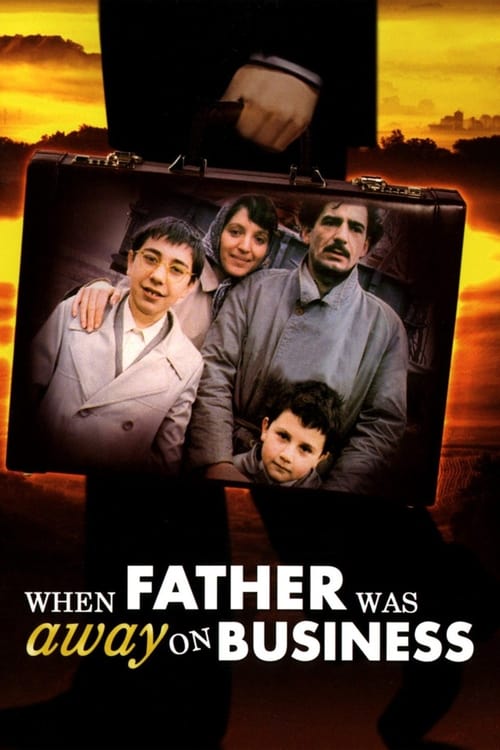
When Father Was Away on Business
1985 · Emir Kusturica
For when you want a rich, novelistic family story that earns its emotion — something tender and sad and slyly funny all at once, best met with patience and a free evening. It's a film to absorb, not background.
What it's about
Sarajevo, the early 1950s, just after Yugoslavia's break with Stalin. Six-year-old Malik is told his father has gone away on business — the family euphemism for what has really happened: a careless remark, a betrayal, and a sentence to a labor camp. Through the boy's half-comprehending eyes, the film follows his mother holding the household together, relatives compromised by the security state, and a child's ordinary life of school, first love, and sleepwalking carrying on inside a political purge.
The experience
Warm and funny in the moment, quietly devastating in aggregate — the comedy of family life keeps bumping against things the adults can't say out loud. It moves at the unhurried pace of memory, and the gap between what Malik sees and what you understand gives even the sweetest scenes an undertow.
Performances
Miki Manojlović makes the father a maddening, magnetic mix of charm and weakness, and Mirjana Karanović gives the mother a stoic strength that anchors the whole film; the child performance at its center is remarkably unaffected.
The craft
Kusturica shoots domestic life with a novelist's eye for detail — meals, weddings, radios, courtyards — so the political terror registers through texture rather than speeches. Abdulah Sidran's screenplay filters the Informbiro era entirely through what a six-year-old could plausibly witness, and the recurring image of the boy sleepwalking gives the film its dreamlike signature.
Why it matters
It won the Palme d'Or at Cannes in 1985, announced Kusturica internationally, and became one of the defining films about everyday life under Eastern Bloc repression — history told from the kitchen table rather than the courtroom.
Snapshot
When Father Was Away on Business (Otac na službenom putu) is a Bosnian-set family chronicle that filters the political terror of early-1950s Yugoslavia through the uncomprehending eyes of a six-year-old boy. Working from a screenplay by the Sarajevo poet Abdulah Sidran, Emir Kusturica set his second feature in the aftermath of the 1948 Tito–Stalin split — the "Informbiro" period, when suspected Soviet sympathizers were arrested and interned. The father, Mehmed "Meša" Malik, is denounced after an offhand remark about a newspaper cartoon, betrayed into the hands of the security apparatus by his mistress and his brother-in-law, and sent to labor. To his young son Malik, and to the neighbors, the euphemism holds: father is simply "away on business." The film's great tonal achievement is to render state cruelty as domestic weather — something felt as absence, silence, and the anxious cheerfulness of adults — rather than as spectacle. It won the Palme d'Or at the 1985 Cannes Film Festival and established Kusturica, then in his early thirties, as a major international figure. Its subtitle in the credits — a "historical film" — reads as gentle irony: this is history recovered as private memory.
Industry & production
The film was produced within the Yugoslav socialist studio system, centered on Sarajevo's Bosnian production infrastructure (Forum Sarajevo and associated Yugoslav production entities), the same milieu that had supported Kusturica's debut. It arrived at a distinctive moment: Yugoslavia's self-managed, decentralized film economy permitted work that was politically pointed yet still officially sanctioned, and by the mid-1980s — with Tito dead since 1980 — the once-taboo subject of the Informbiro purges and the Goli Otok camps could be approached, if obliquely. That a film dramatizing Stalinist-era repression could be produced with state resources and then sent to Cannes as a national standard-bearer speaks to the particular latitude of late-Yugoslav cinema.
Kusturica came to the project having already proven himself: his first feature, Do You Remember Dolly Bell? (1981), also written by Sidran, had won the award for best first film at the Venice Film Festival. That success bought him the standing to mount a more ambitious, period-set production. The Cannes victory — the jury that year was presided over by Miloš Forman, himself a product of the Czech school in which Kusturica trained — gave the film exceptional international visibility, and it went on to a nomination for the Academy Award for Best Foreign Language Film, losing to Argentina's The Official Story. I have not verified reliable theatrical grosses and will not invent them; the film's commercial life outside the festival and arthouse circuit is not something the record makes precise here.
Technology
The film was made on 35mm photochemical film with the synchronized-sound, location-and-set methods standard to European production of its period; there is no evidence of technological novelty, and it would be false to claim any. Its interest lies entirely in craft rather than apparatus. Working within ordinary means, the production reconstructed a 1950s Sarajevo of apartments, courtyards, provincial towns, and railway stations, relying on production design, costume, and period props rather than any optical or mechanical innovation. Where the film feels expansive, that expansiveness is a function of staging and lens choices, not of new tools.
Technique
Cinematography
The images are the work of Vilko Filač, Kusturica's classmate and closest visual collaborator, who would shoot the director's films through the following decade. Filač favors a warm, slightly burnished palette suited to memory, deep-focus compositions that keep foreground action and background incident legible at once, and mobile, unhurried camerawork that lets scenes breathe. The visual strategy is organized around Malik's scale: the camera is repeatedly attentive to how a child apprehends adult events — partially, from below, at the edges of rooms. Rather than underlining the political horror with expressionist distortion, Filač keeps the surfaces lyrical and domestic, so that menace registers as an undertone within an otherwise sunlit world.
Editing
The cutting, by Andrija Zafranović, sustains a novelistic, episodic rhythm across a story that spans years and several locations. The film moves in chapters of family life — a circumcision, a move, a father's return, a boy's illnesses and sleepwalking — and the editing privileges continuity of mood and character over propulsive plotting. Transitions tend to be soft, allowing the passage of time to feel like remembered time. The restraint is deliberate: the film withholds the labor-camp brutality from direct view, and the edit keeps the emphasis on the household, so that what is elided becomes as powerful as what is shown.
Mise-en-scène / staging
Kusturica's signature crowded frame is already present here in a comparatively disciplined form. Domestic spaces teem with relatives, neighbors, and objects; family gatherings, meals, and rituals are staged as dense ensembles in which several small dramas unfold simultaneously. The multiethnic, multiconfessional texture of Bosnian Sarajevo — Muslim, Orthodox, and secular-communist life intermingled — is built into the décor and the crowd. Against this warmth, the intrusions of the state are staged with pointed ordinariness: an arrest that looks like a courtesy, an interrogation conducted in reasonable tones. The film's recurring motif of Malik sleepwalking gives Kusturica his one sustained lyrical-surreal register, a foreshadowing of the fuller magical realism of his later work.
Sound
The score is by Zoran Simjanović, a prolific Yugoslav film composer, whose music leans into the nostalgic and folk-inflected without tipping into sentimentality. Popular songs and period music anchor the film to its era and to the culture of the household. Diegetic sound — radio, conversation, the noise of family life — carries much of the atmosphere, and the film's soundscape is domestic before it is dramatic. As with the images, the aural world is warm and lived-in, which is precisely what makes the intermittent silences around the father's fate land so heavily.
Performance
The ensemble performances are central to the film's success. Miki (Predrag) Manojlović plays Mehmed as a charming, weak, philandering man whose failings are human-scaled rather than villainous — a performance that launched a long partnership with Kusturica. Mirjana Karanović, as the wife Senija, embodies endurance and wounded dignity, holding the family together across humiliation and absence. Mustafa Nadarević plays the brother-in-law Zijo, the party functionary whose personal and political motives fatally intertwine. Presiding over all of it is the child performance of Moreno D'E Bartolli as Malik, whose watchful innocence is the film's organizing consciousness; the movie asks him to carry scenes of considerable emotional complexity, and the naturalism Kusturica draws from him is remarkable.
Narrative & dramatic mode
The film's defining formal choice is its point of view. Events of real political gravity — denunciation, arrest, internment, infidelity, betrayal — are refracted through a child who does not, and largely cannot, understand them. This produces a persistent irony: the audience grasps what Malik does not, so that comedy and dread occupy the same frame. The mode is episodic and memoiristic, closer to a remembered childhood than to a thriller, and it deliberately keeps the machinery of repression off-screen. Dramatic tension arises less from plot mechanics than from the gap between the family's performed normalcy and the truth they are all managing around the boy. This is a coming-of-age structure fused to a political allegory, in which the boy's growth and the family's survival stand in for a society learning to live inside fear.
Genre & cycle
Nominally a drama, the film sits at the intersection of several traditions: the childhood-memoir film, the family chronicle, and the East European "cinema of the thaw" that revisits Stalinist history once it becomes speakable. It belongs to a cycle of Yugoslav works from the 1980s that finally addressed the Informbiro persecutions and the Goli Otok camps — a reckoning that the loosening cultural climate after Tito made possible. It also participates in a broader Central and East European lineage of tragicomedy, where humor is the medium through which political trauma is metabolized. Its blend of warmth, ribaldry, and sorrow resists tidy genre placement, which is part of its identity.
Authorship & method
This is best understood as a dual authorship of director and screenwriter, extended by a stable circle of craftspeople. Emir Kusturica trained at FAMU, the Prague film school, absorbing the humane, comic, character-first sensibility associated with the Czech New Wave; that "Prague school" formation is legible in the film's affection for ordinary people and its refusal of didacticism. His screenwriter, Abdulah Sidran, a major Bosnian poet, supplied both the autobiographical Sarajevo texture and the elegiac register; Sidran had written Dolly Bell as well, and the two films together form a Sarajevo diptych of childhood and memory. The key collaborators recur across Kusturica's early career: cinematographer Vilko Filač, whose warm deep-focus lensing defined the director's look; composer Zoran Simjanović; editor Andrija Zafranović; and actor Miki Manojlović, who became a Kusturica regular. The method is ensemble-driven and location-rooted, prizing lived detail, improvisatory life within densely populated frames, and a tonal balance in which the comic and the tragic are never fully separable.
Movement / national cinema
The film is a landmark of Yugoslav — and specifically Bosnian — cinema, and one of the last great works to emerge from the unified Yugoslav film culture before the country's violent dissolution the following decade. It stands downstream of the Yugoslav "Black Wave" of the 1960s and early '70s, which had first opened critical, socially probing filmmaking within the socialist system, though Kusturica's warmer, more reconciliatory sensibility differs from that movement's harsher edge. It is equally a product of the Prague school's export of FAMU-trained talent. In Kusturica's hands, Sarajevo becomes a specific cinematic place — plural, sensual, and haunted — and the film is a foundational text for how Bosnian identity and memory were represented on screen.
Era / period
The film is set principally in the early-to-mid 1950s, in the shadow of the 1948 Cominform resolution that expelled Yugoslavia from the Soviet bloc and triggered a wave of arrests against real and suspected Stalinists. The historical horizon — labor camps, denunciations, the climate of suspicion — is the engine of the plot, even as it remains largely off-screen. But the film is equally a product of its 1985 moment of making, when the death of Tito and the cautious liberalization that followed allowed Yugoslav artists to look directly at a chapter of national history that had long been suppressed. The film thus lives in two eras at once: the traumatic 1950s it depicts and the reflective 1980s from which it looks back.
Themes
At its center is the collision of the intimate and the political — the way an authoritarian state reaches into the marriage bed and the family kitchen, and the way private failings (Mehmed's infidelities) become fatally entangled with public power (Zijo's denunciation). Childhood innocence as a lens on adult catastrophe is the governing theme, with Malik's incomprehension dramatizing how societies protect and deceive their young. Patriarchy and masculine weakness run throughout: Mehmed is both victim and philanderer, and the film refuses to sentimentalize him. There is a sustained meditation on memory and nostalgia — the golden light of a recalled childhood set against the knowledge of what that childhood concealed. And there is the theme of endurance, embodied by Senija, and of the family as a unit that survives history by absorbing it. The recurring images of sleepwalking and illness suggest a body politic, and a boy, unconsciously registering a truth the waking world will not name.
Reception, canon & influence
Critically, the film was received as a major discovery. The Palme d'Or — awarded by a jury under Miloš Forman — placed Kusturica in the first rank of world directors before he had turned thirty-five, and the subsequent Academy Award nomination for Best Foreign Language Film confirmed its international standing. Critics singled out the child's-eye construction, the ensemble warmth, and the tact with which brutal history was handled through domestic comedy.
Looking backward, the film's influences are well established. Kusturica's FAMU training ties it to the Czech New Wave's humanist tragicomedy (Forman, Menzel), and its evocation of a town and a childhood under an oppressive regime invites frequent, apt comparison to Fellini's Amarcord — nostalgic, sensual memory braided with political menace. Italian neorealism's attention to family and everyday texture, and the reckoning-with-history impulse of East European post-thaw cinema, are audible antecedents. The Yugoslav Black Wave provided the immediate national precedent for socially critical film.
Looking forward, the film launched one of the most decorated careers in European cinema. Kusturica would win a second Palme d'Or a decade later with Underground (1995), making him one of the rare directors to win the prize twice, and When Father Was Away on Business is the work that made that trajectory possible. It helped define a Balkan cinematic idiom — dense, musical, tragicomic, tilting toward magical realism — that shaped how the region's filmmakers represented family, memory, and history. It also stands, in retrospect, as a poignant late monument of a Yugoslav film culture that the wars of the 1990s would shatter, and it remains a touchstone for films that render political terror through the perceptions of a child. Where the fuller reach of its influence on specific later filmmakers is concerned, the record is more impressionistic than documentary, and I flag that rather than overstate it.
A Deleuzian reading
Malik walks in his sleep.
The full Deleuzian reading of When Father Was Away on Business →
Reception
It arrived a triumph — the Palme d'Or at Cannes 1985 plus an Oscar nomination — but has since been overshadowed by Kusturica's louder later films like Underground and Time of the Gypsies, so it now gets rediscovered as the tender, restrained one in a famously maximalist filmography.
How When Father Was Away on Business was received, from release to now →
Influences: the films it descends from and the films it influenced
- Amarcord (1973) — The explicit structural model: an episodic memoir of a provincial town under Fascism organized by adolescent perception, braiding sensual nostalgia with political menace in a single tragicomic register.
- The Loves of a Blonde (1965) — The FAMU 'Prague school' formation Kusturica absorbed: character-first humanist comedy built from ordinary people and observed lived detail rather than didactic plotting.
- Closely Watched Trains (1966) — Tragicomedy that routes wartime political violence through a boy's sexual-comic coming-of-age, deploying elliptical restraint precisely at the moment of catastrophe.
- The Firemen's Ball (1967) — Regime critique staged entirely as crowded-frame communal farce, smuggling political allegory inside densely populated domestic comedy.
- The 400 Blows (1959) — The template of semi-autobiographical memoir organized by a single child lead's subjective everyday experience of a constraining world.
- Bicycle Thieves (1948) — Neorealist attention to family and quotidian texture, location shooting and a child positioned to witness the father's humiliation.
- I Even Met Happy Gypsies (1967) — The immediate Yugoslav Black Wave precedent: socially critical ensemble realism saturated with folk music and non-professional texture.
- Time of the Gypsies (1988) — Extends the method into outright magical realism while keeping the folk-score, improvisatory life within densely populated frames, and tragicomic family saga.
- Underground (1995) — The full flowering of the Balkan idiom seeded here — brass-band folk score, teeming crowded frames, and history-as-tragic-farce — that won the second Palme d'Or.
- Hope and Glory (1987) — Renders WWII as warm tragicomic childhood memoir in which historical catastrophe is refracted as a boy's adventure and domestic detail.
- Goodbye, Lenin! (2003) — Plays state oppression and regime collapse as intimate domestic tragicomedy sustained by memory and protective nostalgia, terror kept offstage of the family.
- Pan's Labyrinth (2006) — Mediates fascist terror through a child's-eye perception, using deep-focus staging and private imagination as refuge from an adult historical horror the film only elliptically shows.
- Black Cat, White Cat (1998) — Builds the ensemble-family farce staged around a wedding/celebration and mines performances from non-professional and child performers, a casting-and-blocking method carried directly forward.
- Pretty Village, Pretty Flame (1996) — Establishes the Yugoslav mode of allegorizing state politics through intimate satire and tonal ambiguity, the political-allegorical lineage Pretty Village extends into wartime.
- Barking at the Stars (1998) — Supplies the child's-eye retrospective-narration framing device, reframing a period of Yugoslav life as intimate family memoir seen from a boy's limited, forgiving vantage.
- Do You Remember Dolly Bell? (1981) — The other half of the Sidran-scripted Sarajevo diptych, sharing the same autobiographical coming-of-age framing, folk-inflected 1950s period texture, and elegiac poet's register.
- The Spirit of the Beehive (1973) — Political terror filtered through a child's uncomprehending gaze, with deep-focus interiors and elliptical omission of the adult world's horrors.
- The Tin Drum (1979) — History and fascism apprehended through a child's perspective inside a grotesque-comic domestic frame charged with political catastrophe.
- Cinema Paradiso (1988) — Sensory, nostalgic childhood-memoir structure with an elegiac score, framing an adult's remembered small-town boyhood as emotional architecture.
Similar films
- Time of the Gypsies (1988) — influence & lineage
- Underground (1995) — influence & lineage
- Bicycle Thieves (1948) — influence & lineage
- Cinema Paradiso (1988) — influence & lineage
- The Tin Drum (1979) — influence & lineage · same viewing thread
- The Spirit of the Beehive (1973) — influence & lineage · same viewing thread
- All That's Left of You (2025) — same viewing thread
- The President's Cake (2026) — same viewing thread
All the films related to When Father Was Away on Business →
Watch it with: curated runs of related films
- War Through a Child's Eyes — Watch these in a run for how each sets a small, watchful child in front of a history far too big to understand — occupation, civil war, dictatorship, genocide — so the child's innocence throws the adult brutality into unbearable relief.