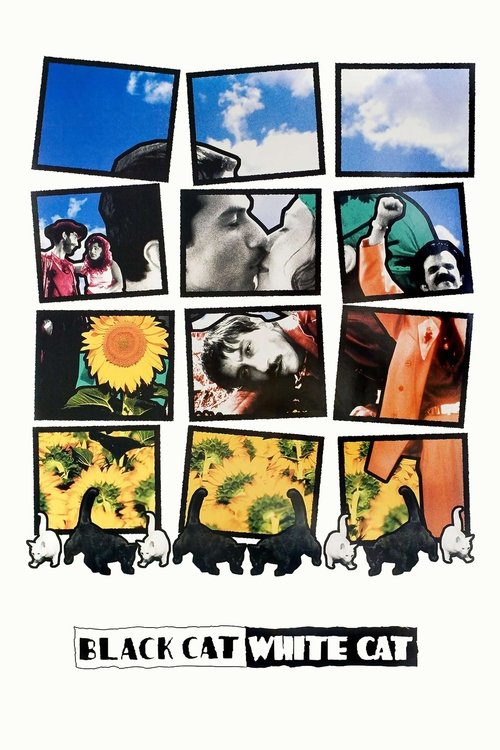
Black Cat, White Cat
1998 · Emir Kusturica
For when you need pure, unhinged joy — a party of a movie for a night when you want to laugh and be swept up in glorious chaos. Comfort food, Balkan-style.
What it's about
Matko, a small-time hustler on the banks of the Danube, botches a smuggling deal and lands in debt to Dadan, a flamboyant, coke-dusted gangster. The price of settlement: Matko's teenage son Zare must marry Dadan's diminutive sister. But Zare loves someone else, and the arranged wedding sets off an anarchic chain of schemes, escapes, and coincidences involving brass bands, con-artist grandfathers, geese, and a pig methodically eating a car.
The experience
Delirious, loud, and joyous — a farce that runs at full tilt for two hours, with gypsy brass music driving nearly every scene. It's chaotic in a way that's completely infectious; you come out grinning and slightly out of breath.
Performances
The ensemble plays it at operatic pitch — Srđan Todorović's Dadan is a gloriously unhinged villain, all menace and disco swagger.
The craft
Kusturica stages the film like a circus that never stops: every frame teems with animals, musicians, and background gags, and the wall-to-wall Roma brass score is practically a lead character. The choreography of chaos — how many things happen at once without the story getting lost — is the real magic trick.
Why it matters
Made after the bruising political controversy around Underground nearly drove Kusturica from cinema, it won him the Silver Lion at Venice and stands as the definitive screen celebration of Balkan Roma music and life.
Snapshot
Black Cat, White Cat (Crna mačka, beli mačor) is Emir Kusturica's exuberant Roma farce, a wedding comedy staged along the banks of the Danube and powered by brass bands, con men, geese, and a pig that eats a car. Made in the immediate aftermath of the political firestorm around his Palme d'Or winner Underground (1995) — a controversy so bruising that Kusturica publicly spoke of quitting cinema — the film reads as a deliberate act of retreat into pure comedy and pure play. The plot is a nested trap: the small-time hustler Matko botches a smuggling deal, falls into debt to the flamboyant gangster Dadan, and agrees to settle it by marrying his son Zare to Dadan's diminutive sister. The young people want no part of it; Zare loves someone else. Around that armature Kusturica builds an anarchic machine of coincidence, disguise, and reversal. The film won the Silver Lion for Best Director at the Venice Film Festival in 1998, restoring Kusturica's standing as a festival auteur and cementing the manic, music-soaked "Balkan carnival" style with which his name is now synonymous.
Industry & production
The film is a European co-production, a structure typical of ambitious art-house cinema emerging from the former Yugoslavia in the late 1990s, when domestic financing was crippled by war, sanctions, and economic collapse. Funding and production partners drew on French, German, and Yugoslav (Serbian) sources — the French house CiBy 2000, the German Pandora Film, and Yugoslav production entities among them — which allowed Kusturica to work at a scale and with a technical polish unavailable to most regional filmmakers of the period. This transnational financing is itself significant: it made Kusturica one of a handful of directors from the Yugoslav successor states with reliable access to Western European capital and festival distribution.
The production context cannot be separated from Underground. That film's reception — celebrated at Cannes, then attacked by critics (most famously in the French press) who read it as pro-Serb apologia during the wars — left Kusturica embittered and, by his own public statements, ready to abandon filmmaking. Black Cat, White Cat is his answer: a film scrubbed of explicit political allegory, set in a marginal community, oriented entirely toward comedy and celebration. Whether that turn was escape or evasion became a recurring critical question, but industrially it functioned as a rehabilitation, returning him to competition and prizes. Precise budget and box-office figures are not something I can state reliably here; the record I can verify concerns the film's festival success rather than its commercial performance.
Technology
Technologically the film is conventional for its moment: shot on 35mm color film stock and finished for standard theatrical exhibition, with no notable use of the digital tools that were beginning to enter the industry in the late 1990s. Its "special effects" are almost entirely practical and performed in-camera — trained (and untrained) animals, physical stunts, staged demolition, and elaborate blocking rather than optical or digital trickery. The much-discussed set pieces (a pig methodically consuming an old car, geese and cats wandering through frame, a body concealed in the loft on blocks of ice) derive their comic force precisely from their evident reality: the pleasure is in knowing these are actual animals and objects, unfaked. In that sense the film's "technology" is old-fashioned craft — animal wrangling, timing, and staging — and the honest thing to say is that the historical record here is thin on any technical innovation because the film sought none.
Technique
Cinematography
The cinematography is by Thierry Arbogast, a choice that is itself worth pausing on: Arbogast was best known as Luc Besson's regular collaborator (Nikita, Léon, The Fifth Element), a cinematographer associated with glossy, high-contrast commercial spectacle. Applied to Kusturica's mud-and-brass milieu, his craft yields a saturated, warm, highly mobile image. The camera is restless — tracking, craning, plunging through crowded interiors and riverbank exteriors — matching the film's kinetic tempo. Wide-angle framings pack the frame with bodies, animals, and props, sustaining the sense of a world overstuffed with life. The palette leans into golds, greens, and earth tones, lending even squalor a burnished, fairy-tale glow. It is a deliberately non-naturalistic beauty: the look flatters a world of hustlers and junk into something closer to folk myth.
Editing
Cut by Svetolik "Mića" Zajc, the film moves at a comic clip, its editing organized around escalation and collision. Kusturica and his editor favor a farce logic in which separate lines of action are cross-cut until they crash together — the wedding, the debt, the runaway bride, the hidden corpses, the rival gangsters all converging. Musical numbers and set pieces are cut to the pulse of the score, and the film's rhythm accelerates toward its climactic double wedding. The editing rarely lingers; it privileges momentum and the payoff of a running gag over contemplative duration, which is consistent with the film's rejection of the heavier, more elegiac register of Underground.
Mise-en-scène / staging
Mise-en-scène is arguably the film's central achievement. Kusturica composes dense, layered tableaux in which the foreground drama is constantly heckled by background business — animals crossing frame, musicians appearing, secondary characters pursuing their own agendas. The riverbank settlement, with its shacks, sty, jetty, and junk, is a fully realized comic cosmos. Recurrent motifs (the two cats of the title, the pig and the car, the omnipresent geese) function as visual leitmotifs threading through the staging. The famous device of the two old patriarchs — Grga Pitić and Zarije — and the concealment of a "death" during the festivities turns the set into a machine of hiding and revelation. This is staging in the tradition of physical farce and folk theater, where space itself is choreographed for maximum collision.
Sound
Sound and, above all, music are inseparable from the film's identity. The score is anchored in the Balkan Romani brass tradition and was produced in association with Kusturica's own band, the No Smoking Orchestra, with Nele Karajlić (Nenad Janković) among the credited composers; the film's music is frequently diegetic, with musicians materializing within the action. The sonic texture is loud, festive, and relentless — brass, percussion, folk song — creating an almost operatic continuity of sound. This musical saturation is a Kusturica signature, and here it carries much of the film's emotional and comic momentum. (Exact composer credits are best confirmed against the film's titles; I attribute the score to Kusturica's band collaboration rather than claim a single sole author.)
Performance
The performances rest heavily on a cast of largely non-professional actors, many drawn from Roma communities, which lends the film a documentary vitality even within its cartoonish register. Bajram Severdžan plays the hapless Matko; Srđan Todorović (a professional, and a Kusturica veteran) plays the volcanic gangster Dadan as pure comic id — twitchy, coke-addled, explosive. The young lovers, played by Florijan Ajdini and Branka Katić (as the spirited Ida), supply the film's romantic heart. Elder performers, including Sabri Sulejmani and Zabit Memedov as the two aged patriarchs, ground the farce in something like folk gravitas. The blend of trained and untrained players — a method Kusturica had used before, notably in Time of the Gypsies — produces performances that oscillate between broad slapstick and startling naturalness.
Narrative & dramatic mode
The dramatic mode is farce, in the strict sense: a plot of debts, deceptions, mistaken arrangements, and forced marriage that generates ever-escalating complications resolved only through a cascade of coincidences and disguises. The engine is the classic comedy-of-obstruction — young lovers thwarted by parental/patriarchal schemes — crossed with the picaresque, following hustlers and rogues through a series of scrapes. Kusturica layers this with elements of magical realism and folk tale: the tone permits the impossible and the grotesque without breaking. Crucially, the film subordinates psychological realism to comic mechanism; characters are broad types (the fool, the tyrant, the lovers, the wise elders) whose function is to keep the machine running toward its festive resolution. The double wedding that closes the film is the conventional comic terminus — order restored, couples correctly paired, community reaffirmed.
Genre & cycle
The film sits at the intersection of comedy, romance, and crime, but its deepest generic kinship is with the wedding-comedy and the folk carnival. Within Kusturica's own filmography it belongs to a "Gypsy cycle" alongside Time of the Gypsies (1988), sharing that film's Romani setting and its blend of the mythic and the squalid — though Black Cat, White Cat trades the earlier film's tragic undertow for near-unbroken comic energy. More broadly it belongs to a European art-cinema tradition of ethnographically inflected magical realism, and to a lineage of anarchic ensemble comedy. It also participates, self-consciously, in a post-Underground cycle of Balkan cinema wrestling with how to represent the region after the wars — here by conspicuous refusal of politics in favor of celebration.
Authorship & method
The film is a Kusturica auteur work in the fullest sense, bearing every hallmark of his style: brass-band musical saturation, animals as co-stars, dense carnivalesque staging, magical-realist license, and a fascination with marginal, vital communities. His method favors improvisation within elaborately prepared settings, the use of non-professional local performers, and a collaborative musical practice through his own band. The screenplay is credited to Gordan Mihić, the veteran Serbian screenwriter who had also collaborated on Time of the Gypsies, and whose feel for Romani milieu and picaresque structure is evident. The cinematographer Thierry Arbogast brings a professional gloss that pushes against the roughness of the material; the editor Svetolik Zajc shapes the farce rhythm; and the music, tied to the No Smoking Orchestra and Nele Karajlić, is arguably a co-authoring voice. The collaboration between a French commercial cinematographer, a Serbian screenwriter, and a Balkan rock-folk band is itself emblematic of Kusturica's hybrid, transnational authorship.
Movement / national cinema
Kusturica is the towering figure of post-Yugoslav cinema on the international stage, and the film must be read against the fracturing of Yugoslav film culture in the 1990s. He belongs to a generation shaped by the Sarajevo and Prague (FAMU) film schools and by the earlier Yugoslav new-wave and "Prague school" traditions, but by 1998 he was working as a diasporic, festival-oriented auteur reliant on Western European co-financing. The film's Romani setting connects it to a strand of Balkan and Central European cinema that has repeatedly turned to Roma communities as a site of vitality, marginality, and myth — a tendency admired for its energy and, at times, criticized for romanticizing or exoticizing its subjects. Black Cat, White Cat stands as a defining document of this transnational, post-Yugoslav art cinema.
Era / period
The film is a product of the late-1990s moment in which the wars of Yugoslav succession had left the region devastated and its cinema dependent on foreign capital. Its very avoidance of the political — its retreat into farce — is legible as a period gesture, a response to the exhaustion and controversy that followed a decade of conflict and of films (Kusturica's own included) freighted with contested political meaning. In the wider international art-cinema landscape of 1998, it arrived as a festival-circuit crowd-pleaser, a reminder of the pleasures of anarchic, music-driven comedy at a time when much prestige cinema was turning toward severity. Its Venice prize marks it as a canonical festival film of its year.
Themes
Beneath the slapstick, the film's themes are recognizably Kusturican. Chief among them is the tension between individual desire and communal/patriarchal obligation — the young lovers versus the marriage arranged to settle a debt — resolved in favor of love and the renewal of the community. It celebrates vitality, appetite, and survival: the world of hustlers and rogues is corrupt and chaotic, but overwhelmingly alive. Money, debt, and the con recur as the grease of social life. Death is treated comically, even irreverently (the concealed "corpses," the mock funeral), affirming a folk sensibility in which life triumphantly overruns mortality. The recurring cats, pigs, and geese propose a continuity between human and animal worlds, a kind of pantheistic earthiness. And running through all of it is the theme of celebration itself — music, feasting, and wedding as the social forms through which a battered community reconstitutes joy.
Reception, canon & influence
Critically, the film was widely received as a return to form after the Underground controversy and as one of Kusturica's most purely entertaining works; its Silver Lion for Best Director at Venice 1998 is the central, verifiable marker of its prestige. Reception was not uncritical: some commentators found its relentlessness exhausting, and the recurring debate about whether Kusturica's Romani films celebrate or exoticize their subjects attended this film as it had Time of the Gypsies. Still, its comic verve and musical energy won it a broad international audience and lasting affection.
Looking backward, the film draws on identifiable lineages: the physical-comedy and folk-carnival traditions; the ensemble anarchy and grotesquerie often compared to Fellini; the Romani-set magical realism of Kusturica's own Time of the Gypsies; and the picaresque comedy of rogues. Looking forward, its greatest influence has been in consolidating an internationally legible "Balkan" cinematic and musical aesthetic — the frenetic brass-band sound, the carnivalesque tone — that shaped the broader popularization of Balkan brass (and the "Gypsy punk" and Balkan-beat currents in world music) and became a template widely imitated and referenced. It stands, alongside Underground and Time of the Gypsies, as one of the works through which Kusturica defined, for global audiences, what a Balkan film could sound and feel like. Precise claims about specific later films it directly inspired are best made cautiously; its clearest legacy is stylistic and atmospheric — the enduring international image of Kusturica's carnival.
A Deleuzian reading
There is a pig eating a car.
The full Deleuzian reading of Black Cat, White Cat →
Reception
Landed at Venice 1998 as Kusturica's comeback — it won him the Silver Lion for Best Director after the bruising political fallout from Underground — and while some critics filed it as 'minor Kusturica' next to that epic, it's since become his most purely loved film, the one people actually rewatch.
How Black Cat, White Cat was received, from release to now →
How to watch Black Cat, White Cat: what to notice on a first viewing
- Watch the background for animals and musicians crossing the frame. Kusturica fills nearly every shot with background business, animals, musicians, and extras pursuing their own errands behind the main action. The world feels overstuffed with life you could follow in any direction.
- Notice the camera tracking, craning, and plunging through crowded spaces. Cinematographer Thierry Arbogast keeps the camera restless through cluttered riverbank interiors and exteriors, matching the film's kinetic pace. The camera's motion becomes part of the film's comic energy, not just a way of covering the action.
- Listen for musicians appearing inside scenes rather than on a soundtrack. Much of the score is diegetic; brass bands and singers materialize within the action itself rather than playing from an unseen source. The music becomes a character in the world, not just background.
- Notice how gold and warm the color palette is, even in squalor. The film's earth tones and warm light give the riverbank settlement's junk and mud a burnished, storybook glow. The visual warmth makes a chaotic world of hustlers read as folk myth rather than misery.
- Watch how quickly the editing cuts between separate, unrelated goings-on. The editing cross-cuts multiple lines of action, favoring momentum and the payoff of a running gag over lingering shots. The pace itself keeps the film moving from gag to gag.
The whole guide to watching Black Cat, White Cat, with the keys for a rewatch →
Influences: the films it descends from and the films it influenced
- Time of the Gypsies (1988) — Establishes the Kusturica–Gordan Mihić template of Romani-milieu picaresque with levitation and animal-inflected magical realism that Black Cat, White Cat reworks in a comic key with the same screenwriter.
- Underground (1995) — Perfects the wall-to-wall diegetic brass-band saturation and relentless carnivalesque tempo — a marching orchestra literally inside the frame — that becomes the seed film's default sonic and rhythmic engine.
- When Father Was Away on Business (1985) — Builds the ensemble-family farce staged around a wedding/celebration and mines performances from non-professional and child performers, a casting-and-blocking method carried directly forward.
- Amarcord (1973) — Supplies the grotesque-ensemble carnivalesque tableau — communal ritual staged as a dense crowded frieze of caricatured faces — that critics repeatedly invoke as Kusturica's compositional grammar.
- La Strada (1954) — Models the itinerant-performer world scored by diegetic brass-and-accordion melody functioning as emotional through-line rather than underscore, a device the seed film amplifies into constant on-screen music.
- I Even Met Happy Gypsies (1967) — Pioneers the Yugoslav Romani feature shot with local non-professionals and untranslated Romani speech, muddy on-location vitality that Kusturica inherits and stylizes.
- W.R.: Mysteries of the Organism (1971) — Bequeaths the Yugoslav Black Wave's cross-cut collision montage — anarchic juxtaposition of bodies, spectacle and provocation — that underlies the seed film's farce-by-editing rhythm.
- Steamboat Bill, Jr. (1928) — Origin of the in-camera physical gag built on collapsing structures and precisely timed bodily peril, the practical slapstick mechanics Kusturica stages with pigs, geese and a wedding cake.
- Snatch (2000) — Extends the cross-cut picaresque-of-rogues structure — overlapping con-artist schemes propelled by percussive music and Romani/'pikey' characters — into Anglo genre cinema just after the seed film.
- Life Is a Miracle (2004) — Kusturica's own continuation of the No Smoking Orchestra brass scoring, animal co-stars and magical-realist wartime farce, the direct stylistic sequel to Black Cat, White Cat's method.
- Everything Is Illuminated (2005) — Deploys Gogol Bordello 'Gypsy-punk' and Balkan-brass on its soundtrack as the internationally legible 'Balkan' sound that the seed film did most to consolidate for global audiences.
- Beasts of the Southern Wild (2012) — Inherits the non-professional local cast and folk-vitality magical realism located among a marginal, exuberant community, filtering Kusturica's carnival into American indie form.
- Promise Me This (2007) — Recycles the seed film's rural-rogue wedding farce, brass-scored slapstick chases and carnivalesque tableaux, confirming Black Cat, White Cat as the comic mold Kusturica returned to.
- The Fifth Element (1997) — Immediately precedes the seed film in cinematographer Thierry Arbogast's filmography, showcasing the saturated color and constantly mobile camera that Arbogast brings as professional gloss against Kusturica's rough material.
- Gadjo Dilo (1997) — Immerses a fictional narrative inside real Romani communities and their live music-making, sharing the seed film's ethnographic-yet-celebratory band-driven diegesis released the same season.
- Delicatessen (1991) — Runs an enclosed grotesque community as a clockwork of practical in-camera farce mechanics and choreographed simultaneous action, a European sensibility parallel to Kusturica's staged chaos.
- Waiting for the Hearse (1985) — A cacophonous overlapping-dialogue ensemble whose weddings and funerals become nonstop grotesque spectacle, comedy mined from crowded chaos.
- We Are Not Angels (1992) — Shares the heightened Balkan carnival-comic register and music-as-continuous-chorus scoring, the regional idiom of frantic pop-driven farce Dragojević helped make commercially viable.
Similar films
- Underground (1995) — influence & lineage
- Time of the Gypsies (1988) — influence & lineage
- When Father Was Away on Business (1985) — influence & lineage
- La Strada (1954) — influence & lineage
- Satantango (1994) — shared sensibility
- Son of the White Mare (1981) — shared sensibility
- Barking at the Stars (1998) — shared sensibility
- Morgiana (1972) — shared sensibility