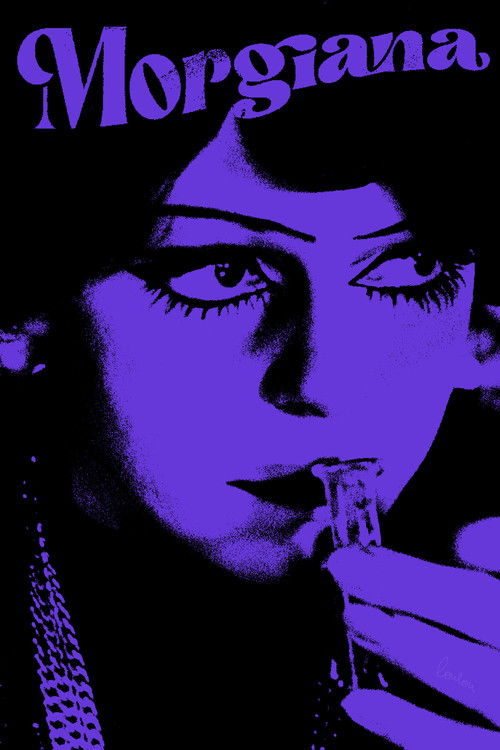
Morgiana
1972 · Juraj Herz
When you're craving something ornate and unhinged — a midnight-movie discovery for lovers of gothic atmosphere and high style. A deliciously weird challenge, not a cozy watch.
What it's about
Two sisters inherit unequally, and the envious one begins dosing the pretty one's tea with a slow-acting poison. As one sister mysteriously weakens, the other finds her scheme curdling into guilt, blackmail, and the growing need to silence anyone who might expose her. Both sisters are played by the same actress — and the household cat, Morgiana, watches everything.
The experience
A fever dream of a gothic melodrama — jeweled colors, swooning music, a camera that prowls at floor level like the cat itself. It's less scary than intoxicating: hallucinatory, perverse, and strange in a way that gets under your skin.
Performances
Iva Janžurová plays both sisters in a bravura dual performance — saintly and venomous, often sharing the frame with herself — and makes each one fully, unnervingly distinct.
The craft
Juraj Herz, a trained puppeteer working at an angle to the Czech New Wave, pushes melodrama into delirium: fish-eye lenses, art nouveau villas, wind-lashed cliffs, hallucinatory dissolves, and Luboš Fišer's swooning score. Made under post-invasion censorship, it smuggles its subversion in through sheer style — every frame is dressed to the teeth.
Why it matters
A cult jewel of 1970s Czechoslovak cinema, made as the New Wave was being systematically defanged — proof that visual audacity could survive where open dissent couldn't, and a key film in Herz's singular career.
Juraj Herz — Holocaust survivor, trained puppeteer, maker of The Cremator — stood at an angle to the Czechoslovak New Wave, and Morgiana is his most delirious proof. Adapted from Alexander Grin's novel, it pits two sisters against each other in a poisoned-tea gothic of inheritance, jealousy, and creeping guilt, both of them played, in a bravura dual performance, by Iva Janžurová. Made under post-invasion Normalization, when Czech cinema was being systematically defanged, it smuggles its subversion in through sheer style: art nouveau villas, wind-lashed cliffs, Luboš Fišer's swooning score, and a camera that periodically drops to floor level to prowl the rooms as Morgiana herself — the cat. Fish-eye lenses, jeweled color, and hallucinatory dissolves push melodrama into fever dream; Herz had planned a final twist revealing the sisters as one divided mind, and its removal by nervous producers only makes the doubling stranger. It was among the last flares of Czech fantastique before the freeze.
Reception
Barely seen outside Czechoslovakia for decades — made just as the post-'68 crackdown was smothering the Czech New Wave — it's been steadily rediscovered on home video and repertory circuits as a lost gothic jewel, now routinely mentioned alongside Valerie and Her Week of Wonders.
How Morgiana was received, from release to now →
Influences: the films it descends from and the films it influenced
- The Cremator (1969) — Herz's own earlier film establishes the wide-angle/fish-eye distortion, roving snorkel-lens glides through decor, and match-cut editing grammar he re-deploys in Morgiana.
- Diabolique (1955) — Supplies the two-women-and-a-slow-poisoning melodrama architecture, where guilt and dread are staged through domestic objects and creeping paranoia rather than overt horror.
- Persona (1966) — Model for the psychological doubling of two women whose identities threaten to merge — the split-self that Herz literalizes by casting one actress as both sisters.
- Repulsion (1965) — Pioneers the subjective wide-angle apparatus that warps interior space to render a woman's paranoid mental disintegration from inside her perception.
- Daisies (1966) — Cinematographer Jaroslav Kučera's tinted filters, prismatic distortions and anti-naturalist image excess are the direct toolkit he brings to Morgiana's poisoned palette.
- Vampyr (1932) — Origin of the drifting, gauzy subjective camera and dream-logic gothic in which the frame itself feels unmoored from waking reality.
- The Fall of the House of Usher (1960) — Template for color-drenched decadent-interior gothic, staging psychological rot through opulent, decaying production design.
- Rebecca (1940) — Codifies the female-gothic melodrama of a haunted mansion and menace circulating between women, foregrounding the house as antagonist.
- The Hourglass Sanatorium (1973) — Extends the Eastern European decadent-baroque mode — labyrinthine art-nouveau/rot production design and continuous dream-dissolve transitions between spaces.
- Suspiria (1977) — Inherits the art-nouveau-into-horror aesthetic: fairy-tale color gels, ornate villa architecture as threat, and subjective camera untethered from realism.
- Beauty and the Beast (Panna a netvor) (1978) — Herz's own later gothic fairy tale carries forward the low-gliding subjective 'creature' POV and lush, morbid art direction of Morgiana.
- Dead Ringers (1988) — Refines the single-actor-as-two-siblings performance craft, using seamless technical doubling to explore one identity splitting into rival selves.
- Crimson Peak (2015) — Revives the female-gothic melodrama where decayed opulent art direction and a poisoning-within-the-house plot are the primary expressive engine.
- Valerie and Her Week of Wonders (1970) — The other pillar of the Czech fantastique — shares Luboš Fišer's fairy-tale-menace scoring and a lace-and-dream editing logic of hallucinatory dissolves.
- The Fruit of Paradise (1970) — Kučera pushes the same saturated, gel-filtered, decoratively abstracted photography into an Edenic gothic register just before Morgiana.
- Spider Baby (1967) — Contemporary gothic grotesque that similarly plays sisterly derangement as arch, stylized melodrama teetering into camp horror.
- Sisters (1972) — Same-year variation on the murderous-twin conceit, using formal doubling devices (split screen) as the visual analog to a divided psyche.
Similar films
- Valerie and Her Week of Wonders (1970) — influence & lineage
- Suspiria (1977) — influence & lineage
- Marketa Lazarová (1967) — shared sensibility
- Beauty and the Beast (1979) — shared sensibility
- Black Cat, White Cat (1998) — shared sensibility
- The Ice Tower (2025) — shared sensibility
- Shadows of Forgotten Ancestors (1965) — shared sensibility
- The Strange Ones (1950) — shared sensibility