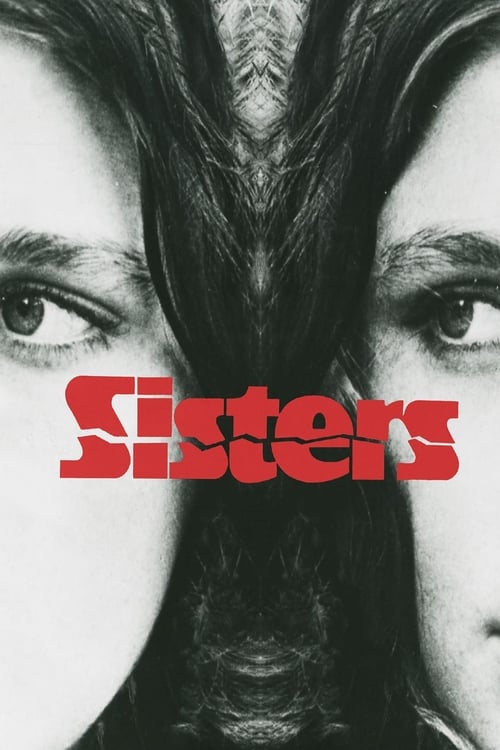
Sisters
1973 · Brian De Palma
When you're craving a real thriller with teeth — voyeuristic suspense that curdles into horror. Challenge viewing for a late night, not a comfort watch.
What it's about
A journalist looks out her Staten Island window and witnesses her neighbor, a French-Canadian fashion model, commit a murder. When the police arrive and find the apartment spotless, no one believes her — so she hires a private investigator and starts digging into the model's past, where a dark secret involving a twin sister waits. What starts as a whodunit becomes something much stranger and more disturbing.
The experience
Tense, playful, and increasingly nightmarish — it toys with you like a cat, splitting the screen so you watch a crime and its cover-up unfold simultaneously, then plunges into full hallucinatory horror in its back half. It's the kind of thriller that makes you complicit in the watching.
Performances
Margot Kidder is remarkable in a role that demands sweetness, fragility, and something far more frightening, often within a single scene; Jennifer Salt makes the disbelieved witness genuinely prickly and stubborn rather than a stock heroine.
The craft
This is the film where De Palma's signature style arrives fully formed: a bravura ten-minute split-screen murder-and-cleanup sequence that remains one of the great suspense set pieces, and a shrieking, unnerving score by Bernard Herrmann, the composer of Hitchcock's greatest thrillers. Shot cheap and grimy, it turns its low budget into tabloid urgency. The split-screen alone rewards a big screen and full attention.
Why it matters
The film that transformed De Palma from counterculture satirist into America's foremost suspense stylist, launching the run of voyeuristic thrillers that defined his career and the whole 1970s conversation about Hitchcock's legacy. A touchstone of independent American horror.
Snapshot
Sisters is the film in which Brian De Palma stopped being a counterculture satirist and became a horror stylist — and, not coincidentally, the film in which the American cinema's most argumentative relationship with Alfred Hitchcock began in earnest. Made cheaply on Staten Island for producer Edward R. Pressman and released by American International Pictures in 1973 (in Britain as Blood Sisters), it takes a tabloid premise — a formerly conjoined twin, a murder witnessed through a window, a policeman who does not believe the witness — and builds from it a machine for thinking about looking.
Its most celebrated passage runs nearly ten minutes in split screen: on one side, a man bleeding to death on a Manhattan apartment floor, dragging himself to the glass to write HELP in his own blood; on the other, the neighbor who sees him, then the police, then the frantic cleanup that will make the crime disappear before the authorities can climb the stairs. The device is not a stunt. In a film about two bodies that were once one, the divided frame is the argument.
Sisters was also the first meeting between De Palma and two collaborators who would define the rest of his major period: editor Paul Hirsch and composer Bernard Herrmann, the latter recruited out of a semi-exile from Hollywood to write one of the last great scores of his career. The film's commercial performance was modest, but its critical impact was decisive: it established the De Palma of Obsession, Carrie, Dressed to Kill, and Blow Out, and it opened a debate about homage, theft, and citation that has never entirely closed.
Industry & production
Sisters belongs to a specific commercial niche: the low-budget New York independent picture made by young filmmakers and sold through an exploitation distributor. De Palma had come out of the East Coast underground with Greetings (1968) and Hi, Mom! (1970), improvisational, Godard-inflected comedies of draft-dodging and voyeurism, and had just endured a demoralizing studio experience on Get to Know Your Rabbit (shot for Warner Bros. in 1970, shelved, and released in altered form in 1972). Sisters was a deliberate change of register — genre as a way back to control.
Edward R. Pressman, who would also produce Phantom of the Paradise, financed it independently; American International Pictures, Samuel Z. Arkoff and James H. Nicholson's company, handled distribution. Published budget figures for the film vary and should be treated cautiously, but every account places it well under a million dollars, and the film's methods show it: real apartments, Staten Island locations, a compact cast, long takes that avoid coverage, and a small number of expensive optical effects reserved for maximum impact.
The casting reflects the informal social world of early-1970s New Hollywood as much as any formal process. Margot Kidder and Jennifer Salt — Salt the daughter of blacklisted screenwriter Waldo Salt — were friends and housemates, and their circle overlapped with the young directors then remaking American film; Peter Biskind's popular history Easy Riders, Raging Bulls is the best-known account of that milieu, and like all such accounts it is anecdotal rather than documentary. What matters on screen is that both actors are used as De Palma knew them: Kidder as a performer of surfaces, Salt as a performer of stubbornness.
The screenplay is credited to De Palma with Louisa Rose. The precise division of labor between them is not well documented, and it would be inventing history to assign specific scenes to either writer. The film's originating image is better attested: De Palma has repeatedly said the project began with a photo essay he encountered in Life on the Soviet conjoined twins Masha and Dasha Krivoshlyapova.
Technology
The film is a 35mm color production of the pre-Steadicam, pre-video-assist era, and its formal signature depends on two technologies that were, in 1973, genuinely costly.
The first is the optical printer. The extended split screens were not shot in-camera; they were assembled photographically in post, which meant that every frame of those sequences went through an additional generation of duplication. On a picture at this budget level, that was a real allocation of resources, and it disciplined the design: the split screen appears in concentrated blocks rather than as decoration. It also imposed a constraint on shooting. Once you know a shot will occupy half the frame, you must stage it for half the frame — figures pushed toward the inner edge, the composition weighted so that the two panels read as one continuous space rather than two competing ones.
The second is the Moog synthesizer, which Bernard Herrmann folded into an otherwise orchestral score. Herrmann was not a natural early adopter, and the choice is striking in a body of work built on strings, brass, and unusual acoustic doublings. The synthesizer gives the main title and the murder music a metallic, non-human edge that sits oddly and productively against the Romantic string writing — an old master using a new machine to make a sound that belongs to neither register.
Elsewhere the technology is that of the location independent: fast stocks, practical interiors, wide and distorting lenses used because they were available and expressive rather than because they were fashionable.
Technique
Cinematography
Gregory Sandor, whose credits include Monte Hellman's mid-1960s existential westerns The Shooting and Ride in the Whirlwind, shot the film, and his work here is notable for range rather than a single look. The Staten Island and Manhattan material is flat, functional, faintly grubby — the register of 1970s American location realism. The apartment across the courtyard is photographed as a proscenium, a lit box seen from a fixed vantage, which is what makes Grace's view of it legible as spectacle before it becomes evidence.
Then there are the deliberate ruptures. The film's hallucinatory late sequence, in which Grace is drugged and hypnotized and effectively inserted into Danielle's memory as the missing twin, abandons color for black-and-white and abandons normal optics for extreme wide-angle and fisheye distortion. Faces bulge toward the lens; the clinic corridors bend. The shift is not subtle, and it is not meant to be: the film is announcing that we have left the register of the witnessed and entered the register of the implanted.
De Palma's own recurring devices are already fully formed. There are long, gliding camera movements that establish geography before violence disrupts it, and there is the vertiginous circling shot — the camera orbiting embracing figures — that he would use throughout his career.
Editing
Sisters is Paul Hirsch's first film with De Palma, and it launched a partnership that ran through Phantom of the Paradise, Obsession, Carrie, The Fury, and Blow Out (Hirsch would win an Oscar for Star Wars in between). Hirsch has written about his career in a 2020 memoir; his account of the De Palma years is the fullest first-hand source on how these films were assembled.
The split-screen passage is the obvious achievement, and its craft lies in rhythm rather than novelty. The two panels are not equal partners: attention is steered by movement, by which side has the louder event, by when one panel goes still. The suspense is generated by the gap between panels — we know something the police do not, and the film makes us watch the knowledge fail to travel across the frame line. It is Hitchcock's definition of suspense (the audience knows about the bomb) rendered as graphic design.
Elsewhere the cutting is patient to the point of provocation. The murder itself is fragmented in a manner unmistakably indebted to the Psycho shower sequence, but the aftermath — the cleanup, the sofa, the arrival of Emil — is played in sustained duration, so that dread accumulates rather than detonates.
Mise-en-scène / staging
The film's architecture is doubling. Two apartments facing each other across a courtyard; two women, one who looks and one who is looked at; two personalities in one body; two halves of a frame; a hide-a-bed sofa that is both furniture and coffin. The sofa is the film's great prop — a domestic object that swallows the evidence and then travels, absurdly, by rail to Quebec, where it sits on a station platform under the surveillance of a private detective perched on a telephone pole. That final image is a joke and a thesis: the watcher is stuck up a pole, guarding a couch, with no one left to tell.
Emil Breton's clinic is staged as an institution of control, and Danielle's apartment as a stage set of femininity — birthday cake, sleeping pills, an ex-husband who lets himself in. The film is careful that we see Danielle's space first as a performance, because the opening sequence has already taught us to treat a woman undressing as a broadcast.
Sound
Herrmann's score is the dominant sonic fact: shrieking, insistent, built on repeated stabbing figures, and threaded with the Moog's cold sustain. It is aggressive to the point of rudeness — it tells you a scene is horrifying before the scene has proved it — and this brazenness is precisely what De Palma wanted. Herrmann had been cast out of Hollywood after the rupture with Hitchcock over Torn Curtain (1966) and had been working in Europe, including for Truffaut. Sisters began his late resurgence among the young cinephile directors; he would score De Palma's Obsession and Scorsese's Taxi Driver before his death in December 1975.
Against the score, the film sets banal audio: the tinny jingle of the fake television game show, an in-film advertisement parody, the flat procedural chatter of policemen. The satire lives in the sound design as much as the images.
Performance
Margot Kidder plays Danielle Breton with an audible French-Canadian lilt and a manner of ingratiating helplessness, then plays Dominique as raw hostility — the transitions handled largely through voice and posture rather than makeup. It is a genuinely difficult assignment, since the film's mechanics require the audience to half-know the answer while the performance keeps a straight face.
Jennifer Salt's Grace Collier is the film's engine: an abrasive, self-righteous local journalist whose exposé on police brutality has made her enemies among the very detectives she now needs. Salt plays her without any softening — she is right about everything and insufferable about all of it, which is exactly why no one listens.
William Finley, a De Palma regular, gives Emil an unctuous, wounded quality that keeps him from being a simple mad doctor, and Charles Durning's private investigator Joseph Larch is the film's ballast: a seedy professional who behaves reasonably in an unreasonable film. Lisle Wilson's Philip Woode is onscreen only briefly but is the film's moral fulcrum, and Barnard Hughes and Dolph Sweet fill out the institutional world of newspaper and precinct.
Narrative & dramatic mode
The film's structure is a deliberate act of vandalism against its own first act. It opens with a fake television program, Peeping Toms, in which a hidden-camera prank is played for studio laughs; the sequence implicates the audience in a look before the plot exists. It then follows Philip and Danielle through a date and a night together — and then kills the character we have been following, roughly a third of the way in, and hands the film to a woman watching from another building.
Both moves are lifted, knowingly, from Hitchcock: the mid-film protagonist substitution from Psycho, the witness-across-the-courtyard from Rear Window, the doomed investigator from Psycho again. But the combination produces something Hitchcock never quite did, because Sisters pushes past disbelief into erasure. It is not merely that no one credits Grace's account; it is that the film's antagonists possess the technical means — hypnosis, psychiatric authority, institutional custody — to remove the account from Grace herself. The ending, in which she recites that there was no body, is closer to Kafka than to suspense.
Genre & cycle
Sisters arrives at the hinge of the horror decade. 1973 is the year of The Exorcist, Don't Look Now, and The Wicker Man; the American genre film was moving from gothic remove into contemporary, bodily, institutional terror. Sisters sits in the Psycho lineage — the psychiatric-explanation thriller, the split personality, the domestic murder — and adjacent to the Italian giallo, which had been working the same territory of the unreliable witness (Argento's The Bird with the Crystal Plumage, 1970, turns on a man who sees a crime through glass and misremembers what he saw). Whether De Palma was directly responding to the giallo or arriving in parallel from the same Hitchcockian source is not settled in the record.
Distributed by AIP, the film also carries exploitation-cycle DNA: a lurid hook, an efficient running time, a marketable atrocity. What distinguishes it is that the exploitation elements are also the analytical ones.
Authorship & method
Sisters is where De Palma's method becomes visible as a method. His procedure is to take a Hitchcock structure, strip out its moral machinery, and replace it with formal exhibitionism — split screen, slow motion, circling camera, ostentatious point-of-view — so that the technique becomes the film's subject. Detractors read this as plagiarism with a smirk; defenders read it as modernist citation, closer to Godard's practice of quotation than to imitation. The film gives ammunition to both.
The collaborators matter enormously. Herrmann is not a neutral choice: hiring Hitchcock's composer is itself an act of criticism, an insistence that the reference be heard. Hirsch's cutting gives De Palma's ideas their tempo. Sandor's photography supplies the documentary flatness that makes the stylistic ruptures land. Louisa Rose's contribution to the screenplay is real but poorly documented, and it would be dishonest to characterize it further than the credit does.
Movement / national cinema
The film belongs to New Hollywood's East Coast wing — the strand of the movie-brat generation that came up through New York rather than through film school in Los Angeles or the Corman apprenticeship. Its cinephilia is worn openly; its production values are those of the American independent; its politics are the residue of the 1960s underground, where De Palma had made agitprop-inflected comedies about surveillance and media. Hi, Mom! had already staged a "Be Black, Baby" sequence of vicious racial provocation; Sisters carries that concern forward, quietly but pointedly, by making its murder victim a Black man whose death the police cannot be troubled to investigate and by routing his date through a nightclub's "African Room."
Era / period
1973 is a year of institutional collapse in American public life, with Watergate unspooling through the spring and summer, and Sisters is legible within the paranoid cycle that would produce The Conversation and The Parallax View the following year. Its particular contribution is to locate the paranoia in the domestic and the psychiatric rather than the governmental: the conspiracy here is a doctor, an apartment, and a piece of furniture.
It is equally a film of the women's movement's second wave, though an ambivalent one. Grace is a feminist journalist whose credibility is destroyed by men with professional authority; Danielle is a woman whose body has been surgically and psychologically managed by the man who married her. The film's sympathies are clear enough. Whether its pleasure in the spectacle of imperiled and violent women undercuts those sympathies is the central question of the long feminist critical argument about De Palma, which Dressed to Kill would later bring to a boil.
Themes
Voyeurism and complicity. The film opens by putting the audience in the position of a hidden camera and never lets that position go innocent again.
The divided self. Not only Danielle/Dominique, but Grace's own absorption into the twin fantasy under hypnosis, and the frame itself split in two.
The unreliability of testimony. Grace sees the truth, reports it accurately, and is systematically stripped of it — first by disbelief, then by tampering.
Medical authority over women's bodies. Emil is surgeon, husband, keeper, and eraser of memory, all in one figure.
Race and credibility. The film does not editorialize, but it constructs its police indifference around a Black victim and lets the arrangement speak.
Media as apparatus. The game show, the newspaper, the pseudo-documentary insert — every institution that ought to transmit truth is shown converting it into content.
Reception, canon & influence
Sisters did not open to consensus. It was widely noticed as the arrival of a real talent, and Pauline Kael — who would become De Palma's most durable and most quoted champion through the 1970s — was among the critics who took it seriously as filmmaking rather than as a genre item. Against that ran the charge that would follow De Palma for thirty years: that the film is a set of Hitchcock parts reassembled, and that its brilliance is borrowed. Commercially it was a modest performer rather than a breakout; the breakout came with Carrie in 1976.
Its influences backward are unusually easy to name because the film names them: Psycho above all, Rear Window structurally, Vertigo in its scoring and its logic of substituted identity. Behind Hitchcock stand Michael Powell's Peeping Tom (1960) and the whole tradition of the camera-as-weapon. Beneath the Hitchcock, there is the residue of De Palma's own underground work and the Life magazine photo essay that supplied the premise.
Forward, its legacy runs on several tracks. It set the template for De Palma's own major cycle — Obsession (1976), Carrie (1976), Dressed to Kill (1980), Blow Out (1981), Body Double (1984) — and he returned to its precise material of split personality and psychiatric husband in Raising Cain (1992). It effectively rehabilitated the extended split screen as a serious dramatic device rather than a 1960s novelty, and its use in the murder-and-cleanup sequence remains the standard reference point whenever the technique is discussed. It began the Herrmann late period that produced Taxi Driver. It gave Paul Hirsch the first credit in one of the more consequential editing careers of the era.
Critics have long paired Sisters with David Cronenberg's Dead Ringers (1988) as the two indispensable films about twinned identity and surgical violence, though Cronenberg's picture derives from a separate source and the pairing is thematic rather than a documented line of influence. The film's canonization was sealed by its inclusion in the Criterion Collection at the turn of the millennium, which brought it a scholarly apparatus and a wider audience than AIP had ever given it, and it was remade in 2006 by Douglas Buck with Chloë Sevigny and Stephen Rea — a version generally judged a footnote to the original.
What has aged best is the thing that looked most like showing off. The split screen was received in 1973 as a flourish; it reads now as the film's argument in its purest form — two images that cannot be reconciled, a truth visible on one side of a line and inadmissible on the other.
A Deleuzian reading
A man is dying on the floor of a Manhattan apartment.
The full Deleuzian reading of Sisters →
Reception
Released by exploitation house AIP in 1973, it was taken seriously by critics like Pauline Kael and marked De Palma's pivot from counterculture comedies to thrillers; now it's a Criterion-canonised cult classic seen as the true start of 'De Palma-ness'.
How Sisters was received, from release to now →
How to watch Sisters: what to notice on a first viewing
- Watch the screen split into two panels at once. For long stretches the frame divides down the middle, one side showing what a character does, the other showing who is watching or arriving, both playing out in real time. You end up watching two things happen at once and feeling the gap between what each side knows.
- Watch Grace watch Danielle's apartment through a lit window. Sandor photographs the apartment across the courtyard flat and frontal, like a small stage seen from a fixed distance, before anything happens inside it worth reporting. The film shows you spectacle before it shows you evidence, and asks you to notice the difference.
- Listen for the score arrive before a scene turns scary. Herrmann's shrieking strings and cold Moog sustain announce horror ahead of the image, telling you how to feel before the scene has proved anything. The music is doing openly what most scores try to hide: deciding your reaction for you.
- Notice the fake game show that opens the film. Before any plot begins, a hidden camera prank plays a woman undressing for studio laughs, seating you at the viewfinder well before there is a story to justify it. The film puts you in the position of a voyeur before it ever asks you to sympathize with one.
The whole guide to watching Sisters, with the keys for a rewatch →
Influences: the films it descends from and the films it influenced
- Rear Window (1954) — Supplies the proscenium armature Sisters rebuilds — a murder witnessed across a courtyard through a framed window, staged in flat planes from a fixed vantage, with an immobilized watcher whose testimony no authority will accept until she gathers physical proof herself.
- Vertigo (1958) — Model for the circling 360-degree camera around a transfigured face and for Herrmann's habanera-and-suspended-harmony vocabulary of obsession, plus the plot engine of one identity substituted for another and mourned as a lost double.
- Psycho (1960) — Direct template for the mid-film protagonist substitution and for the fragmented murder montage — dozens of short shots of knife, mouth, and wound that never show the blade entering — followed by the methodical cleanup of the body, scored by the same composer with the same shrieking strings.
- Peeping Tom (1960) — Establishes the camera-as-weapon premise Sisters opens with: an apparatus that records a victim is itself the instrument of the crime, and the audience is implicated by being placed at its viewfinder — De Palma's game-show 'Peeping Toms' prologue is the joke version of Powell's thesis.
- The Manchurian Candidate (1962) — Precedent for the hallucinated flashback built as a formal rupture — a circling camera revolving through a brainwashing tableau in which the same space holds two irreconcilable versions of events, which is exactly the grammar of the black-and-white asylum sequence.
- Repulsion (1965) — Source of the wide-angle/fisheye treatment of the apartment as a distorted mental interior, where bowing walls and stretched foregrounds convert an ordinary flat into the subjective symptom of the woman inside it.
- Chelsea Girls (1966) — The dual-projection precedent from the underground scene De Palma came out of: two simultaneous images the viewer cannot reconcile or synthesize, which Sisters industrializes on an optical printer so that the unresolvable split is dramatized rather than merely durational.
- The Thomas Crown Affair (1968) — The Pablo Ferro multi-panel montage that made optical-printer split screen a mainstream 1960s flourish — the decorative usage Sisters deliberately answers by tying each panel to a distinct character's knowledge and running the two in real time under one continuous suspense clock.
- Dionysus in '69 (1970) — De Palma's own feature-length split-screen experiment, shot with two synchronized cameras covering performers and spectators at once; it is the technical apprenticeship that taught him a divided frame can hold action and reaction simultaneously instead of alternating them in cuts.
- Hi, Mom! (1970) — The earlier voyeur film with the same apparatus satire — a peeping protagonist filming an apartment block across the street, and the 'Be Black, Baby' verite parody that supplies Sisters' method of mocking documentary and broadcast television inside the fiction.
- Obsession (1976) — The immediate sequel in method: Herrmann rehired for a second, more overtly liturgical Vertigo score, and the substituted-woman structure moved from horror shock to melodrama, with the circling camera promoted from a set piece to the film's basic figure.
- Carrie (1976) — Takes the Sisters split screen from a suspense device to a catastrophe device — the prom massacre runs in divided panels cut by Paul Hirsch, whose tempo and optical-effect vocabulary were worked out on the Sisters murder-and-cleanup sequence.
- Dressed to Kill (1980) — Rebuilds the Sisters chassis at higher gloss: the star killed at the midpoint so a second woman inherits the film, a split personality with a clinician's explanation withheld to the last reel, and split-diopter compositions doing in one shot what the split screen had done in two panels.
- Blow Out (1981) — Extends the disbelieved-witness structure into the recording apparatus itself — the witness must optically and sonically reconstruct the crime frame by frame to be believed, making explicit the Sisters premise that evidence exists on one side of a frame line and is inadmissible on the other.
- Body Double (1984) — The most literal restatement: a murder watched through a window by a discredited voyeur, and a woman substituted for another as a body double — the Sisters twin conceit relocated from surgery to film production and to on-set optical trickery.
- Raising Cain (1992) — Returns to the exact Sisters material — split personality, a controlling psychiatrist-spouse conducting an experiment on his partner — with the dual role now played by a man and the reveal handled through long-take blocking that hides the second self at the edge of the frame.
- Dead Ringers (1988) — The other pole of the twinned-identity-and-surgical-violence film, arriving at the same idea by opposite means: motion-control camera and split-frame compositing put both twins in one continuous shot, replacing De Palma's optically divided screen with a seam the viewer cannot find.
- Requiem for a Dream (2000) — De Palma's sustained split-screen — holding simultaneously unfolding spaces in a single frame as narrative grammar rather than stylistic flourish — established the device Aronofsky deploys in the cross-cut climax to make four simultaneous descents visually coequal and inescapable.
- Black Swan (2010) — De Palma's strategy of routing European split-identity horror (Polanski, Bergman) through an American exploitation register — foregrounding visceral body imagery while maintaining psychological art-film ambiguity — is the mediating tradition Black Swan works within rather than going directly to its European sources.
- Mission: Impossible (1996) — De Palma's own split-diopter and split-screen apparatus, carried by Burum's deep-focus compositions, is first weaponized here and recurs as M:I's signature optical doubling.
- The Diving Bell and the Butterfly (2007) — De Palma's signature split-diopter — one lens half keeping foreground and deep background simultaneously razor-sharp — is the specific optical device the film borrows to bind Bauby's immobile face to the distant world he can no longer reach.
- Taxi Driver (1976) — The other half of the Herrmann late period that Sisters restarted — the same composer's final scores, both built on a repeating low-register ostinato that scores watching rather than action, and both climaxing in overhead-and-fragment coverage of a killing.
- Phantom of the Paradise (1974) — De Palma's own prior split-screen suspense set piece and overt Hitchcock pastiche — the authorial workshop where the Phantom's split-screen/voyeur craft was rehearsed.
- Morgiana (1972) — Same-year variation on the murderous-twin conceit, using formal doubling devices (split screen) as the visual analog to a divided psyche.
Similar films
- Dressed to Kill (1980) — influence & lineage
- Body Double (1984) — influence & lineage
- Carrie (1976) — influence & lineage
- Rear Window (1954) — influence & lineage
- Repulsion (1965) — influence & lineage
- Psycho (1960) — influence & lineage
- Blow Out (1981) — influence & lineage
- Rosemary's Baby (1968) — shared sensibility