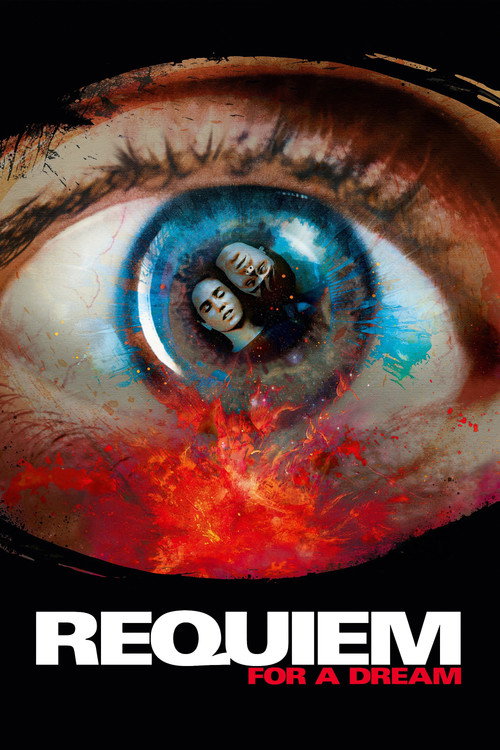
Requiem for a Dream
2000 · Darren Aronofsky
For when you want to be wrecked by a movie and are ready for it — this is the opposite of comfort viewing, a film you brace for and then talk about for days. Do not put this on for a casual night.
What it's about
Four people in Coney Island chase four versions of the same dream. A widow becomes fixated on appearing on television and starts taking diet pills; her son, his girlfriend, and his best friend deal heroin to fund plans for a better life. Across summer, fall, and winter, each addiction tightens its grip, and the film tracks all four spirals in lockstep.
The experience
Relentless — fast cutting, a pounding score, and an escalating rhythm that mimics craving itself. It's brilliant and punishing in equal measure: many people watch it once, are shattered by it, and never watch it again.
Performances
Ellen Burstyn's turn as Sara Goldfarb — a lonely widow dissolving under diet pills and daytime-TV dreams — is one of the most devastating performances in American film, and Jared Leto, Jennifer Connelly, and Marlon Wayans all do career-defining dramatic work around her.
The craft
Aronofsky builds a whole grammar for addiction: rapid-fire hip-hop montages for each hit, split screens, fisheye lenses, and time that speeds up and drags in sync with the characters' states. Clint Mansell's string-driven score became iconic in its own right. The technique isn't decoration — the editing is the addiction, and it hits hardest loud and on a big screen.
Why it matters
A defining film of turn-of-the-millennium American independent cinema, released unrated after an NC-17 battle, and the movie that made Aronofsky's reputation as a formal risk-taker. Its montage style and its score have been imitated and borrowed endlessly.
Snapshot
Darren Aronofsky's second feature is among the most formally aggressive American films of its era: a quartet of addiction narratives set in Coney Island that unspools across three seasons — Summer, Fall, Winter — as four characters are progressively consumed by their compulsions. Working from Hubert Selby Jr.'s 1978 novel, Aronofsky and Selby co-wrote a screenplay that amplifies the book's structural parallelism into a cinematic system where technique and theme become indistinguishable. The film received an NC-17 rating from the MPAA for its final act and was released unrated by Artisan Entertainment, limiting its theatrical footprint while conferring a cultural notoriety that outlasted the controversy. It remains a decisive document of American independent cinema at the turn of the millennium, as well as a touchstone for discussions of cinematic formalism in service of subjective psychological experience.
Industry & production
Aronofsky emerged from the late-1990s American independent scene on the strength of Pi (1998), a paranoid black-and-white debut shot on a reported budget of roughly sixty thousand dollars and acquired at Sundance by Artisan Entertainment. That relationship with Artisan brought Requiem for a Dream to production, though on a budget still modest by studio standards — widely cited at approximately four to five million dollars, though exact production figures from this period of independent financing are sometimes difficult to verify. The film was produced by Eric Watson and Palmer West under their Thousand Words banner.
Aronofsky had first encountered Selby's novel as a Harvard undergraduate and spent several years pursuing the rights. Selby, whose semi-autobiographical work had long resisted straightforward adaptation (his novel Last Exit to Brooklyn had been filmed by Uli Edel in 1989 to mixed results), agreed to collaborate on the screenplay. The partnership was notable for its mutual trust: Aronofsky has spoken of how Selby's presence on set and his willingness to expand the source material gave the production a moral authority it might otherwise have lacked. Selby himself appears in a small cameo, visible in a scene outside a correctional facility. The four principal roles went to Jared Leto, Jennifer Connelly, Marlon Wayans, and Ellen Burstyn — the last of these turning in a performance that became the film's most discussed single element.
The NC-17 designation, assigned primarily for the film's sexually explicit final sequence involving Connelly's character Marion, was not appealed by the studio. Artisan chose an unrated release rather than cutting the film, a decision consistent with their positioning of the title as an art-house provocation. The rating effectively barred the film from most national multiplex chains, and it played predominantly in specialty venues and college markets.
Technology
Matthew Libatique, Aronofsky's cinematographer on Pi, returned for Requiem for a Dream, and together they developed a vocabulary of optical and mechanical devices that pushed well beyond conventional production practice. The most discussed is the Snorricam, sometimes called the chest-mount or bodymount camera: a rig that fixes the camera to the actor's body so that the actor remains centered and stable in the frame while the surrounding environment appears to lurch and spin. Aronofsky deployed this device extensively to place the viewer inside the characters' perceptual distortions, producing an uncanny sensation in which the protagonist seems to move through a destabilized world rather than through a stable world themselves.
Libatique also worked with extreme telephoto and wide-angle lenses to compress or distort space, with time-lapse photography to show the passage of seasons and the acceleration of deterioration, and with split-screen compositions — techniques with roots in the experimental and underground cinema of the 1960s and 1970s — to hold multiple narrative lines in simultaneous visual tension, especially during the film's cross-cut climax. Fiber-optic cameras were threaded through impractical spaces to achieve point-of-view shots from inside pill bottles and syringes. These choices were not stylistic ornament but rather systematic attempts to render subjective states — euphoria, paranoia, craving, shame — as optical facts.
Technique
Cinematography
Libatique's palette tracks the film's seasonal structure. The summer sequences are warm and overexposed, blown toward the white of beachfront light; autumn brings a cooler, more desaturated register; winter moves toward cold blues and institutional fluorescents. This chromatic arc is deliberate and cumulative, functioning less as mood-setting than as a kind of color-coded phenomenology of addiction: pleasure, tolerance, withdrawal. The snorricam shots are counterpointed by handheld sequences of observational directness, so that the film alternates between subjective immersion and clinical distance — a tension that mirrors the moral structure of the drama.
Editing
Jay Rabinowitz cut the film, working closely with Aronofsky on the technique the director called the "hip-hop montage" — a rapid, staccato sequence of images and sounds that renders the ritual of drug consumption as a percussive abstraction. In these sequences, a single instance of drug use is decomposed into extreme close-ups: the crushed pills, the rolled bill, the dilating pupil, the tightening arm vein, the rush of neurological activation. These shots are intercut at a tempo measured in frames rather than seconds, producing something closer to musical rhythm than conventional screen time. The technique is applied each time the characters use, and its repetition creates a formal grammar of compulsion — the film enacts the circular logic of addiction through the very structure of its editing.
The cross-cut finale, in which all four characters reach their respective nadirs simultaneously, draws on a tradition running from Griffith's parallel editing through Eisenstein's dialectical montage, reconfiguring that tradition for an immersive rather than intellectual effect: the simultaneity is horrifying rather than triumphant.
Mise-en-scène / staging
Sara Goldfarb's Brighton Beach apartment is the film's most sustained and precise environment. Burstyn and Aronofsky worked together to calibrate the apartment's physical details — the television as object of devotion, the accumulation of weight-loss paraphernalia, the specific pathos of a woman who has outlived her social world. As the amphetamine-based diet pills prescribed by her doctor begin to disorder Sara's perception, the staging literalizes her delusions: the refrigerator lurches toward her, the television address her directly, her apartment contracts. The production design in these sequences integrates digital compositing and practical set manipulation in ways that are often imperceptible, which is precisely the point — Sara's break from reality unfolds in the same visual register as her earlier normality.
Sound
Clint Mansell's score, performed by the Kronos Quartet, is inseparable from the film's identity and its cultural afterlife. Mansell had come to film scoring from the British alternative rock band Pop Will Eat Itself; his work here introduced a neo-minimalist string vocabulary — ostinato patterns, rising chromatic sequences, dynamic swell and release — that was immediately influential. The central theme, "Lux Aeterna," became one of the most widely licensed pieces of film music of the 2000s, appearing in film trailers, television advertisements, and documentary soundtracks to a degree that eventually became a subject of cultural comment in its own right.
The film's sound design functions as an extension of the editing: the hip-hop montage sequences are defined as much by their percussive sound gestures as by their imagery. Pills clatter, spoons scrape, refrigerators hum with menace. The sonic and visual vocabularies are constructed in tandem, so that the film's formal system operates across registers simultaneously.
Performance
Ellen Burstyn's portrayal of Sara Goldfarb is the film's emotional center of gravity. Her performance engages simultaneously with the naturalistic tradition — the specific physical detail of a woman of her age, class, and neighborhood — and with a mode of expressionist extremity in the film's later stages that demands the viewer hold both registers in mind at once. Burstyn has discussed the physical preparation involved, including working with prosthetics and weight adjustment to chart Sara's deterioration. She received an Academy Award nomination for Best Actress at the 73rd ceremony (2001), losing to Julia Roberts for Erin Brockovich in what became a frequently revisited Oscar outcome among critics who considered Burstyn's the more demanding work.
Leto, Connelly, and Wayans operate within a more recognizably naturalistic mode for much of the film, their performances tuned to the social textures of addiction — the improvised lying, the incremental self-betrayal, the comedic warmth that makes the subsequent devastation legible. Connelly's final-act material, which the NC-17 rating directly addressed, required physical and psychological exposure that she has spoken of as among the most difficult work of her career.
Narrative & dramatic mode
The film is structured as four parallel descents, cross-cut with increasing frequency as the narrative accelerates. The structure owes something to the Victorian triple-decker novel's tradition of parallel plots drawn together at a moral climax, but Aronofsky presses the device toward an almost musical conception: each narrative line is a voice in a fugue, and the film's final movement is a fugal stretto in which all voices converge at once.
Crucially, the film resists the redemptive arc conventional to addiction narratives. There is no recovery, no rock bottom that generates insight, no protagonist who makes it through. The dramatic mode is closer to tragedy in the Aristotelian sense — each character possesses a defining flaw or circumstance that renders catastrophe both comprehensible and inevitable — except that the film withholds the catharsis Aristotle prescribed. What remains after the final cut is closer to shock and grief than to release.
Sara Goldfarb's storyline is formally the film's most radical element because her addiction (to television, to fantasy, and then to prescription stimulants) is explicitly treated as equivalent in structure and consequence to her son's heroin dependency. This equivalence, already present in Selby's novel, becomes in Aronofsky's hands an argument about the nature of compulsion: that it is less a matter of substance than of desire, longing, and the particular vulnerabilities that American consumer culture manufactures and exploits.
Genre & cycle
The film belongs to the addiction drama, a subgenre with roots in the post-war American cinema of doomed urban downfall (The Man with the Golden Arm, Otto Preminger, 1955) and radicalized in the 1970s by films that stripped away the morality-tale scaffolding (Panic in Needle Park, Jerry Schatzberg, 1971). By 2000, the addiction film occupied a complicated space between exploitation and social realism. Requiem for a Dream occupies neither position comfortably; it is, rather, a formally extreme art film that happens to concern addiction, using the genre's familiar stations of the cross — the high, the hustle, the debasement, the crash — as occasions for formal invention.
The film is frequently bracketed with Danny Boyle's Trainspotting (1996), which had renewed the genre's formal ambitions four years earlier, also through kinetic editing and subjective optical effects. The comparison is instructive: Trainspotting is ultimately comic in its emotional register, ending in a kind of ironic escape; Requiem for a Dream is tragic and offers none. Together they form a kind of diptych of the 1990s-2000s addiction film at the level of formal ambition, if not emotional destination.
Authorship & method
Aronofsky's working method emphasizes total formal control: the frame, the cut, the sound, and the performance are conceived as a unified system rather than as separate departments to be coordinated. His collaborations with Libatique (who would continue through Black Swan, 2010, and beyond) and with Mansell (who has scored nearly all of Aronofsky's features) reflect a director who thinks in terms of long-term aesthetic partnership. The Selby co-authorship gave Requiem for a Dream an unusual literary authority at the screenplay level; the adaptation is faithful in structure and atmosphere while translating Selby's densely internal prose into visual correlatives.
Aronofsky has identified a range of influences including Scorsese's kinetic energy, Kubrick's formal precision and willingness to observe degradation at length, and the experiential immersion of avant-garde and underground cinema. His Harvard Film Studies training is visible in the eclecticism of his formal borrowings.
Movement / national cinema
Requiem for a Dream belongs to the American independent cinema that consolidated around the Sundance Film Festival ecosystem in the 1990s — a movement characterized by low budgets, auteurist ambition, urban subject matter, and distribution through specialty divisions and boutique labels. Aronofsky's specific position within this movement is that of the formal maximalist: where contemporaries like Todd Solondz or the Mumblecore generation pursued a deliberate visual understatement, Aronofsky used independent production conditions as license for the kind of formal extremity that studio infrastructure would likely have moderated.
The film's New York geography — specifically Coney Island and Brighton Beach, neighborhoods that carry deep associations of immigrant working-class aspiration and decline — connects it to a longer tradition of New York social realism that includes Selby's own literary world, the early Sidney Lumet, and the documentary energies of 1970s American filmmaking.
Era / period
The film is a product of the post-Sundance independent moment, when the prestige of the independent label attracted serious talent and some distribution infrastructure without corresponding commercial expectation. Its release in 2000 also places it at the hinge between an era of expanding digital post-production capability and the still-dominant film-based production workflows — the optical and practical techniques Libatique employed were on the verge of being superseded by digital equivalents that would become standard within a decade.
Themes
The film's central argument is about the American Dream as a structure of desire that promises fulfillment and delivers compulsion. Each of the four protagonists is pursuing a version of a legitimate aspiration: Harry and Tyrone want financial autonomy and the dignity it implies; Marion wants the recognition of her creative self; Sara wants to recover a version of the young woman she once was, to be seen and desired again, to matter. The tragedy is not that their desires are wrong but that the pathways available to them — heroin, sex work, diet pills and television — are systematically destructive.
The film is also concerned with the body as a site of violation. Its body horror elements — Sara's shock treatment, Harry's infected arm, the degradation of Marion's final sequence — position the body as the ultimate terrain on which addiction's costs are registered. This is consistent with Selby's literary project, which throughout his career examined how social and psychological forces inscribe themselves on flesh.
Isolation is the film's emotional constant: all four characters are, despite their apparent intimacy, profoundly alone. The film's formal rhetoric of parallel editing enforces this — the cross-cutting holds the characters in spatial separation even as their fates converge structurally.
Reception, canon & influence
Critical reception on release was strongly positive, with Roger Ebert awarding the film four stars and placing it among the year's best. Some critics dissented, arguing that the film's formal extremity shaded into exploitation — that the suffering it depicted was aestheticized in ways that compromised its claimed moral seriousness. This debate, which is genuinely unresolved, tracks a fault line in the reception of formalist art about degradation that runs from at least Kubrick's A Clockwork Orange (1971) forward.
Influences on the film include, self-evidently, Selby's novel (1978) and its commitment to following addiction without softening into recovery narrative. The formal influences draw on Scorsese's kinetic editing (particularly the paranoid energy of his 1970s work), Kubrick's capacity for clinical observation sustained at length, the split-screen rhetoric of Brian De Palma, the avant-garde tradition of Stan Brakhage and others who pursued cinema as subjective sensory experience, and the documentary-inflected New York realism of Lumet's urban films.
The film's legacy is substantial and operates on several levels. Mansell's "Lux Aeterna" became arguably the most over-licensed piece of original film music of the decade, transforming from a site-specific composition into a generic signifier of epic doom — a fate that, depending on one's view, either confirms the theme's power or illustrates the very logic of commodification the film critiques. The hip-hop montage technique has been widely imitated in music videos, commercials, and subsequent addiction films, though rarely with the structural integration Aronofsky achieved. The Snorricam, already known from prior use, achieved wider visibility through the film and became a recognizable visual grammar for subjective disorientation.
Aronofsky himself returned explicitly to this film's formal vocabulary in Black Swan (2010), applying the bodymount camera, accelerated editing, and Mansell's neo-minimalist scoring to a psychological horror context, suggesting that Requiem for a Dream established a formal system rather than a one-off experiment. More broadly, the film's approach to rendering interiority — to making psychological states optically present — has been a reference point for subsequent filmmakers working in the space between genre cinema and art film.
A Deleuzian reading
The pills go in like punctuation.
The full Deleuzian reading of Requiem for a Dream →
Reception
It landed in 2000 as a shock-to-the-system succès de scandale — slapped with an NC-17 that Artisan refused, releasing it unrated — and has since settled into canon as the definitive 'masterpiece you only watch once,' a rite of passage more than a rewatchable favorite.
How Requiem for a Dream was received, from release to now →
Influences: the films it descends from and the films it influenced
- Trainspotting (1996) — Boyle's staccato intercutting of heroin preparation into rapid extreme-close-up fragments — lemon, spoon, vein, pupil — provided the direct template Aronofsky formalized as the 'hip-hop montage,' applied with greater repetitive rigidity so each ritual use becomes an identical percussive unit.
- Pi (1998) — Aronofsky and Libatique first systematized the snorricam and subjective-paranoia cinematography here; Requiem scales the same toolbox into color and multiplies it across four protagonists, treating Pi as a proof-of-concept for the complete formal system.
- Sisters (1972) — De Palma's sustained split-screen — holding simultaneously unfolding spaces in a single frame as narrative grammar rather than stylistic flourish — established the device Aronofsky deploys in the cross-cut climax to make four simultaneous descents visually coequal and inescapable.
- Midnight Cowboy (1969) — Schlesinger's two-protagonist parallel-descent structure culminating in a non-redemptive death, combined with expressionist flash-cut sequences that render psychological overload as editing rupture, is the direct formal and narrative template for Aronofsky's four-way fugue.
- Last Exit to Brooklyn (1989) — Edel's prior Selby adaptation established a film grammar for Selby's prose — fragmentary time, multiple parallel storylines without resolution, the same Brooklyn working-class milieu — giving Aronofsky and Selby's co-adaptation a documented precedent for translating his anti-lyrical episodic structure into screen form.
- The Panic in Needle Park (1971) — Schatzberg shot heroin addiction in a documentary-observational register — no expressive augmentation — establishing the cold clinical gaze Aronofsky deploys between snorricam sequences, creating the dual-register tension between subjective distortion and detached observation that is the film's moral engine.
- A Woman Under the Influence (1974) — Cassavetes and Rowlands developed the dual-register performance mode in which naturalistic behavioral specificity slides without marked transition into expressionist excess; Ellen Burstyn's Sara Goldfarb is the direct inheritor, scaling the technique from Cassavetes' domestic register to full neurological dissolution.
- Koyaanisqatsi (1982) — Reggio and Philip Glass established the neo-minimalist score as a structural montage driver — repetitive, accumulating, doom-inflected — that Clint Mansell's Requiem score inherits directly, using minimal string cells that accelerate in lockstep with the editing to render compulsive repetition as musical inevitability.
- Altered States (1980) — Russell established the precedent for rendering chemically altered states as full optical transformations of the mise-en-scène — environments that warp and reconstitute according to the protagonist's neurological state — which Aronofsky's expressionist set manipulation and snorricam sequences continue as a systematic formal project.
- Christiane F. (1981) — Edel formalized the addiction drama's core grammar — episodic degradation without moral commentary, the body as the primary site of narrative information, recovery shown as structurally provisional — establishing the genre logic Aronofsky inherits and amplifies through formal extremity.
- A Clockwork Orange (1971) — Aronofsky and cinematographer Matthew Libatique use extreme macro and wide-angle lenses for addiction-state subjective distortion as a direct descendant of ACO's focal-length-as-psychology technique, while Clint Mansell's score is cut to obsessive rhythmic editing — sequences structured entirely by musical pulse — that descends from Kubrick's principle of subordinating the image to the music's rhythm.
- Fear and Loathing in Las Vegas (1998) — Matthew Libatique's snorricam and extreme wide-angle close-ups — objects lurching toward the lens — directly translate pharmaceutical subjective experience into consistent lens grammar, inheriting Pecorini's principle that the entire film must be shot as though through a compromised perceptual apparatus, not just its hallucination set-pieces.
- Enter the Void (2009) — Noé extended Requiem's fiber-optic-POV logic to its limit by making the entire film a sustained first-person subjective experience, rendering drug states and out-of-body travel as pure optical phenomenology — a project made conceivable by Aronofsky's establishment of the device as a legitimate instrument for rendering consciousness.
- Black Swan (2010) — Aronofsky and Libatique redeployed the snorricam and expressionist-set-manipulation vocabulary of Requiem into psychological horror, where compulsive perfectionism warps the mise-en-scène in the identical systematic way addiction warps it in the earlier film, confirming the technique as a portable grammar for compulsion rather than a drug-specific device.
- Shame (2011) — McQueen's rigorous formal system — sustained long takes and spatial containment rather than montage fragmentation — produces the same anti-redemptive parallel-descent arc for sexual compulsion, treating the body as the site of addiction with identical formal seriousness and the same categorical refusal of catharsis or recovery.
- The Wrestler (2008) — Aronofsky stripped the formal fireworks of Requiem to a handheld follow-shot grammar but retained the anti-redemptive compulsion arc and the dual-register performance mode — Rourke's Randy 'The Ram' as the body-as-addiction-machine, demonstrating that the moral architecture of Requiem survives translation into an austere register.
- Iron Man (2008) — Libatique's rapid-fire 'hip-hop montage' of process and assembly is the precedent for Iron Man's construction-montage editing of the suit being built.
- The Adjustment Bureau (2011) — Editor Jay Rabinowitz's signature rhythmic, associative match-cutting — the same hand that shapes The Adjustment Bureau's elisions and threshold transitions.
- Precious: Based on the Novel 'Push' by Sapphire (2009) — Supplies the technique of splicing hyper-stylized subjective fantasy/hallucination inserts against squalid realism, using rhythmic montage to render an interior state the character can't voice.
- Confessions (2010) — Hip-hop-montage compression and music-cue-driven manipulation of tempo that Confessions echoes in its syrupy slow-motion locked to needle-drops.
- Beautiful Boy (2018) — Parallel cross-cutting between multiple entangled addictions that builds toward a deliberate refusal of catharsis.
- System Crasher (2019) — Codified the staccato hip-hop-montage cutting fused with subjective, distorted sound design to externalize psychological overload — the exact grammar of Benni's meltdown sequences.
- Saw (2004) — Source of the mid-2000s snap-zoom and speed-ramped 'hip-hop montage' — macro-cut bursts and whip-fast micro-edits — that Wan and editor Kevin Greutert weaponize for panic and reveal.
- Straight Outta Compton (2015) — Establishes Matthew Libatique's kinetic, close, naturalistic cinematography — the collaborator whose visual method Gray recruited to give Compton its grain and immediacy.
- Irreversible (2002) — Noé shares the commitment to percussive, physically assaultive sound design as a primary vehicle for dread, and deploys an anti-redemptive fixed-catastrophe structure — the ending is predetermined, escape formally foreclosed — which is the identical structural logic as Requiem's winter finale, arrived at independently within months.
- 21 Grams (2003) — Iñárritu's fragmented parallel-descent structure — multiple protagonists converging on catastrophe through aggressively cross-cut non-linear editing — is the closest structural sibling to Aronofsky's four-way fugue, both films treating the parallel cut not as suspense device but as formal expression of inevitability.
- Amores Perros (2000) — Aronofsky and editor Jay Rabinowitz developed rapid-cut montage — split-screen, extreme close-up, accelerated assembly — as a device for physiological overwhelm in which editing rhythm performs addiction's compulsion; this parallel discovery, made the same year as Iñárritu's dogfighting sequences, confirms a shared formal preoccupation of 2000 rather than direct influence.
- Fight Club (1999) — Aronofsky's hip-hop montage — extreme close-ups of objects and bodies, micro-cut rhythmic sequences accelerating subjective experience into sensory overload — draws from the same music-video editing grammar as Fight Club's first act, applying it to addiction rather than dissociation.
- Traffic (2000) — Aronofsky and Matthew Libatique's visual system distinguishes drug-state from sober reality through distinct photographic registers — fish-eye, time-lapse montage, split-screen — employing the same logic as Traffic's per-strand color grammar: in-camera optical technique used to externalize social and psychological condition without expository dialogue.
- Jesus' Son (2000) — Same-year addiction film achieving subjective drug-perception through an aggressively expressive sound mix and montage — the maximalist inverse of Maclean's hushed subjective track.
- Man on Fire (2004) — The hip-hop montage — micro-bursts of cuts compressing a subjective physiological/emotional state into rhythmic shorthand — is the contemporaneous sibling grammar Scott adopts for Creasy's intoxication and pain.
- Tigerland (2000) — Same-year companion in Libatique's filmography, demonstrating the identical grainy, intimate, performance-driven handheld image deployed for raw emotional immediacy over polish.
- Head-On (2004) — Segments a self-destructive spiral into seasonal chapters and swings violently between rapture and devastation, the chapter-interlude-plus-tonal-whiplash architecture Head-On deploys.
- Lilya 4-ever (2002) — Shares Lilya's subjective-POV rendering of bodily degradation (looming johns / substance highs) and an inexorable downward-spiral cutting rhythm, in a maximalist rather than realist register.
Similar films
- Pi (1998) — influence & lineage
- Black Swan (2010) — influence & lineage
- The Wrestler (2008) — influence & lineage
- Shame (2011) — influence & lineage
- 21 Grams (2003) — influence & lineage
- Inception (2010) — shared sensibility
- Synecdoche, New York (2008) — shared sensibility
- The Notebook (2004) — shared sensibility
All the films related to Requiem for a Dream →