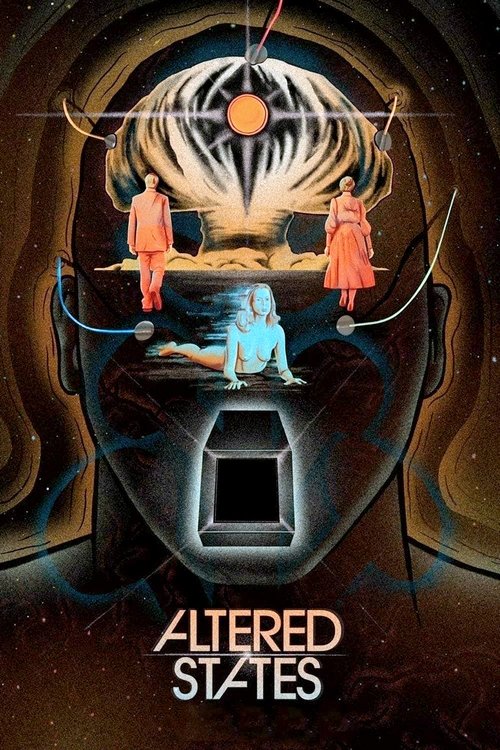
Altered States
1980 · Ken Russell
When you're craving something wild — a midnight-movie mind-melter to watch loud and in the dark, ideally with someone to gasp at it with. Challenge and spectacle, not a chill watch.
What it's about
Eddie Jessup, a driven Harvard scientist, becomes convinced that other states of consciousness are as real as waking life — and that he can reach them by combining a sensory-deprivation tank with a powerful hallucinogen learned from a Mexican tribal ritual. As his experiments go deeper, the trips stop staying inside his head, threatening his body, his sanity, and the marriage he's half-abandoned for the work.
The experience
A head trip in the most literal sense: dense, rapid-fire scientific argument suddenly detonating into some of the most feverish hallucination sequences ever put on film. It's overwhelming by design — talky, then terrifying, then strangely moving.
Performances
William Hurt, in his screen debut, makes Jessup's arrogance magnetic — a man you believe would gamble his own humanity on an idea.
The craft
The collision of Paddy Chayefsky's overlapping, machine-gun dialogue with Ken Russell's anything-goes visual delirium gives the film a texture like nothing else — cerebral and unhinged at once. The hallucination sequences and body-warping effects remain jaw-dropping, and the convulsive score and sound design demand good speakers and a big screen.
Why it matters
A famous case of author and director at war — Chayefsky disowned it — yet it launched William Hurt, pushed studio effects spectacle into genuinely psychedelic territory, and became a cult touchstone for science-fiction body horror.
Snapshot
Altered States is the rare studio picture that fuses the verbal density of Paddy Chayefsky with the delirium of Ken Russell — a collision so volatile that its author disowned the result. Adapted by Chayefsky from his own 1978 novel (his only one), it follows Dr. Eddie Jessup, a Harvard psychophysiologist who combines a sensory-deprivation isolation tank with a hallucinogen sourced from a Mexican Indian tribe, and proceeds to regress — psychically, then physically, then molecularly — toward what he believes is the irreducible ground of consciousness and the origin of being. The film yokes a New Hollywood pedigree to an emergent 1980s effects spectacle and to William Hurt's screen debut, producing a work that is at once a science-fiction body-horror, a domestic drama about a failing marriage, and a metaphysical argument staged as a freakout. Its reputation rests less on box-office than on its singular intensity and the influence its transformation imagery exerted on the consciousness-horror that followed.
Industry & production
The project carried unusual authorial weight for a genre film because Chayefsky — two-time and ultimately three-time Oscar winner for Marty, The Hospital, and Network — controlled it. He adapted his novel himself and, with his longtime producing partner Howard Gottfried, set it up at Warner Bros. as a major studio production. Arthur Penn was initially attached to direct and departed; Ken Russell, the British provocateur of The Devils, Women in Love, and Tommy, replaced him. That substitution defined the film. Chayefsky's method depended on naturalistic, overlapping, rapid-fire dialogue delivered with precise rhythm; Russell's sensibility was baroque, hyperbolic, and image-driven. The clash over how the dialogue was staged and performed led Chayefsky to repudiate the picture and to take his screenplay credit under the pseudonym "Sidney Aaron" (his actual given and middle names). The episode is among the better-documented author-director ruptures of the era, though the full granular record of who changed what on set is thinner than the legend implies, and accounts of it largely descend from Chayefsky's and the production's own framing.
The casting reflected the film's split between prestige drama and spectacle. Hurt, drawn from the New York stage, anchors it; Blair Brown plays his wife and intellectual sparring partner, with Bob Balaban and Charles Haid as colleagues. The cast also included a very young Drew Barrymore in an early screen appearance as one of the Jessup children. Warner Bros. released the film in December 1980.
Technology
Altered States sits at a hinge in effects history — late enough to attempt fully immersive subjective hallucination, early enough that it was achieved overwhelmingly through optical and in-camera means rather than the digital tools that arrived a decade later. The hallucination passages required a battery of techniques: optical compositing, animation, slit-scan-adjacent abstraction, projection, prosthetic and makeup transformation, and elaborate lighting. The transformation makeup falls within the lineage of Dick Smith, the era's preeminent makeup effects artist; the film belongs to the same early-1980s moment that produced the landmark practical transformations of The Howling and An American Werewolf in London. The exact division of labor among the effects houses and artists who worked on the picture is recorded unevenly across sources, and I won't assign specific shots to specific hands where the credit is not clear. What matters technologically is the ambition: the film tried to render altered consciousness as a continuous sensory environment rather than a montage of inserts, and it did so on the cusp before computer imaging made such rendering routine.
Technique
Cinematography
The photography, by Jordan Cronenweth — working immediately before his career-defining Blade Runner — is central to the film's effect. Cronenweth's gift for sculpting darkness and for expressive, motivated light is everywhere in the tank sequences and the laboratory scenes, where pools of light isolate figures against engulfing black. The visual scheme draws a hard line between the cool, clinical naturalism of the academic and domestic worlds and the saturated, unmoored imagery of the trips, so that the descent into Jessup's mind reads as a stylistic rupture as much as a narrative one.
Editing
The cutting carries the film's argument about the dissolution of stable reality. The hallucination sequences are assembled associatively — religious iconography, sacrifice, desert landscapes, and primal forms colliding in rapid succession — against a baseline of conventional dramatic coverage in the dialogue scenes. The contrast is the point: the editing keeps the audience oriented in Jessup's marriage and career precisely so that the trip sequences can shatter that orientation.
Mise-en-scène / staging
Russell stages the talk-heavy scenes with a restlessness that pushes against Chayefsky's text, and stages the visionary material with full theatrical excess. The recurring imagery — the isolation tank as womb and tomb, crucifixion and ritual sacrifice, the regressed proto-human loose in an urban night, the final implosion of matter — is rendered with the iconographic boldness Russell brought from his religiously charged earlier work. The settings themselves (lab, lecture hall, apartment, the tank room) are everyday; what Russell does is detonate the ordinary from within.
Sound
Sound design is one of the film's most aggressive instruments, and it was recognized in the film's awards profile. The roar and muffle of the tank, the layering of voices, and the integration of effects with John Corigliano's score build the subjective interior. The film's sound work earned Academy recognition (a Best Sound nomination), consistent with how integral the aural environment is to selling the hallucinations.
Performance
Hurt's debut performance establishes the persona that would define his early career: cerebral, intense, emotionally withholding. He has to make a man credible who treats his own annihilation as a research problem, and he plays Jessup's monomania straight, which lets the film's metaphysics land as character rather than lecture. Brown grounds the film emotionally as the wife who insists that love, not regression, is the meaningful frontier; the marriage furnishes the film's human stakes. Balaban and Haid supply the skeptical scientific chorus. Notably, the performances became the flashpoint of the Chayefsky–Russell dispute, since the delivery of the dialogue was exactly where author and director could not be reconciled.
Narrative & dramatic mode
The film operates in two registers that it never fully fuses, by design or by friction. One is the Chayefskyan drama of ideas: dense, articulate people arguing about God, self, and meaning across a disintegrating marriage, in the tradition of The Hospital and Network. The other is the horror-spectacle of literalized metaphor, in which an intellectual's search for the ground of being becomes a physical mutation. The structure is a descent — each tank session takes Jessup deeper and renders the regression more bodily, escalating from subjective vision to objective transformation, until the abstraction threatens to consume him entirely. The resolution turns on a reversal Chayefsky's rationalist surface might seem to resist: it is human love, Emily's refusal to let Eddie dissolve, that pulls him back from the void. The drama is finally about whether meaning is to be found at the bottom of consciousness or in the bond between two people.
Genre & cycle
Altered States is a genuine hybrid — science fiction in premise, horror in execution, and a marital melodrama at its core. It belongs to the early-1980s cycle of transformation horror that prized elaborate practical metamorphosis, while reaching back to the "scientist who goes too far" lineage that runs from Frankenstein through the atomic-age mutation films. Thematically it is closer to the consciousness-and-cosmos strain of post-2001 science fiction than to the hardware-driven SF that Star Wars had recently made dominant. It is, in that sense, slightly out of step with its moment: a heady, interior, ideas-first genre film arriving as the blockbuster era was standardizing spectacle.
Authorship & method
The film is the product of two authors at war. Paddy Chayefsky supplied the intellectual architecture — the obsession with God, regression, and the self that he had been circling in Network — and the verbal texture, then disowned the execution and hid behind the "Sidney Aaron" credit. Ken Russell supplied the body: the operatic religious imagery, the willingness to push performance and visuals to extremity, the conviction that metaphysics should be staged as sensory assault. The tension between Chayefsky's word and Russell's image is not a flaw the film overcomes so much as the engine that makes it distinctive.
Among the key collaborators, composer John Corigliano — a major figure in American concert music — wrote what was, remarkably, among his earliest film scores; its modernist astringency and force earned an Academy Award nomination and stands as one of the most ambitious genre scores of its era. Cinematographer Jordan Cronenweth brought the chiaroscuro control he would carry directly into Blade Runner. The makeup and transformation work places the film within the Dick Smith school of effects artistry that dominated the period. The combined result is a film whose authorship is genuinely plural and contested, which is itself part of its meaning.
Movement / national cinema
The picture sits at a transatlantic junction. It is an American studio film, financed and released by Warner Bros., rooted in a distinctly American screenwriting tradition. But it was directed by one of the most flamboyant figures of postwar British cinema, and it bears the unmistakable imprint of Russell's career-long fascination with religious ecstasy and bodily transgression. It is best understood not as the product of a movement but as a late, anomalous flowering of New Hollywood's appetite for serious genre filmmaking — auteur-driven, idea-laden, effects-forward — at the precise moment that sensibility was being eclipsed.
Era / period
Released at the end of 1980, Altered States is a threshold film. It looks back to the 1970s in its literate seriousness and its New Hollywood pedigree, and forward to the 1980s in its commitment to immersive practical effects. The counterculture's interest in expanded consciousness — isolation tanks, psychedelics, the search for transcendence through altered perception — had by 1980 curdled into something more ambivalent, and the film registers that shift: it takes the consciousness quest with total seriousness while treating it as potentially annihilating. It arrives just before digital effects would transform how such interior states could be visualized, making it a high-water mark of the optical era's attempt at the same.
Themes
At its center is the question of where meaning resides. Jessup believes the truth lies at the bottom of consciousness — in the original self, the first matter, the moment before differentiation — and pursues it as a kind of secular mysticism, with religious imagery flooding his visions. The film stages this as scientific hubris in the Frankenstein mode: the rationalist who mistakes self-dissolution for discovery. Against this it sets love and human attachment as the genuine, livable frontier, embodied in the marriage. Faith, the self, regression and evolution, and the body as the unstable record of all that — these are its recurring preoccupations. The film refuses to fully endorse either the mystic's quest or the rationalist's skepticism, leaving its metaphysics deliberately unresolved beneath a melodramatic rescue.
Reception, canon & influence
Contemporary reception was mixed but engaged, and the film generated more debate than its commercial profile alone would explain — driven partly by the spectacle of Chayefsky's public disavowal and partly by the sheer audacity of the imagery. Its strongest institutional recognition came in the technical and musical categories, with Academy Award nominations including John Corigliano's score; the film's sound work was likewise singled out. I'll avoid citing specific box-office figures, as the precise numbers and their interpretation vary across sources.
Looking backward, the film draws on a deep substrate: the consciousness research and isolation-tank experiments associated with the era's interest in expanded perception; the metaphysical science fiction descended from 2001: A Space Odyssey; the mad-scientist horror tradition; and Chayefsky's own thematic territory from Network. Russell brought the religious-ecstatic visual vocabulary of his earlier British work.
Looking forward, Altered States became a touchstone for consciousness-horror and for films that render altered perception as immersive, threatening environment — its DNA is visible in the subjective-horror lineage that includes work like Jacob's Ladder and the cosmic-dread strain of films such as Event Horizon. Its imagery of the body as the site of metaphysical breakdown fed the practical-transformation tradition that flourished through the 1980s. Hurt launched a major career from it; Corigliano went on to one of the most decorated careers in American concert and film music; Cronenweth carried his palette into Blade Runner. The film has been widely quoted and parodied in later popular culture, a sign of how thoroughly its tank-and-transformation iconography entered the collective image-bank. Its enduring standing is that of a magnificent anomaly — the moment a great screenwriter's argument about God and the self was handed to a director temperamentally bound to turn argument into delirium, and the seam between them never closed.
A Deleuzian reading
A man floats in a steel tank of black water, sealed from light and sound, and goes looking for the bottom of his own mind.
The full Deleuzian reading of Altered States →
Reception
Landed in 1980 as a noisy curiosity — critics split between 'visionary' and 'ridiculous', and its own screenwriter publicly disowned it. Decades of midnight screenings and psychedelic-cinema lists have since turned it into a beloved cult trip movie.
How Altered States was received, from release to now →
Influences: the films it descends from and the films it influenced
- 2001: A Space Odyssey (1968) — The Star Gate sequence's model for rendering expanded consciousness as immersive abstract light-and-form montage rather than dialogue, the template for Russell's hallucinatory regression trips.
- The Devils (1971) — Russell's own operatic religious-ecstatic visual grammar — crucifixion and ecstasy imagery staged as transgressive sensory assault — carried directly into the film's regression visions.
- Network (1976) — Chayefsky's architecture of sustained rhetorical monologue circling God, the self, and human regression supplies the verbal/intellectual substrate Russell then overwhelms with image.
- Dr. Jekyll and Mr. Hyde (1931) — The subjective first-person POV camera during a scientist's chemical self-transformation establishes the device of staging metamorphosis from inside the experimenter's perception.
- The Exorcist (1973) — Dick Smith's prosthetic makeup translating metaphysical violation into literal bodily deformation — the same effects school and artist tradition that builds Hurt's regressions.
- Forbidden Planet (1956) — The 'monsters from the id' conceit: a scientist's expanded mind externalizing the unconscious as a literal lethal force, prefiguring the proto-human the tank releases.
- Videodrome (1983) — Hallucination rendered as an immersive, threatening bodily environment, extending the conceit of the flesh itself as the site of metaphysical breakdown.
- The Fly (1986) — The scientist whose self-experiment collapses into a step-by-step practical-effects bodily metamorphosis, the Dick Smith–school transformation cycle pushed to its decade's peak.
- Jacob's Ladder (1990) — Subjective-horror design rendering a destabilized, possibly hallucinated perception as immersive environmental threat — the consciousness-horror lineage the film seeded.
- Event Horizon (1997) — The cosmic-dread strain: an experimental apparatus that breaches into metaphysical horror, inheriting the idea of scientific transgression opening onto annihilating otherness.
- Enter the Void (2009) — Sustained first-person subjective rendering of drug-altered consciousness as immersive abstract light-environment, the trip-sequence aesthetic taken to feature length.
- Beyond the Black Rainbow (2010) — Isolation-tank and sensory-deprivation consciousness experiments staged as analog psychedelic delirium, directly reworking the film's tank-and-research iconography.
- Annihilation (2018) — The body as site of cosmic transformation conveyed through associative, abstract imagery, extending the descent-into-dissolution structure and practical-meets-uncanny effects.
- Mandy (2018) — Inherits Russell's delirium directly — metaphysics staged as saturated, hallucinatory chiaroscuro sensory assault, image privileged over exposition.
- Requiem for a Dream (2000) — Russell established the precedent for rendering chemically altered states as full optical transformations of the mise-en-scène — environments that warp and reconstitute according to the protagonist's neurological state — which Aronofsky's expressionist set manipulation and snorricam sequences continue as a systematic formal project.
- Doctor Strange (2016) — The hallucinatory 'astral push' sequence, in which the hero is flung through violent, body-warping psychedelia, echoes Russell's sensory-deprivation freak-outs as a model for rendering mystical experience as physical assault.
- Sunshine (2007) — Model for the sublime rendered as an assault on the celluloid itself — flash-frame montage, chemical over-saturation and solarised light dissolving a scientist's body — the photochemical vocabulary Boyle deploys for Capa's final approach to the surface.
- Queer (2024) — Source of the ritual-hallucinogen set piece in which two bodies optically merge and separate; Queer's yagé sequence restages that effect with photochemical superimposition instead of digital morphing.
- Blade Runner (1982) — Jordan Cronenweth carried his exact chiaroscuro control — hard shafting key lights raking through smoke and darkness — straight from this shoot into Scott's film.
- An American Werewolf in London (1981) — Rick Baker's practical transformation makeup as on-camera set-piece spectacle, the same early-'80s prosthetic-metamorphosis tradition treating the changing body as the main effect.
- Brainstorm (1983) — Technology that records and plays back raw subjective consciousness, staging interior perceptual experience as an immersive first-person sensory format.
- Possession (1981) — Performance pushed to operatic physical extremity as the vehicle for metaphysical and bodily breakdown — the actor-as-sensory-assault method that drives Hurt's and Brown's scenes.
Similar films
- Videodrome (1983) — influence & lineage
- Mandy (2018) — influence & lineage
- Annihilation (2018) — influence & lineage
- 2001: A Space Odyssey (1968) — influence & lineage
- The Fly (1986) — influence & lineage
- Jacob's Ladder (1990) — influence & lineage
- The Exorcist (1973) — influence & lineage
- The Devils (1971) — influence & lineage · often watched together
All the films related to Altered States →
Watch it with: curated runs of related films
- The Grotesque Sublime — Watch these when you want cinema that pushes the body to hallucinatory, grotesque extremes — each a lurid transformation, half ecstasy and half horror, that dares you to keep looking.