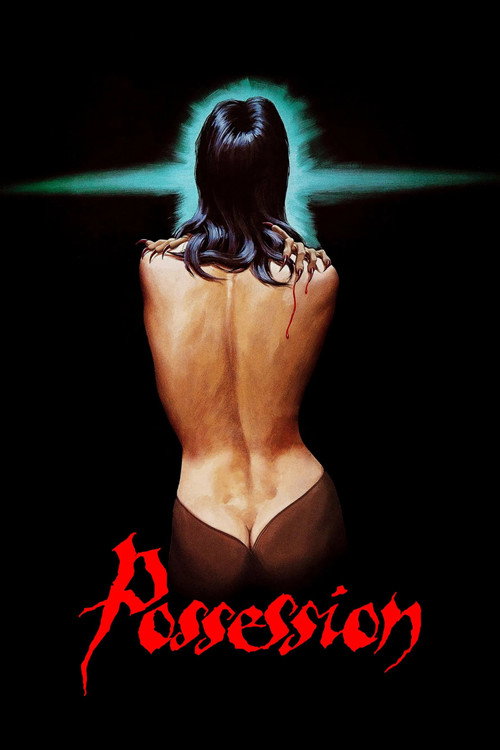
Possession
1981 · Andrzej Żuławski
For when you want to be genuinely destabilized — not a cozy scare but a plunge. This is challenge viewing for adventurous nights, ideal if you like horror that's really about heartbreak.
What it's about
In a gray, walled-in Cold War Berlin, a man comes home to find his wife wants out of the marriage — and no explanation he can extract makes sense. He starts following her, expecting a lover, and instead uncovers a secret life stranger and more terrifying than any affair. What begins as a divorce drama tips, scene by scene, into full-blown horror.
The experience
Overwhelming — everyone plays at a pitch of hysteria most films never touch, and the movie keeps escalating past every point where you think it can't. It's frightening, exhausting, weirdly moving, and unlike anything else; you come out shaken and slightly rewired.
Performances
Isabelle Adjani gives one of the most ferociously committed performances ever filmed — her convulsive solo scene in a subway underpass is legend — and it won her Best Actress at Cannes. Sam Neill matches her with wild-eyed abandon far from anything he's done since.
The craft
Żuławski's camera never stops moving, circling and lunging at the actors until domestic arguments feel like exorcisms, and the practical creature effects are by design master Carlo Rambaldi. Cold blue Berlin light and the ever-present Wall make the whole city feel like part of the marriage.
Why it matters
Banned in Britain as a 'video nasty' and dismissed for years, it's been reclaimed as a cult masterpiece and a touchstone for filmmakers who treat emotional extremity as its own genre.
Snapshot
Possession is a film of domestic rupture pushed past the breaking point of realism — a divorce drama that mutates, scene by scene, into body horror, espionage thriller, and metaphysical allegory. Andrzej Żuławski, a Polish director working in exile in West Berlin, transmuted the wreckage of his own marriage into a delirious account of a couple, Mark (Sam Neill) and Anna (Isabelle Adjani), whose separation detonates into hysteria, doubling, and the literal birth of a monster. The film is best known today for two things: Adjani's almost unwatchably committed performance, which won her Best Actress at the 1981 Cannes Film Festival and a César the following year, and the so-called "subway scene," a convulsive solo set-piece in which Anna miscarries — or gives birth to — something unnameable. Banned in Britain as a "video nasty," cut by more than forty minutes for its US release, and long available only in degraded form, Possession has been progressively rehabilitated into one of the canonical art-horror objects of its era. It sits at the intersection of the European auteur tradition and the genre extremity of the late 1970s and early 1980s, refusing to be domesticated by either.
Industry & production
Possession was a West German–French co-production, shot in West Berlin in 1980 and released in 1981. Żuławski had effectively been driven out of Polish cinema: his ambitious science-fiction epic On the Silver Globe was forcibly shut down by the Polish authorities in 1977, mid-production, an act of state censorship that left him without a domestic future. Possession was made in the West, in English, with an international cast, as the work of a stateless auteur reassembling a career abroad. The Berlin setting was not incidental — the production used the divided city, the Wall a recurring presence in the frame, as both location and metaphor.
The casting paired Adjani, by then a major French star coming off Truffaut's The Story of Adèle H. and Herzog's Nosferatu, with the New Zealand–born Sam Neill, then early in his international career. The creature effects were entrusted to Carlo Rambaldi, the Italian effects artist who had worked on Alien and would shortly design E.T.; his tentacled, evolving creature is the film's literal monster. Precise budget and box-office figures for the original release are not something I can state reliably, and the film was not a commercial success in its initial run; its reputation was built slowly, through festival prestige, censorship notoriety, and later restoration rather than first-run returns.
Technology
Technically, Possession belongs to the era of mobile, lightweight 35mm shooting that made Żuławski's signature restlessness possible. The cinematography by Bruno Nuytten depends on a camera that never settles — handheld and fluid moves that orbit and chase the actors through apartments, corridors, and streets. The creature, as noted, was a practical Rambaldi build, an animatronic and articulated effect rather than an optical or early digital one, consistent with the state of the art in 1980. Beyond this, the film's "technology" is largely the technology of performance and staging rather than of spectacle: there is no reliance on novel processes, and the horror is achieved through physical effects, the actors' bodies, and editing rather than through technical innovation per se. Where the record on specific equipment is thin, I won't manufacture detail.
Technique
Cinematography
Bruno Nuytten — later the director of Camille Claudel — gives Possession a camera that behaves like an anxious participant rather than an observer. The framing is wide-angle and close, distorting domestic interiors into pressurized boxes; the camera circles the actors, swings to follow sudden movement, and refuses the stabilizing grammar of shot-reverse-shot. Cool blues and greens dominate the palette, a chilly municipal modernity that matches the East/West Berlin geography and drains the film of warmth. The visual style is inseparable from the performances: the roving lens amplifies the actors' physical extremity, never granting the viewer a safe, settled vantage. The Wall and the bleached, depopulated cityscape recur as compositional motifs, locating private catastrophe inside a divided political body.
Editing
The cutting (credited to Marie-Sophie Dubus, with Suzanne Lang-Willar) sustains a tempo of escalation rather than relief. Scenes are built to crescendo, and the film tends to hold on hysteria longer than comfort allows, then cut on a spasm of movement. The rhythm contributes to the sense that the narrative is metastasizing — that each confrontation is a worse version of the last. Crucially, the editing does not "explain": the espionage subplot, the doubling, and the supernatural elements are juxtaposed without connective tissue, so that the film's logic feels associative and dreamlike rather than causal.
Mise-en-scène / staging
Staging is where Possession is most radical. Żuławski directs his actors to a register of operatic excess — bodies thrashing, collapsing, contorting, voices breaking into screams and laughter within a single line. The apartments are sparse, modern, and cold, stages for human breakdown rather than lived-in homes. The most famous instance, the subway corridor sequence, is pure physical staging: Adjani alone in a tiled underpass, flailing against the walls, spilling milk and blood, convulsing through what the film presents as both miscarriage and demonic parturition. The choreography of hysteria is the film's defining technique, and it is deliberately anti-naturalistic.
Sound
Andrzej Korzyński, Żuławski's longtime composer, provides a score that veers between plaintive, almost lullaby-like motifs and dissonant agitation, often undercutting the on-screen horror with an eerie tenderness. The sound design foregrounds the human voice in its most strained registers — the film is loud with screaming, gasping, and broken speech. The disjunction between Korzyński's sometimes gentle themes and the brutality of the images is part of the film's destabilizing strategy.
Performance
Performance is the film's engine. Adjani operates at a level of physical and emotional abandon that has become legendary; her work here is frequently cited as one of the most extreme performances in art cinema, and she reportedly described it as deeply damaging to undertake — a claim widely repeated, though I'd treat the specifics of her own later statements with the caution due to oft-paraphrased anecdotes. She plays effectively two roles: Anna, the disintegrating wife, and Helen, Anna's serene green-eyed double, a schoolteacher who is the wife's uncanny inverse. Sam Neill matches her with a jagged, twitching intensity as Mark, the husband whose jealousy curdles into something unhinged. The supporting cast — including Heinz Bennent as Anna's effete lover Heinrich — sustains the heightened pitch.
Narrative & dramatic mode
The dramatic mode is allegory disguised as thriller. On its surface, Possession tracks a marital breakdown: Mark returns from some unspecified intelligence work to find Anna determined to leave him, and he begins to investigate her affair. But the investigation dissolves the genre it appears to inhabit. The "other man" turns out to be only the most banal of Anna's secrets; the real revelation is a creature she is nurturing in a derelict apartment, a monstrous lover that evolves, across the film, toward a duplicate of Mark himself. The doubling structure — Anna and Helen, the creature and Mark — turns the narrative into a hall of mirrors about faith, doubt, and the impossibility of knowing another person. The espionage frame is left deliberately unresolved, less a plot than an atmosphere of surveillance and bad faith. The film's mode is expressionist and symbolic; literal coherence is sacrificed to emotional and metaphysical truth.
Genre & cycle
Possession is a hybrid that resists clean classification. It is marketed and remembered as horror, and its body-horror and monster elements place it within that genre's early-1980s ferment. But it also draws on the European art film, the marital-breakdown drama (one thinks of Bergman's Scenes from a Marriage turned inside out), and the Cold War spy thriller. Within horror history it belongs to a small cycle of "art-horror" or extreme-arthouse films that used genre as a vehicle for serious aesthetic and philosophical ambition. Its notoriety as a banned "video nasty" in Britain also ties it, somewhat unfairly, to the exploitation cycle of that censorship panic — a context that obscured its art-cinema pedigree for years.
Authorship & method
Possession is overwhelmingly an auteur's film. Żuławski wrote and directed it, drawing openly on the collapse of his own marriage; the film is widely read as autobiography refracted through nightmare. His method is famous for demanding total physical and emotional commitment from his actors, directing them toward exhaustion and abandon. He worked here with a tight circle of collaborators that recurs across his filmography: composer Andrzej Korzyński, his longtime musical partner, gives the film its uncanny score. The English-language dialogue was developed with the American novelist Frederic Tuten, whose involvement helped shape the film's sometimes stilted, declamatory English — a quality some read as a flaw and others as part of its alienated texture. Bruno Nuytten's camerawork and the editing by Marie-Sophie Dubus translate Żuławski's hysteria into a coherent visual rhythm. Carlo Rambaldi's creature externalizes the film's psychology. The authorship is singular, but the realization depended on these specific collaborators.
Movement / national cinema
Possession is difficult to assign to a single national cinema, which is itself revealing. Żuławski was a Polish director, formed in part under and against the constraints of the People's Republic and shaped by his association with the Polish cinema of the 1960s and 70s. But Possession is a film of exile, made in West Berlin with French and German money, in English, by a director cut loose from his home industry. It thus belongs to a transnational European art cinema rather than to any one movement. Its Berlin setting, with the Wall ever-present, ties it to a body of Cold War cinema preoccupied with division and surveillance. One can read the film's themes of doubling, betrayal, and ideological exhaustion as displaced commentary on the political condition that exiled its maker — though Żuławski resisted reducing the film to allegory, and the political reading should be held as one layer among several.
Era / period
The film is a creature of the turn from the 1970s to the 1980s — a moment when European auteur cinema and genre extremity briefly converged. It arrives after the high modernism of the 1960s and 70s art film and alongside the body-horror experiments of Cronenberg and the special-effects renaissance that produced Alien and The Thing. Its Cold War Berlin is the Berlin of the late détente period, a frozen geopolitical landscape. The censorship history that engulfed it — the British "video nasty" panic of the early 1980s — is itself a period marker, the product of a specific moral and regulatory moment around the new technology of home video.
Themes
At its core, Possession is about the violence of intimacy and the terror of not knowing another person. Marriage and divorce are rendered as cosmic catastrophe. Faith and doubt run through the film as an explicitly metaphysical concern — Anna's monologues invoke God, sister-and-brother dualities of "good" and "evil," and the search for absolute belief; the creature can be read as the monstrous offspring of misplaced faith. The doppelgänger is the organizing image: every figure has a double, every self a shadow, and identity is shown to be unstable and divisible. Critics working in the tradition of Barbara Creed's "monstrous-feminine" have read Anna's creature-birth as an extreme figuration of male horror at female autonomy and reproductive power, though that is an interpretive frame applied to the film rather than a stated authorial intent. Political division, surveillance, and ideological bad faith form a persistent undertone, mapped onto the divided city.
Reception, canon & influence
Initial reception was sharply divided. Adjani's performance was honored at Cannes in 1981 with the Best Actress prize and at the Césars; the acting was acknowledged even by viewers repelled by the film. But Possession was also widely misunderstood, dismissed by some as incoherent or gratuitous, and it suffered grievous distribution damage: the US release was cut down drastically (by roughly forty minutes, reportedly recut to foreground the horror), and in Britain it was caught in the video-nasty censorship dragnet and effectively banned for years. These mutilations delayed serious critical reckoning.
Looking backward, the film's influences include the marital chamber dramas of European modernism (Bergman an inevitable reference point), the doppelgänger tradition in literature and Expressionist cinema, and the metaphysical-horror lineage; Żuławski's own On the Silver Globe and his earlier work establish the personal stylistic continuity. Looking forward, Possession has become a touchstone for a generation of filmmakers and critics drawn to art-horror and to extremity in performance. It is regularly cited in discussions of the "monstrous-feminine," invoked by contemporary horror directors, and its subway sequence has entered the canon of celebrated single-scene tours de force. Restorations and a full-length re-release rehabilitated the film's reputation, moving it from cult curio toward recognized art-cinema landmark. Its precise line of influence on individual later films is often asserted loosely, so specific attributions should be made carefully; what is securely established is that Possession endures as the defining example of how genre horror can be bent entirely to the purposes of a singular, autobiographical, and metaphysically ambitious auteur.
A Deleuzian reading
Start with the corridor.
The full Deleuzian reading of Possession →
Reception
Butchered by ~40 minutes and sold as schlock horror in the US, banned in the UK as a 'video nasty' — then decades later rediscovered uncut and canonized, with sold-out repertory runs and a full-blown 2020s revival as THE cult art-horror object.
How Possession was received, from release to now →
Influences: the films it descends from and the films it influenced
- The Third Part of the Night (1971) — Żuławski's debut codifies the restless handheld camera that chases actors through space and the directing-to-exhaustion method that Possession refines into Adjani's full-body collapse.
- The Devil (1972) — Establishes the operatic-hysteria register — performers convulsing, screaming, lurching — as a deliberate stylistic system rather than excess, the same pitch Possession sustains feature-length.
- On the Silver Globe (1988) — The roving, near-vertiginous camera prowling around declaiming actors directly prefigures Possession's spatial restlessness and stilted, incantatory English delivery.
- Persona (1966) — The merging/doubling of two women's faces and identities is the modernist doppelgänger grammar Possession reworks via Adjani's dual role as wife and idealized double.
- Scenes from a Marriage (1973) — Anatomizes a marriage's collapse through long, escalating two-hander confrontations in domestic rooms — the chamber-drama skeleton Possession detonates into horror.
- Repulsion (1965) — Wide-angle lensing that warps an apartment into a hostile, swelling space tracking a woman's psychic disintegration is the exact distortion technique Possession applies to its Berlin flat.
- Rosemary's Baby (1968) — Routes body-horror and monstrous gestation through marital paranoia inside the home, modeling how domestic intimacy itself becomes the horror's stage.
- The Exorcist (1973) — Żuławski demands that Isabelle Adjani execute extreme physical contortion and visceral abasement in naturalistic domestic and subway settings, directly inheriting the possessed-body performance mode Linda Blair originated — clinical European staging of body horror in an ordinary apartment rather than a genre-coded environment.
- Hour of the Wolf (1968) — Żuławski extends art-horror into a convulsive register by pushing performers to physical and vocal breakdown through rehearsal-intensive methods that parallel Bergman's repertory company approach, while studio-constructed West Berlin serves as an expressionist externalization of psychic dissolution — the island transformed into a city that physically manifests the couple's psychopathology.
- 3 Women (1977) — Żuławski extends 3 Women's use of extreme physical performance as the register for female identity disintegration: Adjani's bodywork in the subway tunnel sequence takes the physical-transformation/comic-pathetic mode of Duvall's Millie — humiliation made physical — to its maximum expressive intensity, where the body itself becomes the site of psychic replacement.
- The Tenant (1976) — Berlin-apartment art-horror of identity and marital disintegration, pushing The Tenant's erosion of a single self into hysterical performance and literal bodily doubling.
- The Devils (1971) — Pushes possession-hysteria into extreme full-body performance (Adjani's subway convulsion), extending Redgrave's contorted ecstasy into pure physical derangement.
- Antichrist (2009) — A couple's grief curdles into the woman's sexual-violent abandon and self-mutilation as monstrous-feminine — the most direct heir to Possession's performance extremity and marital nightmare.
- Black Swan (2010) — Charts a woman's psychic split through a dual role and literal bodily metamorphosis driven by physical-performance abandon, inheriting Adjani's body-as-site-of-horror.
- mother! (2017) — Locks a handheld camera to a single overwhelmed woman while the household escalates into operatic hysteria, replicating Possession's tempo of mounting domestic apocalypse.
- Climax (2018) — Roving, unbroken handheld camerawork drives an ensemble into escalating bodily abandon; Noé openly claims Żuławski as a touchstone for this hysteria-by-movement.
- Hereditary (2018) — Builds domestic art-horror on a mother's performance pushed to hysterical, contorted extremity (Collette), extending Possession's model of acting-as-rupture.
- Saint Maud (2019) — Stakes an entire art-horror on one actress's religious-ecstatic physical abandon and self-abnegation, the single-body tour de force Possession pioneered.
- Titane (2021) — Pushes monstrous-feminine body-horror through abjection and metamorphosis of a transgressive female body, carrying Possession's fusion of the maternal and the grotesque.
- Die My Love (2025) — Channels marital and maternal collapse into hysterical, full-body physical performance, using the apartment as an arena for bodily extremity and animal abjection.
- The Substance (2024) — Exaggerated Foley design that amplifies tearing, fluid, and visceral bodily sounds to an unbearable register; extreme physical performance of female breakdown rendered through sound as much as image, treating the body's acoustics as a site of horror.
- Irreversible (2002) — Convulsive untethered handheld that pursues bodies in hysteria through real locations — a forerunner of Debie's vertiginous, gravity-defying unmoored camera.
- Kotoko (2011) — Maternal hysteria performed at full convulsive physical extremity (Adjani's subway breakdown), the body-thrown-against-walls acting mode Cocco channels.
- Suspiria (2018) — Cold-War-Berlin body horror in which psychic anguish erupts as convulsive, dancer-like contortion; Jalet's rupturing 'Volk' movement descends directly from Adjani's subway spasm.
- The Brood (1979) — Externalizes the rage of a disintegrating marriage as literal monstrous offspring — the same gambit as Rambaldi's creature, the monstrous-feminine born directly from divorce.
- Don't Look Now (1973) — Associative, premonitory cross-cutting that fractures a grieving couple's chronology supplies the editing-by-juxtaposition logic Possession uses to bind dread across scenes.
- Inland Empire (2006) — Dissolves a woman into multiplying doppelgänger identities via associative, non-linear juxtaposition, sharing Possession's grammar of the splitting female self.
- Eraserhead (1977) — Żuławski's film shares Eraserhead's expressionistic performance mode — actors calibrated between near-catatonic stillness and extreme physical convulsion — and its central structural move of externalizing psychological breakdown as a literal body-horror object that colonizes domestic space, making the apartment and the creature interchangeable as projections of the protagonist's dissolution.
- Nosferatu the Vampyre (1979) — Isabelle Adjani, who plays Lucy Harker in Nosferatu, immediately extended the mode of total physical self-surrender she had developed there; Bruno Nuytten's handheld low-light cinematography and Żuławski's duration-extended horror sequences continue the same horror–art-cinema hybrid register across a direct line of collaboration.
- Nosferatu (2024) — The benchmark for somatic interiority as full-body performance — Adjani's convulsive, self-shattering physicality is the lineage behind Lily-Rose Depp's spasming, trance-state acting.
- Videodrome (1983) — Pairs Carlo Rambaldi's tentacular creature with extreme performance of bodily abjection, rendering a prop-as-living-body lover that rhymes with Videodrome's breathing television and fleshy cassette.
- The Lighthouse (2019) — The two-hander built on violently clashing performance registers — naturalism colliding with operatic hysteria — that legitimizes Dafoe and Pattinson playing in incompatible keys.
- Altered States (1980) — Performance pushed to operatic physical extremity as the vehicle for metaphysical and bodily breakdown — the actor-as-sensory-assault method that drives Hurt's and Brown's scenes.
- Lost Highway (1997) — Hysterical identity-splitting and doppelgängers staged inside an uncanny domestic apartment, sharing Lynch's marriage-as-horror register.
Similar films
- Repulsion (1965) — influence & lineage · often watched together
- Titane (2021) — influence & lineage · often watched together
- Climax (2018) — influence & lineage · often watched together
- Antichrist (2009) — influence & lineage · often watched together
- Rosemary's Baby (1968) — influence & lineage
- Mulholland Drive (2001) — same viewing thread
- Persona (1966) — influence & lineage · often watched together
- Melancholia (2011) — often watched together
All the films related to Possession →
Watch it with: curated runs of related films
- Doubles, Dreams, and Dissolving Selves — Watch these when you want the floor to give way — dream machines, hypnotists, doppelgängers, and haunted houses where perception and identity quietly come undone.