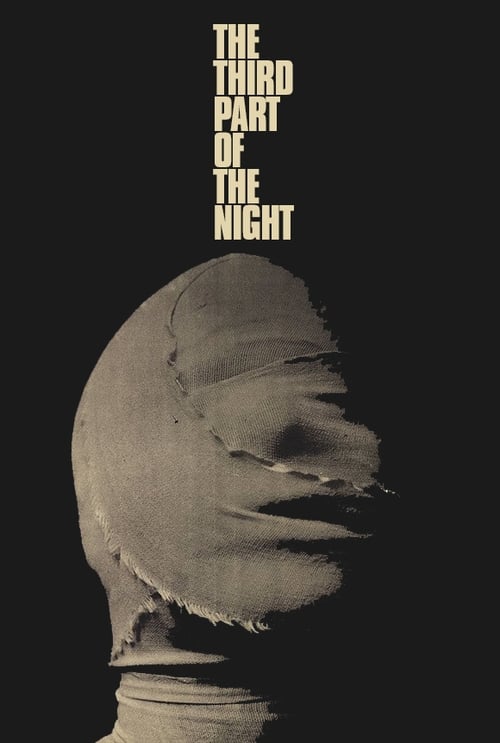
The Third Part of the Night
1972 · Andrzej Żuławski
When you're craving extremity — a film that grabs you by the collar and doesn't explain itself. Strictly a challenge watch: reach for it when you want to be overwhelmed and to spend days piecing together what you saw.
What it's about
In Nazi-occupied Poland, Michał survives the massacre of his mother, wife, and young son, and stumbles into a borrowed second life: he takes shelter working at a typhus-vaccine institute, where men feed lice on their own blood — a real wartime job that came with papers protecting you from deportation. Then he meets Marta, a pregnant stranger who is the exact double of his dead wife, and the war around him starts to warp into a fever of repetitions, doubles, and apocalyptic omens drawn from the Book of Revelation.
The experience
Frantic, feverish, and disorienting by design — the camera careens, scenes double back on themselves, and history blurs into hallucination. It's a war film that feels like a nightmare you can't steer, exhausting and mesmerizing in equal measure.
Performances
Małgorzata Braunek does haunted double duty as the dead wife and her living double, which keeps the film's central vertigo — is he rebuilding his life or reliving his loss? — humming in every scene she's in.
The craft
Żuławski's debut turns documented history — the louse-feeding vaccine labs of occupied Lwów — into delirium through relentless handheld camerawork, jagged editing, and staging pitched at hysteria. The craft is genuinely radical for 1972: it treats occupation not as a period setting but as a state of mind coming apart, and its images have a smeared, apocalyptic beauty.
Why it matters
One of the most audacious debuts in Polish cinema, it announced Żuławski's signature mode of ecstatic excess and set the course for a career of films too intense for their own censors.
Horror · Art-horror · Psychological horror · Religious horror. Feverish art-horror in Nazi-occupied Poland: a grieving man, his dead wife's double, lice-feeding labs and apocalyptic omens.
Snapshot
The Third Part of the Night (Trzecia część nocy) is Andrzej Żuławski's feature debut, a delirious war film that refuses the consolations of the genre. Set in Nazi-occupied Poland—drawn from the milieu of Lwów (present-day Lviv)—it follows Michał, who survives the massacre of his mother, wife, and son and drifts into a second, borrowed existence: he takes refuge as a "louse feeder" at a typhus-vaccine institute and attaches himself to a woman, Marta, who is the double of his dead wife. The film converts documented history—the real practice of feeding lice with one's own blood to produce vaccine, a job that also conferred protection from deportation—into a fever of doubling, repetition, and apocalyptic dread. Its title comes from the Book of Revelation (the sounding of the fourth angel, when "the third part" of sun, moon, and stars is struck), and that eschatological register governs everything: the picture is less a story about occupation than about a consciousness coming apart under it. Made when Żuławski was in his early thirties, the film announced a sensibility—hysterical, metaphysical, camera-forward—that would define his career and make him one of European cinema's most singular and least assimilable voices.
Industry & production
The film was produced within the Polish state film system of the early Gierek period, when a relative loosening of cultural policy briefly widened the space for authorial and unconventional work. Żuławski came to it not as an outsider but as a trained industry figure: he had studied filmmaking in France and served as assistant to Andrzej Wajda, the dominant figure of Polish cinema, on projects including Ashes and Everything for Sale. That apprenticeship placed him inside the Wajda orbit and the "film unit" (zespół) production structure through which Polish features were then developed and financed.
Crucially, the project was a family undertaking at the level of authorship. Żuławski co-wrote the screenplay with his father, the writer and diplomat Mirosław Żuławski, and the material is rooted in the elder Żuławski's own wartime experience in Lwów, including the world of Rudolf Weigl's typhus-research institute, where feeding lice was both scientific labor and a shield against the occupier. The autobiographical substrate gives the film's surrealism an unusual documentary anchor.
The debut's reception inside the system is best understood through what happened next. Żuławski's second feature, The Devil (Diabeł, 1972), was suppressed by the authorities, and the collision with censorship pushed him to relocate to France, where he made L'important c'est d'aimer before returning to Poland for the ill-fated On the Silver Globe. In that sense The Third Part of the Night stands at the threshold of a career defined by conflict with state cultural power. Because Polish cinema of the era operated outside a Western box-office model, no meaningful commercial-gross figures attach to the film, and any such numbers should be treated with suspicion.
Technology
The film was shot on 35mm color stock using the equipment standard to Polish state production of the period. There is no evidence of exotic or experimental hardware; its innovations are those of handling rather than apparatus. What distinguishes it technologically is the mobility of the camera—a restless, near-continuous handheld and crane-borne movement that presupposes lightweight rigs and an operating crew willing to sustain long, physically strenuous takes. The color palette leans toward desaturated, sickly institutional tones punctuated by reds, consistent with the stocks and processing available in Polish labs at the time. Any claim about specific camera bodies or lens sets would go beyond the reliable record.
Technique
Cinematography
The cinematography, by Witold Sobociński—one of the major Polish cameramen of his generation—is the film's defining formal achievement. Sobociński's camera is almost never still: it circles, lunges, and reframes around the actors, refusing the stabilizing master shot and dissolving the boundary between observer and participant. This is the origin of what would become the signature "Żuławski camera," a roving subjectivity that seems to be caught up in the characters' panic rather than composing it from outside. The handheld idiom conveys both the chaos of occupation and Michał's disintegrating interiority; space becomes unreliable, corridors and rooms bleed into one another, and the viewer is denied a fixed vantage from which the horror could be safely surveyed.
Editing
The cutting reinforces the sense of a world that repeats and folds back on itself, matching the narrative's logic of doubling and recurrence. Sequences rhyme and echo—births, deaths, and the same face returning—so that montage becomes a vehicle for the film's metaphysics rather than merely its continuity. I do not have a confident attribution for the editor of record, and rather than invent one I note that the editing credit is a point on which the readily available account is thin; the effect, however, is unmistakably of a piece with the film's obsessive structure.
Mise-en-scène / staging
Żuławski stages action at a pitch of near-continuous crisis. Bodies are crowded, jostling, and frequently in violent or convulsive motion; performers speak over one another and move with an agitation that reads as expressionist rather than naturalistic. The institute where lice are fed on human skin supplies one of the film's central, literalized images—science and sacrifice fused into a single unsettling tableau. Trapdoors, thresholds, and passages recur as staging motifs, giving physical form to the film's sense of a reality riddled with hidden exits into other lives.
Sound
The soundscape is dense and destabilizing, layering overlapping voices, cries, and ambient dread beneath a score that abandons conventional dramatic underlining. Andrzej Korzyński's music—the beginning of a long collaboration with Żuławski that would run through The Devil, Possession, and On the Silver Globe—works in a modernist, unsettling register that intensifies the atmosphere of apocalypse rather than reassuring the viewer. The recitation from Revelation frames the film's aural world from the outset, setting scripture against the noise of catastrophe.
Performance
Performance here is the deliberate opposite of restraint. Żuławski demanded—and would demand throughout his career—an extremity of emotional expenditure that pushes actors to the edge of hysteria, and the film is an early manifesto for that method. Małgorzata Braunek, then Żuławski's wife, carries the film's central conceit in a dual role as the murdered wife Helena and her double Marta, the doubling made flesh in a single performer. Leszek Teleszyński's Michał is a study in dissociation, a man performing a life that is not his own. The acting style—raw, sweat-soaked, verging on breakdown—is inseparable from the film's meaning: the occupation is rendered as a psychic state, and the actors' bodies are its instrument.
Narrative & dramatic mode
The film's mode is subjective and oneiric rather than linear. It begins with a recognizable historical situation—wartime atrocity—and then slides into a dream-logic in which events double, faces repeat, and cause and effect give way to recurrence and prophecy. This is not conventional surrealism-as-decoration but a structural principle: the second half of Michał's life rhymes with the first, so that grief and guilt manifest as literal repetition. The dramatic engine is less "what will happen" than "why is it happening again," and the Revelation epigraph reframes the whole as a vision of the end. The result is a narrative that keeps its historical referent—the real horror of occupied Poland—while insisting that trauma cannot be told as a straight story.
Genre & cycle
Nominally a war drama with strong horror inflection, the film sits athwart all three categories. It has the occupation setting and moral gravity of the Polish war film, but none of its heroic or documentary composure; it has the dread and doubling of horror, but no monster save history and the divided self. It belongs more comfortably to a European art-cinema lineage of the surreal and the metaphysical than to any national war-film cycle. Within Żuławski's own body of work it inaugurates a personal genre—call it metaphysical hysteria—that recurs across his filmography, reaching its most famous expression in Possession (1981), where a broken marriage becomes literal horror.
Authorship & method
The Third Part of the Night is a director's film in the strongest sense, and it establishes the terms of Żuławski's authorship: total emotional extremity, a camera bound to subjective states, and a willingness to treat metaphysics and history as the same problem. The method—actors driven to exhaustion, scenes staged at a scream, reality kept permanently unstable—would remain constant across radically different subjects and countries. His key collaborators here prefigure the pattern of his career: cinematographer Witold Sobociński, whose mobile camera set the template later cameramen would extend; composer Andrzej Korzyński, the beginning of a career-long partnership; and co-writer Mirosław Żuławski, the director's father, whose lived wartime experience supplied the material. The editing partnership is less firmly documented, and I decline to name a collaborator I cannot verify. What is clear is that the film's authorship is doubled at its root—father and son, memory and invention—which is itself thematically apt for a work obsessed with duplication.
Movement / national cinema
The film emerges from Polish cinema after the era of the Polish Film School (Wajda, Munk) and before the late-1970s "cinema of moral anxiety." Żuławski fits awkwardly into any of these currents. He shares the Polish preoccupation with the war and national trauma, but treats it through an expressionist, quasi-religious lens closer to the European avant-garde than to the sober realism or romantic historicism of his countrymen. His subsequent flight to France also makes him a transnational figure, one whose "national cinema" is split between Poland and French art-house production. The film is thus best read as Polish in its material and its wounds, but idiosyncratic—almost solitary—in its idiom.
Era / period
Produced in the early 1970s during the comparative cultural thaw of the early Gierek years, the film benefited from a moment when unconventional authorial work could still be financed within the state system. That window was narrow: the near-simultaneous suppression of The Devil demonstrates how quickly the tolerance closed. The film therefore belongs to a brief, charged interval in Polish cinema—open enough to permit a debut this radical, repressive enough to drive its maker abroad within a year or two. Its apocalyptic mood can be read against that political weather without reducing the film to allegory.
Themes
The governing themes are doubling and repetition; guilt and survival; faith and apocalypse; and the annihilation of the individual under occupation. The doppelgänger—one actress as both dead wife and living stranger—embodies the idea that a life can be lost and then uncannily repeated, that mourning is a form of recurrence. The louse-feeding institute fuses self-sacrifice with parasitism and makes the giving of one's own blood a literal price of survival. The Revelation frame casts private catastrophe as cosmic, so that one man's grief and the end of the world become the same event. Underlying all of it is a meditation on complicity and continuity: whether it is possible to go on living, and in what borrowed shape, after witnessing the unbearable.
Reception, canon & influence
Contemporary reception must be read through the constrained Polish critical culture of the early 1970s, and the film's early reputation was quickly overtaken by the scandal of The Devil's banning and Żuławski's departure. For years his work was more legend than availability, and The Third Part of the Night circulated as the difficult, brilliant debut of a director better known abroad for Possession. Its canonical standing was substantially built later, through restoration and home-video reappraisal, which allowed critics and cinephiles to recognize it as a fully formed statement of a major sensibility rather than mere juvenilia.
Looking backward, the film's influences are legible: the Polish war-cinema tradition it both inherits and violates; a European current of surrealism and metaphysical horror; and, most concretely, the biographical testimony of Mirosław Żuławski and the real history of Weigl's institute, which ground the phantasmagoria in fact. Looking forward, its clearest legacy is internal—it is the seedbed of Żuławski's entire method, and its restless camera, extremity of performance, and fusion of the domestic with the apocalyptic recur throughout his films and culminate in Possession. Beyond his own work, Żuławski has become a touchstone for a strain of intense, physically demanding, emotionally maximalist filmmaking, and admiring directors and critics have repeatedly returned to him. I would be cautious about asserting specific, documented lines of influence from this particular debut onto named later filmmakers; what can be said with confidence is that the film established the visual and emotional grammar that made "Żuławskian" a recognizable adjective, and that its cult reappraisal has secured it a firm place in the canon of European art cinema.
A Deleuzian reading
Start with the skin.
The full Deleuzian reading of The Third Part of the Night →
Reception
Barely seen outside Poland for decades, it circulated mostly as a rumor among fans of Possession — until restorations and home-video releases in the 2000s–2010s got it reappraised as one of the most ferocious debut features ever made.
How The Third Part of the Night was received, from release to now →
How to watch The Third Part of the Night: what to notice on a first viewing
- Watch the camera circle and lunge around the actors. Witold Sobociński's camera almost never settles, circling and reframing around the actors instead of holding a stable master shot, so you never get a safe outside view. The camera behaves like it's caught up in the panic itself, not composing it from a safe distance.
- Listen for voices overlapping instead of taking turns. The soundtrack layers cries, overlapping dialogue, and ambient dread under Andrzej Korzyński's modernist score, which never settles into reassuring underscore. The sound refuses to comfort you the way a normal war-film score would.
- Notice how often bodies crowd and jostle in frame. Żuławski stages nearly every scene at a pitch of crisis, bodies pressed together and moving convulsively, with trapdoors and thresholds recurring as passages into somewhere else. The staging itself feels riddled with hidden exits, as if reality has more doors in it than it should.
- Notice lice being fed directly on human skin. The institute where Michał works stages an actual wartime practice, feeding lice with one's own blood to produce a typhus vaccine, science and sacrifice in one image. The image is drawn from real history, not invented shock, which is part of why it lands so hard.
- Watch how far past calm the performances push. Żuławski drives his actors toward the edge of hysteria, raw and sweat soaked, so the acting reads as breakdown rather than restrained drama. The extremity is the point, since occupation is being rendered as a state of mind, not just an event.
The whole guide to watching The Third Part of the Night, with the keys for a rewatch →
Influences: the films it descends from and the films it influenced
- Ashes and Diamonds (1958) — Żuławski apprenticed as Wajda's assistant, and this film's doomed-romantic hero and deep-focus expressionist compositions supply the Polish war-cinema syntax that The Third Part inherits and then detonates.
- Kanał (1957) — Its claustrophobic subjective descent through wartime hell in high-contrast chiaroscuro models the perpetual-crisis staging Żuławski pushes past the point of breakdown.
- Persona (1966) — The two-women doppelganger structure and the formal editing rupture (merged faces, the film itself burning) prefigure Third Part's dual-role casting and rhyming-doubling montage.
- Hour of the Wolf (1968) — Renders an artist's psychic disintegration as literal demonic apparition, the direct template for treating metaphysics and mental collapse as one continuous, unstable horror.
- Last Year at Marienbad (1961) — Its repetition-and-variation editing and refusal to stabilize which images are real, remembered, or imagined establish the oneiric-rhyming construction Żuławski adopts.
- The Saragossa Manuscript (1965) — Recursive nested storytelling and dream-logic doubling from the Polish surrealist strain feed Third Part's looping, self-duplicating narrative architecture.
- Repulsion (1965) — Subjective psychological horror in which a character's hallucination physically overtakes domestic space — a fellow Łódź-school export's technique that Żuławski radicalizes into full hysteria.
- Un Chien Andalou (1929) — Non-rational image juxtaposition and bodily shock as the deep surrealist ancestor of the film's dream logic and its violence against continuity.
- The Devil (1972) — The literal same-year companion — roving handheld, screaming extremity, and historical apocalypse — made in immediate sequence and promptly banned, extending the identical method.
- Possession (1981) — The direct culmination: the Sobociński-lineage roving camera, Adjani driven to hysterical bodily extremity, and the doppelganger fused with domestic-apocalypse are all first drafted here.
- On the Silver Globe (1988) — Extends the roving-camera-in-extremis and the apocalypse-revelation structure into messianic science fiction, again driving actors to physical exhaustion at a scream.
- That Most Important Thing: Love (1975) — Transposes the perpetual-crisis staging and Andrzej Korzyński's continuing modernist score into contemporary melodrama, proving the grammar portable across genre.
- Black Swan (2010) — Welds a handheld camera to a performer's subjective breakdown and builds a doppelganger of a splitting self, directly extending the Żuławskian coupling of roving lens and hysterical performance.
- Antichrist (2009) — Pushes a grieving couple to hysterical bodily and metaphysical extremity and stages nature as apocalyptic revelation, in the emotionally maximalist register Żuławski pioneered.
- Enter the Void (2009) — Its unmoored, perpetually mobile subjective camera and treatment of death and afterlife as oneiric metaphysics extend the roving-handheld subjectivity bound to unstable states.
- The Hourglass Sanatorium (1973) — Shot by the same cinematographer, Witold Sobociński, whose roving camera glides through collapsing oneiric memory-spaces in the exact mobile idiom he developed on Third Part.
Similar films
- The Devil (1972) — influence & lineage · same viewing thread
- The Hourglass Sanatorium (1973) — influence & lineage · often watched together
- Ashes and Diamonds (1958) — influence & lineage · often watched together
- Possession (1981) — influence & lineage
- Kanal (1957) — influence & lineage
- Repulsion (1965) — influence & lineage
- Hour of the Wolf (1968) — influence & lineage
- The Cremator (1969) — same viewing thread · often watched together
All the films related to The Third Part of the Night →
Watch it with: curated runs of related films
- Fever-Dream Horror — Watch these when you want horror that runs on dream logic — witches, circuses, crematoria and occult dread rendered as hand-crafted, hallucinatory nightmare rather than jump-scare.
- Pacts, Possession and Damnation — A run through cinema's long argument with the Devil, from silent-era Faustian bargains and medieval witch hunts through 1970s possession and Antichrist films to Catholic guilt fever dreams, all asking what faith costs when evil seems to answer back.