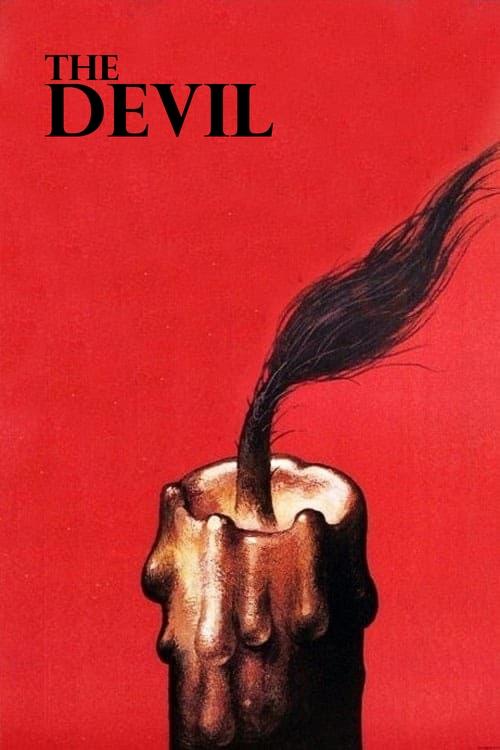
The Devil
1972 · Andrzej Żuławski
Only for when you want to be put through something — this is extreme, demanding cinema that offers no comfort and no rest. Reach for it when you're curious how far a film can go, not when you need a good time.
What it's about
Poland, 1793, as Prussian armies carve up the country. Jakub, a young nobleman imprisoned for conspiracy, is freed by a black-clad stranger who wants one thing in return: the names of his fellow conspirators. Travelling home through the wreckage, Jakub finds everything he loved — family, fiancée, cause — corrupted or destroyed, and with the stranger whispering in his ear, he begins a descent into madness and violence.
The experience
Convulsive is the word: the camera careens, actors scream and claw, and the film moves at a pitch of hysteria most directors never touch. It's exhausting, disturbing, and genuinely unlike anything else — a costume drama that behaves like a horror film having a breakdown.
The craft
Żuławski directs at full convulsion — restless handheld camerawork, performances pushed past naturalism into frenzy, period detail turned nightmarish. The sustained intensity is itself the achievement: few films hold this pitch for two hours, and the physical commitment on screen is astonishing.
Why it matters
Made right after Żuławski's debut, the film was suppressed by Poland's communist authorities — its allegory of informers and corrupted ideals cut too close — and it went unseen for years, cementing his reputation as cinema's great director of hysteria and exile.
Snapshot
Diabeł (The Devil) is Andrzej Żuławski's second feature, made in Poland in 1971–72 straight after his debut, The Third Part of the Night (Trzecia część nocy, 1971). It is set in 1793, during the Prussian incursion that came with the Second Partition of Poland. Jakub (Leszek Teleszyński), a young nobleman held for taking part in a conspiracy, is freed from a convent prison during the chaos of invasion. His rescuer is a black-clad stranger (Wojciech Pszoniak) who wants the names of Jakub's fellow conspirators in return. As the two travel home, Jakub finds everything he left behind corrupted or gone: his family, his fiancée, his friends, the political cause. Guided and goaded by the stranger, he turns into a killer, wielding a straight razor.
The film is a costume drama only on the surface. Underneath it is a convulsive, gory, nearly hallucinatory nightmare about national history. Its loose borrowings from Hamlet, its open violence, and what the authorities took as allegorical comment on contemporary Poland led to its being banned. It was not shown publicly in Poland until 1988. The Devil is now regarded as one of the key works of Żuławski's early career and one of the most extreme Polish films of its time. It is also a point of departure for the hysterical style he developed later in France and in Possession (1981).
Industry & production
The film was made inside the state-run Polish film system of the early 1970s, which was organised into semi-autonomous production units (zespoły filmowe). Żuławski had trained partly in France and had worked as an assistant to Andrzej Wajda, and his early features came out of Wajda's milieu. The Third Part of the Night was produced by Wajda's Zespół Filmowy "X", and The Devil is generally credited to the same unit. The sources available here do not fix the budget, shooting schedule or locations in detail. The film was shot in Poland with largely Polish cast and crew, and its exteriors (forests, manor houses, ruined interiors, winter landscapes) suggest substantial location work.
What defines the film's production history is what happened after it was finished. The censors objected to its violence and nihilism, and above all to how it could be read politically. Its picture of a society of informers, collaborators and fevered conspirators was easy to connect with the repressions after March 1968 and with the general climate of surveillance in People's Poland. The film was shelved. This affected Żuławski's career directly: he soon left for France, where he made L'important c'est d'aimer (That Most Important Thing: Love, 1975). The Devil reached Polish audiences only in 1988, at the end of the communist period. Accounts differ on whether, and how far, it was seen abroad in the meantime, for instance at festivals or private screenings. That part of the record is thin.
Technology
The Devil is a colour 35mm feature shot with the standard equipment of the Polish studios of its day. It has no unusual technical apparatus. What stands out is how hard the equipment is pushed. The camera is mobile throughout, often handheld or close to it, and follows actors through cramped interiors and across open ground. Make-up and practical effects supply a great deal of blood: throat-slashings, bodies, scenes of decay. By the standards of Eastern Bloc filmmaking in 1972 this was unusually graphic, and it fed the censors' objections. Sound appears to combine post-synchronised dialogue with Andrzej Korzyński's score, as was normal Polish practice of the time. Nothing in the record suggests any technical innovation beyond that.
Technique
Cinematography
The film was photographed by Maciej Kijowski. Witold Sobociński had shot The Third Part of the Night. The Devil keeps that film's restless, intrusive camera and pushes it further. Shots are often long and mobile, circling the actors or lunging toward them at close range, and wide-angle lenses distort faces and spaces. The palette is dominated by mud, snow, grey stone and candlelit interiors, broken by sudden red. The result looks less like the composed tableaux of historical drama than like a febrile documentary of a nightmare. This anticipates the roving, nearly unbalanced camerawork of Żuławski's later films.
Editing
The editor's credit is not something this account can confirm with confidence. The cutting serves Żuławski's interest in long, sustained bursts of performance. Scenes tend to play out in extended takes and end abruptly, with the film jolting from one episode to the next rather than building a smooth line of cause and effect. The overall shape is picaresque and episodic: a series of stations on Jakub's road home, each worse than the last. This gives the film a relentless, cumulative rhythm instead of a classically paced one.
Mise-en-scène / staging
The film treats eighteenth-century Poland as a world coming apart. Convents, manor houses, brothels and inns are filled with corpses, debauchery, madness and religious hysteria. Żuławski stages scenes with a crowded, theatrical energy. People burst into frame, writhe, shout and collapse. Space is used to trap rather than to clarify: corridors, doorways and dark rooms keep the characters hemmed in, and open landscapes feel empty and exposed. Costume and décor are period-accurate in outline but treated with deliberate disorder. Garments are torn, bloodied and filthy, and the past looks lived-in and decaying rather than ceremonial. The stranger's sober black clothing marks him as a fixed point amid the chaos and recalls traditional images of the devil as a gentleman or a functionary. A travelling theatre troupe also appears, and it reinforces the film's interest in role-play, masks and performance.
Sound
Andrzej Korzyński, Żuławski's most important musical collaborator, wrote the score. He also scored The Third Part of the Night and, later, Possession and On the Silver Globe. His music for The Devil is generally described as dissonant and unsettling, closer to the contemporary avant-garde than to period pastiche, and it heightens the film's feverish mood instead of anchoring it in the eighteenth century. The soundtrack as a whole is dense with shouting, screaming, ragged breathing and overlapping voices. This is in keeping with Żuławski's practice of letting vocal excess carry emotional states.
Performance
The performances define the film. Leszek Teleszyński's Jakub moves from bewildered idealism to catatonia to manic violence. It is a physically exhausting performance, full of tremors, outbursts and sudden stillness. Wojciech Pszoniak's stranger is the counterweight: ironic, insinuating, by turns playful and threatening. He is at once a tempter, a secret-police agent and a stage manager of catastrophe. Pszoniak would soon be internationally known through Wajda's The Promised Land (1975) and later Danton (1983), and The Devil is among his most remarked-upon early screen roles. Małgorzata Braunek, Żuławski's wife at the time and the lead of The Third Part of the Night, also appears. The acting style is frenzied and anti-naturalistic. It is the first full statement of the "hysterical" mode that critics would later treat as Żuławski's signature, most famously in Isabelle Adjani's work in Possession.
Narrative & dramatic mode
The narrative is a journey, a homecoming and a descent. Jakub is released from captivity into a country under invasion and travels home only to find that home no longer exists in any meaningful sense. The family, the beloved, the friends and the cause are all compromised. With each discovery of betrayal, lust or collaboration he loses another layer of his sanity and moral restraint. The stranger keeps nudging him toward violence while also pursuing his own errand: the list of conspirators.
The dramatic mode combines several registers. There is the costume picture of national history, the Gothic tale of demonic temptation, and the revenge tragedy. The Hamlet elements are commonly noted: a son returning to a household corrupted by sexual and political betrayal, a mother caught up in the corruption, players, and a hero whose madness, real or performed, ends in killing. The film does not adapt Hamlet. It uses the play's outline to frame Jakub as a Hamlet with no restraint left, whose hesitation collapses straight into slaughter. The tone is unrelievedly intense. The film is closer to a fever dream or a passion play than to psychological realism, and it deliberately leaves open whether the stranger is a literal devil, an agent of the state or a projection of Jakub's own disintegration.
Genre & cycle
The Devil sits where several genres meet. It belongs partly to the Polish historical film, a strong tradition built on adaptations of Sienkiewicz, Żeromski and Prus and on Wajda's historical work such as Ashes (Popioły, 1965). It also belongs to the European art-horror of the late 1960s and early 1970s, in which explicit violence and the supernatural served allegorical or metaphysical ends. It sometimes appears in discussions of "folk horror" or historical horror next to films such as Michael Reeves's Witchfinder General (1968) or Ken Russell's The Devils (1971). Those comparisons are typological, not documented lines of influence.
Within Polish cinema it is an anti-heritage film. It takes the national-historical subject, here the late eighteenth-century collapse of the Commonwealth, and strips it of patriotic consolation, presenting the past as a site of betrayal and madness.
Authorship & method
Andrzej Żuławski (1940–2016) wrote and directed the film. He was the son of the writer and diplomat Mirosław Żuławski, studied film in Paris, and was assistant director to Wajda before making his own features. The Third Part of the Night drew on his family's experience of the Nazi occupation. It was already marked by abrupt time-shifts, a doubled heroine and an atmosphere of delirium. The Devil extends these traits into a historical setting. Żuławski's method, as it showed itself across his career, involved extreme demands on actors, a highly mobile camera, metaphysical and political subject matter, and a willingness to let scenes reach hysteria. The Devil is the earliest film in which all of these appear together at full intensity.
Key collaborators:
- Maciej Kijowski (cinematography): carried forward the roaming, intrusive visual style begun with Sobociński on the debut.
- Andrzej Korzyński (music): Żuławski's long-time composer, whose dissonant scoring is part of the films' signature.
- Wojciech Pszoniak and Leszek Teleszyński (lead performers): their opposition (ironic, controlled tempter against convulsive victim) is the film's central dramatic engine.
- Małgorzata Braunek: a continuity of performer across Żuławski's first two features.
The editor's credit and the details of the film's design team are not set out here with enough confidence to describe their contributions specifically.
Movement / national cinema
The Devil belongs to postwar Polish cinema in the generation after the "Polish School" of the late 1950s, the movement of Wajda, Munk and Kawalerowicz that examined the war and national myth. Żuławski's early films take that school's preoccupation with history and martyrdom and make it extreme and unconsoling. The film also stands near the "cinema of moral anxiety" that grew in Poland later in the 1970s, though it is not part of that movement. Like those films it portrays a society of compromise and surveillance, but it does so through Gothic historical allegory rather than contemporary realism.
The film's fate is also part of the history of Polish censorship. With Żuławski's On the Silver Globe, halted by the authorities in 1977–78, it is among the best-known cases of a film suppressed under the Gierek era. Its belated release in 1988 belongs to the wave of "shelved" (półkowniki) films brought out as the system loosened.
Era / period
The film depicts 1793. The Commonwealth was being dismembered by its neighbours, and native conspiracies and collaborations ran alongside foreign invasion. The film itself was made in the early 1970s, after March 1968. That year Polish student protests were suppressed and an "anti-Zionist" campaign drove many Polish Jews and intellectuals out of the country. Gierek's leadership, which began in late 1970, brought economic opening and new consumer promises, but cultural control remained tight. The allegorical reading is invited, though not spelled out: a young idealist pressured to name names, a nation in which every institution is compromised, a mysterious functionary who wants lists. The censors' reaction is the clearest evidence that contemporaries read it that way.
Internationally, the film belongs to the period of European art cinema's greatest openness to explicit sex and violence. It was a moment when directors from Pasolini to Russell to Jancsó were using historical settings to address the political present.
Themes
- Betrayal and informing. The plot turns on the demand for a list of names. Every relationship Jakub returns to has been betrayed, and the film presents a society in which loyalty has no ground left to stand on.
- Madness as political symptom. Jakub's breakdown follows the national collapse around him. The film suggests that a corrupted public world produces private insanity.
- The devil as agent. Pszoniak's stranger brings together the metaphysical tempter and the modern state functionary. Evil appears both as a cosmic force and as a bureaucratic, manipulative presence.
- Demythologising history. Polish romantic nationalism often cast the partitions as national martyrdom. Żuławski presents them instead as a time of complicity, sensuality and violence.
- Performance and role-play. The travelling players and the Hamlet echoes underline how characters perform madness, virtue or loyalty. The excessive acting style itself becomes thematic.
- Body and corruption. Sex, blood and decay are constant. The film insists on the physical reality that heroic historical narrative leaves out.
Reception, canon & influence
Critical reception. The film was suppressed for some sixteen years, so it had no normal initial reception in Poland. Its contemporary standing rests mainly on the fact of the ban and on whatever limited circulation it had. When it was released in 1988 it was received as an important recovered work, though its excess continued to divide viewers. Its international reputation grew mainly from the 2000s onward, through retrospectives and home-video releases that brought Żuławski's whole career back into view. In that period critics increasingly placed The Devil alongside Possession and On the Silver Globe as one of his central works. It is often described as one of the most shocking films produced in the Eastern Bloc. No reliable box-office figures are available.
Influences on the film (backward). The clearest source is Hamlet, used as a structural and thematic frame. The film also draws on the Polish Romantic tradition of national-historical drama, including Mickiewicz, Słowacki and Wyspiański, whose demonic and visionary elements it reworks. The Polish School, and Wajda's historical films such as Ashes, are a further source, along with Żuławski's own apprenticeship under Wajda. Through its image of the gentlemanly devil and the bargain for a soul, it draws more broadly on the European Faustian and Gothic traditions. Żuławski's French training and his familiarity with European modernist cinema are also relevant, though specific borrowings are hard to document.
Legacy (forward). The Devil marks the point at which Żuławski's mature style crystallised: the delirious camera, the hysterical performances, the fusion of metaphysics and politics. All three return in L'important c'est d'aimer, On the Silver Globe and above all Possession, where the doubled, demonic and political imagery of the earlier film finds a contemporary Cold War setting in divided Berlin. The ban also shaped his career. It helped push him toward France, and his later dealings with Polish authorities, including the suspension of On the Silver Globe, repeated the pattern. Within Polish cinema, the film became an emblem of the censorship era and an early example of a strand of Polish filmmaking that treats national history with irreverence and horror rather than reverence. Direct, documented influence on specific later filmmakers is hard to establish, and claims of that kind should be treated cautiously. The film's reputation as a cult object and a key text of Eastern European art-horror has grown steadily as access to Żuławski's work has widened.
Influences: the films it descends from and the films it influenced
- Ashes (1965) — Wajda's anti-romantic Napoleonic-era epic, made with Żuławski in his apprentice years, broke Polish national-historical spectacle into brutal, disordered episodes that undercut heroism. The Devil pushes that demythologising approach to period history into outright horror.
- Mother Joan of the Angels (1961) — It set the Polish model for staging demonic possession as convulsive physical performance inside a cramped, enclosed period community. The Devil turns this into its hysterical anti-naturalism, with madness standing in for ideological pressure.
- The Saragossa Manuscript (1965) — Has built an 18th-century journey out of picaresque stations in which an uncanny guiding figure leads the hero into ever stranger encounters. The Devil follows the same pattern, with Pszoniak's stranger steering Jakub through one corrupted episode after another.
- Witchfinder General (1968) — Reeves made historical horror without heritage gloss: a civil-war landscape where state-backed persecution and informing drive the violence. That is the anti-heritage, politically allegorical register The Devil takes up in its 1793 setting.
- Marketa Lazarová (1967) — Vláčil's restless, intrusive camera, elliptical cutting and dissonant choral score made the historical past feel raw and alien rather than illustrative. It is a direct Eastern Bloc precedent for The Devil's roving handheld treatment of history.
- The Third Part of the Night (1971) — Żuławski's debut already had Korzyński's dissonant score, Braunek as a doubled heroine, a hyper-mobile intrusive camera and a delirious feel for time. The Devil carries the whole toolkit over from occupation-era Poland into the period film.
- L'important c'est d'aimer (1975) — Żuławski's first French film carries over The Devil's lunging handheld camera, its performances pushed to nervous collapse and Korzyński-style emotional dissonance. The devilish manipulator becomes Klaus Kinski's figure in a sordid theatrical milieu.
- On the Silver Globe (1977) — It takes The Devil's wide-angle, hand-held frenzy, declamatory hysterical monologues and Korzyński score into a messianic sci-fi allegory. It was then shut down by the authorities, repeating The Devil's fate as a shelved film.
- Possession (1981) — Possession moves The Devil's doubled, demonic and political imagery into Cold War Berlin. Bruno Nuytten's circling, wide-angle Steadicam and Isabelle Adjani's convulsive performance perfect the camera-and-actor frenzy first fully assembled in 1972.
- Szamanka (1996) — Żuławski's return to Poland again joins a demonic, sexually consuming figure to a national allegory, here post-communist Poland. It is shot with the same hand-held, wide-angle claustrophobia and played at the same anti-naturalistic pitch.
- Come and See (1985) — Klimov follows a young man through stations of atrocity with a roving Steadicam and close-ups that warp the face, until his features break down into madness. It renders history as Eastern Bloc horror in the way The Devil did.
- Hard to Be a God (2013) — German's camera noses through a cramped, filthy pseudo-medieval world in long wide-angle takes crowded with leering faces. It is the most extreme later example of the anti-heritage historical film as a claustrophobic, frenzied allegory of state terror.
- Faust (2011) — Sokurov's anamorphically distorted, wide-angle frame follows a scholar led through episodic stations by a grotesque, ingratiating Mephisto-moneylender. The Devil had already turned the tempter into an ironic functionary of material and political power in the same way.
- On the Silver Globe (1989) — Perfects the convulsive, blood-soaked expressionist tableaux and a camera roaming through mass violence — the small-scale rehearsal for Silver Globe's planetary mass-hysteria staging.
- The Devils (1971) — Russell's contemporaneous film also uses screaming, anti-naturalistic ensemble performance and grotesque period staging to show demonic hysteria being manufactured by the state. The two films are twin assaults on the respectable historical film.
- The Wedding (1973) — Wajda's Wyspiański adaptation, shot handheld by Witold Sobociński, crowds frenzied, drunken ensemble scenes into a cramped interior and sends phantoms from the national past in to taunt the living. It reworks the same Polish Romantic demonic-visionary tradition The Devil draws on.
- Witchhammer (1970) — Vávra used a 17th-century witch trial to dramatise denunciation and a self-perpetuating apparatus of interrogation. As in The Devil, a period setting carries a coded indictment of Eastern Bloc informing and betrayal.
Similar films
- Witchhammer (1970) — influence & lineage · same viewing thread
- Mother Joan of the Angels (1961) — influence & lineage · same viewing thread
- Possession (1981) — influence & lineage · often watched together
- Come and See (1985) — influence & lineage · often watched together
- The Devils (1971) — influence & lineage
- The Third Part of the Night (1972) — same viewing thread
- Faust (1994) — same viewing thread
- Häxan (1922) — same viewing thread
All the films related to The Devil →
Watch it with: curated runs of related films
- Fever-Dream Horror — Watch these when you want horror that runs on dream logic — witches, circuses, crematoria and occult dread rendered as hand-crafted, hallucinatory nightmare rather than jump-scare.