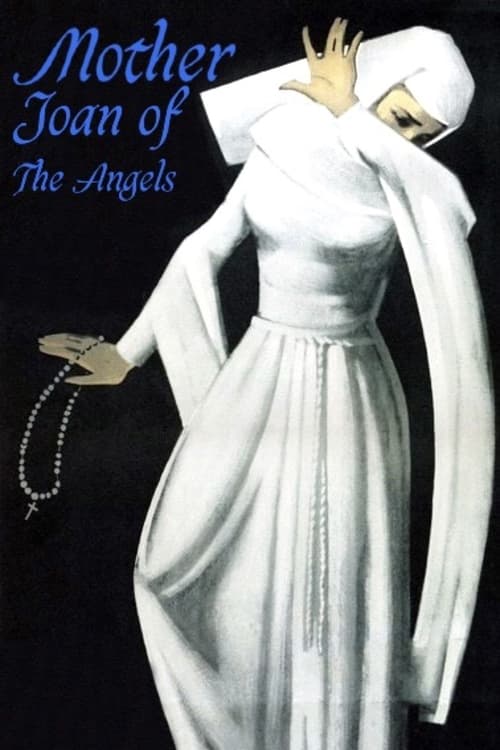
Mother Joan of the Angels
1961 · Jerzy Kawalerowicz
For when you want a film to chew on for days — one that raises questions about faith, desire, and confinement and refuses to answer them. Challenge viewing, best met with full attention.
What it's about
A priest arrives at a remote convent to exorcise the Mother Superior, said to be inhabited by eight demons — the historical Loudun possessions transplanted to a bleak Polish landscape. What he finds is a battle he isn't prepared for: with the demons, with Mother Joan herself, and with his own certainty.
The experience
Austere and quietly electrifying — the convulsions play less like horror set pieces than like ritual gone wrong, and the film keeps you suspended between dread and doubt. It's slow-burning, severe, and impossible to shake.
Performances
Lucyna Winnicka's Mother Joan is one of the great enigmas of the screen — serene, flirtatious, and terrifying by turns, sometimes within a single scene, so you can never settle on what you're watching: affliction, performance, or rebellion.
The craft
Jerzy Kawalerowicz strips the story to stark essentials — white habits against black interiors, faces isolated in scorched, sandy emptiness, movement choreographed like liturgy. The black-and-white compositions are so severe and beautiful they'd hold a gallery wall, and they reward a big, dark screen.
Why it matters
A landmark of the Polish Film School that told the Loudun story a decade before Ken Russell's fevered version, it set the template for possession films that treat the demon as a question rather than a special effect.
A priest arrives at a remote convent to exorcise a Mother Superior said to house eight demons — the same historical Loudun possessions that would later fuel Ken Russell's The Devils, here rendered a decade earlier with monastic severity instead of hysteria. Jerzy Kawalerowicz, a central figure of the Polish Film School, strips the story to white habits against black interiors, faces isolated in scorched, sandy emptiness, and choreographed convulsions that read less as horror set pieces than as liturgy gone wrong. Based on Jarosław Iwaszkiewicz's novella, the film treats possession as a question the camera refuses to settle: demonic affliction, repressed desire, or the only language available to a woman confined by her vows. Lucyna Winnicka's Mother Joan — serene, flirtatious, terrifying by turns — is one of the great enigmatic performances of Eastern European cinema. It took the Special Jury Prize at Cannes in 1961 over Catholic protest, and its geometry has echoed through religious horror ever since: whenever a film frames faith as an arrangement of bodies in stark space, the nuns of Ludyń are somewhere behind it.
Reception
It won the Special Jury Prize at Cannes in 1961 while drawing fierce protests from Catholic circles — scandal and prestige at once. Today it's canonized as a peak of the Polish Film School, its profile boosted by restoration and revival programs like Martin Scorsese's Masterpieces of Polish Cinema tour.
How Mother Joan of the Angels was received, from release to now →
Influences: the films it descends from and the films it influenced
- The Passion of Joan of Arc (1928) — Establishes the template Kawalerowicz inherits of the female religious ecstatic isolated in blank white negative space, the face and body offered up as the sole dramatic terrain of spiritual crisis.
- Day of Wrath (1943) — Models the reading of witch-hunt and repressed carnal desire under clerical authority through slow, grave chiaroscuro compositions where austerity itself becomes the erotic and moral pressure.
- Ordet (1955) — Supplies the whitewashed, near-empty interior as a stage for faith, with figures blocked in deliberate, almost liturgical choreography against blank walls — the 'bodies in stark space' grammar Wójcik and Kawalerowicz adopt.
- The Seventh Seal (1957) — Provides the high-contrast monochrome medievalism and the flagellant procession as choreographed collective convulsion — mass religious hysteria staged as writhing, patterned movement.
- Ivan the Terrible (1944) — Source for the geometric, expressionist arrangement of bodies and cassocks in ritual, with hard directional light carving figures out of blackness into deliberate graphic shapes.
- Diary of a Country Priest (1951) — Ascetic framing of a cleric's spiritual torment, stripping mise-en-scène to essentials so that a priest's crisis of faith is rendered through restraint and absence rather than incident.
- Black Narcissus (1947) — The prototype of the convent as a pressure-chamber of sublimated sexual desire tipping into hysteria, where enclosure and vow become the engine of erotic derangement.
- Ashes and Diamonds (1958) — Polish Film School sibling text sharing Jerzy Wójcik-school deep-focus, glossy high-contrast photography loaded with symbolic objects and stark tonal separation.
- The Devils (1971) — Dramatizes the identical Loudun possessions, escalating Kawalerowicz's restrained choreographed convulsions into full-blown collective nunnery hysteria staged against stark, geometric white-tiled architecture.
- The Exorcist (1973) — Codifies the exorcism film around the possessed body as site of choreographed convulsion and the priest's own faith placed on trial by the rite — the confrontation structure Mother Joan pioneers.
- Ida (2013) — Direct Polish heir: high-contrast monochrome, boxed Academy framing, and radical negative space around a nun's face, using empty top-of-frame to press the figure into her vow — Wójcik's grammar revived.
- The Witch (2015) — Extends the 'religious-horror geometry' of desaturated, rigorously composed period austerity where repressed desire and doctrinal confinement, not gore, generate the dread.
- Benedetta (2021) — Returns to the convent-possession nexus of ecstasy read as hysteria and forbidden desire, dramatizing whether the sacred convulsion is divine, demonic, or erotic — Mother Joan's central ambiguity made explicit.
- Witchhammer (1970) — Shoots an inquisitorial possession trial in stark black-and-white widescreen, using deep-focus institutional interiors to make the Church apparatus itself the antagonist.
- Winter Light (1963) — Contemporaneous distillation of faith-and-doubt into a spare, cold, near-empty ecclesiastical space where God's silence is the drama — the same theme of confinement inside belief.
- The Nun (La Religieuse) (1966) — Literary adaptation (Diderot) treating the cloister as carceral architecture of repressed desire, staging nuns in rigorous, frontal, geometric blocking against bare convent walls.
- Pharaoh (1966) — The director's own extension of his negative-space method — tiny robed figures marooned in vast, emptied desert and temple frames, ritual power rendered through spatial isolation.
- Andrei Rublev (1966) — Monochrome meditation on faith and the body in extremis, with monastic figures set against austere fields and interiors, and bursts of collective pagan/ecstatic movement against the sacred order.
Similar films
- The Devils (1971) — influence & lineage
- The Exorcist (1973) — influence & lineage
- The Passion of Joan of Arc (1928) — influence & lineage
- Ida (2013) — influence & lineage
- Day of Wrath (1943) — influence & lineage
- Diary of a Country Priest (1951) — influence & lineage
- Witchhammer (1970) — same viewing thread
- Häxan (1922) — same viewing thread
All the films related to Mother Joan of the Angels →
Watch it with: curated runs of related films
- Fever-Dream Horror — Watch these when you want horror that runs on dream logic — witches, circuses, crematoria and occult dread rendered as hand-crafted, hallucinatory nightmare rather than jump-scare.