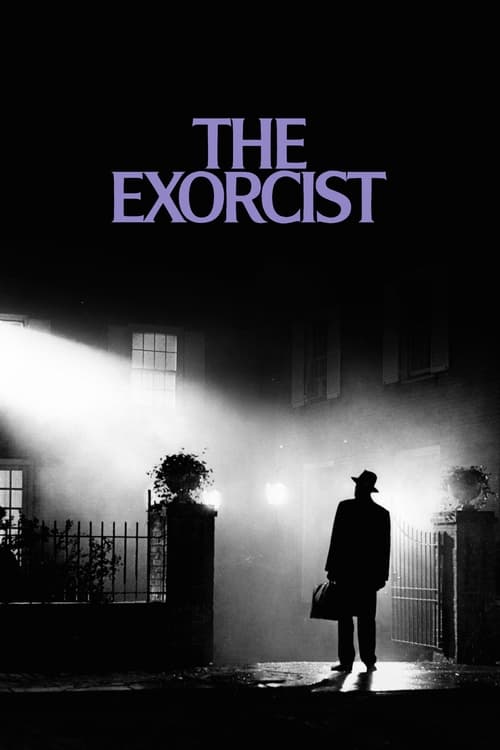
The Exorcist
1973 · William Friedkin
When you're craving a real scare — the serious, sit-in-the-dark kind, not a fun one. This is challenge viewing; approach it when you want horror that means it.
What it's about
In a quiet Georgetown home, an actress's twelve-year-old daughter begins to change — small strangenesses that escalate into something medicine can't name. When every doctor fails, the desperate mother turns to two Catholic priests, one old and battle-worn, one young and losing his faith, and the film becomes a collision between the modern world and something ancient that has entered a child's bedroom.
The experience
Still genuinely frightening fifty years on — not through jump scares but through patient, mounting dread that makes the horror feel medical, real, and blasphemous all at once. It's an endurance test with a soul: as much a film about faith and a mother's desperation as about terror.
Performances
Ellen Burstyn is devastating as a mother watching her child disappear, Jason Miller carries the film's crisis of faith in his tired eyes, and young Linda Blair's transformation remains one of the most fearless child performances ever put on screen.
The craft
Friedkin shot it like a documentary about the impossible — A-list craft applied to horror for the first time, with groundbreaking makeup effects, a sound design of layered whispers and animal noise, and that ice-pick piano theme. Watch it loud, in the dark; the sound is half the terror.
Why it matters
It made horror respectable and enormous at once — a blockbuster with Oscar nominations that drew lines around the block and reshaped what the genre could be. Every serious possession film since lives in its shadow.
Sightlines dossier — a structured, synthesized account written to surface facet evidence. Generated reading, not sourced criticism; citable to film-historical scholarship (Bordwell/Thompson, Kermode) where authority is wanted.
Snapshot
Adapted by William Peter Blatty from his own bestseller and directed by William Friedkin at the height of New Hollywood, The Exorcist turned a theological crisis into a mass-cultural event. Its lasting importance is double: it made horror respectable — a serious director, A-list craft, Oscar attention — and it made horror enormous, drawing queues around the block and helping invent the wide-release event movie a year before Jaws.
Critical reception
On release the film split critics even as it broke records. Detractors (Pauline Kael prominent among them) attacked it as a slick, sensational assault — technically masterful but spiritually hollow, "the biggest recruiting poster the Catholic Church has had." Admirers read it as a sincere drama of faith and doubt wearing horror's clothes. Either way the consensus on craft was near-unanimous: the film was unusually well-made for its genre. It earned ten Academy Award nominations (winning Adapted Screenplay and Sound) — extraordinary for horror — and that prestige is itself part of its influence: it argued that horror could be awards cinema. Reappraisal has only deepened; it sits near the top of most "scariest/most important horror" canons.
Technique
Camera. Friedkin imports the documentary, vérité grammar he had just perfected on The French Connection — handheld immediacy, location texture, an unshowy reportorial eye. The supernatural is shot as if it were being covered, not staged, which is precisely what makes it unbearable: it looks like it is actually happening.
Editing. Beyond conventional escalation, Friedkin and editors Norman Gay and Evan Lottman deploy subliminal and flash cutting — single-frame inserts of the white "Captain Howdy" demon face spliced into otherwise calm shots, priming dread below conscious notice. The technique weaponizes the cut itself.
Sound. The film's terror is carried as much by the ear as the eye. Rather than a wall-to-wall orchestral score, Friedkin builds a designed soundscape — guttural layered voices for the possessed Regan (Mercedes McCambridge), animal growls, disquieting room tone — and famously borrows Mike Oldfield's Tubular Bells as a cold, tinkling non-horror motif. Sound here is the primary instrument of dread; it won the film its Oscar.
Light and look. The palette is clinical and cold — hospital whites, the harsh diagnostic sequences, the blue-gray of the sickroom — refusing gothic atmosphere in favor of a recognizable, contemporary, almost medical realism. The famous arrival shot (Father Merrin in lamplight outside the house) is the rare composed, painterly exception that proves the rule.
Staging and performance. The horror is located in a domestic, ordinary, upper-middle-class setting — a Georgetown townhouse, a movie-star single mother, a child's bedroom, doctors' offices — not a castle or crypt. Performances are pitched at the naturalistic everyday (Ellen Burstyn, Jason Miller), which throws the eruption of the grotesque into unbearable relief. Central to it all is a child performance as the engine of horror: Linda Blair's possessed Regan makes the violated body of a twelve-year-old the site of terror.
Genre and movement
The Exorcist is a foundational text of possession horror and the immediate trigger of the mid-'70s Satanic-child cycle. It is equally a landmark of prestige / "elevated" horror — the lineage in which serious directors and serious craft take genre material seriously. And it is a product of New Hollywood (1967–80): director-driven, realist, willing to be transgressive, commercially ambitious.
Influences (backward)
The film inherits Roman Polanski's prestige Satanic dread in ordinary apartments (Rosemary's Baby, 1968) and his treatment of domestic space as psychological body-horror (Repulsion, 1965). It inherits Hitchcock's proof (Psycho, 1960) that a respectable director could mainstream graphic horror and that sound could be the violence. And most directly it inherits Friedkin's own prior film, The French Connection (1971): the procedural, location-shot realism that he then trained on the supernatural.
Legacy (forward)
The grosses set off the Satanic-child cycle at once (The Omen, 1976). It licensed adolescence-as-body-horror (Carrie, 1976) and bodily-violation dread executed with A-list craft (Alien, 1979). It opened the door for auteurs to claim horror outright (The Shining, 1980). And it is the acknowledged grandparent of the contemporary "elevated horror" wave — period dread (The Witch, 2016), maternal/inheritance terror with sonic dread (Hereditary, 2018). Commercially, alongside Jaws (1975) and Star Wars (1977), it helped inaugurate the wide-release event movie.
Themes
At its core the film is a drama of faith versus doubt — a lapsed priest's crisis as much as a possession. It stages the body violated (the child's body as battleground), evil erupting in the everyday (the secular, affluent, modern home), maternal terror (a mother helpless before what has her daughter), and the testing of institutions — church and medicine both fail Regan before faith is risked.
A Deleuzian reading
Start with the clinic.
The full Deleuzian reading of The Exorcist →
Reception
In 1973 it was a full-blown phenomenon — blocks-long lines, reports of fainting and walkouts, and a then-shocking 10 Oscar nominations for a horror film — even as critics like Pauline Kael dismissed it. Half a century on it's settled comfortably into 'scariest film ever made' shorthand, the rare zeitgeist smash whose reputation never actually dipped.
How The Exorcist was received, from release to now →
Influences: the films it descends from and the films it influenced
- The French Connection (1971) — Friedkin directly transplants this film's documentary vérité grammar — handheld cameras, real locations, procedural pacing, naturalistic ensemble — onto supernatural material, making possession look like it is being covered rather than staged.
- Rosemary's Baby (1968) — Polanski's staging of Satanic horror within a contemporary upper-middle-class domestic interior, shot without gothic atmosphere in a clinical observational style, is the direct template Friedkin adapts for the Georgetown townhouse.
- Repulsion (1965) — Polanski's use of ambient sound design — dripping, breathing, distorted room tone — as the primary instrument mapping interior disintegration onto screen space is the formal model Friedkin's sound team amplifies for the Regan possession sequences.
- Psycho (1960) — Hitchcock proved that an A-list director could bring graphic bodily horror to mainstream prestige cinema and attract Oscar consideration, establishing the template The Exorcist's ten nominations follow; Herrmann's score functioning as the act of violence also prefigures Friedkin's sound-as-terror approach.
- The Innocents (1961) — Clayton established placing a child at the center of supernatural dread within a naturalistic procedural-doubt narrative (a rational investigator confronting the inexplicable), while Freddie Francis's cold, hard cinematography refuses gothic warmth for clinical observation — the direct structural and visual precursor to Father Karras's skeptic-to-believer arc.
- The Pawnbroker (1964) — Lumet pioneered subliminal single-frame flash cuts in American mainstream cinema as a technique for intrusive psychological violation of the narrative surface, which Friedkin directly weaponizes for horror by splicing the Captain Howdy demon face below the viewer's conscious notice.
- Onibaba (1964) — Friedkin has explicitly named Onibaba's demonic, disfigured face as the source for his conception of the possessed visage — the cross-cultural transfer of the mask-revealed demon into Western horror.
- Mother Joan of the Angels (1961) — Codifies the exorcism film around the possessed body as site of choreographed convulsion and the priest's own faith placed on trial by the rite — the confrontation structure Mother Joan pioneers.
- The Omen (1976) — The primary heir to the Satanic-child cycle The Exorcist's grosses directly triggered; Jerry Goldsmith's 'Ave Satani' scored-shock orchestral-choir method systemizes into repeatable genre signature what Friedkin achieved piecemeal through borrowed Tubular Bells and designed soundscape.
- Carrie (1976) — De Palma inherits The Exorcist's authorization of A-list formal craft applied to horror and its premise of the adolescent female body as the site of supernatural violation and abjection, replacing Friedkin's documentary vérité with De Palma's own operatic formal vocabulary: split-screen and slow-motion as escalation devices.
- Alien (1979) — Scott inherits The Exorcist's premise of the human body as horror battleground — the chest-burster as body-violated-from-within — and executes it with A-list craft in a clinical, cold environment (the Nostromo as antiseptic ward), deploying Ben Burtt's designed soundscape as the primary atmospheric dread instrument rather than conventional orchestral score.
- The Brood (1979) — Cronenberg inherits The Exorcist's clinical-medical framing of supernatural body horror — the doctor's office and examination room as horror setting rather than the crypt — and its conceit of the violated maternal body as the site where psychology literalizes into physical monstrosity.
- The Shining (1980) — Kubrick's Steadicam — a pursuing, omniscient presence gliding through ordinary hotel corridors — is the formal evolution of Friedkin's handheld vérité approach; both films locate horror in a domestic, inhabited space made uncanny by a camera that documents rather than dramatizes.
- Possession (1981) — Żuławski demands that Isabelle Adjani execute extreme physical contortion and visceral abasement in naturalistic domestic and subway settings, directly inheriting the possessed-body performance mode Linda Blair originated — clinical European staging of body horror in an ordinary apartment rather than a genre-coded environment.
- The Silence of the Lambs (1991) — Demme consummates The Exorcist's authorization of horror as prestige awards cinema — five Oscars completing what ten nominations began — inheriting its procedural-realism structure (FBI investigation as horror container), clinical fluorescent-institutional look, and naturalistic performance anchoring extreme transgressive content.
- The Witch (2015) — Eggers inherits The Exorcist's core genre-formation move of centering horror in a crisis of Christian faith as the drama's actual engine, applying period-authentic research and documentary-style observational framing as the contemporary elevated-horror equivalent of Friedkin's clinical vérité realism.
- Hereditary (2018) — Aster directly inherits The Exorcist's double formal signature — subliminal demonic-face inserts spliced into otherwise calm imagery, and designed soundscape (clucking tongue, impact sounds) as primary terror instrument over conventional score — while centering horror in maternal helplessness before a child's possession within domestic procedural realism.
- The Wailing (2016) — Na's possession-climax staging — the prolonged bodily ordeal, the exhausted family witness, the priest confronting incommensurable evil — directly extends Friedkin's template; both films embed a Book of Job structure where faith and paternal love prove structurally inadequate to what has arrived.
- Longlegs (2024) — Originates the occult-procedural rhythm of rational investigators forced toward literal possession, treating the supernatural with documentary flatness rather than spectacle.
- Saint Maud (2020) — Provides the religious-horror genre frame in which Catholic ritual, the body as battleground, and the literal/clinical ambiguity of possession give Glass her generic vocabulary.
- Don't Look Now (1973) — Roeg's contemporaneous film independently deploys flash-cut temporal editing as a dread mechanism — intrusions destabilizing the narrative surface — and stages body horror in ordinary inhabited tourist locations rather than gothic settings, arriving at parallel formal solutions from a European art-cinema angle.
- Jaws (1975) — The Exorcist's 1973 box-office earthquake directly helped create the conditions for the wide-release summer event movie that Jaws inaugurates; Spielberg inherits Friedkin's strategy of using a cold, spare musical motif — Williams' two-note ostinato as structural parallel to Tubular Bells — as the film's primary dread mechanism rather than continuous underscore.
- Angel Heart (1987) — Pioneers subliminal demonic flash-frames cut into otherwise naturalistic footage; Angel Heart adopts the same near-invisible intercutting (faces, blood, descending shapes) to seed dread below conscious registration.
- The Conjuring: The Devil Made Me Do It (2021) — Establishes the possession-film's core device the sequel inherits directly: staging demonic affliction through practical, in-camera body horror (contorted bodies, physical performance of the demon) intercut with skeptical adult investigators, treating exorcism as a procedural to be documented and verified.
Similar films
- Rosemary's Baby (1968) — influence & lineage · same viewing thread
- The Shining (1980) — influence & lineage · same viewing thread
- The Innocents (1961) — influence & lineage · same viewing thread
- Repulsion (1965) — influence & lineage · same viewing thread
- Carrie (1976) — influence & lineage
- Psycho (1960) — influence & lineage
- Possession (1981) — influence & lineage
- The Silence of the Lambs (1991) — influence & lineage
All the films related to The Exorcist →
Watch it with: curated runs of related films
- The Walls Are Closing In — Watch these when you want horror that comes from inside the house — a mind or a family cracking apart in rooms that slowly turn hostile.