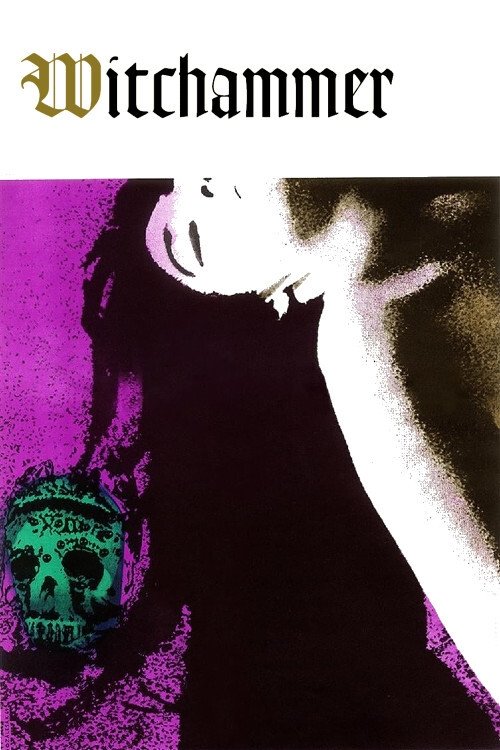
Witchhammer
1970 · Otakar Vávra
For when you want a serious, demanding film about how injustice actually works — a challenge, not comfort, and all the more powerful for it. Best when you're ready to sit with something bleak and true.
What it's about
In 1670s Moravia, an old woman's petty theft of a communion wafer brings an inquisitor to town — and he builds, confession by tortured confession, a self-sustaining industry of accusation. Drawn from actual court records, it follows how witch trials devour the innocent, enrich the accusers, and grind down the few decent people who try to stand in the way.
The experience
Grim, gripping, and quietly furious — the horror is bureaucratic rather than gothic, all ledgers, protocols, and property inventories of the condemned, which somehow makes it worse. It builds a slow, righteous anger that stays with you.
The craft
Otakar Vávra — the grand professor of Czech cinema who trained a generation of New Wave directors — shoots in stark black-and-white widescreen with clinical attention to procedure, letting the machinery of persecution indict itself. The restraint is the point: no gothic flourishes, just documents, faces, and the torture chamber. Striking compositions that reward a dark room and full attention.
Why it matters
Shot in 1969 in the shadow of the Soviet invasion, it was unmistakably read as an allegory of the Stalinist show trials — forced confessions and all — and stands as one of Czech cinema's great acts of coded protest.
The witch trials of 1670s Northern Moravia, reconstructed from actual court records: an inquisitor named Boblig arrives to investigate an old woman's petty theft of a communion wafer and builds, confession by tortured confession, a self-sustaining industry of accusation that devours the innocent and enriches the accusers. Otakar Vávra — the grand institutional figure of Czech cinema, the FAMU professor who trained Forman, Chytilová and much of the New Wave — directs in stark black-and-white widescreen, with a clinical attention to procedure that makes the horror bureaucratic rather than gothic: ledgers, protocols, property inventories of the condemned. Shot in 1969, in the shadow of the Soviet tanks that had just crushed the Prague Spring, it was unmistakably an allegory of the Stalinist show trials of the 1950s — forced confessions, invented conspiracies, the machinery of terror validating itself — and audiences read it instantly as a warning about the normalization then descending. The wonder is that it was released at all; within months, films like it no longer were.
Reception
Banned almost immediately after its 1970 premiere — 1.5 million Czechoslovaks saw it before the normalization regime pulled it from theaters, and it stayed shelved until 1989; it has since been rediscovered abroad as a cornerstone of witch-trial cinema via Second Run and Severin's folk-horror box set.
How Witchhammer was received, from release to now →
Influences: the films it descends from and the films it influenced
- Häxan (1922) — Dramatizes inquisitorial procedure straight from period witch-hunting manuals, treating the interrogation-torture-confession sequence as a reproducible bureaucratic mechanism rather than spectacle.
- The Passion of Joan of Arc (1928) — Builds its trial entirely from the surviving court transcript, staging heresy examination as a documentary reconstruction of the interrogation record — the same 'court-record reconstruction' spine Vávra adopts.
- Day of Wrath (1943) — Renders a 17th-century witch trial in austere high-contrast monochrome where torture manufactures the confession that proves the accusation, modeling the self-sealing logic of forced confession.
- The Seventh Seal (1957) — Frames the medieval burning of an accused witch as a bureaucratized execution overseen by fearful clerics, the austere B&W medieval-terror tableau Vávra inherits.
- Les Sorcières de Salem (The Crucible) (1957) — Adapts Miller/Sartre to stage a witch trial explicitly as a show-trial allegory of contemporary political purges, the exact allegorical maneuver Witchhammer aims at Stalinist Czechoslovakia.
- Mother Joan of the Angels (1961) — Shoots an inquisitorial possession trial in stark black-and-white widescreen, using deep-focus institutional interiors to make the Church apparatus itself the antagonist.
- The Trial (1962) — Turns Kafka's endless corridors and unaccountable tribunal into a visual grammar for the machinery of terror grinding forward without a locatable author.
- The Devils (1971) — Extends the witch/possession trial into an overt study of political power liquidating a target through a rigged tribunal, foregrounding the show-trial-as-allegory Witchhammer keeps period-clad.
- Danton (1983) — Stages a revolutionary tribunal as a scripted show trial where the verdict precedes the evidence, carrying the machinery-of-terror procedural allegory forward into an explicitly Eastern Bloc-coded present.
- Marketa Lazarová (1967) — Establishes the Czech black-and-white widescreen historical idiom — harsh natural light, austere period materiality — that Witchhammer applies to the 1670s Moravian setting.
- Witchfinder General (1968) — Depicts the witch-hunter as a self-financing functionary whose accusations breed more accusations, the same 'self-sustaining escalation' where the persecution machine feeds on its own confessions.
- The Joke (1969) — A Czech New Wave adaptation staging a Party disciplinary tribunal as a ritual of denunciation and confession, the domestic normalization-era show-trial allegory Witchhammer disguises as history.
- The Confession (1969) — Reconstructs a Stalinist show trial as procedural detail — sleep deprivation, scripted self-incrimination — exposing the mechanics by which the state extracts a confession it has already written.
- The Cremator (1969) — A Czech allegory in which an ordinary functionary's bureaucratic diligence becomes the instrument of mass murder, dramatizing the same banal machinery-of-terror through procedure.
- The Ear (1970) — A banned normalization-era Czech film built on surveillance and the arbitrary manufacture of guilt, the contemporaneous companion allegory to Vávra's political indictment.
- Mark of the Devil (1970) — Presents the inquisition as a licensed, paperwork-driven torture bureaucracy where legal formality authorizes atrocity, sharing the inquisition-horror-as-procedure register.
Similar films
- Häxan (1922) — influence & lineage · same viewing thread
- Mother Joan of the Angels (1961) — influence & lineage · same viewing thread
- The Cremator (1969) — influence & lineage · same viewing thread
- Day of Wrath (1943) — influence & lineage
- Marketa Lazarová (1967) — influence & lineage
- The Devils (1971) — influence & lineage
- The Trial (1962) — influence & lineage
- Valerie and Her Week of Wonders (1970) — same viewing thread
All the films related to Witchhammer →
Watch it with: curated runs of related films
- Fever-Dream Horror — Watch these when you want horror that runs on dream logic — witches, circuses, crematoria and occult dread rendered as hand-crafted, hallucinatory nightmare rather than jump-scare.