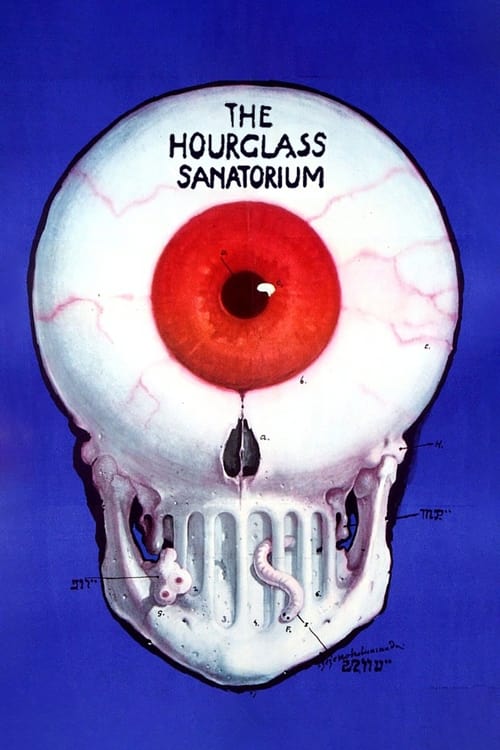
The Hourglass Sanatorium
1973 · Wojciech Has
For when you want to be swallowed by a film — a late-night, lights-off, phone-away experience for viewers craving pure imagination over story. Demanding, not comforting, and it will haunt you for days.
What it's about
Józef rides a decrepit train to a remote sanatorium where his dead father is kept alive by a trick of suspended time. Once inside, every door opens onto another layer — childhood memories, historical pageants, dreams and nightmares bleeding into each other — until the building becomes a whole vanished world he wanders through, looking for his father.
The experience
Overwhelming in the best way: dense, dreamlike, and gorgeous, with the logic of sleep rather than plot. It asks you to surrender to it, and if you do, it's hypnotic — mournful under all the delirium, an elegy disguised as a hallucination.
The craft
Wojciech Has fills every frame to bursting — crumbling interiors, candlelit crowds, whole streets dressed as living memory — creating one of the most sumptuous production designs ever put on film. The camera glides between times and places without cuts you can catch, and it absolutely demands the biggest screen you can find.
Why it matters
Adapted from Bruno Schulz's stories, it mourns the Polish-Jewish world the war destroyed at a moment when the authorities wanted that subject buried; the state suppressed it, it reached Cannes anyway and took the Jury Prize, and it now stands as a summit of Eastern European surrealist cinema.
A man rides a decrepit train to a sanatorium where his dead father is kept alive by a trick of suspended time — and steps into a building where every door opens onto another layer of memory, history, and dream. Wojciech Has, Polish cinema's great fabulist (The Saragossa Manuscript), adapted the stories of Bruno Schulz, the Jewish writer murdered by a Gestapo officer in 1942, into one of the most sumptuous hallucinations ever put on film: crumbling interiors dressed to bursting, colonial phantasmagoria, a shtetl conjured in loving, mournful detail. Beneath the delirium it is an elegy — for a father, and for the entire Polish-Jewish world the war erased, a subject the communist authorities, fresh from the antisemitic purges of 1968, did not want touched. The state suppressed the film; it reached Cannes anyway and took the Jury Prize in 1973, while Has spent years in official disfavor. Horror lists claim it for its cobwebbed waxworks dread, but its真 register is stranger: grief staged as carnival, with the camera gliding from one century to the next inside a single ruined house.
A Deleuzian reading
Somewhere else, Józef's father is dead.
The full Deleuzian reading of The Hourglass Sanatorium →
Reception
Suppressed by Poland's communist authorities at home, it won the Jury Prize at Cannes in 1973 anyway — and after decades as a hard-to-see legend, restorations (including via Martin Scorsese's Masterpieces of Polish Cinema project) turned it into a canonical deep cut.
How The Hourglass Sanatorium was received, from release to now →
Influences: the films it descends from and the films it influenced
- The Saragossa Manuscript (1965) — Has's own prior film established his Chinese-box nesting of stories-within-stories and a camera that wanders continuously through interlocking chambers so that separate tales share one labyrinthine architecture — the exact structural grammar Sanatorium inherits and intensifies.
- 8½ (1963) — Pioneered the fluid moving-camera dream space in which remembered and fantasized figures materialize seamlessly inside a continuous shot, letting memory and present tense coexist without a cut — the procession logic Has adopts for the sanatorium's revived dead.
- Juliet of the Spirits (1965) — Externalized a psychic interior through overloaded, saturated decorative mise-en-scène where costume, foliage and bric-a-brac crowd the frame — the same principle of rendering subjectivity via baroque set-dressing rather than dialogue.
- Last Year at Marienbad (1961) — Made the tracking camera glide through ornate interiors while chronology dissolves, treating time as a navigable spatial layout — Has borrows this idea of moving through space to move through time.
- Wild Strawberries (1957) — Staged the protagonist physically walking into his own remembered past within a single unbroken spatial continuity, the device Sanatorium's Józef uses to enter his dead father's revived world.
- Orphée (1950) — Built poetic thresholds between the living and the dead using mirrors and doorways as passages and practical in-camera tricks, modeling the crossing into a realm where the deceased persist that Sanatorium literalizes.
- The Cabinet of Dr. Caligari (1920) — Used overtly theatrical, painted and distorted stage sets to externalize a diseased subjectivity — the Expressionist studio-bound artifice Has revives in the sanatorium's crumbling, hand-built dream architecture.
- Morgiana (1972) — Extends the Eastern European decadent-baroque mode — labyrinthine art-nouveau/rot production design and continuous dream-dissolve transitions between spaces.
- Street of Crocodiles (1986) — A direct Bruno Schulz adaptation that translates his decaying, tactile interiors — dust, tarnished mechanisms, sealed vitrines — into stop-motion texture, extending Has's Schulzian atmosphere of rotting opulence.
- Institute Benjamenta (1995) — Sets a hermetic dream inside a crumbling institution lit like a sepulcher, where servants' repetitive rituals and antiquated objects supply the drama — a live-action heir to Has's enclosed decaying-world staging.
- Brazil (1985) — Constructs a labyrinthine, decaying bureaucratic architecture in which dream and waking states bleed into one continuous designed space, inheriting Has's use of oppressive, over-built sets as a psychic maze.
- The Fall (2006) — Nests an ornate story-within-a-story rendered as lavish painterly set-pieces where each locale is a self-contained pictorial world, extending the nested-narrative-as-spectacle craft Has refined.
- The Great Beauty (2013) — Deploys a roving, gliding camera through decadent, decaying interiors haunted by memory and mortality, carrying forward the Fellini-via-Has tradition of the wandering camera as an instrument of remembrance.
- Careful (1992) — Recreates a hermetic, studio-bound world in deliberate silent/Expressionist pastiche with artificial light and painted depth, reviving the same anti-realist, hand-built mise-en-scène Has uses to signal a dream register.
- The Color of Pomegranates (1969) — Composed frontal, near-static tableaux where arranged textiles, objects and bodies function as living still-lifes instead of dramatic action — a parallel Eastern-bloc rejection of narrative motion for pictorial density.
- Valerie and Her Week of Wonders (1970) — A contemporaneous Central-European surrealist film governed by dream-and-memory montage where time loops and associative logic, not causality, dictates the edit — the same anti-linear editing grammar.
- The Phantom of Liberty (1974) — Structured as a picaresque relay where each scene hands off to the next via a chance encounter, dissolving linear plot into drift — Sanatorium's episodic passage from room to room follows the same baton-passing surrealist logic.
- The Holy Mountain (1973) — Advances through a chain of baroque, meticulously composed surreal tableaux and processions of grotesques rather than plot, sharing Has's tableau-by-tableau accumulation of symbolic spectacle.
- The Third Part of the Night (1972) — Shot by the same cinematographer, Witold Sobociński, whose roving camera glides through collapsing oneiric memory-spaces in the exact mobile idiom he developed on Third Part.
Similar films
- Last Year at Marienbad (1961) — influence & lineage
- 8½ (1963) — influence & lineage
- The Cabinet of Dr. Caligari (1920) — influence & lineage
- The Saragossa Manuscript (1966) — same viewing thread
- Solaris (1972) — same viewing thread
- The Man Who Sleeps (1974) — same viewing thread
- Woman in the Dunes (1964) — same viewing thread
- Wild Strawberries (1957) — influence & lineage · often watched together
All the films related to The Hourglass Sanatorium →
Watch it with: curated runs of related films
- The Vanishing Self — A run of 1960s–70s modernist art cinema where identity comes undone — people simply vanish, faces are remade, memory bleeds into hostile landscape — that rewards being watched in a stretch, each film deepening the last's dread.