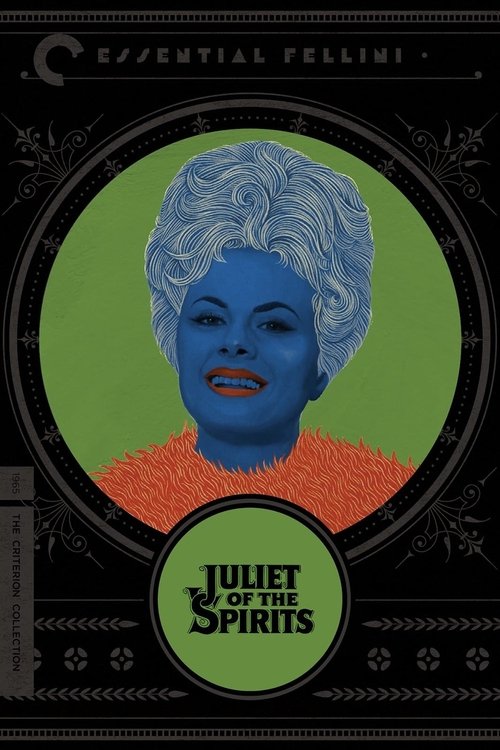
Juliet of the Spirits
1965 · Federico Fellini
When you want pure visual intoxication and something to chew on for days — a film for a curious, unhurried evening, not a plot-hungry one. Definitely a challenge in the best sense: bring patience, leave with images you won't shake.
What it's about
Giulietta is a well-off Roman housewife who begins to suspect her husband is cheating — and then a parlor séance cracks something open, and spirits, memories, and visions start flooding into her orderly life. What follows is her journey through mystics, decadent neighbors, and her own painful past as she tries to figure out which voices to trust, and who she is apart from her marriage.
The experience
Like wandering through someone else's dream while wide awake — lush, strange, funny, and unmoored, with images so saturated they feel edible. It drifts rather than drives, and the reward is surrendering to it.
Performances
Giulietta Masina carries the film with an open, wounded expressiveness — small and still at the center of the pandemonium, she makes the wildest fantasy feel like an honest portrait of a woman's inner life.
The craft
Fellini's first color feature, and he treats color like a new toy he refuses to put down — screaming reds, hallucinatory greens, costumes and sets crowding every frame like a carnival that got loose. It's one of the most visually extravagant films ever made and begs for the biggest, brightest screen you can find.
Why it matters
A landmark of Italian art cinema that showed the dream-logic style of 8½ could be turned outward onto a woman's psyche, and a touchstone for filmmakers who paint the unconscious directly onto the screen.
Snapshot
Fellini's first feature film in color is a hallucinatory, overflowing portrait of Giulietta Carini, a prosperous but spiritually adrift Roman housewife who begins to suspect her husband of infidelity and is gradually overwhelmed by visions, spirits, and memories she can neither fully trust nor suppress. Where 8½ (1963) had excavated a male artist's psyche in black-and-white chiaroscuro, Juliet of the Spirits turns the same autobiographical-fantastical method outward onto a woman — and into saturated, almost hallucinogenic color. The result is one of Italian art cinema's most formally extravagant works: a film that treats the unconscious not as a literary metaphor but as a literal mise-en-scène, crowding the frame with spirits, carnival grotesques, and sensual apparitions until the border between Giulietta's interior life and the visible world dissolves entirely. It is simultaneously a meditation on Catholic repression, a dissection of bourgeois marriage, and a record of Fellini's sustained engagement with Jungian psychoanalysis — a process he had been undergoing throughout the early 1960s and which shapes the film's architecture at every level.
Industry & production
The film was produced by Angelo Rizzoli and Rizzoli Film, the same house behind La Dolce Vita and 8½, giving Fellini a level of creative autonomy unusual in European commercial production of the period. Clemente Fracassi served as production manager. The international distribution was handled by Embassy Pictures in the United States, reflecting the global art-house appetite that Fellini's prior Oscar-winning success had opened.
The central casting decision was Giulietta Masina, Fellini's wife since 1943 and the star of La Strada (1954) and Nights of Cabiria (1957). Casting one's own spouse in a role that dramatizes marital suspicion and emotional suffocation gave the project an unavoidable biographical charge that both Fellini and Masina acknowledged — though both were also careful to insist on the fictional distance. Sandra Milo, already associated with Fellini through 8½, was cast as the hedonistic neighbor Suzy, functioning as Giulietta's libidinal double and structural foil. The international co-production context also brought in French and Spanish distribution partners, which partly explains the film's relatively lavish budget by Italian standards of the time.
Production centered on Cinecittà, the Rome studio complex where Fellini had staged the constructed realities of La Dolce Vita and 8½. Piero Gherardi, who had designed costumes and sets for both those films and received Academy Awards for his work on them, served again as production designer and costume designer, building the interiors of Giulietta's villa, Suzy's extraordinary pleasure-villa next door, and the various dreamscape environments from the ground up on the Cinecittà stages. This studio-bound approach was deliberate: Fellini, who distrusted location shooting as insufficiently controllable, wanted every environment to function as an externalization of psychological state — a goal achievable only through total design control.
Technology
Juliet of the Spirits was Fellini's first feature in color, and the transition was neither incidental nor cosmetic. The choice to work in color was closely bound up with the film's thematic and psychological program: color here functions as a language of emotional intensity, not a documentary record of appearances. Gianni Di Venanzo, the cinematographer, worked in Technicolor-adjacent processes that allowed for vivid, highly saturated results, and the film deploys color symbolically and expressively throughout — the bleached, restrained whites and beiges of Giulietta's bourgeois domestic world against the operatic reds, oranges, and purples of her visions and of Suzy's transgressive domain.
Di Venanzo, who had previously shot Antonioni's L'Eclisse (1962) and La Notte (1961), brought to the film an extraordinarily refined handling of diffused light and soft focus, creating a dreamlike luminosity that refused the crisp, indexical quality of conventional color photography. He died in 1966 at the age of forty-five, making Juliet of the Spirits among his final completed features and one of the culminating achievements of his brief career. The film was shot in the widescreen 1.85:1 ratio, with the wide frame enabling Fellini and Di Venanzo to populate the edges of compositions with apparitional figures and visual clutter that generates unease without direct confrontation.
Technique
Cinematography
Di Venanzo's approach is consistently anti-naturalistic. The interiors of the villa are bathed in flat, even light that subtly estranges the domestic from the comfortable; the vision sequences shift to a warmer, more directional illumination that makes faces glow from within and gives spirits a tactile, almost material presence. Long lenses compress space in crowd scenes, pressing figures together in a way that reads as claustrophobic or hallucinatory. The camera frequently maintains a middle distance from Masina that frames her as both observing subject and object of scrutiny, capturing the peculiar double consciousness of a woman who is both protagonist of her own interiority and a figure surveilled by the social world around her.
Editing
Ruggero Mastroianni, younger brother of Marcello and a key figure in Italian art cinema of the period, served as editor. The cutting between Giulietta's real-world scenes and her visions eschews conventional optical transitions — the dissolves and superimpositions of classical Hollywood — in favor of hard cuts that give the visions the same ontological weight as the reality sequences. This refusal to mark the distinction conventionally is central to the film's effect: vision and waking life occupy the same temporal and spatial register, making Giulietta's experience of her own mind as immediate and inescapable as her marriage.
Mise-en-scène / staging
Gherardi's design is the film's most commented formal feature. Suzy's villa, in particular, is a monument of production design: a palazzo of erotic theater, complete with a slide descending into a swimming pool, elaborate canopied beds, and a decorative vocabulary that blends Art Nouveau, Indian temple iconography, and Roman baroque into something at once sumptuous and feverish. Fellini stages the film's crowd scenes and vision sequences with his characteristic orchestral density — figures fill every plane of the image, and the frame's edges are rarely quiet. This accumulative visual logic recalls the circus and carnival traditions Fellini had drawn on since La Strada, but here the excess is feminized: it belongs to Giulietta's overloaded interiority rather than to the spectacle of public performance.
Sound
Nino Rota's score is among his more complex contributions to Fellini's films. Working within the Fellini-Rota collaboration's established idiom of carousel-like melodies, operatic swells, and musical quotation, Rota here introduces passages of atonal dissonance and distorted folk melody to underscore the visions. The sound design distinguishes between the muffled, slightly reverberant acoustic of Giulietta's everyday world and the heightened, sometimes artificially bright sonic texture of her hallucinations — a subtle but persistent cue to the permeability of the boundary.
Performance
Masina's performance is among the most formally demanding of her career. Unlike the expressive, almost mime-derived work she brought to Cabiria and Gelsomina, she is asked here to play repression and implosion — a character whose interiority is enormous but whose external comportment is restricted by social form. Her face is frequently held in uncertainty, in a watchful attentiveness that reads differently depending on which layer of the film's reality one is tracking. The performance has attracted debate in feminist film scholarship: some critics argue Masina succeeds in making Giulietta's liberation genuinely felt; others contend that the film's fantasy projections remain structured by a male director's assumptions about what female desire looks like. That tension is perhaps irresolvable, but it is also the film's most productive critical fault line.
Narrative & dramatic mode
The film operates in what might be called a permeable realism: the diegetic world is established with enough social and domestic specificity — the suburban Roman villa, the bourgeois friends, the hired investigator trailing Giorgio — to anchor Giulietta's situation, but that anchor is systematically loosened by visions that bleed into the waking scenes without announcement. The narrative progression is not plot-driven in any conventional sense; it moves instead through a series of encounters, séances, and apparitions that function more like a psychic case history than a story. The climax is correspondingly interior: not the revelation of Giorgio's infidelity (this arrives relatively early and without dramatic fanfare) but Giulietta's gradual confrontation with the childhood wound — the Catholic school, the martyred saint, the authoritarian grandfather — that has structured her self-suppression. The film's final scene, Giulietta leaving the villa and walking into the light as the spirits release her, has the quality of a therapeutic resolution more than a dramatic one.
Genre & cycle
Juliet of the Spirits belongs loosely to the European art cinema of the 1960s, specifically to that cycle's intensified interest in female interiority and subjectivity — a thread running from Bergman's Through a Glass Darkly (1961) and Persona (1966) to Antonioni's Red Desert (1964) and Demy's work in France. Within Italian cinema, it participates in the broader boom of internationally oriented prestige filmmaking that followed the critical and commercial success of La Dolce Vita, when Italian producers briefly had the appetite and capital to support formally ambitious work. It also belongs, more specifically, to a smaller cycle of Italian films engaged with the occult and spiritualism — not the genre horror of giallo and Bava, which was developing simultaneously, but a more literary interest in séances, mediumship, and psychic phenomena that reflected a widespread popular fascination in postwar Italy.
Authorship & method
The screenplay was developed collaboratively, as was Fellini's consistent practice. Tullio Pinelli and Brunello Rondi, both longtime Fellini collaborators, contributed to the script alongside the director, with the process involving extensive improvisation and revision during pre-production. Ennio Flaiano, who had co-written La Dolce Vita and 8½, was less involved at this stage, marking a slight shift in the core writing team.
Fellini's most important intellectual influence on the film was his ongoing Jungian psychoanalysis. He had begun analysis with Dr. Ernst Bernhard, a prominent Jungian analyst in Rome, in the early 1960s, and Bernhard's frameworks — the collective unconscious, the anima, the shadow — structured both the content of the visions and their narrative logic. The spirits that besiege Giulietta can be read as Jungian archetypes made literal; the film's therapeutic arc corresponds to a Jungian process of individuation. Fellini himself spoke publicly about this influence, though the film translates Jungian schema into a sensory and cinematic idiom rather than a diagrammatic one.
Gherardi's contribution as production designer and costumer was so integrated into the film's conception that the line between his work and Fellini's is difficult to draw: the visual system of the film — its color code, its spatial logic, its accumulative excess — emerged from their close collaboration. Rota's score similarly cannot be separated from the film's emotional tempo; his music does not illustrate the images so much as inflect their psychological register.
Movement / national cinema
The film sits at the apex of postwar Italian art cinema, a movement centered on a generation of directors — Fellini, Antonioni, Visconti, Pasolini — working within and against the industrial structures of Cinecittà and the international co-production market. This movement was characterized by formal experimentation, a turn toward subjectivity and interiority, and a sustained critique of Italian modernity and its discontents — the legacy of Fascism, the trauma of war, the spiritual vacuity of the economic miracle. Juliet of the Spirits engages all three: the bourgeois milieu Giulietta inhabits is the world of the miracle's beneficiaries, and her crisis is in part a critique of what that world costs its women.
Era / period
1965 places the film at an inflection point in Italian and European film culture: the nouvelle vague had demonstrated internationally the viability of a formally experimental art cinema, and Italian filmmakers were both responding to and competing with that French example. Domestically, the early 1960s boom was beginning to consolidate into a more stable (and more conservative) art-film establishment. The mid-decade period also saw the beginning of the political radicalization that would culminate in 1968, and some critics have read Juliet of the Spirits — with its critique of bourgeois domesticity, Catholic repression, and the containment of female desire — as an early symptom of that cultural shift, though Fellini himself resisted direct political readings of his work.
Themes
The film's dominant preoccupation is with the structures — social, religious, psychological — that suppress a woman's knowledge of herself. The Catholic Church functions as the primary institution of repression: the convent school flashbacks, the martyred saint who appears as a vision, and the guilt-laden eros that runs through Giulietta's spiritual experience all point to Catholicism as the system that taught her to distrust and punish desire. Bourgeois marriage is its secular counterpart: Giorgio's infidelity is less a dramatic event than a symptom of a marriage organized around appearances and the management of female interiority.
Against these structures, the film poses liberation — but a liberation ambiguously gendered. The sensual world of Suzy, which represents one available form of female freedom, is spectacularized in terms that are visually exciting but not obviously liberating: Suzy's pleasure-villa is also a kind of trap, a mirror-image confinement organized around the male gaze rather than its refusal. The film's resolution — Giulietta alone, the spirits gone, the husband gone — is quiet and deliberately open: freedom from illusion rather than access to a new life. Whether this constitutes genuine liberation or a consolatory ambiguity has remained a productive question in the film's critical reception.
Reception, canon & influence
The film premiered at the Venice Film Festival in September 1965 to considerable attention, benefiting from the enormous international profile Fellini had accumulated. Initial critical reception was mixed in ways that tracked existing fault lines in the critical discourse about Fellini: admirers of his work found in it a logical and enriching extension of 8½'s method, while detractors who had already grown impatient with Fellini's baroque self-indulgence found the film excessive and self-congratulatory. The absence of a strong narrative through-line and the relentlessness of the visual accumulation were common complaints. In the United States and Britain, the film found its audience primarily in the art-house circuits where Fellini's name alone was sufficient draw.
Over subsequent decades, critical reassessment has been uneven. Feminist film scholarship from the 1970s onward engaged seriously with the film's representation of female interiority, producing readings that are attentive both to the film's critique of patriarchal structures and to the tensions inherent in a male director's claim to ventriloquize female experience. Scholars including Millicent Marcus, in her work on Italian cinema, and others working in the Italian film studies tradition have situated the film within the broader politics of gender and representation in 1960s Italian culture.
Influences on the film: The most direct formal antecedent is 8½ itself, and the shadow of that film hangs over Juliet of the Spirits in ways that have sometimes limited the latter's independent reputation — it has too often been read as a supplement to or feminization of 8½ rather than as a major work in its own right. Fellini's own earlier work on female subjectivity (Nights of Cabiria above all) is a crucial context. Beyond Fellini, Buñuel's surrealist cinema — particularly the dream sequences of Belle de Jour (released 1967 but conceived in the same period) and The Exterminating Angel (1962) — shares the film's interest in bourgeois entrapment and hallucinatory intrusion. Bergman's chamber dramas of the early 1960s, with their focus on female psychology and spiritual crisis, are part of the same European art-cinema conversation, as is Antonioni's Red Desert (1964), which had similarly deployed color expressionistically to render psychological estrangement the year before.
Legacy: The film's influence has operated primarily through its visual and tonal example rather than through direct citation. Pedro Almodóvar's color-saturated melodramas of the 1980s and 1990s — their theatrical excess, their engagement with female interiority, their willingness to treat the domestic as a space of barely suppressed hallucination — are the most frequently noted lineage, though Almodóvar brings his own very different cultural and political formation to the inheritance. The film's model of fantasy sequence integrated into a realist domestic frame has been widely adopted in European and American art cinema, though usually with greater narrative discipline. More broadly, Juliet of the Spirits stands as one of the most ambitious attempts in the cinema of its era to render a woman's inner life in fully cinematic terms — not through voice-over or psychological exposition, but through the medium's own visual and sonic resources. That the attempt remains contested, formally thrilling, and irreducible to any single critical account is perhaps the best measure of its genuine ambition.
A Deleuzian reading
Hold one frame in your mind.
The full Deleuzian reading of Juliet of the Spirits →
Reception
Landing right after 8½, it struck many 1965 critics as self-indulgent overspill from the maestro — though it still took the Golden Globe for Best Foreign Film. Decades on, its delirious Technicolor maximalism has been thoroughly reappraised, and it's now a go-to touchstone for color design in cinema.
How Juliet of the Spirits was received, from release to now →
Influences: the films it descends from and the films it influenced
- 8½ (1963) — Gianni Di Venanzo photographed both films, and the hard-cut grammar of permeable realism — hallucination entering continuity with no optical transition marker — was first systematized here and transplanted directly into Juliet.
- Nights of Cabiria (1957) — Giulietta Masina's method of sustained emotional containment breaking catastrophically — repression-and-implosion — was established here and transplanted into Juliet, where the same face carries a radically different social register.
- Red Desert (1964) — Carlo Di Palma's deployment of expressive color saturation to map a bourgeois woman's psychological alienation in an Italian domestic setting immediately precedes and sets the chromatic precedent for Juliet's total-color strategy.
- The Exterminating Angel (1962) — The structural device of bourgeois characters held captive in a social space by invisible psychic forces — entrapment without visible causation — provides the architectural logic Fellini adapts for Juliet's domestic psychological imprisonment.
- Viridiana (1961) — Catholic repression producing hallucinatory transgressive fantasy within a bourgeois domestic frame, rendered through staging that makes the repressed visible without psychological explanation or optical surrealism.
- Through a Glass Darkly (1961) — A female protagonist whose hallucinatory religious visions intrude into a realist domestic space through staging and performance rather than optical manipulation — the template Fellini scales up into full chromatic production design.
- Wild Strawberries (1957) — The Jungian therapeutic arc — a protagonist's staged encounter with repressed figures from their own unconscious structured as a journey toward psychological integration — provides the narrative armature Fellini feminizes in Juliet.
- The Bitter Tears of Petra von Kant (1972) — A single elaborately dressed interior functions as a total expressive environment through which female repression-and-implosion is performed, extending Juliet's method of treating production design as the direct projection of a woman's psychological state.
- Suspiria (1977) — Luciano Tovoli's supersaturated color design — crimson and emerald pushed to abstraction — directly inherits Juliet's total production design logic, transposing it into genre horror while preserving its function as spatial psychological destabilization.
- Women on the Verge of a Nervous Breakdown (1988) — Theatrical color saturation and the treatment of the domestic apartment as a space of barely-suppressed psychological crisis directly inherit Juliet's model of chromatic mise-en-scène excess as the primary register of female interiority.
- All About My Mother (1999) — Antxón Gómez's production design uses accumulative chromatic intensity — deep reds and stage-influenced décor — to carry emotional interiority, extending Juliet's model of color-saturated total design as psychological notation into the register of grief and maternal loss.
- Mulholland Drive (2001) — The structural grammar of permeable realism — a female protagonist's interior life intrudes into and ultimately displaces the realist narrative through unannounced hard cuts — directly inherits Juliet's editing logic for dissolving the boundary between fantasy and outer reality.
- Satyricon (1969) — Rotunno's first Fellini collaboration introduced the theatrically arbitrary color lighting system — warm amber practical sources punctuated by impossible cold fills — and the method of staging costumed bodies as decorative spectacle within anamorphic frames; Satyricon extends this grammar from female fantasy to ancient violence.
- House (1977) — Precedent for the candy-box color palette — surreal domestic space rendered in saturated storybook hues as an externalized interior life.
- The Hourglass Sanatorium (1973) — Externalized a psychic interior through overloaded, saturated decorative mise-en-scène where costume, foliage and bric-a-brac crowd the frame — the same principle of rendering subjectivity via baroque set-dressing rather than dialogue.
- Belle de Jour (1967) — Developed concurrently, both films use unannounced hard cuts to move a bourgeois wife into her own fantasy life with no transition marker, refusing to demarcate the boundary between social reality and interior imagination.
- Persona (1966) — Sven Nykvist's diffused soft-focus portraiture and the treatment of female psychological dissolution through total mise-en-scène integration — décor, costume, and staging carrying psychological meaning without exposition — runs parallel to Juliet's visual method.
- Daisies (1966) — Female subjectivity rendered through anarchic accumulative visual density — costume, color, and spatial overload signaling psychological disruption — and the formal refusal of narrative causation as a feminist cinematographic strategy.
Similar films
- 8½ (1963) — influence & lineage
- Nights of Cabiria (1957) — influence & lineage
- Red Desert (1964) — influence & lineage
- Belle de Jour (1967) — influence & lineage
- Suspiria (1977) — influence & lineage
- Persona (1966) — influence & lineage
- La Dolce Vita (1960) — same viewing thread
- I Vitelloni (1953) — same viewing thread
All the films related to Juliet of the Spirits →
Watch it with: curated runs of related films
- Adrift in the Modern World — Watch these when you want to drift through postwar Rome and Paris alongside people who have everything and feel nothing — they rhyme on beautiful boredom, aimless days, and a search for meaning that modern comfort keeps failing to supply.