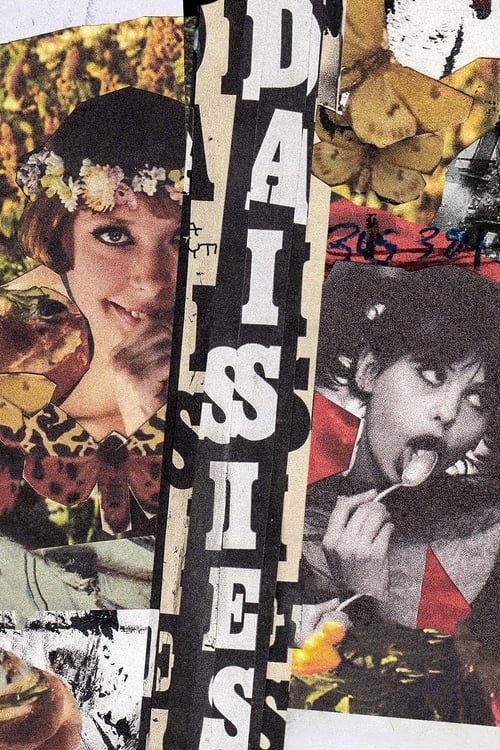
Daisies
1966 · Věra Chytilová
For when you're feeling mischievous and want cinema with the rules torn out — a short, anarchic jolt rather than a comfort watch. Reach for it when you want to be dazzled and provoked, not soothed.
What it's about
Two teenage girls, both named Marie, look at the world, decide it has gone bad, and resolve to go bad right along with it. What follows is a spree of pranks and appetites — scamming older men out of dinners, gorging on food, wrecking rooms, unraveling every social nicety in their path — staged as a chain of escapades rather than a plot. Made in 1960s Czechoslovakia, it's rebellion in its purest, most gleeful form: two girls against everything.
The experience
It feels like being inside a scrapbook that's caught fire — colors shift mid-scene, cuts land like slaps, sounds detach from what you're seeing. It's funny, bratty, and disorienting in equal measure, over in barely 75 minutes and buzzing in your head long after.
Performances
Jitka Cerhová and Ivana Karbanová, both non-professionals, play the two Maries as giggling agents of chaos — their doll-like affect and total commitment are what keep the anarchy charming instead of grating.
The craft
Chytilová and cinematographer Jaroslav Kučera throw everything at the frame: tinted monochrome, sudden color shifts, collage cutting, jump cuts, sound effects that mock the image. With designer Ester Krumbachová they built a film that behaves like its heroines — greedy, destructive, and gorgeous — and the riot of color and texture genuinely rewards a big, bright screen.
Why it matters
Banned by the Czechoslovak authorities — officially for its wastefulness — with Chytilová frozen out of filmmaking afterward, it became the emblem of the Czechoslovak New Wave and a touchstone for feminist and punk-spirited cinema ever since.
Snapshot
Sedmikrásky (Daisies) is the best-known film of the Czechoslovak New Wave and one of the most radical feminist and formalist works of 1960s European cinema. Two young women, both named Marie, decide that because the world has "gone bad," they too will be bad — embarking on an episodic spree of gluttony, deception, and destruction that culminates in a demolished banquet hall. Věra Chytilová, working with cinematographer Jaroslav Kučera and co-writer/designer Ester Krumbachová, transforms this thin anecdote into a barrage of visual experiment: tinted monochrome, collage editing, jump cuts, and a soundtrack severed from naturalism. The film was completed in 1966, banned by the Czechoslovak authorities not long after for its "depiction of the wanton" and its wasting of food, and Chytilová was effectively prevented from working for several years. Today it is canonical — a touchstone for feminist film theory, avant-garde practice, and the study of state-socialist art cinema. Its reputation rests less on story than on the sustained audacity of its form and its refusal to resolve into a stable moral or political message.
Industry & production
Daisies was produced within the state-run Czechoslovak film industry, centered on the Barrandov Studios in Prague, and financed through the nationalized production system that also sustained the New Wave films of Miloš Forman, Jiří Menzel, Jan Němec, and others. The mid-1960s liberalization that preceded the 1968 Prague Spring created an unusual pocket of tolerance: films could be experimental and obliquely critical so long as they passed through the studio's dramaturgical groups and censorship review. Daisies emerged from this window. Chytilová had trained at FAMU (the Film and TV School of the Academy of Performing Arts in Prague) and had already drawn attention with the feature Something Different (O něčem jiném, 1963).
The production was small in scale but technically ambitious, relying on optical effects, color processing, and elaborate art direction rather than expensive sets or stars. The two leads, Jitka Cerhová and Ivana Karbanová, were largely non-professional performers, consistent with the New Wave's preference for fresh, untrained faces. The film's afterlife with the authorities is the most-cited fact of its production history: it was banned domestically, and Chytilová faced a period of enforced inactivity, unable to direct again in Czechoslovakia until the mid-1970s. Accounts commonly attribute official objection to the film's imagery of squandered food; the precise administrative record is less widely documented in English-language sources, and specific internal deliberations should be treated with appropriate caution.
Technology
The film was shot on 35mm and exploits the full apparatus of mid-1960s laboratory technique as expressive material rather than transparent support. Its most conspicuous technological gesture is color manipulation: sequences shift between black-and-white, monochrome tints (rose, amber, green, blue), and full color, achieved through filtration and laboratory processing. These are not incidental flourishes but a structural principle — color is applied and withdrawn to keep the viewer aware of the image as a manufactured surface.
Optical printing and in-camera effects extend this. The film uses superimposition, cut-out collage, kaleidoscopic fragmentation of the frame, and rapid montage of disparate materials. The technology of the editing bench — the splice itself — is foregrounded rather than hidden. In this sense Daisies belongs to a lineage of films that treat the physical and chemical properties of the medium as content. The resources available within the Barrandov system, including its optical and processing departments, made this laboratory-intensive approach feasible on a modest budget.
Technique
Cinematography
Jaroslav Kučera's photography is inseparable from the film's meaning. Rather than serving legibility, the camera participates in the two Maries' anarchy. Kučera moves fluidly between registers: crisp, high-contrast compositions; deliberately artificial tinted frames; and passages of collage in which the image dissolves into abstraction. Framing is frequently frontal and flattened, emphasizing the picture plane over illusionistic depth. Handheld mobility and abrupt scale shifts refuse the settled, invisible camera of classical style. Kučera — a major figure of Czech cinematography and Chytilová's husband at the time — treats the lens as a co-conspirator in the girls' assault on order, and the film's celebrated set pieces (the fruit-and-flower collages, the multiplied and re-colored bodies) are as much photographic events as narrative ones.
Editing
Editing is arguably the film's dominant expressive system. Daisies is built on discontinuity: jump cuts, non-matching action, sudden interpolations of unrelated footage (industrial imagery, flowers, cut paper), and rhythmic bursts that fragment a single gesture into a stutter. The banquet-destruction climax is a crescendo of accelerating cutting. This montage aesthetic aligns the film with the Soviet avant-garde tradition of Eisenstein and Vertov — cutting as argument and shock rather than as smooth transport between story beats. The effect is anti-illusionist: the viewer is never allowed to forget that the film is assembled. Continuity is sacrificed deliberately, and the "meaning" of a sequence often lies in the collision of images rather than in any depicted event.
Mise-en-scène / staging
Ester Krumbachová's contribution to design and conception is central here. The film's world is deliberately artificial: rooms cluttered with props, tables laden with food, costumes and settings arranged as compositions to be dismantled. Staging is theatrical and often absurdist — the Maries pose, recline, and perform for the camera as much as they act within a scene. Food is the recurring material of the mise-en-scène, presented as spectacle and then as debris. The famous banquet is staged as a lavish tableau explicitly built to be desecrated. Objects, textures, and surfaces carry as much weight as human figures; the frame is treated as a canvas for arrangement and destruction.
Sound
The soundtrack is detached from realist synchronization. Diegetic sound, music, and effects are used elliptically and often ironically — a brass motif, mechanical noises, snatches of dialogue that repeat or dislocate. Voices are sometimes stylized or fragmented rather than delivered as naturalistic conversation. The sound design reinforces the film's collage logic: it comments on, contradicts, or punctuates the image rather than anchoring it. Silence and abrupt aural cuts contribute to the sense of a world that has come unhinged from ordinary cause and effect.
Performance
Jitka Cerhová and Ivana Karbanová play the two Maries as a near-interchangeable pair — giggling, provocative, alternately childlike and predatory. Their performance style is anti-psychological: they are figures or types rather than rounded characters, and the film offers little interior motivation. They mug, pose, and perform archness directly at the camera. This deliberate flatness is essential to the film's design; the Maries are less individuals than a principle of disruption, and the actresses' willingness to be stylized, unglamorous, and grotesque is a key part of the effect.
Narrative & dramatic mode
Daisies is essentially plotless by the standards of conventional drama. It proceeds as a series of loosely connected episodes bound by a single premise the girls state aloud: since everything is spoiled, they will be spoiled too. There is no arc of development, no causal chain leading to consequence in the classical sense, and no psychological resolution. The mode is closer to satire, farce, and avant-garde provocation than to narrative drama. Dada and Surrealism are the relevant reference points — the film shares their taste for non-sequitur, absurdist juxtaposition, and gleeful negation.
The one gesture toward structure is the ending, in which the Maries, having wrecked a banquet hall, attempt to "repair" the damage and declare themselves good again, only to be crushed — a mordant, ambiguous coda over which the film appends a dedication concerning those who get upset over trampled lettuce. This closing irony has been read both as an ostensible moral concession to censors and as a further layer of mockery. The refusal of conventional narrative is not a failure of construction but the film's central formal argument.
Genre & cycle
Nominally a comedy-drama, Daisies resists genre placement. It functions as absurdist satire, feminist provocation, and formal experiment simultaneously. Within the Czechoslovak New Wave it belongs to the movement's more radical, non-realist wing — closer to Jan Němec's dreamlike A Report on the Party and the Guests (1966) than to the observational comedies of Forman or Menzel. It can be situated in a broader 1960s European cycle of anti-narrative, politically restless art cinema alongside Godard's contemporaneous experiments and the international current of Pop and collage aesthetics. If it belongs to a "cycle," it is the short-lived flourishing of formally daring films that the pre-1968 thaw made briefly possible.
Authorship & method
Daisies is the signature achievement of Věra Chytilová (1929–2014), the leading woman director of the Czechoslovak New Wave and one of the era's most uncompromising filmmakers. Trained at FAMU, Chytilová combined a background that included work outside cinema with a rigorous formalist sensibility and a lifelong resistance to being labeled — she often rejected the "feminist" tag even as her films became foundational to feminist criticism. Her method here is confrontational and constructivist: build a world of order, comfort, and social ritual, then subject it to systematic derangement.
Crucial to the film's identity is collaboration. Ester Krumbachová, co-writer and designer, was a defining creative force of the Czech New Wave, and her sensibility — visual invention, dark irony, an interest in artifice and the grotesque — is woven through the film's conception and look. Jaroslav Kučera, the cinematographer, supplied the technical daring that realized the imagery. This triangulation of a woman director, a woman writer-designer, and a virtuoso cinematographer is central to any account of the film's authorship; Daisies is genuinely a shared creation, even as Chytilová's directorial vision governs it. Chytilová's later work (Fruit of Paradise, 1970, again with Kučera and Krumbachová; and films made after her return to directing in the 1970s) confirms the concerns visible here: form as argument, and a satirical eye trained on hypocrisy and appetite.
Movement / national cinema
The film is a cornerstone of the Czechoslovak New Wave (Nová vlna), the remarkable burst of filmmaking that emerged from FAMU-trained directors in the early-to-mid 1960s and that produced two foreign-language Academy Award winners in the period (Kadár and Klos's The Shop on Main Street and Menzel's Closely Watched Trains). Within that movement, Daisies occupies the experimental extreme. Where much of the New Wave favored humane realism, wry observation, and everyday texture, Chytilová pursued outright avant-garde abstraction. The movement's political and creative space was foreclosed after the Soviet-led invasion of August 1968 ended the Prague Spring; the subsequent "normalization" curtailed or exiled many of its figures. Daisies thus stands as an emblem of what the national cinema achieved in its brief opening and of the reprisals that followed.
Era / period
Daisies is a document of the mid-1960s socialist thaw — the loosening of cultural controls in Czechoslovakia that preceded the reforms of 1968. That context is essential. The film's imagery of consumption and waste, its mockery of social ritual and propriety, and its refusal of edifying "positive" content read against the backdrop of both state-socialist orthodoxy and the surrounding European ferment of 1966–68. It shares the decade's global spirit of youthful revolt, Pop-art surface, and anti-authoritarian energy, but filters it through the specific pressures of life under a communist regime. The ban that followed makes the film inseparable from its moment: it marks the outer limit of what the thaw would tolerate.
Themes
The film's governing theme is destructive negation as a response to a corrupted world — the Maries' logic that if everything is spoiled, spoilage is the only honest way to live. Consumption is central: eating, wasting, and destroying food operate as a critique of appetite, consumer excess, and, by extension, the hollow abundance offered by both consumerist and official-socialist promises. Gender runs throughout: the two women weaponize the roles of the flirtatious, decorative young female, luring and dismissing older men, parodying feminine performance even as they enact it. This has made the film a durable feminist text, though Chytilová resisted didactic readings.
Other threads include artifice and the constructed nature of images (the film constantly reminds us it is made), the tension between order and chaos, and moral ambiguity — the film withholds any clear judgment on its heroines' anarchy, and its ironic ending refuses to convert the spectacle into a lesson. Destruction is presented as both liberating and self-consuming, and the film declines to resolve which.
Reception, canon & influence
On release the film was censored in Czechoslovakia and its director penalized, which shaped its early reputation as much as any review. Internationally it circulated in festival and art-house contexts and accrued critical prestige over subsequent decades, particularly as feminist film scholarship and avant-garde studies took it up. It is now widely regarded as a landmark — routinely cited among the essential works of both the Czechoslovak New Wave and 1960s experimental cinema, and preserved and reissued in restored form for later generations.
Influences on the film (backward): Daisies draws on the historical avant-gardes — Dada's provocation and anti-art stance, Surrealism's absurdist juxtaposition (with a specifically Czech surrealist lineage in the background), and the Soviet montage tradition of Eisenstein and Vertov in its collision-based editing. Contemporary Pop art's flat, collaged surfaces and the broader 1960s international climate of formal rule-breaking, exemplified by Godard, are also legible antecedents.
Legacy (forward): The film became foundational to feminist film theory and to the study of women's authorship in cinema, and a reference point for experimental and collage filmmaking. It anchors Chytilová's own reputation as the New Wave's leading woman director and stands with Krumbachová's and Kučera's contributions as a model of collaborative avant-garde practice. Its imagery and spirit have been repeatedly invoked by later filmmakers, artists, and critics interested in feminist provocation and formal excess, and it remains a fixture of film-school curricula and repertory programming. Specific lines of direct homage are best asserted case by case; the more secure claim is that Daisies helped legitimate a mode of playful, destructive, image-driven cinema that continues to be rediscovered.
A Deleuzian reading
Two girls lie on a bed in swimsuits, and when they move their limbs creak like rusted hinges — the sound of dolls, not bodies.
The full Deleuzian reading of Daisies →
Reception
Banned at home almost immediately — Czechoslovak authorities shelved it and Chytilová spent years frozen out of filmmaking — while it slowly traveled abroad as an avant-garde curio. Now it's the crown jewel of the Czech New Wave and one of the most beloved experimental films on the internet, period.
How Daisies was received, from release to now →
How to watch Daisies: what to notice on a first viewing
- Listen for the girls' joints creaking like rusty hinges. Early on, small movements of the two Maries are dubbed with a creaking, mechanical sound, as if their bodies were dolls rather than people. The film tells you upfront that these are figures, not psychologically rounded characters.
- Notice the image suddenly tinted rose, amber, or green. Kučera shifts the whole frame into a single flat color without warning, then lets it drop back to normal photography just as abruptly. Color stops describing a real room and starts announcing that you're watching something made, not filmed.
- Watch a single gesture get chopped into several jump cuts. Chytilová fragments ordinary actions like a hand reaching or a head turning into repeated, mismatched cuts instead of one continuous movement. The cutting keeps reminding you the film is assembled, not a window onto anything continuous.
- Watch how much food gets handled, eaten, and wasted. Food recurs constantly as the two Maries eat, order, and discard meals through one loosely connected episode after another. Appetite and waste become the film's real material, more than any story it tells.
- Notice how interchangeable the two Maries seem to be. Jitka Cerhová and Ivana Karbanová play the pair as near-identical types, swapping registers between childlike and predatory scene to scene, with little inner life shown. You're watching a principle of disruption at work, not two individual people with a plan.
The whole guide to watching Daisies, with the keys for a rewatch →
Influences: the films it descends from and the films it influenced
- Un Chien Andalou (1929) — Its surrealist shock-cut juxtapositions and anti-art provocation supply the model for Daisies' collision editing, where images are joined for scandal and disjunction rather than continuity.
- Entr'acte (1924) — A Dadaist nonsense-cinema of absurd gags and rhythmic disjunction that licenses Daisies' plotless, prank-driven episodic structure.
- Ballet Mécanique (1924) — Its rhythmic montage of fragmented objects, faces, and machine parts prefigures Daisies' object-collage cutting and repetition-as-abstraction.
- Man with a Movie Camera (1929) — The self-reflexive, trick-laden montage that flaunts the apparatus feeds Daisies' constant foregrounding of editing, splicing, and film as manipulable material.
- Battleship Potemkin (1925) — Dialectical collision montage — meaning generated by the clash of shots — is the Soviet technique Daisies weaponizes for satire rather than agitation.
- Breathless (1960) — The jump cut as an expressive rupture of continuity, breaking spatial-temporal smoothness, is a direct editing debt visible throughout Daisies.
- A Woman Is a Woman (1961) — Pop-saturated color, self-aware artifice, and a playful female protagonist toying with the frame model Daisies' tongue-in-cheek treatment of color and performance.
- Meshes of the Afternoon (1943) — A pioneering woman-authored avant-garde film built on dream-logic repetition and female doubling, precedent for Daisies' two-Marie mirroring and anti-psychological interiority.
- Valerie and Her Week of Wonders (1970) — Krumbachová's design sensibility — artifice, the grotesque, decorative excess — animates its Czech-surrealist look, the shared visual DNA of Daisies.
- Sweet Movie (1974) — Extends Daisies' food-as-material transgression, deploying eating, waste, and the body as tools of feminist-political provocation and disgust.
- Céline and Julie Go Boating (1974) — Inherits the anarchic, plotless female-duo picaresque in which two women's games progressively dissolve narrative reality itself.
- Marie Antoinette (2006) — Deploys a Pop pastel palette and pastry/food-as-material excess in artificial tableaux to stage feminine consumption and appetite as critique, Daisies' banquet spirit in couture.
- The Forbidden Room (2015) — Builds its cinema from collage montage and optical-printer tinting, courting degraded, hand-processed film surfaces in the same laboratory-manipulated, materially self-conscious mode.
- if.... (1968) — Chytilová's within-film alternation between color and monochrome stock to signal shifts in ontological register — not historical period — is the closest technical precedent for Anderson's own color-monochrome switching logic.
- 3 Women (1977) — Two young women who perform femininity as an exchangeable, destabilizing game — progressively collapsing the distinction between their identities through deliberate role-swapping and anarchic self-invention — establishes the formal treatment of femininity-as-mutable-performance that 3 Women deepens into sustained psychological uncanny.
- Sweetie (1989) — A female-authored anarchic comedy that escalates to gleeful destruction, using formally disruptive, saturated imagery as provocation — the precedent for Sweetie's comedy-to-catastrophe arc driven by an unruly woman.
- Morgiana (1972) — Cinematographer Jaroslav Kučera's tinted filters, prismatic distortions and anti-naturalist image excess are the direct toolkit he brings to Morgiana's poisoned palette.
- A Report on the Party and the Guests (1966) — Co-written by Ester Krumbachová, it shares her dark-ironic absurdist allegory of social ritual and conformity, staged as artificial tableau.
- Diamonds of the Night (1964) — A Czech New Wave exercise in subjective, associative surrealist montage that ruptures linear narrative in the same collage idiom Daisies pushes to comedy.
- Fruit of Paradise (1970) — The same Chytilová–Krumbachová–Kučera team extends Daisies' tinted, optically-printed color abstraction and frontal artificial staging into near-total painterly non-narrative.
- The Colour of Pomegranates (1969) — Its frontal, flattened tableaux and openly artificial staging pursue the same anti-psychological, non-illusionist framing Daisies uses to refuse depth and realism.
- Juliet of the Spirits (1965) — Female subjectivity rendered through anarchic accumulative visual density — costume, color, and spatial overload signaling psychological disruption — and the formal refusal of narrative causation as a feminist cinematographic strategy.
- L'Âge d'or (1930) — Anarchic, anti-narrative assault on bourgeois decorum through free-associative collage editing and gleeful destruction of a banquet, extending Surrealist montage into the New Wave.
- The Cremator (1969) — The movement's collage editing and staccato match-cut rhythm wielded for absurdist black comedy — the same New Wave montage energy Herz channels into cremation-furnace cutting.
- One Sings, the Other Doesn't (1977) — Anarchic feminist play with song, costume, and collage as political refusal; the kinship lies in treating female friendship as joyous, formally disruptive rebellion rather than melodrama.
- The Firemen's Ball (1967) — Parallel Czech New Wave satire whose banquet-destruction climax similarly turns a table of food into an image of collective appetite and social collapse under the censors' noses.
Similar films
- Valerie and Her Week of Wonders (1970) — influence & lineage
- Battleship Potemkin (1925) — influence & lineage
- Céline and Julie Go Boating (1974) — influence & lineage
- Female Trouble (1976) — shared sensibility
- La Chinoise (1967) — shared sensibility
- Even Dwarfs Started Small (1971) — shared sensibility
- Marketa Lazarová (1967) — shared sensibility
- The Firemen's Ball (1967) — shared sensibility
All the films related to Daisies →
Watch it with: curated runs of related films
- Midnight Movie Provocations — Watch these when you want cinema at its most gorgeously deranged — cult objects that turn desire, violence, and pure anarchy into their own strange grace.