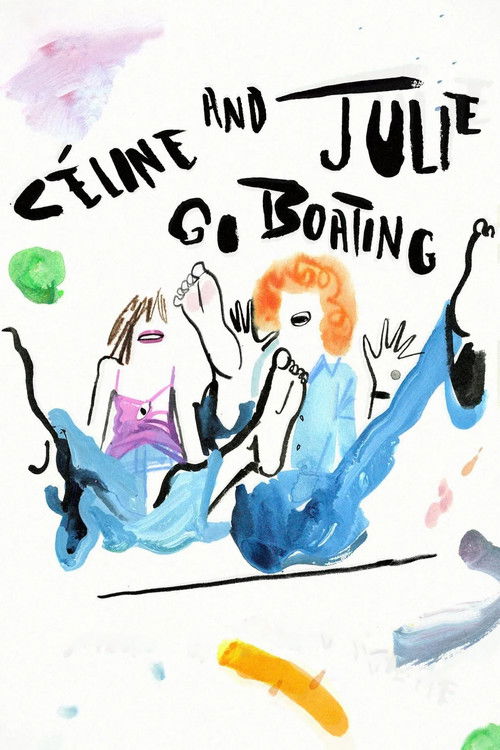
Céline and Julie Go Boating
1974 · Jacques Rivette
For an afternoon when you have real time to give and want to get pleasantly lost — playful, strange, and unhurried rather than gripping. Choose it when you're in the mood for a film that feels like a game you're invited to join.
What it's about
Julie, a daydreaming librarian, gets tangled up with Céline, a fast-talking cabaret magician, and the two become inseparable co-conspirators in Paris. Their games lead them to a quiet suburban house where a hothouse melodrama — a widower, two rival women, a child in danger — seems to replay itself endlessly, and the pair discover they can slip in and out of the story like spectators sneaking into a matinee. What begins as a lark becomes a mission: figure out the rules of the haunted plot, and maybe change it.
The experience
Loose, funny, and quietly hypnotic — for over three hours it ambles, doubles back, and repeats itself, and somewhere along the way the silliness turns spellbinding. It feels like being let in on a private game between two friends, with an undertow of mystery that keeps pulling you forward.
Performances
Juliet Berto and Dominique Labourier built their roles substantially through improvisation, and it shows in the best way: their rapport is giddy, conspiratorial, and completely lived-in — the friendship is the film's engine.
The craft
Rivette shapes the whole thing around repetition and duration, cutting between the women's shaggy everyday Paris and the stiff, perfumed melodrama in the house so that each keeps commenting on the other. The structure is the star: a movie about watching movies that turns spectatorship itself into a plot. It rewards patience and total immersion — a long sitting, no interruptions.
Why it matters
A touchstone of post-New Wave French cinema and one of the great films about female friendship, its story-within-a-story games echoed through decades of puzzle films and time-loop comedies that came after.
Snapshot
Céline et Julie vont en bateau is Jacques Rivette's three-and-a-quarter-hour comic fantasia about two women — a bookish, daydreaming librarian (Julie) and a mercurial cabaret magician (Céline) — who stumble into, and eventually hijack, a haunted melodrama unfolding inside a suburban house. Running roughly 193 minutes, it is at once one of the most playful and one of the most rigorous films of the post-Nouvelle Vague era: a movie about spectatorship, storytelling, and female friendship that treats narrative itself as a haunted house to be explored, mocked, and finally rewritten. Built substantially through improvisation and collaboration with its lead performers, the film distills Rivette's decade-long preoccupation with theater, conspiracy, and duration into something unexpectedly buoyant. It has become, over fifty years, a touchstone cult object — frequently cited as a formative influence on later filmmakers of feminine reverie and dream-logic, and regularly ranked among the essential French films of the 1970s.
Industry & production
The film was produced independently on a modest budget, in the artisanal, low-overhead mode Rivette had adopted after the collapse of large-scale ambitions surrounding Out 1 (1971). Barbet Schroeder — the producer, distributor, and director associated with Les Films du Losange, the Éric Rohmer–linked production house — is central to the film's existence; he is credited as producer and also appears on screen as Olivier, the widower at the heart of the interior melodrama. This double role is characteristic of the picture's cottage-industry ethos, in which collaborators wore several hats and the boundary between crew and cast was porous.
Production proceeded without a conventional locked screenplay. Rivette developed the material with his four principal actresses — Juliet Berto, Dominique Labourier, Bulle Ogier, and Marie-France Pisier — who are credited alongside him and the writer Eduardo de Gregorio for the film's conception and dialogue. This was consistent with Rivette's working method of the period: a framework of situations and character relations elaborated through rehearsal and shooting rather than a fixed script. The film was shot largely on location in Paris (Montmartre and its environs feature prominently) and in the house that anchors the interior narrative. Precise budget and box-office figures are not something I can state reliably; the film was, by any account, a commercial non-event on release and made its reputation slowly through critical writing and revival screenings rather than initial returns.
Technology
The film was shot on 35mm color stock using largely available or naturalistic light, in keeping with its low-budget, semi-improvised production. There is no evident reliance on optical trickery for its "magical" effects: the fantastic elements — the abrupt spatial dislocations, the candy-triggered flashes of the interior drama, the appearances and disappearances of characters — are achieved primarily through editing, framing, and performance rather than in-camera or laboratory effects. Rivette's technological conservatism is deliberate: the film locates the uncanny not in visual-effects apparatus but in the grammar of cinema itself — the cut, the ellipsis, the reprise. The one recurring quasi-effect, the fragmentary "memory" images of the house that the women recall after sucking their magic candy, is constructed through editing and sound rather than any special photographic process.
Technique
Cinematography
Jacques Renard is credited with the cinematography. The visual approach is loose, mobile, and observational in the exterior Paris sequences — handheld or lightly supported camera following the two women through parks, cafés, and streets, capturing the improvised, chase-like games of their friendship with a documentary immediacy that recalls the early Nouvelle Vague. By contrast, the interludes inside the haunted house are shot in a more fixed, frontal, theatrical register: static or slow compositions, a stagier sense of blocking, and a color palette that reads as artificial and hermetic against the daylight naturalism of the street scenes. This stylistic bifurcation is the film's central formal device — the "outside" of lived, contingent reality against the "inside" of a closed, endlessly repeating fiction.
Editing
Editing, credited to Nicole Lubtchansky, is arguably the film's true special effect and its structuring intelligence. The picture's dream-logic — the way Céline and Julie slip between their shared apartment life and the melodrama within the house, the way the house's story is delivered in scrambled, repeating fragments that the two women (and the audience) must piece together — is entirely a construction of the cut. The candy-induced recollections arrive as disordered shards that gradually cohere across the film's length, so that narrative comprehension becomes an explicit act of montage performed jointly by characters and viewer. The great length is not incidental: duration is used to naturalize the strange, letting the audience acclimate to the film's rules until the eventual "rescue" inside the fiction feels both surreal and earned.
Mise-en-scène / staging
The film stages a fundamental opposition between two spaces and two modes of being. The Paris exteriors are the domain of spontaneity, games, and female complicity; the house interior is the domain of fixed roles, fatal repetition, and stifled women. Within the house, the staging is consciously theatrical — Rivette's lifelong fascination with theater surfaces in the melodrama's mannered performances and its recurrence of the same scenes with slight variation, like a play in rehearsal that can never reach a new ending. The recurring props — the magic candy, the cat, the objects the women smuggle back from the fiction — function as connective tissue between the two worlds, tokens proving that the imaginary has left residue in the real.
Sound
The soundscape favours location naturalism in the exteriors and a more enclosed, artificial ambience inside the house. Music is used sparingly rather than as continuous scoring; the film's rhythm is carried by dialogue, silence, and the incantatory repetition of phrases from the interior drama. (Jean-Marie Sénia is associated with the film's music, though I would not overstate the score's prominence — the film is not driven by a memorable musical theme so much as by verbal and structural rhythm.) The repeated, half-remembered lines from the house melodrama take on an almost liturgical quality through reiteration.
Performance
Performance is the film's living center, and the collaborative method shows in the ease between the two leads. Dominique Labourier's Julie is grounded, watchful, a touch melancholic; Juliet Berto's Céline is quicksilver, theatrical, and provocative. Their rapport — improvised games, shared costumes, overlapping identities, a running gag of impersonating each other — gives the film its warmth and its feminist charge, presenting a self-sufficient female friendship that needs no romantic plot. Inside the house, Bulle Ogier and Marie-France Pisier play the rival women of the melodrama with a deliberately heightened, hothouse intensity, embodying exactly the trapped femininity that Céline and Julie will ultimately disrupt.
Narrative & dramatic mode
The film operates on two nested narrative planes. The outer plane is a picaresque, Alice-in-Wonderland friendship comedy: Julie follows Céline (or is it the reverse?) through a Paris of chases, disguises, and shared apartment life, the two women's identities increasingly interchangeable. The inner plane is a static, fatalistic melodrama — a Jamesian chamber tragedy set in a house where a widower, two rival women, and a doomed little girl named Madlyn replay the same story toward the same murder. The two women gain access to the inner story by taking employment there and, upon leaving, retain only fragmentary "memories" that a piece of magic candy allows them to recall. Across the film's length these fragments assemble into a legible plot, at which point Céline and Julie resolve to re-enter the fiction — not as passive spectators but as agents — to rescue the child from her scripted death. The dramatic mode is thus fundamentally about spectatorship becoming intervention: the audience-surrogates break the fourth wall of the story they are watching and change its ending. This is Rivette's most lucid dramatization of his recurring theme — fiction as a haunted, autonomous machine that can nonetheless be entered and altered.
Genre & cycle
Generically the film is a hybrid — comedy, fantasy, and melodrama braided together, with strong currents of the fairy tale and the ghost story. It belongs to Rivette's early-1970s cycle of long, theatrical, conspiracy-and-performance films, most directly connected to Out 1 (1971) and L'Amour fou (1969), and it can be read as the lightest, most accessible expression of that cycle's obsessions. It also participates in a broader 1970s art-cinema interest in reflexive, meta-fictional storytelling. Against the era's more austere modernist experiments, however, Céline and Julie is distinguished by its comedy and its generosity, functioning almost as a children's story for adults — a quality that has made it more durably beloved than many of its more forbidding contemporaries.
Authorship & method
The film is inconceivable without Rivette's collaborative authorship. The director supplied the architecture — the two-world structure, the theme of fiction-as-haunting, the theatrical framework — but the texture came from his performers. Juliet Berto and Dominique Labourier are credited as collaborators on the film's conception and dialogue, and the movie's charm derives largely from their invented business and rapport. Eduardo de Gregorio, the Argentine writer who worked with Rivette across this period, is generally associated with shaping the interior melodrama, whose closed, doom-laden literary quality draws on Henry James — the material is frequently traced to James's stories of houses, jealousy, and endangered children (notably "The Other House"). Bulle Ogier and Marie-France Pisier contributed to the interior story in which they perform. On the craft side, Nicole Lubtchansky's editing and Jacques Renard's photography are the decisive technical authorships. Barbet Schroeder's dual function as producer and on-screen widower underlines the film's collective, boundary-blurring nature. The method — situations elaborated through rehearsal, identity treated as fluid and performative, duration used to earn the fantastic — is quintessential Rivette.
Movement / national cinema
The film sits at the mature end of the French Nouvelle Vague lineage. Rivette was one of the original Cahiers du cinéma critics-turned-directors, alongside Godard, Truffaut, Chabrol, and Rohmer, and this film carries the movement's DNA — location shooting, improvisation, cinephile reflexivity, a fascination with theater and literature — while pushing it toward the more experimental, durational cinema of the 1970s. It is a landmark of French auteur cinema of that decade and, in retrospect, a signal work of women-centred French filmmaking, valued for its portrait of female friendship and imaginative autonomy at a moment when such portraits were rare.
Era / period
Made in the early-to-mid 1970s, the film reflects the post-1968 French cultural moment: a turn away from grand collective politics toward more intimate, playful, and reflexive experiments, and a growing feminist consciousness that surfaces here in the two women's self-contained world. It also belongs to the era of expansive, long-form art cinema, when directors like Rivette, Jacques Tati (in a different key), and others tested the outer limits of running time and narrative patience. The film's sensibility — whimsical, literary, faintly melancholic, resistant to commercial imperatives — is very much of its period.
Themes
The film's governing theme is the porousness of the boundary between fiction and reality: stories are presented as autonomous, haunted structures that can absorb spectators and that spectators can, in turn, invade and rewrite. Closely related is the theme of spectatorship as agency — the passive act of watching transformed into the active work of rescue and revision. A second major axis is female friendship and identity: Céline and Julie's fluid, interchangeable selves model a self-sufficient feminine world set against the trapped, fatally scripted women of the melodrama, giving the film a quietly feminist force. Memory, repetition, and play recur throughout — the magic candy as a figure for the way narrative fragments are recalled and reassembled, the games and disguises as a mode of freedom, the house's endless loop as a figure for stories that cannot end until someone breaks their rules. Underlying all of it is childhood and the fairy tale: the Alice in Wonderland logic, the endangered child, the sense that imaginative play is a serious and even liberating enterprise.
Reception, canon & influence
Critically, the film was recognized early by cinephile critics as a major achievement, though its length and strangeness kept it a specialist enthusiasm rather than a popular success on release; its wider canonization came through decades of revival screenings, festival programming, and eventual restoration and home-video release (including a restored circulation in the 2010s that broadened its audience). It is now routinely counted among Rivette's finest films and among the essential French films of its decade, and it appears with some regularity on critics' and filmmakers' lists of the greatest films.
The influences on the film run backward to Lewis Carroll (the Alice books and their dream-logic) and to Henry James's chamber fictions of jealousy and menaced children, mediated through Eduardo de Gregorio's literary sensibility; more broadly, it draws on the theatrical and cinephile inheritance of the Nouvelle Vague and on Rivette's own prior experiments in improvisation and conspiracy narrative. The title itself plays on the French idiom mener en bateau — to lead someone on, to spin a tale — signaling the film's self-aware relationship to storytelling.
Its legacy forward is substantial. The film is a recurrent reference point for later filmmakers of feminine reverie, dream-structure, and slippery identity: it is frequently invoked in discussions of David Lynch's Mulholland Drive and its doubled women and nested realities, and it has been cited as an inspiration by directors working in registers of female friendship and the fantastic (Susan Seidelman's Desperately Seeking Susan is a commonly noted descendant, and contemporary French filmmakers including Céline Sciamma have expressed admiration). More diffusely, its model of the spectator who enters and alters a fiction has made it a favorite of academic and cinephile writing on reflexivity and narrative. Where the documentary record on specific claims of direct influence is thin, I've flagged these as affinities and citations rather than settled fact — but the film's status as a beloved, generative cult classic, endlessly rediscovered by new generations of viewers and filmmakers, is not in doubt.
A Deleuzian reading
A woman sucks a piece of candy and her eyes go soft.
The full Deleuzian reading of Céline and Julie Go Boating →
Reception
A hit on the 70s festival circuit but a legendary rarity for decades afterward — rights limbo kept it off home video, making it cinephilia's great 'have you actually seen it?' film. Restoration and a 2021 Criterion release turned the whispered-about legend into a certified classic, high on the Sight & Sound poll.
How Céline and Julie Go Boating was received, from release to now →
How to watch Céline and Julie Go Boating: what to notice on a first viewing
- Notice the camera turn fixed and frontal inside the house. Renard shoots the Paris scenes loose and handheld, then locks the camera into static, theatrical framing the moment the women step inside the house. The camera itself tells you when you have crossed from a lived world into a sealed, repeating one.
- Listen for the same lines repeated inside the house. The melodrama's dialogue recurs almost word for word each time the women return, taking on a chanted, almost ritual quality. The repetition tells you this story is stuck, playing the same scene toward the same end no matter who watches.
- Watch the two women swap clothes and mannerisms. Labourier and Berto trade identities as a running game, dressing as each other and slipping into one another's habits mid-scene. Their friendship reads as a world complete in itself, needing no one else to explain or complete it.
- Notice objects carried back and forth between the two worlds. The magic candy, a cat, and other small items move between the Paris apartment and the house, physical proof that one world has leaked into the other. These small props are how the film proves the fiction is real enough to leave a residue.
- Notice a scene arrive out of order, in scrambled pieces. The candy-induced recollections come back as scrambled shards that the two women, and the audience, have to piece together across the film's length. Understanding the story becomes something you actively assemble, not something the film simply hands you.
The whole guide to watching Céline and Julie Go Boating, with the keys for a rewatch →
Influences: the films it descends from and the films it influenced
- Orphée (1950) — Establishes the mirror as a literal, walkable threshold between the everyday and a fictional/death-realm — the same porous-membrane device Rivette uses when the women eat the candy and re-enter the melodrama house.
- The Golden Coach (1952) — Rivette's revered Renoir model of theater-and-life bleeding into each other through commedia framing and performed role-play supplies the theatrical-repetition staging that structures Céline and Julie's re-enactments.
- Les Vampires (1915) — The serial-mystery template of an occult conspiracy embedded in ordinary Paris, complete with a stage-magician performer (Berto's cabaret magic act), descends directly from Rivette's lifelong Feuillade enthusiasm.
- Chronicle of a Summer (1961) — Rouch's verité method of handheld naturalism plus subjects co-authoring their own scenes through improvisation is exactly the working process by which Berto and Labourier invented their dialogue and business.
- Persona (1966) — The interchangeable female duo whose identities dissolve into one another, framed by reflexive reminders that we are watching film-as-material, prefigures Céline and Julie's swapped, fluid personhood.
- L'Amour fou (1969) — Rivette's own prior use of a theatrical rehearsal as the film's load-bearing structure, with real-time duration earning the emotional rupture, is the immediate rehearsal-as-form precedent.
- Out 1 (1971) — The immediately preceding experiment in improvised conspiracy narrative stretched across extreme duration, where paranoid fiction is generated collaboratively by the actors, is the direct workshop for this method.
- Out 1 (1990) — Extends the improvised-performance and play-within-the-film 'game' method into a lighter register, with actresses co-authoring the fiction they inhabit.
- Daisies (1966) — Inherits the anarchic, plotless female-duo picaresque in which two women's games progressively dissolve narrative reality itself.
- Mulholland Drive (2001) — Extends the doubled-women-and-nested-realities architecture, with two female figures whose identities and the fiction they inhabit reshuffle — the film most routinely traced back to Rivette's two-world structure.
- Desperately Seeking Susan (1985) — Carries forward the interchangeable-duo premise into a female-friendship comedy of identity swap, where one woman is drawn into and rewrites another's story.
- Petite Maman (2021) — From an admirer of the film, it earns an overt fantastic (a girl meeting her mother as a child) purely through patient naturalist duration and doubled female performers — Rivette's technique of using real-time observation to license magic.
- Irma Vep (1996) — Directly inherits the Feuillade-via-Rivette film-within-a-film reflexivity, staging a modern remake of Les Vampires as a porous, self-aware fiction about performance and possession.
- Synecdoche, New York (2008) — Pushes the nested-metafiction and theatrical-repetition device to its limit, with a rehearsed play recursively swallowing and re-performing the life around it.
- Frances Ha (2012) — Revives the model of a female-friendship film whose texture comes from the actresses' co-authored, improvised business and rapport rather than plot, echoing the Berto–Labourier collaborative method.
- Inland Empire (2006) — Stages women slipping in and out of a haunted nested fiction, watching and then inhabiting a recurring melodrama, an architecture of porous embedded frames.
- Trenque Lauquen (2023) — Rivette's method of two women reconstructing a haunted story by literally entering it treats investigation as collaborative, playful fiction-making — the female storytelling-as-detection mode Trenque Lauquen runs on.
- La Belle Noiseuse (1991) — The house as a set of communicating rooms the camera and bodies traverse on foot — adjacent spaces held in continuity so eavesdropping, arrival and interruption become the editing logic rather than cutaways.
- La Flor (2019) — Establishes the actress-as-co-author method Llinás hands to Piel de Lava — the fiction is written outward from what two performers invent together, so the women, not the story, become the film's only load-bearing structure.
- Last Year at Marienbad (1961) — Shares the device of narrative built from incantatory repetition and theatrically frozen, re-staged scenes whose status as memory, fiction, or event is deliberately undecidable.
- Valerie and Her Week of Wonders (1970) — A contemporaneous Carroll-esque female reverie whose dream-logic editing lets a young woman drift between menacing domestic tableaux — the same Alice-in-Wonderland structure of a girl navigating a haunted adult melodrama.
- Right Now, Wrong Then (2015) — Builds meaning from repetition-with-variation of the same scenes played twice, using long takes and improvised naturalist rapport — duration-as-device and montage-as-comprehension in Rivette's key.
- City of Pirates (1984) — A fixed theatrical tableau replayed with variations, entered by ingesting a substance, treats fiction as a physical location one can walk into — the same frames-within-frames device Ruiz uses when scenes are watched from doorways and windows.
Similar films
- Last Year at Marienbad (1961) — influence & lineage
- L'Amour fou (1969) — influence & lineage
- Mulholland Drive (2001) — influence & lineage
- La Belle Noiseuse (1991) — often watched together
- Pierrot le Fou (1965) — often watched together
- L'Âge d'or (1930) — often watched together
- Weekend (1967) — often watched together
- The Young Girls of Rochefort (1967) — often watched together
All the films related to Céline and Julie Go Boating →
Watch it with: curated runs of related films
- Dream Logic, Made by Hand — A run for when you want films where imagination doesn't just appear onscreen but rebuilds the world — stories nested inside stories, daydreams that leak into daylight, realities that quietly dissolve.