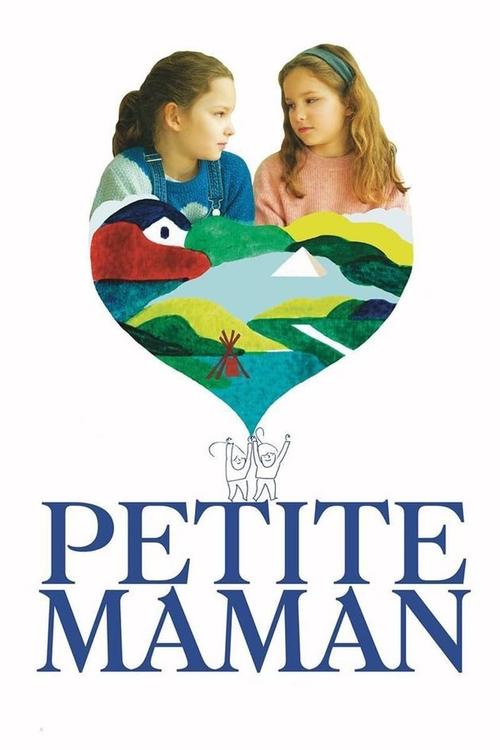
Petite Maman
2021 · Céline Sciamma
For a contemplative evening when you want something tender rather than loud — especially if you're missing someone, or thinking about your parents. A short, healing watch that asks for stillness and repays it.
What it's about
After her grandmother dies, eight-year-old Nelly helps her parents empty the old house, and in the woods behind it she meets a girl her own age who seems strangely, impossibly familiar. What unfolds is a small, tender fable about grief, and about the ache of wishing you could have known your mother when she was young.
The experience
Quiet, gentle, and only seventy-two minutes long, it moves at the unhurried rhythm of childhood play — then lands an emotional weight far beyond its size. It's the kind of film you finish in silence and carry around for days.
Performances
Real-life twins Joséphine and Gabrielle Sanz carry the whole film with unforced naturalness; their uncanny resemblance does quiet magic no special effect could match.
The craft
Céline Sciamma strips everything to essentials — a few rooms, a wood, autumn light beautifully caught by cinematographer Claire Mathon — and shoots at a child's eye level, treating the fantastical premise with total matter-of-factness. The restraint is the point: no effects, no explanations, just precision.
Why it matters
Arriving after Portrait of a Lady on Fire, this pared-down miniature confirmed Sciamma as one of the defining European filmmakers of her generation and became a widely beloved model of how much a small film can hold.
After the sweeping romanticism of Portrait of a Lady on Fire, Céline Sciamma pared her cinema down to seventy-two minutes and the eye level of an eight-year-old. A girl mourning her grandmother, a house being emptied, a wood behind it where a strangely familiar playmate appears: from these spare elements Sciamma builds a fable about grief, time, and the impossible wish to have known one's mother as a child. Shot in autumn 2020 under pandemic constraints, the film turns limitation into concentration — a handful of rooms, two seasons of light caught by cinematographer Claire Mathon, and the remarkable Sanz twins, Joséphine and Gabrielle, whose real-life resemblance does quiet metaphysical work no effect could match. Sciamma, the great contemporary chronicler of French girlhood from Water Lilies through Tomboy, treats the fantastic with total matter-of-factness; there is no shimmer, no threshold, just a child accepting wonder the way children do. The result plays like a Miyazaki film made in live action, or a ghost story told entirely in daylight. Its final effect is out of all proportion to its size — a whole theory of family compressed into a game of make-believe in the woods.
A Deleuzian reading
A girl walks into the wood behind her grandmother's house and meets another girl dragging branches for a hut.
The full Deleuzian reading of Petite Maman →
Reception
Landed at Berlinale 2021 as the quiet, 72-minute follow-up to Portrait of a Lady on Fire, and some initially filed it as 'minor Sciamma' — a reading that has steadily flipped, with many now calling it her most perfect film and an early-2020s essential.
How Petite Maman was received, from release to now →
Influences: the films it descends from and the films it influenced
- Portrait of a Lady on Fire (2019) — Same Sciamma–Claire Mathon partnership: available-light, painterly compositions built on held two-shots and long silences, where an emotional charge is carried by faces at rest rather than dialogue.
- Tomboy (2011) — Sciamma's earlier practice of pinning the camera to a child's exact eye-height and directing a non-professional child lead to naturalistic stillness, letting girlhood identity play out through small gestures.
- My Neighbor Totoro (1988) — The explicit Miyazaki debt: two young sisters, a mother convalescing away from home, and forest spirits presented matter-of-factly and without menace, so the fantastic reads as consolation rather than threat.
- The Spirit of the Beehive (1973) — Child-eye framing inside a hushed, near-empty domestic space where the fantastic is filtered entirely through a grave little girl's solemn attention and long silences.
- Ponette (1996) — Sustained naturalistic direction of a very young child working through a mother's death, camera lowered to her height and patient enough to let real childlike logic about the dead surface on screen.
- Céline and Julie Go Boating (1974) — Playful, matter-of-fact slippage between women into a haunted house that replays another time, treating a temporal/ghostly membrane as a game rather than a horror device.
- Where Is the Friend's House? (1987) — A child's simple, self-contained quest filmed with unadorned realism at his level, trusting a small domestic mission to carry the film's entire emotional weight.
- La Jetée (1962) — Memory rendered as an involuntary return to a specific place and beloved person across time, achieved through radical elliptical compression rather than exposition.
- The Double Life of Véronique (1991) — The uncanny doubling of a single performer across two lives, with an unexplained emotional connection passing between them treated as felt fact, not puzzle to be solved.
- Sound of Falling (2025) — Transgenerational memory collapsed across interleaved timelines anchored to one house and woods, played hushed by young non-star performers.
- My Life as a Zucchini (2016) — Extends the same pared-down child's-grief storytelling, staking large loss on miniature, near-fairytale simplicity and restraint rather than plot.
- House of Hummingbird (2019) — Reduces coming-of-age to hushed child-scale observation and duration, trusting stillness and gesture over plot to carry emotional weight.
- Aftersun (2022) — Grief reconstructed as memory of a parent through elliptical compression and restraint, withholding the explanatory scene and letting an accumulation of small observed moments do the mourning.
- Water Lilies (2007) — Sciamma's debut establishes her minimalist adolescent-desire register — sparse settings, unadorned framing, and adolescent interiority observed without adult voice-over or explanation.
- Uncle Boonmee Who Can Recall His Past Lives (2010) — The dead return and quietly join the living at the table with no fright and no explanation — the same matter-of-fact-fantastic staging where ghosts are ordinary household presences.
- A Ghost Story (2017) — Grief and time collapsed through a deadpan, matter-of-fact ghost, rendered in patient minimalist long takes that make loss spatial and quiet rather than dramatic.
- The Quiet Girl (2022) — A watchful child in a hushed, minimalist farmhouse, near-wordless, with withheld emotion and child-eye framing carrying a story of surrogate parenthood and loss.
- Playground (Un monde) (2021) — The camera locked rigorously at child eye-level for the entire film, so the adult world exists only as legs and fragments and the child's-scale perspective becomes the formal system.
- Close (2022) — Contemporary European childhood-and-grief cinema in the Sciamma mode: naturalistic child leads, restrained handling of a bereavement, and emotion staged through proximity and silence rather than speech.
- Blue Heron (2026) — Distills grief into a child's-eye chamber piece with natural light, elliptical economy, and unforced child performance, sharing Romvari's stripped naturalism applied to mourning a family member.
- Romería (2025) — Literalizes the encounter with a parent across time as Romería's fantasy reveal does, using a spare, controlled rupture of realism to stage mourning rather than explain it.
- My Father's Shadow (2025) — A child-scaled memory film built on restrained score and near-real-time intimacy, dramatizing loss of a parent through a child's quiet, unspoken processing.
- Summer 1993 (2017) — Shares the hushed, scoreless treatment of childhood bereavement and memory, working at eye-level with young non-stars and trusting small gestures over exposition to convey a mother-shaped absence.
- Falcon Lake (2022) — Domesticates the ghost story into a quiet childhood uncanny of doubling and time-slippage, staged in woodland natural light with deliberate narrative under-explanation.
- Love Letters (2025) — Sibling in treating non-biological/chosen maternal bonds with hushed tenderness and a formally spare, anti-melodramatic register.
Similar films
- Portrait of a Lady on Fire (2019) — influence & lineage
- The Quiet Girl (2022) — influence & lineage
- Tomboy (2011) — influence & lineage
- My Neighbor Totoro (1988) — influence & lineage
- Little Amélie or the Character of Rain (2025) — shared sensibility
- Memoir of a Snail (2024) — shared sensibility
- Tótem (2023) — shared sensibility
- Sound of Falling (2025) — shared sensibility
All the films related to Petite Maman →