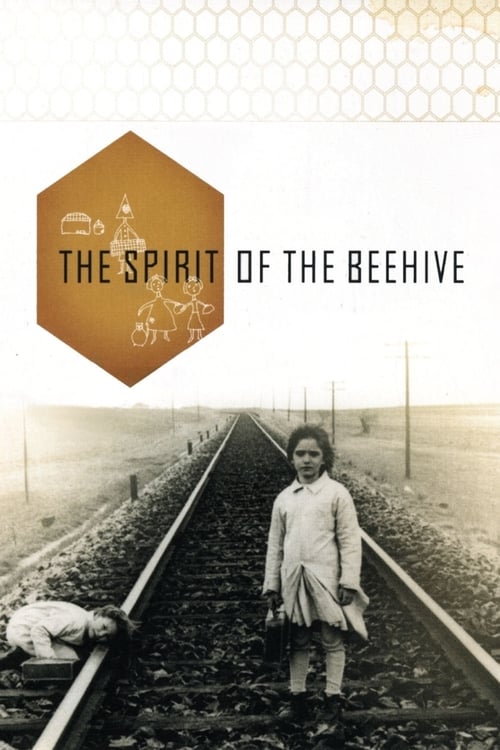
The Spirit of the Beehive
1973 · Víctor Erice
For a still, contemplative evening when you want a film to sit with rather than be swept along by — something tender and mysterious that you'll turn over for days. Patience required; the reward is real.
What it's about
In 1940, in a quiet village on the Castilian plain just after the Spanish Civil War, a six-year-old girl named Ana attends a traveling screening of the 1931 Frankenstein. Her older sister tells her the monster isn't dead — it lives on as a spirit nearby — and Ana begins searching for it, in an abandoned barn and in the silences of her withdrawn parents' house. It's a film about how a child's imagination fills the spaces adults refuse to explain.
The experience
Hushed, slow, and spellbound — long amber-lit rooms, whispers, and images that carry more than anyone says aloud. It works on you like a half-remembered dream: gentle on the surface, quietly devastating underneath.
Performances
Ana Torrent, six years old at the time, gives one of the great child performances on film — her enormous, unblinking watchfulness isn't acting so much as pure presence, and the whole film rests on it.
The craft
Erice builds the film from silence and light: honey-colored interiors glowing like the inside of a beehive, vast empty plains, scenes that communicate through glances because words were dangerous under a dictatorship. Every frame is composed like a painting, and its whispers and stillness deserve a quiet room and full attention.
Why it matters
Made in the last years of Franco's rule and slipping its meanings past the censors through allusion, it won the Golden Shell at San Sebastián and became the defining work of Spanish cinema about the Civil War's long shadow — endlessly echoed in later films about children and monsters.
Snapshot
The Spirit of the Beehive (El espíritu de la colmena) is Víctor Erice's feature debut and one of the defining works of Spanish cinema — a hushed, elliptical fable about childhood, wonder, and the psychic aftermath of the Spanish Civil War. Set in 1940 on the Castilian meseta, it follows a six-year-old girl, Ana, who is transfixed by a traveling screening of James Whale's Frankenstein and, prompted by her older sister's teasing, comes to believe the monster survives as a spirit in the countryside near her village. Made in the last years of the Franco dictatorship and threading its meanings past state censors through allusion and silence, the film transmutes political trauma into a child's-eye metaphysics. It won the Concha de Oro (Golden Shell) at the 1973 San Sebastián Film Festival and has since been enshrined in international critical canons as a summit of poetic, contemplative cinema.
Industry & production
The film was produced by Elías Querejeta, the most important independent producer of the anti-Franco "New Spanish Cinema" and the figure who enabled much of the country's oppositional filmmaking in the late 1960s and 1970s. Querejeta's production model — small budgets, a stable of recurring collaborators (cinematographer Luis Cuadrado, editor Pablo González del Amo), and a willingness to shepherd oblique, allegorical scripts past the censorship apparatus — is inseparable from what Beehive became. Erice, then in his early thirties and known chiefly for a segment of the 1969 portmanteau film Los desafíos, was given his first solo feature within this protective structure.
Production took place in and around the village of Hoyuelos, in the province of Segovia, whose sun-bleached plain, honey-colored stone, and near-empty streets supplied the film's landscape of desolation. Spanish cinema of this period operated under a censorship regime that scrutinized any reference to the Civil War, the Republican defeat, or the regime's violence; Erice and co-writer Ángel Fernández Santos accordingly built their political content into atmosphere and implication rather than statement — a fugitive who is never explicitly identified as a Republican, a family whose estrangement is never explained, a nation figured only through absence. The precise budget and box-office record are not well documented in English-language sources and should not be overstated; what is clear is that the film was made economically and quickly, in the artisanal mode characteristic of Querejeta's productions.
Technology
Beehive was shot on 35mm color film in a standard spherical (roughly 1.66:1 / 1.85:1) format, using available and heavily controlled naturalistic light rather than elaborate technology. Its most consequential "technical" fact is a human one: cinematographer Luis Cuadrado was losing his eyesight during the shoot, a degenerative condition that would soon leave him effectively blind. The film's celebrated lighting — its amber, low-key interiors and diffuse plains — was therefore realized by a cinematographer working at the edge of his vision, reportedly relying on assistants and his own deep experience to judge exposure and placement. This circumstance has become part of the film's legend, and it lends a poignant literalism to a work so preoccupied with seeing, light, and darkness. Beyond this, the film is notable less for any technological innovation than for its disciplined restraint: no optical trickery, minimal camera movement, and an almost total reliance on the physical properties of light passing through windows, doorways, and the hexagonal panes of the family's house.
Technique
Cinematography
Cuadrado's photography is the film's signature achievement. Interiors glow with a warm, honeyed amber — light filtered through the yellow hexagonal windowpanes of the family home, an image that visually rhymes the house with a beehive's comb. The palette is muted and autumnal; compositions are frontal, still, and painterly, frequently invoking comparisons to Dutch interior painting (Vermeer is often cited) in the way figures are placed within pools of window light against shadowed rooms. Exteriors, by contrast, are washed in the flat, pale, overexposed light of the Castilian plain — vast horizontals in which small human figures are dwarfed. The camera rarely moves emphatically; Erice and Cuadrado favor the fixed frame, the long hold, and the human face — above all the face of Ana Torrent, whose enormous dark eyes the camera returns to again and again as the film's true landscape.
Editing
Pablo González del Amo's cutting is patient, elliptical, and rhythmically slow, built on the withholding of connective information. Scenes are frequently truncated or left to breathe past the point of narrative necessity; transitions elide explanation, so that cause and effect dissolve into a dreamlike drift that mirrors Ana's consciousness. A recurring device — punctuating the film with fades to and from black, and with intertitle-like beginnings ("Érase una vez…," Once upon a time) — frames the whole as a fairy tale even as its content darkens. The editing refuses the reassurance of conventional coverage, keeping the viewer, like Ana, in a state of partial, wondering apprehension.
Mise-en-scène / staging
The film's world is one of separations and thresholds: doorways, window frames, the corridor of the family house, the isolated barn on the plain, the railway line that cuts the landscape. The Fernán Gómez household is staged as a place of emotional distance — the father absorbed in his beehives and his writing, the mother writing letters to an unseen absent figure — its members seldom sharing the frame in intimacy. Recurring motifs organize the mise-en-scène: the hexagon of the beehive and windowpane; the color amber; fire and smoke; the well; the mushroom the father warns is poisonous. The beehive itself, glimpsed behind glass with its swarming, anonymous workers, functions as the governing image of a society — Franco's Spain — in which individual life is subordinated to a blind collective hum.
Sound
Luis de Pablo, a major figure of the Spanish musical avant-garde, composed a spare, unsettling score that draws on simple, folk- and lullaby-like motifs distended into something eerie. Music is used sparingly; much of the film rests on silence and ambient sound — wind across the plain, the drone of bees, the mechanical clatter of the train, footsteps in empty rooms. This acoustic austerity is central to the film's atmosphere of suppression and unspoken grief, an aural correlative to a country that cannot speak its own history. Dialogue is minimal, and the children's voices — questioning, conspiratorial, half-whispered — carry disproportionate weight.
Performance
The film is anchored by the extraordinary presence of Ana Torrent, roughly six or seven at the time of shooting, whose grave, watchful face became an icon of Spanish cinema. Erice worked with the children — Torrent and Isabel Tellería as her sister Isabel — in a manner attuned to their real spontaneity, capturing looks of genuine curiosity, fear, and absorption rather than performed emotion; the character even carries the actress's own name. As the parents, two established figures ground the film: Fernando Fernán Gómez, one of Spain's most eminent actor-directors, plays the remote, melancholic beekeeper father, and Teresa Gimpera the beautiful, distracted mother. Their restrained, interiorized performances convey a marriage and a household hollowed out by unnamed loss.
Narrative & dramatic mode
Beehive operates in a lyrical, associative mode rather than a plot-driven one. Its ostensible events are few: the arrival of the Frankenstein screening; Ana's questions and Isabel's teasing claim that the monster is a spirit one can summon; Ana's discovery of a wounded fugitive hiding in the barn, whom she feeds and clothes; the man's killing by the authorities; Ana's flight, a night of hallucination in which she seems to encounter the monster, and her recovery. But the film subordinates causality to states of feeling and perception. Point of view is filtered through a child's imagination, so that the boundary between reality and fantasy is deliberately porous — the "spirit" of the title is at once the monster of a film, the ghost of the war dead, and the animating force of Ana's inner life. The result is a coming-of-consciousness narrative in which a child's first reckoning with death, cruelty, and the invisible currents of the adult world is rendered as myth.
Genre & cycle
The film sits at the intersection of several modes: art-house drama, poetic realism, the childhood-perspective film, and a distinctly Spanish strain of political allegory. Its explicit invocation of Frankenstein also makes it a meditation on the fantastic and on cinema itself. Within Spanish film history it belongs to a small, potent cycle of early-1970s and mid-1970s works that used the figure of the sensitive, watchful child to smuggle critique of Francoism past the censors — most famously alongside Carlos Saura's Cría cuervos (1976), which also stars Ana Torrent. It is less a genre film than an anti-genre work that absorbs and transfigures genre materials, turning the horror movie into an elegy.
Authorship & method
The Spirit of the Beehive is a director's film in the fullest sense, yet its greatness is bound up with a tight circle of collaborators assembled under Querejeta. Víctor Erice — who conceived the story and co-wrote the screenplay with Ángel Fernández Santos, a noted critic and writer — is a famously exacting, slow-working filmmaker whose entire feature output is tiny: Beehive (1973), El Sur (1983), and the documentary-essay El sol del membrillo (The Quince Tree Sun, 1992), followed by decades of shorts, essay films, and unrealized projects before a late return. His method privileges contemplation, painterly composition, silence, and the resonance of the image over exposition. Luis Cuadrado's cinematography, executed as his sight failed, gave the film its light; Luis de Pablo's music gave it its unease; Pablo González del Amo's editing gave it its elliptical rhythm; and Querejeta's producing gave it the freedom and protection to exist. The film is best understood as the product of this collective, focused through Erice's singular sensibility.
Movement / national cinema
The film is a landmark of the Nuevo Cine Español and, more specifically, of the oppositional, allegorical current that Querejeta's productions represented under late Francoism. It stands as one of the supreme achievements of Spanish national cinema and is routinely named, alongside Buñuel's work and Saura's films of the same era, among the greatest films the country has produced. Where earlier Spanish opposition cinema often relied on realist critique, Beehive helped define a more poetic, symbol-laden alternative — using myth, childhood, and landscape to speak of a nation's suppressed grief. It is also a founding text for the international art-cinema tradition of "slow," contemplative filmmaking.
Era / period
Released in 1973, two years before Franco's death in 1975, the film is doubly historical: it depicts 1940, the raw aftermath of the Civil War (which ended in 1939), while speaking from and to the exhausted twilight of the dictatorship itself. That doubling is essential. The "once upon a time" of 1940 — with its defeated silences, its fugitive, its emptied village — is a mirror held up to 1973, a Spain still living inside the long shadow of that defeat. The film thus belongs to a charged moment when Spanish artists sensed the regime's approaching end and reached for ways to name what three decades of censorship had forbidden.
Themes
Its central themes include the loss of innocence and a child's first encounter with mortality; the porous border between imagination and reality, and cinema's power to shape belief; and the pervasive, unspoken trauma of the Civil War. The recurring beehive image proposes a vision of society as a collective organism in which individuality is suppressed — a quiet indictment of the conformist, isolating order of Francoist Spain. The film is preoccupied with seeing and blindness (given added charge by Cuadrado's own condition), with communication and its failure (letters to the absent, the near-muteness of the parents), and with monstrousness as a matter of perspective — the "monster" being an object of Ana's compassion, while lethal violence comes from the ostensibly ordinary adult world. Death, absence, and the persistence of spirits — of the dead, of the defeated, of imagination — haunt every frame.
Reception, canon & influence
The Spirit of the Beehive was recognized immediately at the highest level, taking the Golden Shell at the 1973 San Sebastián Film Festival, and its critical standing has only grown. It is now widely regarded as one of the greatest of all Spanish films and a canonical work of world cinema, championed by critics and filmmakers internationally and preserved and reissued as a classic (including in a Criterion Collection release). Its reputation rests on the near-universal admiration for Cuadrado's imagery, Erice's control of atmosphere, and Ana Torrent's unforgettable face.
Influences on the film (backward): The most overt is James Whale's Frankenstein (1931), embedded in the film both as plot catalyst and as thematic mirror — the misunderstood, hunted monster shadowing the film's fugitive and its meditation on innocence and violence. More broadly, Erice's contemplative aesthetic draws on the European art-cinema and poetic-realist traditions and on a painterly heritage of chiaroscuro interior light often associated with Vermeer and Dutch genre painting. The film's fairy-tale framing situates it within a long lineage of folk narrative and the archetype of the child-quester.
Legacy (forward): Beehive became a touchstone for subsequent cinema of childhood and of the Spanish Civil War's memory. Its immediate sibling is Carlos Saura's Cría cuervos (1976), which recast Ana Torrent in a comparable role of the watchful, death-haunted child. Its influence is most famously visible in the work of Guillermo del Toro, who has repeatedly acknowledged Erice's film as formative for The Devil's Backbone (2001) and Pan's Labyrinth (2006) — both of which fuse the fantastic with the trauma of the Civil War through a child's eyes. More generally, the film is a cornerstone reference for the international tradition of slow, image-driven, contemplative cinema, and it remains a standard against which poetic films about childhood are measured.
A Deleuzian reading
A truck rolls into a village on the empty plain and unloads a film.
The full Deleuzian reading of The Spirit of the Beehive →
Reception
It won the Golden Shell at San Sebastián in 1973 but, released in the last years of Franco's dictatorship, its hushed ellipticism left many contemporary audiences puzzled. It has since climbed to near-unanimous status as the greatest Spanish film ever made, a fixture of Sight & Sound polls and critics' all-time lists.
How The Spirit of the Beehive was received, from release to now →
How to watch The Spirit of the Beehive: what to notice on a first viewing
- Watch warm amber light pour through hexagonal windowpanes. Interiors glow with honeyed light filtered through yellow hexagonal panes, visually rhyming the family house with the comb of a beehive. The house looks like it is built from the same shape as the hive glimpsed elsewhere in the film.
- Watch the camera hold on Ana's face without cutting away. Erice returns again and again to Ana Torrent's enormous, watchful eyes, letting her face carry scenes with almost no dialogue at all. The reading calls a face held this long a qualisign: an image of pure quality, wonder or dread, that never quite resolves into one feeling.
- Notice doorways, windows, and thresholds recurring throughout the house. The film stages its world around separations, doorways, window frames, the corridor, the isolated barn on the plain, as recurring physical boundaries. The architecture keeps marking the space between people before anyone says a word about distance.
- Listen for wind, bees, and a distant train instead of music. Much of the film rests on ambient sound and silence rather than score, with dialogue kept minimal and often half-whispered. The quiet itself becomes part of what the film is withholding, an unspoken weight sitting under every scene.
- Watch the plain go pale and flat outdoors. Exteriors are washed in overexposed light, vast flat horizontals in which the two small girls walking across them look nearly erased. The reading calls a space like this any-space-whatever: emptied of the usual coordinates for action, not a stage but a blank.
The whole guide to watching The Spirit of the Beehive, with the keys for a rewatch →
Influences: the films it descends from and the films it influenced
- Frankenstein (1931) — Its monster-meets-little-girl-by-the-water scene is literally screened inside the film, and Whale's staging of the creature's misunderstood gentleness becomes the template for Ana's encounter with the fugitive.
- Forbidden Games (1952) — Establishes the device of children privately ritualizing death and building a secret cosmology of graves and totems, filmed at their eye-level and outside adult comprehension.
- The Night of the Hunter (1955) — Expressionist chiaroscuro and stylized nocturnal fairy-tale landscapes rendered as a frightened child's subjective vision of a hunted man in the countryside.
- Ivan's Childhood (1962) — Filters war through a child's dream-logic using associative editing and contemplative long takes, prioritizing poetic image-resonance over narrative exposition.
- Vampyr (1932) — Diffused, gauzy light and a somnambulant movement through doorways and windowframes model the film's threshold staging and hushed, uncanny atmosphere.
- The 400 Blows (1959) — Erice renders a child's interior life through long observational takes and elliptical editing that refuses to psychologize the protagonist, extending the Bazinian approach to childhood consciousness that Truffaut encoded in the freeze-frame finale.
- Germany, Year Zero (1948) — Erice extends Germany Year Zero's central formal strategy — filming a child's incomprehension of adult ideological violence without psychological explanation or reaction shots — in a different historical setting, using similarly flat, de-sentimentalized light that refuses to aestheticize atrocity.
- The Strange Ones (1950) — Builds childhood dream-logic inside a hermetic interior world where myth recited to a child reorganizes reality, extending the recited-myth/sealed-world device.
- Bride of Frankenstein (1935) — Builds its entire emotional logic around a child absorbing the Frankenstein Monster's pathos, treating Whale's sympathetic-creature staging as sacred text.
- Tristana (1970) — Luis Cuadrado's desaturated ochre photography of a silent Castilian town, near-scoreless with wind, bells and footsteps carrying the track, and compositions built through doorways, window frames and thresholds — the Tristana visual system turned toward the same late-Francoist household as political institution.
- The Fallen Idol (1948) — Narration held with near-total discipline to a small girl's sightline: reverse angles withheld, adult conversation reaching her as fragments, score used only in isolated cues, and the catastrophe issuing from her literal reading of an adult fiction.
- Cría cuervos (1976) — Recasts Ana Torrent's identical watchful, death-haunted stare as the organizing consciousness of a film about repression and mortality under late Francoism.
- El Sur (1983) — Erice extends his own method — honeyed interior light, elliptical fades, and a girl's-POV mystery about an unknowable father — into a companion memory-film.
- The Devil's Backbone (2001) — Del Toro's acknowledged homage transposes the Civil-War-through-a-child's-eyes structure and amber-lit institutional interiors into a ghost story of national trauma.
- Pan's Labyrinth (2006) — Builds directly on Erice's fusion of the fantastic as a child's refuge from Francoist violence, using threshold-crossings into an imagined otherworld to frame historical horror.
- The Tree of Life (2011) — Extends the elliptical, whispered, associative montage of childhood perception under natural light, subordinating story to the lyrical accretion of remembered sensation.
- The Reflecting Skin (1990) — A child mistakes a neighbor for a monster and constructs a private myth of horror, staged in golden-hour rural light as a study of innocence curdling into dread.
- Beasts of the Southern Wild (2012) — Filters rural poverty through a small child's magical-realist perception, where an imagined monster becomes emotionally literal — the template for Hushpuppy's aurochs.
- Au Revoir les Enfants (1987) — Renders a child's-eye life under fascism through available low-key light, observational stillness and meaning carried almost entirely in glances and bodies rather than dialogue.
- Intacto (2001) — Establishes the Spanish-fantastic device of placing small figures against vast desaturated arid plains, the wide-landscape framing of human fate dwarfed by emptiness that Intacto stages on Tenerife's volcanic flats.
- My Life as a Dog (1985) — Pairs a warm golden rural palette with a child's-eye withheld revelation, locating large grief inside small provincial life — the exact tonal architecture Persson's cinematography reproduces.
- The Others (2001) — Founds the Spanish-gothic register of hushed honey-lit interiors and a grave, watchful child, where dread is a matter of stillness, framing and the threshold between the real and the imagined.
- Chocolat (1988) — Erice's child's-eye structure, in which a watchful girl observes an opaque adult world she cannot decode while silence and landscape carry the meaning, is the formal engine of France's child-POV memory frame.
- The Quince Tree Sun (1992) — Distills Erice's patient fixed-frame observation of changing painterly light over time into a documentary-essay on the act of looking itself.
- Mirror (1975) — Shares the lyrical-associative construction of memory and warm, painterly natural light that dissolves plot into a chain of resonant childhood images.
- Fanny and Alexander (1982) — Stages a child's imaginative world against authoritarian repression through doorway and threshold framing, letting the boy's gaze mediate magic and fear.
- The White Ribbon (2009) — Uses austere fixed-frame, painterly compositions and children positioned as silent watchers to build a political allegory of a society's latent violence.
- Valerie and Her Week of Wonders (1970) — Renders a girl's threshold into knowledge as fairy-tale surrealism, using folk-archetype imagery and a child's dream-associative logic to structure the film.
- The Enigma of Kaspar Hauser (1974) — Erice and cinematographer Luis Cuadrado film non-professional child Ana Torrent in available light with peripheral positioning — camera at the child's side or behind, never confronting her eyeline — treating opacity of interiority as meaning rather than obstacle, the identical strategy Schmidt-Reitwein applies to Bruno S.
- The Tin Drum (1979) — Pioneers fascism rendered through a child's uncomprehending low-angle gaze, the framing strategy that lets a small protagonist measure the adult catastrophe around him.
- The Travelling Players (1975) — Parallel post-dictatorship reckoning that encodes suppressed national memory through silence, elliptical long-held shots, and a child's-eye distance rather than expository drama.
- Landscape in the Mist (1988) — Sustains the unsentimental child's-eye journey through a hushed, golden-leached landscape, building meaning through silence, ellipsis, and refusal of the reaction close-up.
- Hope and Glory (1987) — Sibling in child-naturalist staging: builds wartime meaning entirely from a small child's gaze and silences, the same trust in the unspeaking, watching child's face that Boorman uses for Bill.
- Institute Benjamenta, or This Dream People Call Human Life (1995) — Erice's hushed chiaroscuro and the wide-eyed, near-trance child's gaze through honey-toned light shares Benjamenta's strategy of rendering interior states through stilled, low-key lit faces rather than dialogue.
- Pather Panchali (1955) — Shares Ray's method of telling history through a child's uncomprehending observation, using available light, ambient natural sound, and elliptical structure rather than expository plot.
Similar films
- Cria! (1976) — influence & lineage · same viewing thread
- The Devil's Backbone (2001) — influence & lineage · often watched together
- El Sur (1983) — influence & lineage
- Pan's Labyrinth (2006) — influence & lineage
- Frankenstein (1931) — influence & lineage
- Forbidden Games (1952) — influence & lineage · same viewing thread
- Ivan's Childhood (1962) — influence & lineage · same viewing thread
- The Night of the Hunter (1955) — influence & lineage · often watched together
All the films related to The Spirit of the Beehive →
Watch it with: curated runs of related films
- War Through a Child's Eyes — Watch these in a run for how each sets a small, watchful child in front of a history far too big to understand — occupation, civil war, dictatorship, genocide — so the child's innocence throws the adult brutality into unbearable relief.