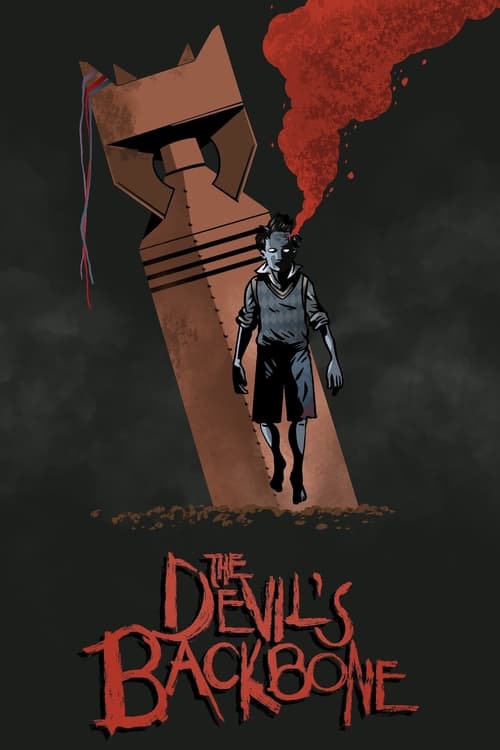
The Devil's Backbone
2001 · Guillermo del Toro
Pinocchio's stop-motion Oscar and his Frankenstein made him the loudest voice for handmade craft against AI ("I'd rather die than use it") — his interviews are reliably viral anti-algorithm sermons. Cinephile Twitter's beloved uncle.
For when you want a ghost story with a soul — real chills, but ones that make you feel something rather than just flinch. A challenge worth taking on a dark, quiet night, not a party horror pick.
What it's about
Spain, 1939, in the final days of the civil war: a boy named Carlos is left at a remote orphanage that shelters the sons of the Republican dead — along with a hidden cache of gold and an unexploded bomb standing upright in the courtyard. As Carlos makes friends and enemies among the boys, he begins following the traces of a ghostly child who haunts the building, a quiet presence with unfinished business. The adults, meanwhile, have secrets and appetites of their own, and the war outside is closing in.
The experience
Slow-burning and mournful rather than jumpy — the dread comes from atmosphere, whispers, and the sense that violence is coming from the living as much as the dead. It's genuinely eerie, but also tender about childhood, and it leaves an ache more than a scream.
The craft
Del Toro builds the orphanage into a complete gothic world: amber desert light, sickly green-gold interiors, and a ghost designed with painterly care — cracked like porcelain, trailing wisps in the air. The sound design of sighs and creaks does as much work as the images, and the sustained visual mood rewards a dark room and good speakers.
Why it matters
This is the film where del Toro's signature fully arrived — the fusion of fairy-tale horror with real historical violence — and it laid the direct groundwork for his later Spanish-language masterwork and his rise as a major fantasy director.
Snapshot
El espinazo del diablo is Guillermo del Toro's third feature and the film in which his sensibility fully crystallized: a ghost story set at a remote orphanage in the dying days of the Spanish Civil War, where the supernatural and the political are made inseparable. A boy, Carlos, is deposited at the Santa Lucía orphanage in 1939 by guardians who do not return; the institution shelters Republican war orphans and, less openly, a cache of Republican gold. An unexploded bomb stands defused but upright in the courtyard, a fascist artifact frozen mid-fall. The apparition of a murdered boy — Santi, "the one who sighs" — haunts the building, but del Toro's structural gambit is to make the human villain, the brutalized caretaker Jacinto, the true monster, while the ghost is a figure of grief and warning. The film's famous framing question, posed in voiceover — "What is a ghost? A tragedy condemned to repeat itself time and again?" — announces its thesis that the past does not stay buried. Del Toro has repeatedly described it as the male companion piece to Pan's Labyrinth (2006), its "brother" film; together they form his diptych on childhood and the Spanish Civil War.
Industry & production
The Devil's Backbone arrived at a pivotal moment in del Toro's career. After the acclaimed Mexican debut Cronos (1993), he had moved to Hollywood for Mimic (1997), a studio horror picture whose production under Miramax/Dimension proved creatively bruising — a widely documented experience of lost authorial control that del Toro has spoken of as formative in the worst sense. The Devil's Backbone was a deliberate return to Spanish-language, author-driven filmmaking, and it was made possible institutionally by Pedro and Agustín Almodóvar's production company El Deseo, which co-produced. The Almodóvars' involvement lent both prestige and a protective creative latitude; the picture was a Spain–Mexico co-production, with del Toro's own Tequila Gang and Anhelo Producciones among the partners. This arrangement let del Toro work within a European art-cinema infrastructure rather than a Hollywood genre pipeline.
The project itself was long-gestating. Del Toro had carried versions of the story for years; in its earliest conception the setting was the Mexican Revolution (some accounts mention the Cristero context), and it was relocated to the Spanish Civil War — a shift that aligned the material with a national trauma whose cultural reckoning was still very much alive in Spain. The film was shot in Spain. Del Toro has spoken in interviews and commentary of the production as one where he finally married his personal obsessions (Catholic iconography, insects and decay, the gothic) to a historical frame, and the relative creative freedom is legible in the finished work's confidence and specificity. Precise budget and box-office figures are not something I can responsibly quote here; the salient industrial fact is the institutional one — an independent European co-production shielding a genre film with art-cinema ambitions.
Technology
Technically the film is a relatively traditional turn-of-the-millennium production: shot on 35mm, reliant on practical sets, location work, and physical effects more than on digital spectacle. Its most distinctive technological signature is its use of effects to render the ghost. Santi is realized through a combination of prosthetic and practical design and selective digital enhancement: his cracked skull leaks a perpetual wound, and blood is shown drifting upward and outward in suspension, as if he were submerged — an image of a body that died in water. This "floating blood" motif is del Toro's defining visual conceit for the apparition, achieved through compositing that lets liquid behave against gravity. The restraint is notable: rather than saturate the film with computer-generated imagery, del Toro deploys it sparingly and pictorially, in service of a single uncanny idea, keeping the period world tactile and grounded.
Technique
Cinematography
The cinematography is by Guillermo Navarro, del Toro's most important visual collaborator (their partnership spans Cronos through Hellboy and Pan's Labyrinth). Navarro builds the film around a controlled tension between warm amber and cold blue — the gold of lamplight, dust, and the buried Republican treasure against the steel-blue of night, water, and death. The orphanage is shot to feel both vast and enclosed: long corridors, high windows admitting hard Castilian light, and the great open courtyard dominated by the bomb. Compositions repeatedly subordinate the children to the architecture and to the looming ordnance, visualizing their smallness within forces — historical and supernatural — that dwarf them. The camera favors elegant, classical movement over handheld immediacy, lending the horror a measured, mournful gravity rather than shock-driven kineticism.
Editing
Cut by Luis de la Madrid, the film is paced as a slow accretion of dread rather than a sequence of scares. The editing patiently establishes the geography of the orphanage and the social order of the boys before tightening, in its final act, into a more conventional thriller rhythm as Jacinto's violence detonates. The ghost is doled out in fragments — a glimpse, a sigh, a smear of motion — so that the apparition accumulates meaning across the film rather than being "explained" in a single reveal. The structure is bookended by the meditative voiceover on the nature of ghosts, a framing device the cutting honors by returning the film to contemplation even after its bloodletting.
Mise-en-scène / staging
Mise-en-scène is del Toro's great strength, and here it is unusually disciplined. The unexploded bomb in the courtyard is the film's master image — a defused but ever-present threat, a piece of war planted at the literal center of the children's world, humming faintly. Casares's study, with its jars of malformed fetuses preserved in rum — the "limbo water" he sells as a folk tonic, the deformed spines that give the film its title — externalizes the picture's preoccupation with the unborn, the arrested, and the deformed legacies of violence. The setting marries Spanish gothic with a sun-bleached, dust-laden materiality; decay, rust, and stagnant water recur as textures. The staging consistently reads space morally: the cistern where Santi died, the cellar where the gold is hidden, the open courtyard of the bomb.
Sound
Javier Navarrete's score — he would go on to score Pan's Labyrinth — is a plaintive, lullaby-inflected composition that underscores the film's elegiac register, treating horror as sorrow. The film's sound design is built around the ghost's signature: the sigh that earns Santi his epithet, "the one who sighs," and the wet, displaced acoustics that accompany him. Ambient sound — wind across the open plain, the creak of the building, the distant register of a war just over the horizon — keeps the historical threat audible even when it is offscreen.
Performance
The ensemble is anchored by two veteran actors central to del Toro's world. Federico Luppi (who had led Cronos) plays Dr. Casares, the aging, dignified intellectual whose courtly humanism is shadowed by impotence — literal and political — embodying the doomed decency of the Republic. Marisa Paredes, a key Almodóvar collaborator, plays Carmen, the headmistress with a prosthetic leg, carnal and pragmatic, caught in a coercive entanglement with Jacinto. Eduardo Noriega gives Jacinto a charismatic, wounded cruelty — himself a former orphan of the institution, which complicates him as a product of the same cycle of abandonment. Among the children, Fernando Tielve as Carlos and Íñigo Garcés as the older, defensive Jaime carry the central arc of fear curdling into solidarity, with Junio Valverde as the spectral Santi.
Narrative & dramatic mode
The film operates in a hybrid mode: gothic ghost story fused with coming-of-age drama and political allegory. Its dramatic engine is the inversion of horror convention — the dead boy is not the threat but a messenger, and the danger is the living man. Carlos's arc follows the classic structure of the newcomer who must decode a closed community's secrets, but del Toro layers onto it the moral education of learning that adults fail and that justice, if it comes, will be exacted by the children themselves. The narration's framing meditation on ghosts gives the whole a fable-like, retrospective quality, as though the story is being told from beyond its own ending. Tonally it sustains melancholy over terror; the violence, when it arrives, is sudden and unromanticized.
Genre & cycle
The Devil's Backbone belongs to the gothic ghost story and the "haunted institution" subgenre, but its lasting contribution is to the cycle of Spanish-set films that use the supernatural or the fantastic to address the Civil War and its memory. It sits within del Toro's own cycle of fairy-tale horror as well as a broader lineage of Spanish cinema that filters the war through a child's eyes. The film helped reinvigorate the prestige art-horror ghost story at the turn of the millennium, in proximity to Alejandro Amenábar's The Others (2001), another Spanish-produced, elegant period ghost film — the two are frequently discussed together as evidence of a Spanish renaissance in literate genre cinema, though they were independent endeavors.
Authorship & method
This is a profoundly authored film, and del Toro's recurring signatures are all present: the sympathetic monster, the child protagonist navigating a corrupt adult world, Catholic and bodily iconography, insects and decay, and the conviction that fairy tales and horror are vehicles for moral truth. He co-wrote the screenplay with Antonio Trashorras and David Muñoz, sharing story credit while stamping the film with his personal mythology. His method is famously notebook-driven — del Toro's illustrated journals and obsessive design specifications (the ghost's floating blood, the jarred fetuses) translate directly to the screen. His key collaborators form the through-line of his career: cinematographer Guillermo Navarro and composer Javier Navarrete, both of whom would reunite with him on Pan's Labyrinth, and actor Federico Luppi, his recurring patriarchal presence. The production's protective context — El Deseo and the Almodóvars — should be read as part of the authorship story: it is the film where del Toro reclaimed control after Hollywood compromised it.
Movement / national cinema
The film stands at the intersection of Mexican and Spanish cinema. Del Toro is a Mexican director, part of the loosely grouped generation alongside Alfonso Cuarón and Alejandro González Iñárritu whose international ascent reshaped perceptions of Mexican filmmaking; the cross-border, Spanish-Mexican production embodies that transnational moment. At the same time, the film consciously enters Spanish national cinema's long project of reckoning with the Civil War and the Franco era — a project that, in the post-Franco decades and the era of the "historical memory" debates, gave the war renewed urgency on screen. Del Toro approaches that national trauma as an outsider with deep affinity, refracting it through genre.
Era / period
Set in 1939, in the final throes of the Republican defeat, the film is precise about its historical moment: the orphanage is a Republican island whose hidden gold marks it as a target, and the looming fascist victory is the unspoken weather of every scene. Del Toro uses the period not as backdrop but as meaning — the war is the adult violence that orphans these children and that the ghost's fate literalizes. The unexploded bomb is the era made object: ideology fallen from the sky into the middle of childhood, defused yet never truly safe. The film's elegiac tone is inseparable from hindsight — the knowledge, shared by filmmaker and audience, of the long dictatorship that the Republic's defeat would inaugurate.
Themes
The governing themes are the persistence of the past, the failure of adults, and the cyclical nature of violence. The opening question — a ghost as "a tragedy condemned to repeat itself" — is the film's thesis, dramatized in Jacinto, an abandoned orphan who grows into the abandoner and abuser, perpetuating the harm done to him. Childhood is figured as both vulnerable and capable of moral clarity and even retributive justice. The title's image — the exposed spines of the malformed unborn, the "devil's backbone" of folk belief — knits together motifs of deformity, the curse of poverty, and limbo, the state of being suspended between worlds that defines Santi and, allegorically, the Republic itself. Water and drowning, sterility and impotence (Casares's, the bomb's), gold and greed, and the contrast between the dead who cannot rest and the living who refuse to remember all recur. Above all the film insists that the supernatural is the form historical guilt takes when it is unaddressed.
Reception, canon & influence
The Devil's Backbone was strongly received critically and has since hardened into a canonical entry in del Toro's filmography and in the broader canon of intelligent horror — frequently cited, alongside Pan's Labyrinth, as among his finest and most personal work, and as a key text in discussions of the Spanish Civil War in cinema. Del Toro himself consistently names it as one of his favorites among his films.
Its lines of influence run backward to a rich literary and cinematic inheritance. The gothic ghost-story lineage of Henry James's The Turn of the Screw — the child, the haunted house, the ambiguous apparition — is an evident antecedent. Within Spanish cinema, the film descends from Víctor Erice's The Spirit of the Beehive (1973), the touchstone for the war-through-a-child's-eyes mode, and resonates with Carlos Saura's films of childhood under Franco such as Cría cuervos (1976); these are widely recognized reference points for del Toro's project, though the specific weighting of each is a matter of critical reading. Del Toro's own Cronos and his lifelong immersion in horror, Catholic iconography, and Mexican gothic feed directly into it.
Forward, its most direct legacy is Pan's Labyrinth, the companion film that extended its fusion of fairy tale, history, and the Spanish Civil War to wider acclaim and crystallized del Toro's international standing; The Devil's Backbone is rightly seen as the laboratory in which that synthesis was achieved. More broadly it stands as a model for the literate, melancholic art-horror ghost story — proof that the genre could carry historical and moral weight — and it remains a recurrent point of reference in writing on del Toro's career-long argument that monsters are how we tell the truth about ourselves.
A Deleuzian reading
Start with the bomb.
The full Deleuzian reading of The Devil's Backbone →
Reception
A well-reviewed arthouse ghost story in 2001 that stayed a connoisseur's pick until Pan's Labyrinth blew up in 2006 — after which everyone went back and discovered its 'brother' film, and a 2013 Criterion release sealed the reappraisal.
How The Devil's Backbone was received, from release to now →
Influences: the films it descends from and the films it influenced
- The Spirit of the Beehive (1973) — Establishes the Spanish 'war-through-a-child's-uncomprehending-eyes' grammar — a small protagonist wandering a fascist-era rural enclosure, with the monster as a screen for political trauma — the exact framing del Toro transposes to the orphanage.
- Cría cuervos (1976) — Models the dead who refuse to leave the child's world under Franco, treating a haunted household as the persistence of national history rather than supernatural spectacle.
- The Innocents (1961) — The defining cinematic Turn of the Screw — deep-focus monochrome, apparitions held at the edge of frame and ambiguity, the child-and-ghost gothic whose staging del Toro inherits wholesale.
- The Curse of the Cat People (1944) — Lewton-school template of a lonely child befriending a benign ghost, where atmosphere and suggestion replace shock — the sympathetic-spectre logic at the film's heart.
- The Night of the Hunter (1955) — Children navigating a predatory adult world rendered as expressionist fairy tale, with a fable's moral architecture imposed on real menace — del Toro's organizing principle.
- Cronos (1993) — His own first feature establishes the through-line collaborators and obsessions — Federico Luppi's wounded patriarch, Catholic-bodily iconography, insects and decay, the monster as victim.
- Don't Look Now (1973) — A grief-haunted ghost story built on a saturated red motif and premonitory cross-cutting, prefiguring the amber-and-blood palette and the slow accretion of dread through editing.
- Frankenstein (1931) — The foundational 'sympathetic monster' text del Toro openly venerates — the creature drowning a child reframed so our horror turns to pity, which Santi the ghost directly answers.
- The Devils (1971) — Fuses Catholic iconography, bodily horror and political-historical atrocity into a single transgressive register — the conviction that religious imagery is the proper language for institutional violence.
- The Sixth Sense (1999) — Extends the suggestion-over-display ghost as an emblem of unresolved grief and trauma, the spectre treated with somber sincerity rather than as a monster-movie threat.
- Time for Revenge (1981) — Casts Luppi as the honorable elder amid political violence, again leaning on the gravitas persona first defined in Aristarain's film to anchor a story of atrocity and resistance.
- Macario (1960) — Del Toro explicitly channels Figueroa's Mexican-Gothic lighting and the death-fable form into a chiaroscuro ghost story of moral reckoning.
- Pan's Labyrinth (2006) — The direct sequel-in-spirit, reuniting Guillermo Navarro and Javier Navarrete to extend the exact synthesis — Civil War history, a child's fairy tale, and the monster as moral truth — to fuller scale.
- The Orphanage (2007) — Produced and shepherded by del Toro, it transplants the orphanage-as-haunted-institution, the spectral child, and the melancholic literate ghost story into a new Spanish gothic.
- Crimson Peak (2015) — Pushes the floating-blood/translucent-revenant effect and the amber-vs-blue color contrast into full-blown Gothic Romance, the ghost-as-warning device scaled up from Santi.
- The Devil's Backbone's heir Mama (2013) — Del Toro-produced, it carries forward the maternal/protective ghost and his design-driven creature-as-wounded-soul approach from notebook to screen.
- Guillermo del Toro's Pinocchio (2022) — Source of the benevolent-monster iconography and Catholic imagery bent toward heterodox ends against a fascist backdrop, del Toro's recurring authorial grammar.
- Tumbbad (2018) — Navarro's restricted amber/ochre-against-cold-blue palette, gold hidden inside the building's own walls, and a ghost built as a prosthetic performer with only light digital extension — the precise method of Hastar's make-up-plus-CG design.
- Marrowbone (2017) — Guillermo Navarro's amber-interior against bleached-exterior scheme and the ghost figured as an unmourned wound rather than a menace — the Spanish-gothic production-design method Marrowbone inherits nearly intact.
- The Others (2001) — A contemporaneous Spanish-produced classical ghost story that, like Backbone, weaponizes restrained period staging and apparitional ambiguity to deliver a who-is-haunting-whom inversion.
- A Tale of Two Sisters (2003) — Shares the art-horror project of grounding a ghost in trauma and guilt with painterly composition and a slow-burn unfolding, proving the literate, sorrowful ghost film as an international mode.
- El Espinazo del Diablo's sibling The Sixth Sense (1999) — A contemporaneous mainstream rehabilitation of the ghost as a being needing help rather than feared, sharing the structural turn that the dead linger to complete an unresolved injustice.
- Intacto (2001) — Released the same year as the flagship of the intellectually ambitious Spanish genre wave, wedding magical-realist conceit to grave, painterly craft rather than camp.
- Frankenstein (2025) — Builds the gothic frame-tale of paternal abandonment around a wounded child-revenant, rehearsing the nested-confession architecture and the orphan's grief that drive Frankenstein.
- The Shape of Water (2017) — Del Toro's amber-and-blue ghost-story palette and his method of treating the supernatural being as a mournful figure of loss, with fascist violence as the real horror—same director-led workshop aesthetic.
Similar films
- Pan's Labyrinth (2006) — influence & lineage · same viewing thread
- The Spirit of the Beehive (1973) — influence & lineage · often watched together
- Crimson Peak (2015) — influence & lineage
- Cria! (1976) — influence & lineage
- The Innocents (1961) — influence & lineage
- The Others (2001) — influence & lineage
- Cronos (1993) — influence & lineage
- A Tale of Two Sisters (2003) — influence & lineage
All the films related to The Devil's Backbone →
Watch it with: curated runs of related films
- Where Children Meet the Dead — Watch these together and Coco's candlelit sweetness darkens by degrees into a run of folk fables where the dead won't stay buried and children bargain with mortality under the shadow of war and fascism.