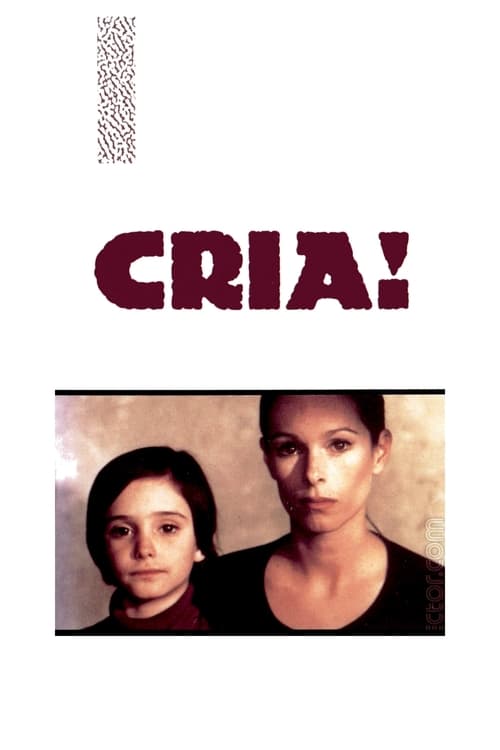
Cria!
1976 · Carlos Saura
When you need to feel something deep and are ready for sorrow — a film for a solitary, attentive night, not background viewing. Challenge, with an ache that stays for days.
What it's about
Eight-year-old Ana lives in a shuttered Madrid house with her two sisters, a mute grandmother, and a housekeeper, in the wake of her mother's death. She is a grave, watchful child who believes she holds the power of life and death — convinced she caused her authoritarian father's end, certain her dead mother still moves through the rooms at night. The film moves inside her head, where memory, fantasy, and grief are indistinguishable.
The experience
Haunting and hushed — a child's-eye film where the everyday and the ghostly share the same rooms, threaded with a pop song that turns unbearably sad through repetition. It's slow, intense, and quietly devastating rather than dramatic.
Performances
Ana Torrent, one of cinema's unforgettable child performers, carries the film on her enormous dark-eyed stare — a performance of pure watchfulness that never once reads as acting. Geraldine Chaplin is piercing in a dual register as the remembered mother.
The craft
Carlos Saura dissolves past and present, real and imagined, without seams or signposts — the editing simply trusts you to live in Ana's time. Shot in a single suffocating house, the film turns domestic space into a portrait of a country's inheritance, made in the very year Spain emerged from dictatorship.
Why it matters
A prizewinner at Cannes and one of the essential films of Spain's transition from Franco's rule, its image of childhood haunted by the parents' world became a touchstone for how cinema speaks politically through a child's eyes.
Snapshot
Released in Spain as Cría cuervos and abroad often under the truncated Cria!, Carlos Saura's seventh feature is one of the essential films of Spain's transition out of dictatorship — a chamber drama about grief, memory, and the poison that families and nations pass down to their children. The title comes from the proverb "Cría cuervos y te sacarán los ojos" ("Raise ravens and they will peck out your eyes"), and that idea of nurture curdling into ruin governs everything in the film. Eight-year-old Ana (Ana Torrent), living in a shuttered Madrid house with her two sisters, a mute paralyzed grandmother, and a housekeeper, is convinced she killed her father — a Francoist army officer — by mixing what she believes is poison into his bedtime milk. She is equally convinced her dead mother still moves through the rooms at night. Saura films this half-orphaned interior world as a place where the living and the dead, the remembered and the imagined, occupy the same corridors. The film premiered in 1976 and shared the Special Jury Prize at that year's Cannes Film Festival. It remains, alongside The Spirit of the Beehive, the film through which Ana Torrent's grave child's face became an icon of Spanish cinema.
Industry & production
Cría cuervos was produced by Elías Querejeta, the single most important producer in the Spanish auteur cinema of the late Franco years, whose company underwrote nearly all of Saura's major work of the period. The Querejeta–Saura partnership was a model of how ambitious, oppositional cinema could be made inside a censored industry: modestly budgeted, shot largely in controlled interiors, and built around a stable repertory of collaborators — cinematographer Teo Escamilla, editor Pablo González del Amo, and a recurring core of performers.
The production's timing is central to its meaning. The film was shot in 1975, the year Francisco Franco died in November after nearly four decades in power, and released in 1976 into the uncertain opening of the transition to democracy. It thus stands on the exact hinge between the dictatorship and what came after — a film about a household waiting for a death that has already, in the world outside, occurred. Saura had spent his career developing strategies of indirection to survive censorship, and by 1975–76 the apparatus was weakening; Cría cuervos is more direct in its political undertow than his allegories of the 1960s, though it still works chiefly through metaphor rather than statement. The exact budget and box-office figures are not something I can cite reliably, and I will not invent them; what is well established is that the film was an international art-house success and that its Cannes prize secured its foreign distribution.
Technology
The film was shot on 35mm color stock using the largely naturalistic, available-light-leaning approach that characterized Querejeta's productions of the era. There is no technological novelty being showcased here — no new format, optical process, or camera system driving the film's identity. Its "technology," properly understood, is the modest, portable, interior-friendly filmmaking kit of mid-1970s European art cinema: relatively fast color emulsions that allowed the dim, curtain-filtered interiors of the house to be rendered without heavy artificial fill, and lightweight equipment permitting the fluid, prowling camera movements through the domestic space. The soundtrack is monaural, in keeping with the period and the intimate scale. If there is a technical protagonist, it is the recorded pop song at the heart of the film (see Sound), which functions less as a technical artifact than as a cultural one.
Technique
Cinematography
Teo Escamilla's photography is the film's expressive engine. He lights the great Madrid house as a world of soft, curtained daylight and deep shadow, so that the interior always feels half-sealed against the outside — a mausoleum as much as a home. The camera moves with a quiet, insinuating fluidity, following Ana through doorways and along corridors, and Escamilla repeatedly frames her small figure against the large emptiness of the rooms, emphasizing scale and isolation. The palette is muted and autumnal, with pools of warm lamplight against cool interiors. Crucially, the cinematography refuses to visually distinguish memory, fantasy, and present reality: when the dead mother appears, or when the adult Ana materializes to narrate, the image grants them the same solidity and light as the ostensibly "real" scenes. This continuity of the image is the film's central formal argument — that for a grieving child the dead are not less present than the living.
Editing
Pablo González del Amo's cutting is the mechanism that dissolves time. The film moves without warning between the present of the household, Ana's memories of her parents, her fantasies, and flash-forwards to a grown Ana (also Geraldine Chaplin) speaking to the camera two decades later. These strata are joined not by dissolves or optical signals but by direct cuts and matched actions, so the viewer, like the child, must continually reorient. Objects, gestures, and above all the repeated playing of a single pop record serve as the connective tissue that lets one temporal layer slide into another. The editing thereby enacts the film's theory of memory as something non-linear, involuntary, and triggered by sensory recurrence.
Mise-en-scène / staging
The film is almost entirely confined to one house and its walled garden, and Saura turns that confinement into meaning. The rooms are crowded with the furniture, photographs, and objects of a bourgeois family in decline; the swimming pool, the terrace overlooking Madrid's rooftops, and the shuttered bedrooms become a complete, sealed universe. Within it Saura stages recurring rituals — the children playing dress-up in the mother's clothes and jewelry, the invalid grandmother wheeled before a wall of old photographs, the housekeeping routines — that render the family as a set of inherited performances. The staging insistently doubles the generations: the daughters imitate the adults, the adult Ana watches the child Ana, and Geraldine Chaplin's dual casting makes mother and grown daughter literally the same body.
Sound
Sound is where the film achieves its most famous effect. The pop song "¿Por qué te vas?" ("Why Are You Leaving?"), performed by the singer Jeanette, recurs throughout as the record the children play again and again; its bright, plaintive melody about someone departing becomes the film's emotional refrain and a diegetic engine of memory. Against it Saura sets the austere piano music of the Catalan composer Federico Mompou, whose spare, melancholy pieces score the film's more contemplative registers. The contrast — disposable 1970s pop against distilled classical minimalism — mirrors the film's braid of a child's everyday present and an adult's distilled retrospection. Following the film's success, "¿Por qué te vas?" became a genuine international hit, an afterlife that is one of the more unusual cultural footnotes attached to any European art film of the decade.
Performance
Ana Torrent, around seven or eight at the time of filming, gives one of cinema's great child performances: watchful, unsmiling, interior, with enormous dark eyes that Saura frames as the film's recurring image of a consciousness taking everything in and judging it. Geraldine Chaplin, Saura's partner and frequent collaborator, plays a double role — the ailing, unhappy mother in the remembered scenes and the adult Ana narrating from the future — and modulates between fragile warmth and weary reflection. The supporting playing (the two sisters, the housekeeper Rosa, the interfering aunt, the wordless grandmother) is kept naturalistic and small-scaled, so that nothing distracts from the child's vantage. The performances collectively sustain the film's most difficult demand: that adult griefs be shown entirely as a child perceives them, without a child's understanding.
Narrative & dramatic mode
The film's mode is subjective, elliptical, and memory-driven rather than plot-driven. Its "action" — a father's death, a mother's earlier illness and death, a summer in a shuttered house — is minimal; the drama lies in Ana's inner life and in the reordering of time around her perceptions. Saura uses an unreliable, layered narration: the grown Ana addresses us directly, framing the whole as recollection, while the child's fantasies (her belief that she poisoned her father, her nocturnal visitations from her mother) are presented with the same weight as fact. The result is a psychological drama built on the logic of grief, in which cause and effect, guilt and innocence, past and present are deliberately entangled. It belongs to the European art-cinema tradition of interiorized, ambiguous storytelling rather than to any classical dramatic structure.
Genre & cycle
Nominally a family drama, Cría cuervos sits at the intersection of several strains: the psychological study of childhood, the domestic melodrama drained of melodrama's excess, and the political allegory disguised as private story. It forms an unofficial diptych with Víctor Erice's The Spirit of the Beehive (1973), the two films bound by Ana Torrent, by their grave child protagonists named Ana, and by their use of a child's-eye view to speak indirectly about Franco's Spain. Within Saura's own filmography it belongs to the cycle of Querejeta-produced psychological dramas — The Garden of Delights, Ana and the Wolves, Cousin Angelica — that used the bourgeois family as a microcosm of the nation and memory as a battleground.
Authorship & method
Carlos Saura is the film's clear author, and by 1976 he had refined a distinctive method: intimate, interior-bound productions in which time is treated as fluid and the family stands in for the state. His signature devices — actors playing across ages, memory and present sharing a single frame, the past intruding physically into the now — are all present here. But Cría cuervos is inseparable from its collaborators. Producer Elías Querejeta shaped the conditions and the recurring team that made such personal work possible. Cinematographer Teo Escamilla gave the film its hushed, curtained light. Editor Pablo González del Amo constructed its temporal braid. Geraldine Chaplin, as both performer and creative intimate, embodied the film's doubling of generations. And the film's musical identity — Mompou's piano set against Jeanette's pop single — is as authorial as any image. Saura reportedly worked closely with the children on set to elicit their unforced performances; specifics of that process beyond what is visible on screen are not something I can document with confidence.
Movement / national cinema
The film is a landmark of the late-Franco and transition-era Spanish auteur cinema — the current sometimes grouped with the "New Spanish Cinema" and its aftermath — that used allegory and interiority to evade censorship and interrogate the dictatorship. Saura, together with Erice, Querejeta, and their collaborators, represents the intellectual, oppositional wing of that national cinema, distinct from both the commercial industry and the popular comedies of the day. Cría cuervos is often taught as the paradigmatic Spanish film of 1975–76 precisely because its private story of a house awaiting a death so exactly figures a nation awaiting, and then living through, the death of Franco.
Era / period
Made on the cusp of Spain's democratic transition, the film is saturated with the atmosphere of an order coming to an end. The dead and dying figures — the mother, the Falangist-officer father, the paralyzed and silent grandmother — read readily as the exhausted generations of the regime, while the children are the inheritors left to raise themselves amid the wreckage. The father's identity as a military man, and the household's genteel decay, place the story squarely within the bourgeois Spain that the dictatorship had shaped. The film neither celebrates nor mourns simply; it registers the strange suspended feeling of an era ending, in which the survivors are unsure what, if anything, the future holds.
Themes
Death and grief are the film's surface and depth: it opens with a father's death and is threaded with a mother's, and it inhabits a child's magical, guilt-ridden relationship to mortality. Memory is its formal obsession — how the past is not left behind but continuously replayed, triggered by a song or an object. Childhood is treated with unusual seriousness, as a state of clear-eyed watching without the consolations of adult understanding. The inheritance of the family — its cruelties, its unhappiness, its politics — is the "raven" that the title warns of. And running beneath all of it is the national allegory: the sealed house as Spain, the dying parents as the regime, the children as an uncertain democratic future. The film holds these registers together without ever reducing the child's private sorrow to mere symbol.
Reception, canon & influence
Cría cuervos was received internationally as a major work and shared the Special Jury Prize at the 1976 Cannes Film Festival, which anchored its art-house distribution and critical standing abroad. It has since become a fixture of the Spanish canon and of world-cinema curricula, frequently paired with The Spirit of the Beehive as the twin summits of the child's-eye Spanish film. Its most conspicuous popular legacy is the song "¿Por qué te vas?", which found enormous success beyond the film — a rare case of an art film launching a pop standard.
Looking backward, the film draws on the interiorized, memory-based European modernism of the 1960s and 70s and on Saura's own earlier family allegories; its treatment of a child's consciousness is in direct dialogue with Erice's 1973 film, which first cast Ana Torrent. Looking forward, its influence runs through subsequent Spanish cinema's fascination with childhood, memory, and the buried past — a lineage later filmmakers, including Guillermo del Toro in his Spanish-set work, have openly acknowledged in general terms through the image of the watchful child confronting a world of death and secrets. Ana Torrent's face here became one of the enduring icons of the national cinema. The precise chain of specific homages is more diffuse than any single citation can capture, and I will not overstate it; what is certain is that Cría cuervos endures as one of the defining films of Spain's passage out of dictatorship.
A Deleuzian reading
A glass of milk, carried down a dark hallway by a girl in a nightgown.
The full Deleuzian reading of Cria! →
Reception
A prize-winner from the start — Special Jury Prize at Cannes 1976 — and read at the time as a coded farewell to Franco's Spain; it has since climbed from 'important Spanish film' to genuine international canon, now routinely mentioned in the same breath as The Spirit of the Beehive.
How Cria! was received, from release to now →
How to watch Cria!: what to notice on a first viewing
- Listen for the same pop song playing again and again. Jeanette's '¿Por qué te vas?' keeps recurring as the record the children play over and over, at odd moments, too loud, more than any other music in the film. A bright, cheerful little song is doing more emotional damage than anything spoken.
- Watch how the house stays dim, curtained, and half-sealed. Teo Escamilla lights the Madrid house in soft daylight and deep shadow, so the interior feels closed off from the outside world at every hour. The house reads like a place suspended between being lived in and being a memorial.
- Watch Ana's face for what it refuses to show. Torrent plays the girl watchful and unsmiling, her large eyes doing all the work of a consciousness that's taking everything in and judging it. You're being asked to read a child's whole interior life off one steady expression.
- Notice that one actress plays two different women in this house. Geraldine Chaplin appears as both the mother in remembered scenes and Ana grown up narrating from years later, without the film remarking on the doubling. The same face standing in for two different people starts to feel deliberate, not accidental.
- Watch the sisters play dress-up in their mother's clothes. Saura stages the girls repeatedly trying on their dead mother's clothes and jewelry, a recurring ritual rather than a single scene. The household's inheritance is being performed by children before they understand what it costs.
The whole guide to watching Cria!, with the keys for a rewatch →
Influences: the films it descends from and the films it influenced
- The Spirit of the Beehive (1973) — First cast Ana Torrent and codified the silent, watchful child's-gaze and hushed honeycomb-curtained available-light interior that Cría reuses as its visual and emotional grammar.
- La prima Angélica (Cousin Angelica) (1974) — Perfected Saura's signature device of a single actor inhabiting his own child-self while the remembered past physically invades the present frame — the seamless temporal braid Cría refines.
- Ana and the Wolves (1973) — Established the single-house, Geraldine-Chaplin-anchored family-as-Francoist-state allegory whose confinement staging Cría inherits wholesale.
- Wild Strawberries (1957) — Supplied the model of memory intruding bodily into the present, the protagonist stepping into and observing his own remembered scenes rather than cutting to conventional flashback.
- Persona (1966) — Its doubling and merging of two women's faces licenses Chaplin's dual role as both the dead mother and the grown daughter narrating from the future.
- Hiroshima mon amour (1959) — Pioneered the subjective, association-driven flashback montage that fuses past and present into one continuous stream of mental time, the editing logic of Cría's nonlinear braid.
- Forbidden Games (1952) — Centered a child's private rituals enacted around death — the morbid child's-game as structuring device — that Ana's play-acting with her dead parents extends.
- The 400 Blows (1959) — Modeled the unforced, semi-improvised child performance and the child's watchful outsider gaze on an opaque adult world, the register Saura elicits from Torrent.
- Viridiana (1961) — Buñuel's subversion of Francoist Catholic-bourgeois Spain staged inside a single estate as national allegory is the mentor-precedent for Cría's house-as-nation critique.
- Tristana (1970) — Post-Franco reckoning built on Tristana's premise that the bourgeois house is the state in miniature, with time slipping between memory and present across unmarked cuts inside the same rooms — Buñuel's dream-flush-with-reality editing repurposed for a child's account of inherited domination.
- El Sur (1983) — A child's fragmented, unreliable memory of an unknowable absent parent, shot in the same curtained available-light interiors of the Erice–Saura child's-eye tradition.
- Pan's Labyrinth (2006) — Del Toro's openly acknowledged debt: the watchful girl-child of the Torrent lineage confronting death and Francoist secrets, retaining the child's subjective framing of a lethal adult world.
- The Devil's Backbone (2001) — A child's-eye Civil War ghost story in which the buried national past literally haunts a single confined building — Saura's house-of-secrets confinement recast as horror.
- Secretos del corazón (1997) — A child piecing together adult secrets and a hidden death inside a family house, carrying forward Cría's child's-eye memory drama into post-Franco Spanish cinema.
- Ponette (1996) — Sustains an entire film on the unforced performance of a very young girl grieving a dead mother, extending the Truffaut-Saura art of directing children through raw loss.
- The Mysterious Gaze of the Flamingo (2025) — Filters political dread and mortality through a watchful child whose interiority reorganizes adult reality, the child-POV focalization Céspedes uses to make epidemic grief legible.
- Blue Heron (2026) — Filters a mother's death and a grieving household through the watchful, semi-fantastical perception of a young girl, modeling the child's-eye treatment of mourning and analog keepsakes (photos, a record) as memory triggers.
- Romería (2025) — Pioneers the layered fantasy-memory device Romería inherits — a child summons and converses with a dead parent, collapsing past and present without marking the seam between real and imagined.
- Mustang (2015) — Sisters sealed inside one repressive household, adult cruelty filtered through the watchful point of view of the youngest child.
- Summer 1993 (2017) — Models the child processing a parent's death through unreliable memory and imagined presence, letting grief register as a domestic mood rather than a dramatized event — the exact register of Frida's mother-haunted summer.
- Close Your Eyes (2023) — Shares Ana Torrent as the living emblem of a haunted, unblinking child's gaze; Erice's craft debt is the deliberate casting of that same iconic face to carry Spanish cultural memory across fifty years.
- La Ciénaga (2001) — The decaying bourgeois household filtered through a child's memory-sensation, mortality and stagnation seeping through domestic space — the remembered-childhood method Martel names as her own source.
- Elisa, vida mía (1977) — Reunites Chaplin the following year with the same layered memory-narration and generational doubling, extending Cría's temporal method almost as a companion piece.
- Volver (2006) — Builds its emotional architecture on a diegetic pop-song refrain and a mother-daughter bond spanning death and generations, the same fusion of Spanish pop and family grief as '¿Por qué te vas?'
- Fanny and Alexander (1982) — Renders a parent's death and its aftermath through children's eyes within a family house governed by inherited ritual, memory and imagination — the same child-centered domestic modernism.
Similar films
- The Spirit of the Beehive (1973) — influence & lineage · same viewing thread
- El Sur (1983) — influence & lineage
- The Devil's Backbone (2001) — influence & lineage
- Pan's Labyrinth (2006) — influence & lineage
- Volver (2006) — influence & lineage
- Forbidden Games (1952) — influence & lineage · same viewing thread
- Wild Strawberries (1957) — influence & lineage · often watched together
- Close Your Eyes (2023) — shared sensibility
All the films related to Cria! →
Watch it with: curated runs of related films
- War Through a Child's Eyes — Watch these in a run for how each sets a small, watchful child in front of a history far too big to understand — occupation, civil war, dictatorship, genocide — so the child's innocence throws the adult brutality into unbearable relief.