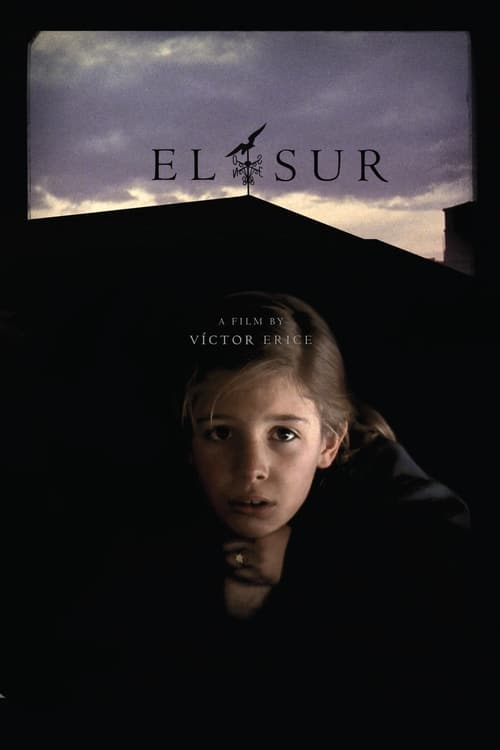
El Sur
1983 · Víctor Erice
For a contemplative night when you want beauty and stillness — a film to sink into slowly and chew on for days afterward. Reach for it when you're in the mood to remember your own childhood's unanswered questions.
What it's about
An adult woman, Estrella, sifts through her memories of growing up in the north of Spain, circling the great mystery of her childhood: her father, Agustín, a water diviner with a hidden past in the South he never speaks of. Through a child's fragmentary glimpses — a name, a postcard, a film poster, a first communion — she tries to assemble the man he was and the country's silences he carried.
The experience
Hushed, painterly, and hypnotic — the film unfolds like memory itself, in pools of lamplight and long quiet scenes where a glance carries more than a speech. It's melancholy without being heavy, and it leaves you with the particular ache of things left unsaid between parents and children.
Performances
Omero Antonutti gives the father a magnetic, wounded gravity — a man visibly carrying a secret he can neither share nor escape — and the film's power depends on how completely you believe a child would be fascinated by him.
The craft
Víctor Erice's compositions and José Luis Alcaine's cinematography turn interiors into Rembrandt paintings — faces emerging from darkness, a pendulum swinging in golden light. Famously, the production was halted before Erice could shoot the second half of his story, and the film's haunting, suspended quality is inseparable from that incompleteness. It rewards a dark room and total attention.
Why it matters
Widely held among the summits of Spanish cinema, it cemented Erice's legend as a perfectionist who made only a handful of films, each treasured — and it gave post-Franco Spain one of its great portraits of a generation's inherited silence.
Snapshot
El Sur is the second feature of Víctor Erice, made a full decade after El espíritu de la colmena (The Spirit of the Beehive, 1973), and it stands among the summits of post-Franco Spanish cinema despite — or because of — being, by its own director's account, only half the film he set out to make. Adapted from a text by Adelaida García Morales (Erice's partner at the time), it is a first-person recollection: an adult woman, Estrella, reconstructs her childhood and adolescence in the north of Spain and her fascination with her enigmatic father, Agustín, a water diviner haunted by a life he left behind in the South. The film is a study of the unknowable parent, of memory as an act of partial reconstruction, and of a Spain still silently cleaved by the Civil War. Its reputation rests on the extraordinary painterly light of José Luis Alcaine's cinematography, the gravity of Omero Antonutti's central performance, and Erice's patient, elliptical style. It is also inseparable from its production legend: financing was withdrawn before the "South" of its title could ever be filmed, so a story built on the promise of a journey southward ends before that journey begins — a truncation the film absorbs into its own theme of longing for what remains out of reach.
Industry & production
El Sur was produced by Elías Querejeta, the most important independent producer of the late-Franco and Transition era and Erice's producer on The Spirit of the Beehive. Querejeta's production house had for two decades been the institutional home of Spain's auteur cinema (Saura, Erice, later Gutiérrez Aragón), and the film carries French co-production participation typical of Querejeta's European financing arrangements of the period. It arrives in the specific industrial moment of the early 1980s: the first Socialist government had just come to power, and the "Ley Miró" reforms were reorganizing Spanish film subsidy toward quality, literary, auteur production — precisely the register in which El Sur operates.
The defining production fact is its incompleteness. Erice's screenplay conceived the film in two movements — the North, filmed in and around a country house, and the South (Seville and the father's buried past), toward which the whole narrative leans. Financing was halted before the southern portion could be shot; Erice has consistently maintained that the released film is roughly the first half of the intended work, and that the ending as it stands was not his designed conclusion. What survives is a film of about 95 minutes that carries the structural imprint of its own amputation: the yearning for the South is never satisfied, and the title names a place the film never reaches. Erice has spoken of this with a mix of loss and acceptance; critics have long debated whether the mutilation wounds the film or, paradoxically, perfects its subject. Beyond Erice's own recollections, the granular financial record of the shutdown is thin, and I won't reconstruct figures I can't verify.
Technology
The film was shot on 35mm color stock in standard practice for early-1980s European art cinema, with no unusual technological apparatus. Its interest lies not in equipment but in the disciplined manipulation of available and constructed light: Alcaine and Erice pursued low-key, source-motivated illumination — windows, lamps, doorways — that pushes color film toward the tonal range of oil painting. Antonutti, an Italian actor, performs in a language not his own and is dubbed into Spanish in post-production, a standard convention of Spanish and Italian filmmaking of the era rather than a defect; it nonetheless contributes to the faintly displaced, remembered quality of his presence.
Technique
Cinematography
The cinematography, by José Luis Alcaine, is the film's most celebrated element and one of the touchstones of Spanish camerawork. Alcaine works in a deep chiaroscuro that has repeatedly drawn comparison to Dutch Golden Age painting — Vermeer above all — in its treatment of windowed daylight falling into shadowed rooms and of faces modeled by a single dominant source. The palette runs to ambers, browns, deep blacks, and cold northern whites; interiors glow while retaining their darkness. Camera movement is measured and motivated, often gliding or holding to let light and duration do the work. The imagery is not decorative but epistemological: the film is about seeing partially, about a child straining to read an opaque adult, and Alcaine's half-lit compositions make the very act of perception — things half-emerging from shadow — the visual argument of the film.
Editing
The editing sustains long, contemplative rhythms and pronounced ellipses; time leaps across years between shots, and whole stretches of Estrella's life are compressed into single remembered images. The cutting follows the logic of recollection rather than continuity, letting fades, dissolves, and held frames register the gaps and emphases of memory. Erice's regular editorial collaboration within the Querejeta workshop of the period shaped this elliptical grammar, though I'd rather not attach a specific credit I can't confirm with certainty. The result is a film that feels less assembled than exhaled.
Mise-en-scène / staging
Erice organizes the film around a handful of charged spaces and objects. The family house, "La Gaviota," with its attic, staircase, and windows, becomes a psychic map. Recurring motifs — the father's dowsing pendulum, the bicycle, the postcards and images of the South, a cinema and a film poster, the wedding-banquet dance, the Gran Hotel where the grown Estrella is meant to leave — accrete meaning through repetition. Staging favors thresholds: doorways, windows, the edges of rooms, from which the child observes adults whose motives she cannot fully grasp. The pendulum motif ties the father's occult gift for divining hidden water to the film's larger theme of buried, unreachable truths.
Sound
Sound is spare and attentive, with silence used as an active material. The film relies largely on pre-existing music rather than a through-composed original score, drawing on Spanish concert and popular repertoire; the most famous instance is the first-communion banquet, where Agustín rises to dance a paso doble with his young daughter — a scene of tenderness and unspoken sorrow that has become one of the film's signatures. (I'd flag that precise cue-by-cue musical attributions are easy to get wrong, and I won't assert specific titles I can't verify.) The adult Estrella's first-person voice-over threads the film, the grain of remembered narration binding image to memory.
Performance
Omero Antonutti's Agustín anchors the film: reserved, courtly, melancholic, a man whose warmth toward his daughter never dissolves the mystery of his private grief. The role of Estrella is split across ages — Sonsoles Aranguren as the child and Icíar Bollaín as the adolescent, the latter making her screen debut before becoming one of Spain's foremost directors (Te doy mis ojos, También la lluvia). Lola Cardona plays the mother. The performances are keyed to interior states and glances rather than declamation; the film asks its actors to withhold, and their restraint is what makes the father's eventual despair land with such weight.
Narrative & dramatic mode
The film's mode is lyrical, first-person memory-narration — poetic realism shading into elegy. It opens at the moment of a loss (dawn, an empty bed, the sense that the father is gone) and then circles back through childhood to reconstruct how that ending became inevitable. The dramaturgy is elliptical and associative rather than causal: scenes are selected for their emotional charge, not their plot utility, and crucial events (the father's disillusionment, his connection to a former love, his death) are approached obliquely, glimpsed at the child's angle of incomplete understanding. The unreliability and incompleteness of memory is not a flaw the film corrects but its very form — a form the aborted "South" only intensifies, since the narrative's promised destination is permanently deferred.
Genre & cycle
Nominally a family drama, El Sur belongs more precisely to the art-cinema tradition of the childhood-memory film and to a distinctively Spanish cycle of works that read private family history as national allegory in the shadow of the Civil War. It sits alongside Erice's own Spirit of the Beehive and Carlos Saura's memory films (Cría cuervos, La prima Angélica) as part of a cluster that uses the perspective of a watchful child to speak, indirectly, about Francoism, silence, and inherited trauma at a time when direct speech was either censored or freshly, uneasily possible.
Authorship & method
Víctor Erice is one of world cinema's great miniaturists of output and maximalists of intensity — a director of very few features across decades, each an event. His method is one of patience, precision, and withholding: light as meaning, duration as feeling, the child's gaze as a moral instrument. His central collaborator here is cinematographer José Luis Alcaine, whose painterly lighting is co-authorial to the film's achievement and who would go on to become one of Spain's most decorated cinematographers (a long association with Almodóvar among much else). The source text is by Adelaida García Morales, then Erice's partner; her novella El Sur was published in 1985, after the film, so the film adapts her writing rather than a canonized prior book. The producer Elías Querejeta is a shaping presence in the negative sense too, as the decision to end financing determined the film's final shape. Erice has framed the film as a wound he learned to live with — an authorship marked, unusually, by what he was prevented from doing.
Movement / national cinema
El Sur is a landmark of Spanish auteur cinema in the years of the democratic Transition. It emerges from the Querejeta school that had carried Spain's most ambitious filmmaking through the last years of the dictatorship, and it exemplifies the "cine de autor" that state cultural policy of the early Socialist years actively favored. Within Spanish film history it is routinely paired with The Spirit of the Beehive as the twin pillars of Erice's reputation and, more broadly, as evidence that the most searching reckonings with Spain's recent past were conducted in a hushed, allusive register rather than a documentary one.
Era / period
The film depicts, roughly, the post-Civil War decades of the 1940s and 1950s in northern Spain — a gray, provincial, Catholic milieu of first communions and repression, in which the father's estrangement from his own family in the South is bound up with the political rupture the war left in Spanish households. The unspoken division between North and South operates as a figure for the deeper division between the two Spains. Made in 1983, the film looks back on that period from the vantage of a newly democratic country still learning how to remember its wounds.
Themes
The great subject is the unknowability of the father — the child's love for a parent whose inner life remains sealed, and the adult's belated, incomplete effort to reconstruct him. Around this cluster memory and its gaps; the pull of an idealized, unreachable South standing for the past, for origin, for everything lost; the buried presence of the Civil War in the private lives of a family; the theme of images and cinema themselves (posters, photographs, a former love who is a screen actress) as vessels of desire and deception; and divination — the pendulum's search for hidden water as a metaphor for the search for hidden truth. Suicide and paternal despair shadow the whole, giving the film's tenderness its undertow of grief. The film's own missing "South" folds these themes back on themselves: it too is a promised place we never arrive at.
Reception, canon & influence
El Sur premiered in competition at the Cannes Film Festival in 1983 and was received with high critical esteem, consolidating Erice's international standing as a major, if famously sparing, auteur. Over the ensuing decades its reputation has only risen; it appears with regularity on serious critics' and filmmakers' lists of the finest Spanish films and of the great films of memory and childhood, frequently discussed in tandem with The Spirit of the Beehive. (Specific award tallies I can't securely verify, I'll leave aside rather than risk error.)
Looking backward, the film draws on a lineage of poetic realism and painterly cinema — the Dutch masters invoked by its lighting, the memory-film tradition, and the Spanish current of Civil-War-haunted family drama that Saura had been developing; Erice's own Spirit of the Beehive is its most direct precursor, sharing its watchful child, its rural interiors, and its allegorical hush.
Looking forward, El Sur has been enormously influential on subsequent Spanish and international art cinema devoted to childhood, memory, and light. Its visual language — Vermeer-like interiors, source-motivated chiaroscuro — became a reference point for cinematographers, and Alcaine's work here is cited in the training of the craft. Icíar Bollaín's presence links the film to the next generation of Spanish directors, one of whom it launched as a performer. Perhaps its most singular legacy is conceptual: El Sur is the canonical example of the "unfinished masterpiece" whose incompleteness is read as expressive rather than merely unfortunate — a film whose missing half has itself become part of film history's ongoing conversation about longing, loss, and the South that no one ever reaches.
Reception
Acclaimed straight out of Cannes 1983 despite being, by its own director's account, only half a movie — and in the decades since it's climbed from 'tragic truncated project' to fixture on greatest-Spanish-films lists, often ranked right beside The Spirit of the Beehive.
How El Sur was received, from release to now →
Influences: the films it descends from and the films it influenced
- The Spirit of the Beehive (1973) — Erice's own prior film establishes the watchful, near-silent child positioned at thresholds as a moral instrument, and honey-toned source-light falling through rural interiors as the carrier of allegorical meaning.
- The Magnificent Ambersons (1942) — Elegiac first-person voice-over narrating a vanished household, deep-chiaroscuro staircase interiors, and elliptical time-jumps that render a family's decline as remembered rather than dramatized.
- Night of the Hunter (1955) — Expressionist source-motivated chiaroscuro that renders adult menace and mystery through a child's frightened, uncomprehending perception.
- Ordet (1955) — Vermeer-like window light in whitewashed interiors where a single motivated source sculpts figures against darkness — the northern-painting model Alcaine's interior lighting reworks.
- Cría Cuervos (1976) — Post-Franco family haunted by a dead parent and filtered through a solemn girl's fixed gaze, anchored by an obsessively repeated preexisting pop record.
- The Mirror (1975) — Nonlinear memory-reconstruction assembled from elliptical, associative fragments and a poet's voice-over — the template for first-person childhood recollection as film form.
- Distant Voices, Still Lives (1988) — Builds family memory as static, painterly tableaux scored to communally sung preexisting songs, treating recollection as arranged music rather than plot.
- The Long Day Closes (1992) — Elliptical-associative montage of a lonely boy's inner life, drenched in preexisting popular music and pooled, source-motivated light through domestic space.
- Landscape in the Mist (1988) — Children journey in long elliptical takes toward an unreachable elsewhere in search of an unknowable father — Erice's unattainable 'South' rendered as literal quest.
- The Devil's Backbone (2001) — Transplants the Civil-War-haunted watchful child and source-lit institutional gloom of the Erice tradition into a ghost story of unresolved paternal absence.
- Pan's Labyrinth (2006) — Post-Civil-War Spain seen through a solitary girl stationed at the threshold between allegory and brutal history — a direct heir to Erice's child-gaze method.
- The Tree of Life (2011) — Associative memory-collage of childhood organized around an unknowable, forbidding father, built from source-motivated natural light and whispered voice-over.
- Tabu (2012) — Structures longing around an unreachable 'South' and a lost, half-narrated past in elegiac voice-over — a formal echo of El Sur's absent, never-filmed second half.
- Roma (2018) — Autobiographical childhood memory rendered in luminous source-motivated monochrome through patient, elliptical domestic observation.
- Blancanieves (2012) — Carries José Luis Alcaine's high-contrast painterly chiaroscuro — the source-light craft he co-authored on El Sur — into a later black-and-white Spanish film.
- Close Your Eyes (2023) — Inherits the truncated, elliptical form of a film organized around an absent, searched-for man — El Sur was itself famously left unfinished, and Close Your Eyes builds its whole architecture from that poetics of the abandoned/incomplete work.
- Dream of Light (1992) — Extends Erice's painterly, penumbral interiors and his structuring of narrative around the slow physics of daylight moving across a space.
- Days of Heaven (1978) — Néstor Almendros's insistence on natural, source-motivated magic-hour light paired with a child's plain, unliterary voice-over narration.
- Fanny and Alexander (1982) — Bergman and Nykvist stage a child's-eye chronicle of an extended family in lamp-lit, source-motivated interiors, structured as remembered vignettes.
- Who Can Kill a Child? (1976) — José Luis Alcaine's signature method at full strength — exposing for the practical light source and letting whites blow out, interiors carried on natural light — the photographic approach that gives the seed its unnerving daylight.
Similar films
- The Spirit of the Beehive (1973) — influence & lineage
- Cria! (1976) — influence & lineage
- Landscape in the Mist (1988) — influence & lineage
- Amarcord (1973) — same viewing thread · often watched together
- 8½ (1963) — same viewing thread
- Nostalgia (1983) — same viewing thread
- Cinema Paradiso (1988) — same viewing thread
- L'Avventura (1960) — often watched together
All the films related to El Sur →
Watch it with: curated runs of related films
- The Past Is a Foreign Country — A run of films that reach back through memory — lost summers, vanished friends, the golden light of a place you can never return to — best watched in a row when you're in the mood to ache a little.