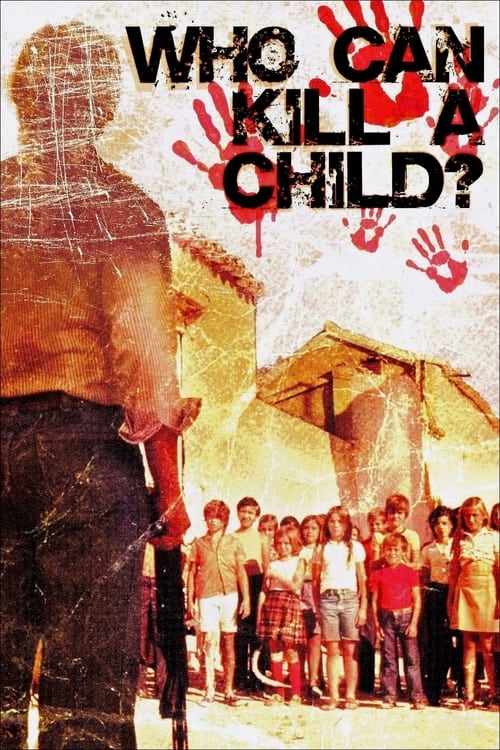
Who Can Kill a Child?
1976 · Chicho Ibáñez Serrador
For when you want a real scare that gets under your skin rather than jump-scares — a challenge, not a comfort watch, and one that will leave you rattled on the walk to bed.
What it's about
An English couple on holiday — Tom and Evelyn, who is several months pregnant — take a boat from the Spanish mainland to the small island of Almanzora, expecting a quiet fishing village. What they find is a town with no adults anywhere, just children standing in the sunlit streets, watching them and smiling. What begins as an eerie mystery about where everyone has gone slowly tightens into a fight to get off the island.
The experience
Slow-burn dread in blazing daylight — the horror happens under a blue sky, in whitewashed streets, which somehow makes it worse. It builds patiently, then corners you, and the title's question hangs over everything until the film forces you to actually feel it.
The craft
The film's boldest move is refusing every horror convention: no darkness, no gothic house, no monster — just sun, silence, and children's faces held a beat too long. The empty-village stretch is a masterclass in making an ordinary place feel wrong, and the sound of a festival with no one at it lingers. It rewards patience and a quiet room.
Why it matters
A cornerstone of Spanish horror and the definitive killer-children film, its sunstruck menace echoing through decades of later evil-kid and folk-tinged horror; it remains director Chicho Ibáñez Serrador's towering theatrical work.
Snapshot
An English couple on holiday — Tom and Evelyn, she several months pregnant — cross from the Spanish mainland to the small island of Almanzora and find a fishing village emptied of adults. Children remain, standing in the whitewashed streets, watching, smiling. Over roughly two hours the film moves from the sunlit stillness of an apparently abandoned resort to a siege, and then to a chase, and finally to an ironic coda that pushes the infection back toward the mainland. Narciso "Chicho" Ibáñez Serrador's second and last theatrical feature is one of the few horror films that stakes everything on a question posed in its title and then refuses the viewer any comfortable answer. It is also, formally, an argument against the conventions of its own genre: no shadows, no gothic architecture, no monster. The horror happens at noon, in high-key Mediterranean light, committed by people who cannot be fought without becoming what the film has spent eight documentary minutes condemning.
Industry & production
The film was made at a hinge moment in Spanish cinema. Franco died in November 1975; the state censorship apparatus was weakening but had not yet been dismantled — formal abolition came in late 1977 — so ¿Quién puede matar a un niño? belongs to that narrow window in which Spanish filmmakers could push considerably further than a year earlier while the institutional machinery still stood. The domestic industry of the mid-1970s was dominated by the destape (the sudden commercial license around nudity) and by a cheap, prolific horror sector often called fantaterror, built around figures like Paul Naschy, Amando de Ossorio and Jorge Grau. Ibáñez Serrador worked adjacent to that sector but not really inside it: the film's resources, its shooting time, and above all its control of craft set it apart from the run of Spanish genre production.
Ibáñez Serrador came to it from television, where he was a national institution rather than a marginal genre figure — creator of the anthology Historias para no dormir (1966–68) for TVE and, from 1972, of the enormously popular quiz program Un, dos, tres... responda otra vez. That standing bought him a degree of latitude. The screenplay is credited to Luis Peñafiel, the pen name Ibáñez Serrador used for writing, and the film is credited as an adaptation of Juan José Plans's novel El juego de los niños, published the same year; accounts differ on the precise sequence of novel and screenplay, and the record here is genuinely murky rather than settled.
Production was Spanish, with the two leads imported from Britain: Lewis Fiander as Tom and Prunella Ransome as Evelyn. That casting is an industrial and thematic decision at once. English-speaking leads improved the film's export prospects in a market where Spanish horror routinely traveled dubbed and retitled — and indeed this one circulated abroad as Island of the Damned, Death Is Child's Play, and Trapped, among other titles, frequently shorn of its prologue. Shooting took place on the Catalan coast at Sitges and on Menorca, whose blinding limewashed towns supply the film's visual signature.
Technology
Two technical conditions shape the film more than any equipment choice. The first is Eastmancolor under unfiltered Mediterranean sun. Rather than fight the contrast, the production embraced it: white walls blowing toward pure white, black doorways reading as voids, and a palette narrowed to lime, sea blue and ochre. This is a deliberate inversion of the low-key convention that horror photography had inherited from expressionism and from Ibáñez Serrador's own previous feature.
The second is Spanish post-production practice. The industry had worked under compulsory dubbing since the 1941 language law, and full post-synchronisation remained the norm well into the 1970s. Consequently there is no single "authentic" soundtrack: the British leads performed in English and were dubbed for domestic release, while the Spanish supporting cast and the children were voiced in post throughout. The dislocated, slightly floating quality of the dialogue in every version is not a flaw of a particular print but a structural feature of how the film was made — and it happens to serve a story about a place where human sound has come unmoored from human bodies.
Location work relied on portable rigs and zoom lenses typical of mid-1970s European production, which allowed the long, slow reframings and the sudden telephoto punch-ins that punctuate the village scenes.
Technique
Cinematography
José Luis Alcaine, later one of the defining Spanish cinematographers through his work with Almodóvar, Saura and Trueba, shot the film early in his career, and it already carries his instinct for legible, unfussy naturalism pushed to an expressive extreme. The dominant strategy is emptiness in wide shot: streets photographed as depopulated architectural spaces, held long enough for the absence to register as a fact rather than a mood. When children appear, they are frequently placed at the edge of frame or in the far distance, so that the composition rather than the cut does the work of dread. Alcaine alternates these patient wides with compressed telephoto views that flatten a street into a wall of watching faces, and with handheld coverage in the final pursuit, where the camera's instability finally matches Tom's.
The most-discussed image in the film — children swinging at a hanged corpse as a piñata — is staged in flat daylight in an open square, viewed initially from a distance and partly obstructed, so the horror arrives as comprehension rather than shock.
Editing
The cutting is unusually withholding for the period. Early sequences run long and refuse the reverse shot that would confirm what Tom or Evelyn is seeing; information is released in increments too small to act on. The film's structural pivot is the point at which ambiguity collapses — once the couple can no longer pretend they are misreading the island, the editing tightens and the picture converts from investigation to survival. The eight-minute documentary prologue works by an entirely different logic, an assaultive montage of archival atrocity footage set against narration and statistics, which functions less as exposition than as an argument the fiction will then be obliged to answer. English-language sources are inconsistent about the below-the-line technical credits, including the editor; this is one of the areas where documentation of the film is genuinely thin.
Mise-en-scène / staging
Staging is built on stillness and on the geometry of the empty village. Children do not lunge; they stand, walk, turn their heads in unison, and smile. Violence, when it comes, is often framed as play — a game with a scythe, a game with a body, a game with a gun — which is precisely the film's thesis rendered as blocking. The interiors reverse the exteriors: cramped, dim, cluttered with the abandoned furniture of ordinary life, so that the couple are given a choice between exposure and entrapment. Evelyn's pregnancy is staged with escalating physical prominence, until her body becomes the last enclosed space the film invades.
Sound
Waldo de los Ríos — the Argentine composer best known for orchestral-pop arrangements of the classical repertoire, who had also scored La residencia — builds the score around children's voices: a chanting, nursery-rhyme motif that reads as innocuous in the opening minutes and as predatory by the end. It is a simple, ruthless device, and it is deployed sparingly. Elsewhere the film relies on the ambient sound of an emptied place — sea, wind, a shutter, an unanswered telephone — and on unlocated laughter, which becomes the reliable signal of proximity. The mainland festival that opens the fiction is a wall of firecrackers and crowd noise, a deliberate saturation the island then removes. De los Ríos died in 1977, shortly after the film's release.
Performance
The film is effectively a two-hander surrounded by non-professionals. Fiander carries the heavier arc, moving from holiday complacency through embarrassed rationalization to a desperation that finally breaks the film's central taboo; Ransome plays Evelyn's dawning comprehension largely in reaction, and the performance's restraint is what makes the final act land. The children were directed toward affect that is not so much "creepy acting" as ordinary childhood behavior deprived of context: they smile as children genuinely smile. Production lore holds that Ibáñez Serrador kept the young performers unaware of the film's subject and elicited real amusement on set; this is frequently recounted but should be treated as anecdote rather than documented method.
Narrative & dramatic mode
The structure is a slow-burn siege in the Night of the Living Dead lineage, prefaced by an essayistic prologue and closed by a bitter circular twist. The opening establishes tourism, festivity and comfort; the crossing to Almanzora functions as a threshold; the middle movement is investigative, almost procedural, as Tom searches houses and radios for an explanation the film has no intention of providing. The turn from mystery to certainty happens roughly at the midpoint and is irreversible.
Crucially, the film supplies no origin. A vague suggestion circulates that the condition passes from child to child through contact or laughter — a contagion of play — but nothing is confirmed, and the deliberate absence of explanation is what keeps the title's question sharp. If the children were possessed, or infected by a defined agent, killing them would be a technical problem. Because they remain children, it stays a moral one. The film's dramatic engine is not "will they escape" but "what will Tom become in order to escape," and the answer is delivered in a sustained sequence that the picture stages without absolution.
Genre & cycle
It sits at the intersection of two cycles. The first is the "sinister children" strain running from The Bad Seed (1956) through Village of the Damned (1960), Lord of the Flies (1963) and the early-1970s wave of demonic-child pictures. The second is the rural-isolation siege film, in which a small group is surrounded by an implacable, unexplained collective — The Birds (1963) and Night of the Living Dead (1968) are the obvious antecedents, and the film's tactical situation is essentially theirs.
Within Spain it belongs to the 1970s fantaterror boom while standing conspicuously apart from it in ambition and finish. It also anticipates the "hostile holiday" thriller — the tourist punished by a landscape they treated as scenery — which recurs across European genre cinema for the next forty years.
Authorship & method
Ibáñez Serrador (1935–2019), born in Uruguay into a family of performers and raised between Argentina and Spain, was a television author first and a filmmaker second: two features in a career otherwise built on anthology horror and mass-audience light entertainment. That double life is legible in the work. La residencia (1969) and this film share a taste for classical construction, patient exposition and a single devastating structural reversal — the discipline of someone who spent years writing for a medium where the audience can leave at any moment. Late in life he received an honorary Goya in recognition of that career.
The key collaborators are unusually consequential. Alcaine's photography supplies the film's counter-generic daylight. De los Ríos's score supplies its most economical scare. The writing, under the Peñafiel pseudonym, is Ibáñez Serrador's own, working from Plans's novel; the decision to open with documentary atrocity footage — implicating the historical adult world before a single fictional child does anything — is the authorial gesture that defines the film, and the one most often argued about.
Movement / national cinema
The film is a document of la Transición. Made months after Franco's death, it treats the question of inherited guilt in a country then beginning to negotiate what to do with its own recent history, and it does so obliquely enough to have passed. Spanish cinema of the period was producing its allegories in two registers: the art-cinema symbolism of El espíritu de la colmena (1973) and Cría cuervos (1976), where children carry the weight of a traumatized polity, and the genre sector, where the same anxieties surfaced as monsters. Ibáñez Serrador's film sits between them — genre in form, allegory in structure — and its opening montage internationalises the charge, refusing to make the accusation exclusively Spanish.
Era / period
Beyond Spain, 1976 places the film in the middle of the decade's crisis horror: the post-Vietnam, post-Manson genre cinema of The Texas Chain Saw Massacre (1974), The Exorcist (1973) and The Omen (1976), in which the family, the child and the countryside were all reclassified as threats. It shares that moment's pessimism and its willingness to end badly. It also belongs to the specific history of Mediterranean mass tourism — the couple are consumers of a "Spain is different" holiday economy, and the film's geography of ferries, hotels and shuttered gift shops is exact.
Themes
The central proposition is retribution, not possession: the children of the world return the violence adults have done to children, and the prologue's real corpses establish the debt. From this follow the film's more uncomfortable moves. Innocence is not destroyed but weaponized — the children remain recognizably children while killing, which is what makes the title unanswerable. The pregnancy makes the theme literal and internal: the threat is not merely outside the door but inside the body, and the future is not a promise but a verdict.
Two secondary threads matter. The tourist gaze — an English couple who arrive expecting a picturesque village and are unable to read the place they are in — turns the film into a story about spectatorship, which the title's direct address to the viewer reinforces. And the coda's move back toward the mainland converts a local horror into an unstoppable historical process, closing off the consolation that the island might be contained.
Reception, canon & influence
Contemporary reception was uneven and, outside Spain, largely indifferent. The film traveled in cut and retitled versions, frequently missing the documentary prologue that supplies its moral architecture — a mutilation that made it legible as a routine killer-kids picture and delayed serious assessment by decades. Its recovery came through home video and festival retrospective culture from the 2000s onward, when restored editions returned the prologue and critics reassessed it as one of the strongest European horror films of the 1970s. Debate about the prologue persists and is worth preserving: to some readers it is the ethical ground the fiction stands on, to others an appropriation of real suffering to license a genre exercise. Both positions are defensible and the film does not resolve them.
Looking backward, the clearest inheritances are The Birds and Night of the Living Dead for the siege and the withheld explanation, Village of the Damned and Lord of the Flies for the collective child, and Ibáñez Serrador's own La residencia for the institutional cruelty of the young. Looking forward, its influence runs through the "murderous children" strain — The Children (2008) and the broader cycle of hostile-rural thrillers work recognizably in its idiom — and it was directly remade as Come Out and Play (2012) by the pseudonymous director Makinov. Claims that it inspired Children of the Corn should be treated cautiously: Stephen King's story appeared in 1977, after the film, and no documented connection establishes influence in either direction.
Its most secure legacy is national. Ibáñez Serrador is now positioned as the founding figure of a modern Spanish genre tradition that runs through Alejandro Amenábar, Jaume Balagueró, Paco Plaza and J. A. Bayona — a lineage made explicit in 2021 when a group of contemporary Spanish directors, Amenábar and Plaza among them, revived Historias para no dormir as an anthology series in his name. ¿Quién puede matar a un niño? remains the fullest statement of what he could do with a feature: a horror film that declines to let its audience watch from a safe distance, and whose title is not a tagline but a demand.
Reception
Barely seen abroad in the '70s — it hit the US in a cut version retitled 'Island of the Damned' and sold as cheap exploitation — but decades of restoration and word-of-mouth have made it a crown jewel of Spanish horror, now routinely called one of the great killer-kid films.
How Who Can Kill a Child? was received, from release to now →
How to watch Who Can Kill a Child?: what to notice on a first viewing
- Notice the horror happens in bright, unfiltered daylight. Alcaine shoots at noon under Mediterranean sun, white walls blowing toward pure white, with no shadows or gothic architecture to hide in. Removing horror's usual darkness means nothing here can hide behind atmosphere, so the threat has to be the people themselves.
- Watch the empty streets held in long, wide shots. Alcaine photographs the village as depopulated architecture, holding each street long enough that the absence of adults registers as fact, not mood. The stillness of the frame, not a cut, is what makes the empty village feel wrong.
- Watch the children stand still and turn to look together. The children do not lunge. They stand, walk, and turn their heads in unison, watching the couple with smiles that give nothing away. The children were directed to act like ordinary kids with no context, which is what makes the calm so unsettling.
- Listen for a children's chant that turns unsettling. Waldo de los Rios builds the score around a nursery-rhyme motif sung in children's voices, innocuous at first and predatory by the film's end. The same simple tune tells you how far things have shifted, without a single line of dialogue.
- Notice the film opens with real archival atrocity footage. An eight-minute documentary montage of war and massacre footage, with narration and statistics, plays before any of the fiction begins. The prologue puts real adult violence on record first, so the fictional children arrive already owed a debt.
The whole guide to watching Who Can Kill a Child?, with the keys for a rewatch →
Influences: the films it descends from and the films it influenced
- Village of the Damned (1960) — Blocks a group of children as a single blank-faced unit — matched eyelines, unison movement, no cutaway that would grant them psychology — the collective-child staging Ibáñez Serrador reuses whole in the Almanzora square.
- Lord of the Flies (1963) — Brook's semi-documentary method — non-professional children, long handheld takes on a real island, ritual violence arrived at through improvised play — supplies the exact performance register for the seed's unrehearsed island kids.
- The Birds (1963) — Establishes the scoreless siege with a permanently withheld origin: escalation staged in wide daylight exteriors, a boarded-up interior, and an ending that grants flight instead of explanation.
- Kill, Baby... Kill! (1966) — Bava's giggling child-ghost and her bouncing ball codify unlocated child laughter as the offscreen sound cue that precedes a death — the seed's most economical scare device before De los Ríos scores it.
- Night of the Living Dead (1968) — Grafts documentary news material onto fiction to authenticate it, then combines the barricaded-house siege with the taboo image of a child killing a parent — both structural moves the seed adopts and hardens.
- The House That Screamed (La residencia) (1969) — The director's own prior feature: patient classical exposition engineered toward one late structural reversal, with cruelty originating among the young inside a closed institution, shot in telephoto-compressed corridor and courtyard coverage.
- The Blood on Satan's Claw (1971) — Makes a village's own children the corrupting agent and shoots their gatherings in flat ordinary field daylight, refusing gothic night — the counter-generic lighting logic Alcaine pushes further into overexposure.
- The Texas Chain Saw Massacre (1974) — Opens with an authenticating voiceover prologue asserting documented atrocity, then plays the horror in sun-blasted overexposed daylight with handheld pursuit — the same prologue-plus-daylight contract the seed signs.
- Tesis (1996) — Takes the seed's most argued-over gesture — the found atrocity footage — and makes the ethics of watching it the entire plot, turning the prologue's implication of the viewer into a thriller mechanism.
- [REC] (2007) — Handheld pursuit through a sealed space with the contagion's origin withheld until the last room, and the film's terminal image reserved for a child figure — the Spanish genre line the seed founded, running through Serrador's declared heirs.
- The Orphanage (2007) — Stages children's games as the literal mechanics of horror — the counting-and-knocking game structuring a sequence — extending the seed's violence-as-play grammar, where killing is performed with the rhythm of a piñata.
- The Children (2008) — Transposes the seed's siege to a snowbound holiday house and runs the same suspense engine: adults who cannot bring themselves to strike back at their own children, with the infection's cause never given.
- Eden Lake (2008) — Rebuilds the seed's moral trap — kill a child or be killed by one — with handheld pursuit across sunlit rural England, the children recording their violence as a game they are performing for each other.
- Come Out and Play (2012) — Direct authorized remake, reproducing the island geography, the pregnant-wife structure and the withheld reverse shot of the first killing, while dropping the documentary prologue that anchors the original's ethics.
- Midsommar (2019) — Feature-length high-key daylight horror: ritual violence staged in open sunlit fields and read in telephoto compression, with the frame deliberately offering no shadow for the threat or the viewer to hide in.
- The Wicker Man (1973) — An outsider investigator walks a sunlit island community whose complicity is total; the conspiracy is withheld by structure rather than by darkness, and the reveal is architectural, not a jump.
- El Sur (1983) — José Luis Alcaine's signature method at full strength — exposing for the practical light source and letting whites blow out, interiors carried on natural light — the photographic approach that gives the seed its unnerving daylight.
- Children of the Corn (1984) — Convergent rather than derived (King's story postdates the film and no link is documented): the same depopulated-town premise in which adult outsiders discover the children have already killed everyone and now hunt them.
Similar films
- [REC] (2007) — influence & lineage · same viewing thread
- The Texas Chain Saw Massacre (1974) — influence & lineage · same viewing thread
- The Wicker Man (1973) — influence & lineage
- The Birds (1963) — influence & lineage
- El Sur (1983) — influence & lineage
- Night of the Living Dead (1968) — influence & lineage · same viewing thread
- Halloween (1978) — same viewing thread
- Cria! (1976) — shared sensibility
All the films related to Who Can Kill a Child? →
Watch it with: curated runs of related films
- Nowhere Left to Hide — Watch these when you want pure primal terror — ordinary people cornered by something relentless, from open water to a silent farmhouse to a stairwell in Barcelona.