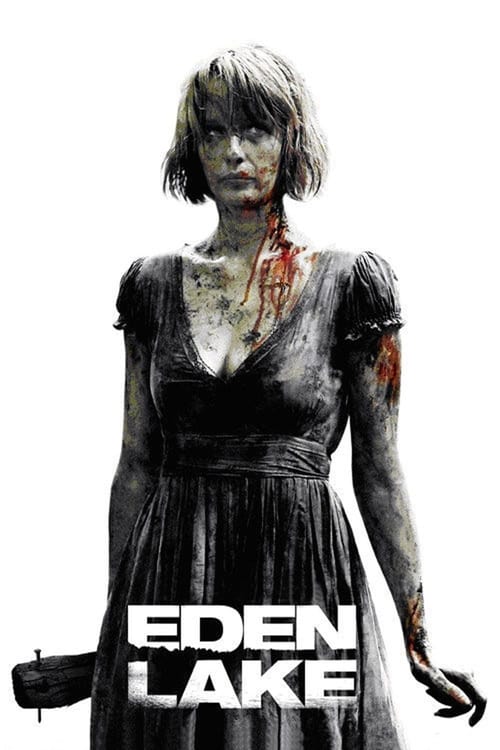
Eden Lake
2008 · James Watkins
When you want to be put through the wringer — a nasty, white-knuckle ordeal rather than fun scares. Save it for a night you can handle bleak; this one does not send you to bed soothed.
What it's about
Jenny, a nursery teacher, and her boyfriend Steve drive out of London for a romantic weekend at a secluded quarry lake — he's planning to propose. A gang of local teenagers is already on the beach, and the friction starts small: loud music, a menacing dog, a stolen bag. Each confrontation escalates past the point of return, until the weekend becomes a desperate fight to survive the woods and the people in them.
The experience
Relentless and genuinely upsetting — the escalation is engineered so each step feels horribly plausible, and once it tips into violence the film never lets you exhale. It's a survival thriller with a streak of social anger that makes the cruelty sting more than most horror.
Performances
Kelly Reilly carries the film, charting Jenny's collapse from holiday ease into feral survival with total conviction. A young Michael Fassbender grounds Steve's doomed decency, and Jack O'Connell is chilling as Brett — a teenager whose menace comes from insecurity curdling into sadism.
The craft
James Watkins directs his first feature with ruthless economy: the screenplay ratchets tension through small, believable decisions, and the woodland chase scenes are shot and cut for maximum panic. The sun-bleached lake and mud-dark forest give the brutality an ugly beauty, and the sound of the kids' voices in the trees is as frightening as anything shown.
Why it matters
A flashpoint of late-2000s British horror, endlessly debated for how it channeled the era's tabloid panic about feral youth, and an early showcase for Fassbender and O'Connell before stardom.
Snapshot
Eden Lake is a British survival-horror film written and directed by James Watkins, and his first feature as director. A nursery teacher, Jenny (Kelly Reilly), and her boyfriend Steve (Michael Fassbender) drive out of London for a weekend at a flooded quarry lake that is about to be fenced off for a gated housing development. Steve plans to propose there. A gang of local teenagers led by Brett (Jack O'Connell) is already at the beach, and the trouble starts small: loud music, a rottweiler off its lead, backchat. It turns into theft, a confrontation that ends with the dog dead, and then a manhunt through the woods. Brett gets the others to torture Steve and films it on a mobile phone. Jenny is left to run and fight through the woods and finally into the town the kids come from. There, the adults turn out to be worse than the children.
The film is lean and very hard to watch, and its ending is famously bleak. It is also one of the most argued-over British genre films of its decade. Critics and cultural commentators read it as the defining text of what the British press called "hoodie horror." That was a short cycle of late-2000s films that turned middle-class fear of working-class youth into genre material. Whether the film examines that fear or exploits it has been the central question about it ever since.
Industry & production
Eden Lake came out of the British independent sector of the mid-2000s. Lottery-funded and private-equity-backed genre production was booming then, after the commercial success of films such as 28 Days Later (2002), Shaun of the Dead (2004) and especially Neil Marshall's The Descent (2005). Christian Colson and Richard Holmes produced, and the company most closely associated with it is Rollercoaster Films. Colson was producing Slumdog Millionaire in the same period. The UK distributor was Optimum Releasing, which had a strong catalogue of genre and art-house titles and a home-video business. The film appears to have played at London's FrightFest in August 2008, the main showcase for British horror at the time, before its UK theatrical release in September 2008.
The budget was modest by feature standards. I can't confirm a reliable figure, and none is given here. The production relied on a small principal cast and English woodland and lakeside locations. The fictional lake was put together from locations in the Home Counties rather than any one real site. The specific locations are reported in production publicity but are not well documented in scholarly sources.
The casting is notable in hindsight. Fassbender was not yet an established name: Steve McQueen's Hunger premiered at Cannes the same year. O'Connell was a teenage actor fresh from Shane Meadows's This Is England (2006), and Thomas Turgoose, that film's young lead, also joined the gang. Kelly Reilly was the best known of the three, from Mrs Henderson Presents (2005) and Pride & Prejudice (2005). Bringing in performers from the British social-realist tradition, and Meadows's work in particular, gave the teenagers a texture closer to Meadows than to American slasher villains.
Technology
Eden Lake was shot on 35mm film and framed widescreen, in the conventional manner of a mid-budget British theatrical feature. Its technical interest is less in its own production than in the technology it puts inside the story. The mobile phone camera matters to the plot. The gang films Steve's torture, Brett insists that each member take part and be recorded, and the final image shows Brett deleting the footage from Jenny's phone. The film was released when "happy slapping" had been a tabloid panic for some years: violent assaults filmed on phones and passed around. Eden Lake builds that anxiety into its plot. The recording makes the group act together and binds them to Brett, so the phone becomes a tool of coercion as well as a witness.
Technique
Cinematography
Christopher Ross shot the film. The look moves through stages. The opening sequences are warm, sunlit and almost pastoral. The lake is shot as a romantic escape, with golden light on the water and wide, open compositions that sell the couple's sense of discovering the place. As the film moves into the woods, the framing tightens and the light flattens. Night scenes become murky and close, with Jenny often lit only by torches or moonlight in thick undergrowth. Handheld camerawork takes over in the chase and torture scenes, but the film does not commit to the full "found-footage" or shaky-cam idiom of contemporaries. It keeps enough compositional control that space stays readable. That matters, because much of the suspense depends on where Jenny is relative to her pursuers.
Editing
Jon Harris edited the film. He had previously cut The Descent and Matthew Vaughn's Layer Cake (2004). His work on Eden Lake is disciplined about rhythm. The first act escalates slowly through a series of small social irritations, and each one is allowed to play out awkwardly in real time. The editing then speeds up as the hunt begins. The film often holds on Jenny alone, in hiding or waiting, in long tense passages broken by sudden violent cuts. The torture of Steve is mostly conveyed through cutting between the boys' faces, the phone screen and Jenny's hidden point of view rather than through lingering gore. That is arguably more upsetting, because it puts the ordeal in the gang's reactions.
Mise-en-scène / staging
The production design sets up a key opposition. On one side is the couple's world: a 4x4, a wicker picnic, a guidebook, a proposal ring. On the other is the gang's world: BMX bikes, cheap tracksuits, a dog, a cluttered and hostile town. Billboards for the planned gated community, "Eden Lake," appear early, and the irony is clear. This pastoral is about to be privatised, and the locals are about to be shut out.
The woods are staged as a labyrinth: dense, disorienting and without landmarks. The film's most notorious image, Jenny hiding in a rubbish skip, is a calculated descent from the picnic to the dump. The last act moves into the town itself, with domestic interiors and a back-garden party. The setting changes from wilderness to community, and the community proves the more dangerous place.
Sound
David Julyan composed the score. He is best known for his long collaboration with Christopher Nolan, from Following through The Prestige, and he also scored The Descent. His music for Eden Lake is restrained and textural. It favours low drones and sparse figures over orchestral stingers, and it often drops out entirely so that ambient sound can carry the tension: wind, breaking branches, the distant whine of bicycles and dogs. Diegetic sound has a lot of work to do. The gang's portable stereo in the opening beach scene is the first intrusion, and offscreen voices and whistles in the woods keep up the sense of being hunted.
Performance
Kelly Reilly carries the film. Her performance traces Jenny's change from a gentle, conflict-averse teacher who tries to defuse the kids' behaviour with patience to a filthy, wounded and finally lethal survivor. The film's moral discomfort depends on that change. When Jenny kills Cooper, the youngest and most reluctant member of the gang, it is a frantic accident of self-defence, and Reilly plays it as horror rather than triumph.
Fassbender's Steve is a study in masculine pride. He wants to stand up to the teenagers in order to impress Jenny, and the film suggests his escalation helps turn conflict into catastrophe. Jack O'Connell's Brett is the performance most often singled out. He plays a charismatic, volatile bully whose authority over the others visibly comes from fear, and whose cruelty is shown partly as learned behaviour. That is confirmed when his father, Jon (Shaun Dooley), appears in the final act. The younger gang members, including Turgoose and Finn Atkins as Paige, give the group distinct and reluctant individual faces. That makes the group's collective violence harder to read as simple monstrousness.
Narrative & dramatic mode
The film follows a linear survival-horror structure with three clear movements. First comes an escalating social encounter. Then comes a hunt and siege in the woods, with Steve's capture and torture at its centre. Last comes Jenny's flight into the town, where she believes she has reached safety. The dramatic method relies on sympathetic mistakes. At several points the couple, Steve above all, choose confrontation when they could leave. The film does not let the audience off with simple identification: it invites us to judge Steve's escalation even as we fear for him.
The ending, which critics discussed at length, refuses rescue or justice. Jenny reaches a house that turns out to belong to the gang's parents. The adults close ranks, and the film strongly implies that Jenny will be killed offscreen. In the last scene Brett deletes the phone evidence and looks at his reflection in Jenny's sunglasses. The dramatic mode is nihilist tragedy rather than catharsis, closer to 1970s American horror than to the "final girl" survival endings of the slasher tradition.
Genre & cycle
Eden Lake sits where several genre traditions overlap:
- Backwoods and "urbanoia" horror: the city-dweller who ventures into the provinces and is punished. The ancestors are Deliverance (1972) and The Texas Chain Saw Massacre (1974), and Carol J. Clover's analysis of the "urbanoia" mode in Men, Women, and Chain Saws fits the film closely.
- Home-invasion and siege thrillers, especially Sam Peckinpah's Straw Dogs (1971). That film is set in rural England and also turns on a couple, an outsider husband and a local gang.
- Killer-children horror, such as Narciso Ibáñez Serrador's Who Can Kill a Child? (1976). Lord of the Flies is also an obvious literary reference for a group of children reverting to a violent social order.
- The contemporary French and European extremity wave, especially David Moreau and Xavier Palud's Ils (Them, 2006). That film also features a couple attacked in rural isolation by adolescents.
Within British cinema it is the central example of the "hoodie horror" cycle, a term used in the press and in later criticism. Related titles include The Great Ecstasy of Robert Carmichael (2005), Noel Clarke's Kidulthood (2006), Outlaw (2007), Harry Brown (2009), Heartless (2009), Cherry Tree Lane (2010), F (2010), Comedown (2012) and Ciarán Foy's Citadel (2012). These films vary a lot in quality and politics, but they share a fixation on feral youth, sink estates and the collapse of authority. Eden Lake is generally seen as the cycle's most commercially and critically visible horror entry.
Authorship & method
James Watkins came to directing as a screenwriter. He had co-written My Little Eye (2002), a reality-TV-themed horror film directed by Marc Evans, and Gone (2007), a backpacker thriller set in Australia. Both are about vulnerable people under surveillance or isolated in hostile places, and Eden Lake sharpens those concerns. As writer-director, Watkins builds the script around plausible escalation: each beat is a small step from the last, and the film's power lies in how ordinary its first act is.
His later career confirms an interest in the mechanics of dread and in civility as a thin cover. He directed the Hammer revival hit The Woman in Black (2012), the action thriller Bastille Day (2016), episodes of Black Mirror ("Shut Up and Dance", 2016, also about coercion through recorded video) and the BBC series McMafia (2018). He also directed Blumhouse's English-language remake of Speak No Evil (2024), another story of a well-mannered couple confronted with violence they are socially unprepared for.
Key collaborators:
- Christopher Ross, cinematographer: the passage from pastoral warmth to nocturnal claustrophobia.
- Jon Harris, editor: The Descent connection; disciplined escalation.
- David Julyan, composer: also a The Descent connection; minimal, ambient dread.
- Christian Colson and Richard Holmes, producers.
The crossover of personnel with The Descent is worth noting. Editor and composer both link the two films, and they are often paired as the high points of 2000s British horror.
Movement / national cinema
Eden Lake belongs to a broader revival of British genre cinema in the 2000s. It also borrows from British social realism, the tradition of Ken Loach, Alan Clarke and, more recently, Shane Meadows. The casting of Meadows alumni, the regional settings and the attention to class markers through clothes, accents, cars and dogs all borrow from social realism's vocabulary while turning its sympathies around. Social realism usually takes the point of view of the working-class characters. Eden Lake stays almost entirely with the middle-class outsiders, and the working-class community is seen through their terrified eyes.
This inversion is what made the film controversial, and it ties it to a wider national conversation. The late 2000s saw intense media coverage of youth crime, ASBOs (Anti-Social Behaviour Orders, introduced under the Crime and Disorder Act 1998), knife crime and the pejorative figure of the "chav." Owen Jones's Chavs: The Demonization of the Working Class (2011) is the best-known critique of that discourse, and it cited Eden Lake as an example of class fear made into entertainment.
Era / period
The film is very much of its moment, during the late New Labour years and just as the 2008 financial crisis broke. Its anxieties include feral youth and broken families, the loss of parental and police authority, the commercial enclosure of common land (the gated "Eden Lake" development), and a new culture of filmed and shared violence on mobile phones. Its view of England is also shaped by the period's growing social segregation. The couple are commuters from London who see the countryside as a leisure resource, while the town has been left behind. The billboard advertising the exclusive development is a quiet but pointed image: the dispute over the lake is partly a dispute over who the English landscape now belongs to.
Themes
- Class fear and class conflict. The central and contested theme. The film can be read as exploiting middle-class fears of the working class, or as dramatising them with a critical eye. The evidence for the second reading lies in its attention to Steve's provocations, the couple's assumption that they are entitled to the place, and the economic dispossession hinted at by the development.
- Violence learned and inherited. Brett's brutality is mirrored and explained by his father's. The final act moves the source of horror from children to adults, suggesting that violence passes down through the generations and is protected by the community.
- Masculinity and pride. Steve's need to assert himself, partly to impress Jenny, drives the escalation. The film's treatment of male honour echoes Straw Dogs, though it is less admiring of it.
- Coercion and complicity. Brett makes every gang member take part in the torture and records it. Group violence is shown as something forced on individuals who might otherwise refuse, as in Lord of the Flies or Milgram's experiments.
- The corruption of innocence and pastoral. The title's Eden is false from the start. The garden is already fallen, already being fenced off for sale, and the children are its serpents as much as its innocents.
- The failure of liberal decency. Jenny is a teacher who believes in reasoning with children. The film tests her values to destruction, and the bleak ending denies her any reward for them.
Reception, canon & influence
Critical reception. The film was widely praised as craft and widely argued about as politics. Reviewers commended its tension, Reilly's performance, the emerging talents of Fassbender and O'Connell, and Watkins's control as a debut director. Many also found it relentless and unpleasant, and its class politics were contested in reviews and opinion pieces from the start. The British press often framed it as horror reflecting contemporary headlines, and some critics were troubled that it seemed to confirm tabloid caricatures of working-class youth. It won the Empire Award for Best Horror in 2009. Beyond that, documentation of its awards in sources available to me is limited, and no box-office figures are given here because I cannot reliably confirm them.
Influences on the film (backward). Straw Dogs, Deliverance, The Texas Chain Saw Massacre, Who Can Kill a Child?, Lord of the Flies, Ils (Them), The Descent and the social realism of Alan Clarke and Shane Meadows. It is also shaped by the broader landscape of 2000s "torture" and extremity horror, including Wolf Creek (2005), Hostel (2005) and Michael Haneke's Funny Games (1997), though Watkins is notably more restrained about explicit gore than most of them.
Legacy and influence (forward). Eden Lake became the reference point for later British horror about youth and class. Heartless, F, Cherry Tree Lane, Citadel and Harry Brown are all regularly discussed in relation to it, whether as followers or reactions. It started the screen careers of Fassbender and O'Connell, who became major names in the following years, and it is a frequent title in lists of the most disturbing horror films and the best British horror of its era.
Its bigger legacy may be the critical debate it provoked. It is a standard case study in academic and popular writing on class representation in British cinema, and it gave "hoodie horror" its most quoted example. Watkins's later work, especially Speak No Evil, can be read as a continuation of its main concern: civilised people who meet violence they are not prepared for, and who find their good manners useless or worse. It also pointed ahead to a strand of 2010s folk and rural horror (Kill List, 2011; The Ritual, 2017; Alex Garland's Men, 2022) that treats the English countryside as unsettled, contested ground rather than a place of refuge.
Influences: the films it descends from and the films it influenced
- Straw Dogs (1971) — Its structure of an educated couple in the English countryside, provoked step by step by local men until a siege breaks out, is the escalation plan Watkins follows, with each insult a small, plausible step past the last.
- Deliverance (1972) — It set the urbanoia template in which city weekenders drive into an untouched place to enjoy it, and the place's natural beauty becomes the trap. Eden Lake's lakeside turn from idyll to threat copies that design.
- The Texas Chain Saw Massacre (1974) — Watkins borrows its long final-act ordeal and the bright daylight that gives way to night, then reverses the closing escape. Where Sally survives into the dawn, Jenny's rescue turns out to be the last trap.
- Who Can Kill a Child? (1976) — It is the founding killer-children film about tourists on holiday, built on the couple's moral hesitation to strike back at children. Eden Lake makes that hesitation, and Jenny's eventual violence against a child, the centre of its horror.
- Lord of the Flies (1963) — Brook's loose, close-up direction of non-professional boys turning on each other gave the film its pecking order of peer-pressured cruelty. Eden Lake restages it with Brett's gang forcing the weaker members to take part, and films it on a phone.
- Made in Britain (1982) — Clarke's study of a charismatic, articulate young bully who leads by intimidation, shot with a tracking, observational camera, is the source of the social-realist performance style that Eden Lake turns into horror through Jack O'Connell's Brett.
- Funny Games (1997) — Haneke's use of a polite middle-class couple's civility as a weakness, and his refusal to give the audience the expected rescue, shape Eden Lake's view that good manners are useless and its nihilistic ending.
- Dead Man's Shoes (2004) — Meadows moved Midlands social realism into a rural setting with handheld natural-light camerawork and petty-criminal locals who are frightening because they seem ordinary. Watkins adopts that texture to ground the genre beats.
- The Descent (2005) — It shares editor Jon Harris and composer David Julyan with Eden Lake. Harris's tightly controlled cutting of panic and Julyan's sparse ambient drone carry over directly into Eden Lake's nocturnal claustrophobia.
- Wolf Creek (2005) — Its slow, almost documentary first act of an ordinary trip, followed by a refusal to let the protagonists escape, is the arc of tourists in a remote landscape that ends without reassurance that Eden Lake also uses.
- Ils (Them) (2006) — It supplied the model of a couple attacked by hooded attackers who are revealed to be adolescents, and of a night chase through woods shot with tight handheld camerawork. Eden Lake removes the mystery and shows the teenagers from the start.
- Cherry Tree Lane (2010) — It packs Eden Lake's story of a middle-class couple brutalised by teenagers into a near-real-time home invasion. The violence stays off-screen and is conveyed through reaction shots, which takes Watkins's reaction-cutting further.
- F (2010) — It turns hoodie horror into a siege: a school at night is attacked by faceless hooded teenagers who are never explained. That abstracts Eden Lake's young attackers into a pure stalking threat.
- Citadel (2012) — Feral hooded children stalk a tower block in this film, which pushes Eden Lake's estate-youth threat into supernatural allegory. It is filmed from the agoraphobic victim's subjective, enclosed point of view.
- Kill List (2011) — It continues Eden Lake's move from social-realist naturalism into rural horror, ending on a nihilistic twist in which the protagonist's own violence condemns them. This is the reversal of the final girl as folk horror.
- Speak No Evil (2024) — Watkins goes back to his central device of a civilised couple held hostage by their own politeness, escalating through small social humiliations that turn into violence. Here the countryside retreat is a hosts' farmhouse.
- Good Boy (2026) — The hoodie-horror cycle's handheld pursuit grammar and its feral-English-youth antagonist are the genre soil the film argues with, inverted by handing the keys and the camera's fixed vantage to the middle-class household.
- Heartless (2009) — Ridley takes hoodie-horror iconography, gangs of faceless youths on a London estate, and turns it into explicit demonology. It is a stylised reply to Eden Lake's realist approach to fear of class.
- Harry Brown (2009) — It brings Eden Lake's portrait of feral youth onto the estate as a vigilante film, again casting Jack O'Connell as a young thug. It uses Eden Lake's escalation in reverse, with the victim turning into the aggressor.
Similar films
- Who Can Kill a Child? (1976) — influence & lineage · same viewing thread
- Funny Games (1997) — influence & lineage
- Kill List (2011) — influence & lineage
- The Texas Chain Saw Massacre (1974) — influence & lineage · same viewing thread
- Friday the 13th (1980) — same viewing thread
- "Wuthering Heights" (2026) — shared sensibility
- Fear Street: 1978 (2021) — shared sensibility
- Funny Games (2008) — shared sensibility
All the films related to Eden Lake →
Watch it with: curated runs of related films
- Nowhere Left to Hide — Watch these when you want pure primal terror — ordinary people cornered by something relentless, from open water to a silent farmhouse to a stairwell in Barcelona.