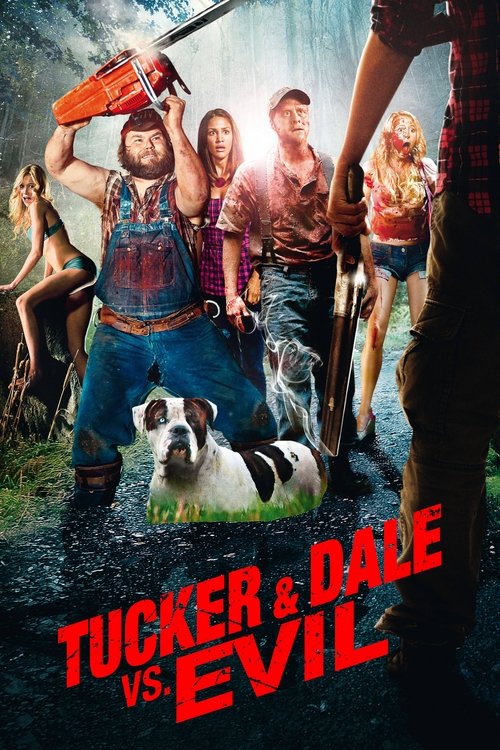
Tucker and Dale vs. Evil
2010 · Eli Craig
When you need a good laugh and don't mind it arriving with a chainsaw — ideal for a beer-and-pizza night with friends, including the ones who claim they hate horror. Pure comfort viewing in slasher clothing.
What it's about
Tucker and Dale, two sweet-natured West Virginia buddies, head to the woods to fix up the ramshackle vacation cabin of their dreams. A group of college kids camping nearby have seen enough horror movies to know exactly what two hillbillies at a creepy cabin means — and when Dale rescues one of the students from drowning, her friends read it as a kidnapping. Every attempted rescue goes catastrophically, hilariously wrong.
The experience
A gleeful, gory farce that runs one perfect joke — the 'killers' are the victims — through every slasher setup in the book. It's splattery but never mean, and its secret weapon is how much you end up rooting for its two lovable doofuses.
Performances
Alan Tudyk and Tyler Labine are a genuinely great comic duo: Tudyk's exasperated confidence and Labine's shy, big-hearted Dale turn what could have been a one-joke sketch into characters you'd happily follow anywhere.
The craft
Eli Craig's direction works because it plays the horror film straight — the lighting, framing and gore effects are all genre-accurate, which is exactly what makes the misunderstandings land. The escalating accidents are staged with slapstick precision, each one a small machine of setup and payoff.
Why it matters
A festival hit that found its real audience on home video and became a modern cult classic, now a fixture on best-horror-comedy lists and a reference point for genre parodies with genuine affection for what they're spoofing.
Snapshot
Tucker and Dale vs. Evil is a horror-comedy that turns the backwoods slasher inside out. Two good-natured West Virginia "hillbillies", the confident Tucker (Alan Tudyk) and the shy, self-doubting Dale (Tyler Labine), arrive at a dilapidated vacation cabin they mean to fix up. A group of college students camping nearby already know this story from the movies: the inbred mountain men are the killers and the city kids are the prey. When Dale saves a student named Allison (Katrina Bowden) from drowning, her friends read it as an abduction. Their attempts at rescue and revenge become a series of grotesque accidents, with the students impaling, burning and mulching themselves while the bewildered heroes look on. The joke is simple and runs the whole length of the film: the killers are the victims, and the killing is done by prejudice.
Eli Craig's first feature premiered at the Sundance Film Festival in January 2010. It was a festival favourite, had a staggered and modest theatrical release, and found its large audience on home video and streaming. Today it is one of the best-regarded horror-comedies of its decade and a standard example of the "inverted slasher".
Industry & production
The film was a Canadian–American independent production. It was shot in Alberta, Canada, with the province's forests and lakes standing in for Appalachia. That was a common arrangement for North American genre films of the period, which used Canadian locations and incentives to stretch modest budgets. Eli Craig wrote the screenplay with Morgan Jurgenson, who was also among the producers. The record on financing is less precise than for a studio film. Reliance's film arm (Reliance Big Pictures) is generally credited as a backer, and specific budget figures in circulation are not well sourced, so none is given here.
After its Sundance premiere in the Park City at Midnight section, the film played other genre-friendly festivals, including SXSW. Distribution came piecemeal. It opened in some international markets and in Canada before the United States. In the US, Magnet Releasing, Magnolia Pictures' genre label, released it in 2011 on video-on-demand with a limited theatrical run. That gap between festival enthusiasm and a delayed, low-profile release was typical for independent horror-comedy at the time. Its theatrical gross was small. Its reputation was built afterwards, through DVD, Blu-ray, streaming and word of mouth.
Technology
The film uses no notable new technology. It is a conventionally shot independent production of its moment. Its gore effects were made mostly with practical prosthetics, blood rigs and dummies, with some digital augmentation. This was a deliberate fit for the comedy. The gags depend on tactile, physical absurdity: a body flying into a wood chipper, a student running onto a broken branch, a fall onto a pike. That links the film to the practical-effects splatter comedy of the 1980s, especially Sam Raimi's Evil Dead films and Peter Jackson's early work. The record does not document in detail which effects houses did which sequences, so this account doesn't name them.
Technique
Cinematography
The cinematographer, David Geddes, shoots the film as a sunlit pastoral as often as a nocturnal nightmare. Much of the film uses a split register. When the camera is with Tucker and Dale, the woods look inviting, almost postcard-like: warm daylight, a placid lake, a fishing trip, beer on the porch. When it takes the students' point of view, the same spaces are lit and framed with stock slasher grammar: low angles on the two men, figures seen through trees, night scenes with harsh sources and deep shadow. The film's main visual idea is that one event looks entirely different depending on whose genre you are standing in.
The best-known example is the scene where Tucker accidentally disturbs a bees' nest and runs flailing through the trees with a chainsaw. From his side it is slapstick panic. From the students' vantage, framed as a slasher shot, it looks like a homicidal charge.
Editing
Bridget Durnford's editing does a lot of the comic work. The film often crosscuts between the two camps so that the audience knows more than either side, the basic engine of farce. Many of the deaths turn on a cut. The film sets up an accidental trajectory, then reveals the gory result in a sudden insert or a wide shot that holds on the heroes' horrified reactions. The rhythm balances the snap timing of comedy against the anticipation of horror. Several set pieces build like slasher stalking scenes, then undercut themselves through a mismatch between what the characters think is happening and what we have seen happen.
Mise-en-scène / staging
The cabin is a deliberate pastiche of the horror cabin. It is cluttered, decaying, and full of newspaper clippings and old photographs from an earlier massacre, the kind of décor the genre treats as proof of evil. To Tucker and Dale it is just a fixer-upper. The props are the backwoods-horror iconography (chainsaw, scythe, wood chipper, nail gun, the old shack), each reframed as an ordinary rural tool. The staging returns again and again to a few kinds of composition. One is the tableau of the two heroes holding an innocent tool that looks murderous. Another is the reaction shot of them watching, appalled, as a student dies in front of them. A third is the misread composition, where a framing that would mean "threat" in another film means nothing of the kind here.
Sound
The sound design and score work in both registers. The score is credited to Mike Shields, though the record on the music is relatively thin. It uses suspense cues that would fit a straight slasher, which makes the comic reversals land harder. Diegetic sound is pushed for comic effect: chainsaw roars, screams and the wood chipper's grind are played both for shock and as punchlines. Much of the dialogue humour is in the gap between the heroes' polite, bewildered talk and the hysteria of the students.
Performance
The film rests on Alan Tudyk and Tyler Labine, and their chemistry is widely seen as its main pleasure. Tudyk, already a cult figure from Joss Whedon's Firefly and Serenity, plays Tucker as the steady, practical one, whose exasperation grows as the corpses pile up. Labine plays Dale as a big, gentle man with crippling social anxiety, and his tentative courtship of Allison is the film's emotional centre. Both men play their characters sincerely and never wink at the audience. That sincerity is what makes the satire work: the comedy depends on the viewer believing in their decency.
Katrina Bowden's Allison is a psychology student. She becomes the bridge between the camps and the one student able to see past the stereotype. Jesse Moss plays Chad, the preppy leader of the students, whose paranoid aggression grows into real villainy. His arc completes the reversal: the "normal" college boy becomes the actual monster.
Narrative & dramatic mode
The film is built as a farce of misrecognition, set into the frame of a slasher. Its structure follows the backwoods-horror template closely: city kids drive into the country, have an ominous encounter at a gas station, camp in the woods, hear a campfire tale of an old massacre, and then die one by one. The film keeps every structural beat and changes the causes. The deaths come from panic, accident and the students' own violence, not from a killer's intent.
Under the farce sits a fairly traditional romantic and buddy comedy. Dale's growing confidence through his friendship with Allison and his loyalty to Tucker give the film a sincere arc. As the plot goes on, Chad's backstory becomes tied to the legend of the earlier massacre, and in the final act the film lets the genre "correct" itself. A real killer emerges, and it is the student who has insisted all along that the hillbillies are killers. The climax, set in an old sawmill with a captive heroine, is a deliberately conventional horror finale, now with the heroes and villain properly identified.
Genre & cycle
Tucker and Dale vs. Evil belongs to several overlapping traditions:
- The backwoods or "hillbilly horror" film. This lineage runs from Deliverance (1972) and The Texas Chain Saw Massacre (1974) through The Hills Have Eyes (1977) and on to its 2000s revival in films like Wrong Turn (2003), Cabin Fever (2002) and the remakes of Texas Chainsaw and Hills Have Eyes. These films stage a fear of rural, poor, isolated white Americans as the urban middle class imagines them. Tucker and Dale is a direct commentary on that cycle.
- The cabin-in-the-woods slasher, from Friday the 13th (1980) and The Evil Dead (1981) onward.
- The self-aware horror-comedy. This tradition includes An American Werewolf in London (1981), Evil Dead II (1987), Braindead/Dead Alive (1992), Scream (1996) and, closest in time, Edgar Wright's Shaun of the Dead (2004).
Within the meta-horror wave of the late 2000s and early 2010s, it is often grouped with Drew Goddard's The Cabin in the Woods. That film was shot in 2009 but held back until 2012, so the two were made at the same time with no influence either way. Both films take apart the cabin-horror formula, but in different ways. Cabin in the Woods exposes the genre's machinery as a conspiracy. Tucker and Dale exposes the genre's assumptions as prejudice.
Authorship & method
Eli Craig made his feature directing debut here, having previously worked as an actor and made short-form work. (He is the son of the actress Sally Field. That is a frequently cited biographical fact, though it has little bearing on the film.) He co-wrote the screenplay with Morgan Jurgenson. Craig has said in interviews that the idea came from turning the Deliverance-style scenario on its head and asking how the "monsters" of such films would see events. His later feature, the Netflix horror-comedy Little Evil (2017), works the same seam by parodying the evil-child film (The Omen and its heirs) through a stepfather comedy. Together the two films suggest a consistent method: take a fixed horror subgenre, keep its forms, and rewrite its point of view as warm-hearted comedy.
Key collaborators:
- David Geddes, cinematographer: a Canadian DP with a wide television and genre background, who gives the film its double register of pastoral and menacing.
- Bridget Durnford, editor: shapes the crosscut farce and the timing of the gags.
- Mike Shields, composer: supplies a score that plays horror straight beneath the comedy.
- Alan Tudyk and Tyler Labine: their partnership is arguably as central to the film's identity as anything behind the camera.
Movement / national cinema
The film is not part of a formal movement. It belongs to the transnational North American independent genre sector of the 2000s, where Canadian production played a large and often uncredited role. Canada had its own tradition of horror and exploitation filmmaking, including the tax-shelter era of the 1970s–80s and the early work of David Cronenberg. Later it became a major service location for American-set genre films, and Tucker and Dale is one of many films in which Canadian landscapes and crews stand in for the American hinterland. Its cultural target and setting are firmly American: Appalachian stereotypes and the class geography of US horror. Its industrial base is cross-border.
Era / period
The film comes from the late 2000s, a period marked by:
- the commercial dominance and then exhaustion of "torture porn" and the remake cycle (Saw, Hostel, and the remakes of Texas Chainsaw, Friday the 13th and The Hills Have Eyes), which made the old backwoods iconography widely familiar again;
- the rise of festival-launched genre films and the VOD release model, through which distributors such as Magnet built an audience for independent horror outside the multiplex;
- a broad cultural interest in genre self-reflexivity, following Scream and Shaun of the Dead.
It also appeared during an American public conversation about class and region, one that a decade later would more often frame the rural white working class as misunderstood or caricatured. Tucker and Dale is not an overtly political film. Its gentle reversal of the "redneck" stereotype nonetheless reads, in hindsight, as an early pop-culture version of that critique.
Themes
- Prejudice as horror. The film's central claim is that the students' stereotypes do the killing, not the hillbillies. Each death follows from a misreading based on class and regional bias, and the film turns the genre's own assumptions into its body count.
- Point of view and genre literacy. The students are, in effect, horror-movie viewers. They "know" how such stories go, and that knowledge destroys them. The film satirises genre literacy as a closed way of seeing.
- Class. The college students are affluent, mobile and condescending. Tucker and Dale are working men with a cheap fixer-upper and modest dreams. The film sides with the latter without sentimentalising them too much.
- Masculinity and friendship. The heroes' tender, loyal friendship is set against Chad's aggressive, wounded masculinity. Dale's arc, from self-loathing to self-acceptance, is the film's emotional throughline.
- Communication and therapy. Allison, the psychology student, finally settles the conflict through talk and empathy. In one of the film's best-remembered scenes she tries to mediate between the two sides over tea. The film suggests, comically, that the whole massacre could have been avoided by a conversation.
Reception, canon & influence
Critical reception. Reviews were broadly very positive from the festival premiere onward. Critics singled out the strength of the central conceit, the comic timing of the death set pieces, and above all the Tudyk–Labine double act. The most common reservations were that one central joke is stretched across a feature, and that the last act turns to a more conventional villain-and-chase finale, which sits a little awkwardly against the satire. The film's aggregate critical standing has stayed high, and it often appears on critics' and fans' lists of the best horror-comedies.
Influences on the film (backward). Its main sources are clear from the text. Deliverance supplies the city-folk-versus-mountain-men premise. The Texas Chain Saw Massacre supplies the chainsaw and rural-horror iconography. Friday the 13th and The Evil Dead supply the cabin-and-campfire slasher structure. The 2000s backwoods films (Wrong Turn, Cabin Fever, the remake cycle) are the immediate target of its parody. In comic tone and its treatment of gore as slapstick, the most-cited predecessors are Raimi's Evil Dead II and Wright's Shaun of the Dead. Shaun of the Dead's mix of genre faithfulness and character-based buddy comedy is an especially close model. The comedy of mistaken identity and escalating accident also descends from older farce traditions.
Legacy (forward). The film's commercial impact on release was small. Its long-term influence is mainly reputational, together with its standing as a model for the inverted-perspective horror-comedy. It is regularly cited alongside The Cabin in the Woods as a key early-2010s deconstruction of the slasher, and it helped show audiences and distributors that sincere, character-driven horror-comedy could build a durable audience through home video and streaming. Its "the monsters are the good guys" reversal has become a familiar move in later genre comedy. Specific claims of direct influence on particular later films are hard to document and should be treated with caution. For Tudyk and Labine, the film became one of their most beloved credits. Craig and the cast talked publicly over many years about a possible sequel, but no sequel has been made.
Within an atlas of influence, Tucker and Dale vs. Evil sits where several lines meet. It looks back to the backwoods horror of the 1970s through the 2000s and to the splatter-comedy tradition. Its forward line runs through the meta-horror of the 2010s and the broader pop-cultural re-examination of the rural American stereotype that horror helped create.
Influences: the films it descends from and the films it influenced
- Deliverance (1972) — Supplies the template the film inverts: urban visitors reading rural men through a threatening, lens-distant point of view. Craig keeps that framing but moves the camera to the mountain men's side of the misunderstanding.
- The Texas Chain Saw Massacre (1974) — Its iconography of the chainsaw-wielding rural man and the decrepit farmhouse is restaged in shot after shot, so that innocent acts (clearing brush, hauling bodies) visually rhyme with Leatherface's tableaux.
- The Hills Have Eyes (1977) — Establishes the 'family of degenerate locals versus vacationing youths' power structure. Tucker and Dale's farce works by flipping who is truly savage in that structure, as Craven's own second half did.
- Friday the 13th (1980) — Gives the lake, the campfire-legend prologue and the picking-off of college kids one by one. Craig parodies this staging grammar by having each kid die by accident, with no killer behind it.
- The Evil Dead (1981) — The derelict cabin, the cellar of found artifacts and the low prowling approach shots are borrowed as pastiche. The 'evil' POV becomes a misread view of two harmless men fixing up a vacation home.
- Evil Dead II (1987) — Its model of gore as physical slapstick, where practical effects are timed like pratfalls, directly shapes the woodchipper and impalement gags.
- The Trouble with Harry (1955) — A deadpan farce of innocent people mishandling a corpse in a pastoral setting. It anticipates the film's comedy of guilt-by-circumstance, where body disposal looks like murder to anyone watching.
- Braindead (Dead Alive) (1992) — Jackson's escalating practical splatter, played as cartoon excess, licenses the film's grand-guignol accident set pieces.
- Scream (1996) — Makes genre literacy a working narrative device inside the slasher. Tucker and Dale extends this by letting characters' horror-movie assumptions drive the plot's catastrophes.
- Cabin Fever (2002) — One of the immediate 2000s backwoods targets. Its paranoid college kids and its hostile, comic-grotesque locals are the stereotype the film sets out to rehabilitate.
- Wrong Turn (2003) — The 2000s inbred-hillbilly slasher in its purest form. Its villain imagery is what the students project onto Tucker and Dale, and the film parodies its composition directly.
- Shaun of the Dead (2004) — The closest structural model: a sincere buddy duo whose friendship is the emotional spine. The horror is played straight while the comedy comes from character, not from winking at the audience.
- The Cabin in the Woods (2012) — Its companion deconstruction of the cabin slasher. It also crosscuts the victims' horror-movie view with an outside view that reframes what they think is happening.
- What We Do in the Shadows (2014) — Extends the 'monsters as sincere, likeable protagonists' reversal by building comedy from their earnest, domestic outlook while horror conventions go on around them.
- The Final Girls (2015) — A warm-hearted slasher pastiche that turns its genre-self-awareness gags into sincere character emotion. It restages Friday the 13th camp conventions as the Tucker and Dale model does.
- Little Evil (2017) — Craig repeats his method on the evil-child film, keeping The Omen's forms and score cues. He rewrites its point of view as a good-hearted, put-upon-everyman comedy.
- Bodies Bodies Bodies (2022) — Reworks the farce of misrecognition: deaths come from the victims' own panic and suspicion rather than a killer. The final reveal shows the 'monster' never existed.
- Behind the Mask: The Rise of Leslie Vernon (2006) — A festival-circuit slasher deconstruction that tells events from the 'monster's' side. It shares the device of showing the mechanics behind what victims take for supernatural evil.
- Severance (2006) — A contemporaneous horror-comedy that cuts gory forest-slasher set pieces against office-farce character comedy. It keeps a straight suspense score beneath the jokes.
Similar films
- The Cabin in the Woods (2012) — influence & lineage
- Evil Dead II (1987) — influence & lineage
- The Final Girls (2015) — influence & lineage
- The Texas Chain Saw Massacre (1974) — influence & lineage
- The Evil Dead (1982) — shared sensibility
- Buddy (2026) — shared sensibility
- Bride of Chucky (1998) — shared sensibility
- Zombieland (2009) — shared sensibility